B2B sales terms that actually come up in real deals
A practical breakdown of b2b sales terms covering roles, pay structure, and outreach, plus the specific term pairs reps and candidates confuse most often.
 Michael Doyle14 min read
B2B sales terms are the shorthand a sales team uses for roles, money, and the stages of a deal: things like SDR, ICP, and OTE.
Knowing them matters because a missed term on a call or in a proposal signals unfamiliarity with selling to businesses. Here is what the common ones mean, and which ones people mix up.
What this list assumes
This list assumes you already work in or around B2B sales, meaning your company sells to other companies rather than to individual consumers. It does not require a sales background. A founder handling their own outbound, a new SDR two weeks into the job, and someone running a two person sales team all run into the same handful of terms, just at different volumes.
I read through twenty currently published cold email templates, the kind reps copy and send straight to a prospect's inbox, and counted every acronym or piece of jargon sitting inside the actual message text. None of the twenty used one.
Every SPIFF, every ICP, every MQL stayed inside internal comp plans, job postings, and CRM notes, never in the message a buyer actually opens. That gap between internal shorthand and outward facing language is exactly why a rep can go months without needing to define these terms out loud, then get caught flat footed the first time a colleague or a hiring manager expects them to.
If you sell into government or education accounts, SLED, short for state, local, and education, adds its own layer of terms around procurement and budget cycles that this list does not try to cover. What follows instead is grouped by where a term shows up in a deal: the people, what the account is worth, how reps get paid, the first contact, the data behind it, and the pairs people mix up.
The stage of a deal decides which of these terms actually apply, so it helps to see them mapped to where they happen.
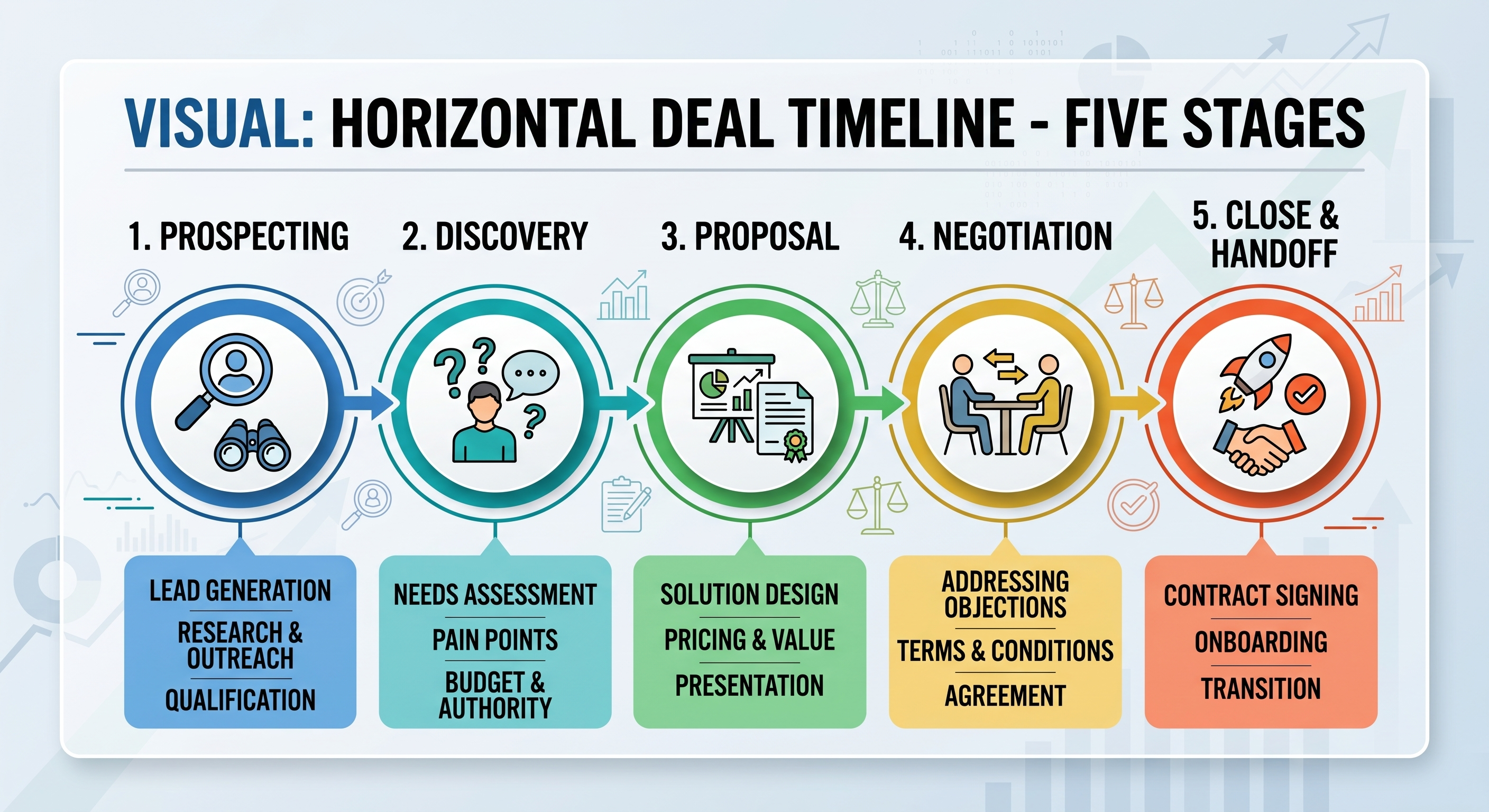
Terms toward the left of that line matter most to a rep who has never spoken to the account before. Terms toward the right matter most once a proposal is already on the table.
The roles you will hear on a call
A sales development representative, usually shortened to SDR, spends most of the day finding and qualifying new contacts before handing them to someone who closes deals.
A business development representative, BDR, does close to the same job. Some companies use SDR for inbound leads and BDR for outbound work, others use the two words the same way. An account executive, AE, owns the deal from the first real conversation through signature. A customer success manager, CSM, takes over once the contract is signed and is judged on renewal and expansion rather than new logos.
Tech sales refers to selling software or IT products specifically, as opposed to other categories of goods and services in a B2B relationship. It describes a segment more than a formal title, so job postings inside tech sales still use SDR, AE, and the rest of the same vocabulary.
Two roles get less attention than they deserve. A sales engineer sits inside technical B2B deals and answers questions an AE cannot: how the product handles a specific integration, what happens at a certain data volume, whether a security requirement is met.
The role reports into sales, not engineering, working alongside a cross functional team that usually includes product and support, even though the title suggests otherwise.
An AI SDR is software, not a person: a system that runs the early stage prospecting and outreach tasks an SDR would otherwise do by hand, then flags a contact as ready for a human once it replies with real interest.
Salesforce's 2024 State of Sales report found that 81 percent of sales teams were already experimenting with or had fully implemented some form of AI, which is part of why the term now shows up in job postings and org charts. The term is recent enough that recruiters sometimes ask a candidate to define it before the candidate asks them.
What the account is actually worth
An ideal customer profile, ICP, describes the type of company most likely to buy and stay a customer: a size range, an industry, a specific problem they already know they have. Reps use it to decide who is worth calling before they ever pick up the phone.
Firmographic data is the company level information that builds an ICP: employee count, revenue band, industry code, funding stage, and similar facts about the business itself rather than the person inside it.
A sales lead is any contact who has shown some signal of interest, from filling out a form to accepting a cold call. Once marketing decides a lead is worth passing to sales based on fit and behavior, it becomes a marketing qualified lead, MQL. Once a rep talks to that lead and confirms budget, authority, need, and timeline are all plausible, it becomes a sales qualified lead, SQL. The two get confused constantly because both start as the same person; only the handoff point changes.
A sales pipeline is every open deal a rep is currently working, usually shown as a list with a stage and a dollar value attached to each one. A sales funnel is the same information turned sideways: how many contacts started at the top and how many made it to a closed deal at the bottom. A pipeline tells a rep what to work on today. A funnel tells a sales leader whether the whole process is leaking contacts at a particular stage.
Here is a quick reference for the acronyms already in play, plus a few more that come up just as often.
Acronym | Stands for | Where you will hear it |
|---|---|---|
SDR | Sales development representative | Cold outreach and early qualification |
BDR | Business development representative | Outbound prospecting, sometimes partnerships |
AE | Account executive | Live deal calls, proposals, negotiation |
CSM | Customer success manager | Onboarding, renewal, expansion conversations |
ICP | Ideal customer profile | List building, targeting decisions |
MQL | Marketing qualified lead | Handoff meetings between marketing and sales |
SQL | Sales qualified lead | Forecast calls, pipeline reviews |
BANT | Budget, authority, need, timeline | Qualification frameworks |
ARR | Annual recurring revenue | Board decks, company wide reporting |
CAC | Customer acquisition cost | Finance and marketing spend reviews |
ABM | Account based marketing | Enterprise and named account strategy |
OTE | On target earnings | Offer letters and comp plans |
How reps actually get paid
On target earnings, often shortened to OTE, is the total pay a rep can expect if they hit 100 percent of quota: base salary plus the variable portion, added together.
A 2024 compensation benchmark from the Bridge Group put median OTE for SaaS account executives at 190,000 dollars, split 53 percent base to 47 percent variable. That split matters more than the headline number: a rep with a smaller base and bigger variable portion is taking on more risk for the same OTE figure.
A quota is the specific target, usually revenue or number of deals, a rep has to hit inside a set period to earn their full variable pay. Commission is the actual dollar amount paid out based on performance against that quota, calculated by a formula set in the comp plan.
A SPIFF is a short term, one off bonus layered on top of normal commission, usually tied to a narrow goal the company is pushing right now: sell a specific product this month, close five deals before quarter end, book a certain number of demos. It expires. Regular commission does not. People sometimes write it as SPIF, without the second F, and both spellings show up in real comp plans.
A starter list, if you only learn a dozen
Anyone new to a B2B sales team can get functional with these twelve, in this order.
B2B: business to business, meaning the company sells to other companies rather than individual consumers.
ICP: ideal customer profile, the type of company most likely to buy and stay.
Lead: any contact who has shown some sign of interest.
MQL: marketing qualified lead, a contact flagged as fit before a rep talks to them.
SQL: sales qualified lead, a contact a rep has personally confirmed as ready.
SDR: sales development representative, the role that finds and qualifies new contacts.
AE: account executive, the role that owns a deal from first call to signature.
Outbound: contact the rep initiates, as opposed to inbound, where the contact reaches out first.
Pipeline: every open deal a rep is currently working.
Quota: the specific target a rep has to hit to earn full variable pay.
OTE: on target earnings, the total pay possible at 100 percent of quota.
CRM: customer relationship management, the system that stores every contact and deal record.
How the first contact usually happens
Outbound sales means the rep initiates contact: a cold call, a cold email, a message on a professional network to someone who has not asked to hear from the company. Inbound is the reverse, where the contact found the company first, through a search result, a referral, or content they read.
Sales prospecting is the research and list building work that happens before any of those first messages go out: finding the right person at the right company and confirming they are worth contacting at all.
A cold call is a call to someone with no prior relationship or expressed interest. A warm call is a call to someone with some existing connection, maybe a mutual contact, a past interaction, or a form they filled out weeks ago.
Some teams also use hot call for a warm call taken a step further, someone who just requested a callback or replied asking to talk right now. A discovery call is none of those; it is the first real conversation after someone has already agreed to talk, where the rep asks about the problem, budget, and timeline before proposing anything.
The data that sits behind all of it
B2B data enrichment is the process of filling in the gaps on a contact or company record: adding a verified email, a job title, a company size, or a technology the company already uses, to a record that started with just a name or a domain.
Some of this data entry now happens through workflow automation rather than a rep typing it in by hand.
It matters because a CRM, customer relationship management system, is only as useful as the data sitting inside it. A CRM full of blank fields cannot support good targeting no matter how the software is configured.
Lead scoring assigns a number to each contact based on fit and behavior, so a rep knows which of fifty leads to call first. A firmographic match on its own is not enough for a high score. A lead also needs some sign of actual interest, like opening three emails or visiting a pricing page twice.
What the other side of the table actually notices
A buyer at a company being sold to rarely uses this vocabulary out loud, but they notice when a rep gets it wrong. Calling a signed customer a lead, describing a renewal conversation as prospecting, or asking an already qualified buyer discovery questions that were answered in the first email are fast ways to signal that a rep has not read their own notes.
The terms are mostly for the seller's own bookkeeping, kept out of the message a buyer actually opens. Using them correctly around a buyer just proves the internal paperwork behind the deal is being kept straight.
The pairs people mix up most
Account executive and practitioner Martin Weiss has written that sales and marketing roles overlap enough to confuse people entering the field, a pattern that shows up most often in the pairs below.
Sales enablement and sales operations get swapped constantly enough that new hires often ask which one they will actually be working in. Sales enablement covers the content, training, and messaging a rep needs to run a good conversation: battle cards, case studies, onboarding material, call coaching.
Sales operations covers the process and systems side: territory design, quota setting, CRM administration, reporting. A useful shortcut: enablement helps a rep say the right thing, operations makes sure the right systems and numbers exist behind them.
Hot, warm, and cold describe the same three temperature levels applied to both calls and leads, and definitions don't always match between companies. A cold lead has shown no interest and no connection. A warm lead has some signal: an open email, a mutual contact, a form fill from months ago. A hot lead is actively engaged right now: replying quickly, asking pricing questions, requesting a call.
The safest habit on a new team is to ask what their own company means by each word, since the exact threshold shifts from one sales floor to another.
OTE causes a separate mix up: candidates treat the number in an offer letter as guaranteed pay rather than a target. A widely upvoted post on the professional network Blind, from someone evaluating a sales offer, showed a candidate unsure whether a quoted OTE range of 100,000 to 150,000 dollars was even realistic for the role, since OTE only pays out at full quota attainment.
The thread itself shows exactly how wide that uncertainty gets in practice.
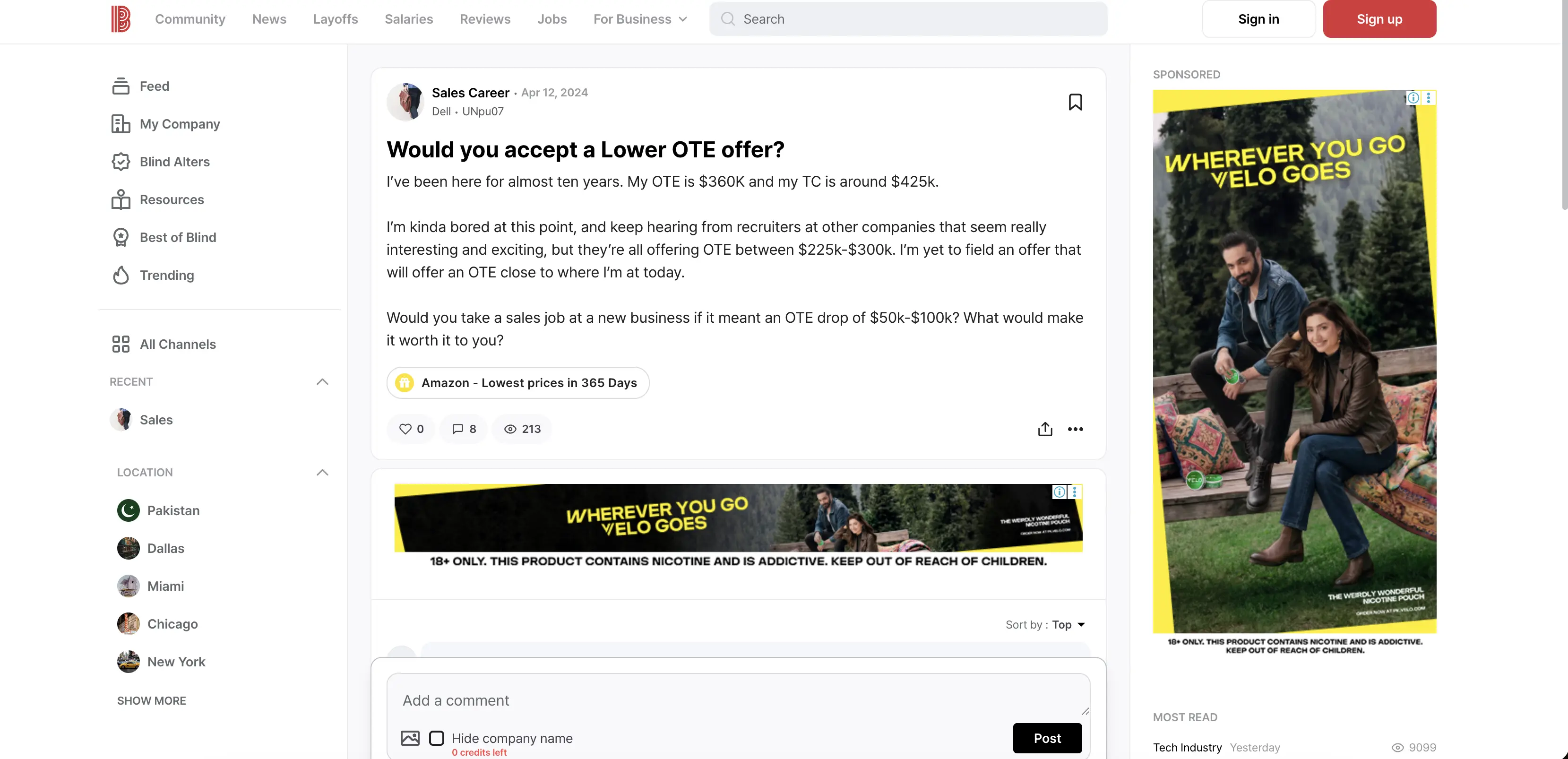
Thousands of people engaging with a single post about one job offer is a fair sign that OTE is one of the most misunderstood numbers a candidate ever receives.
FAQs
What does SDR stand for?
SDR stands for sales development representative, the role responsible for finding and qualifying new contacts before handing them to an account executive. The role is entry level in most B2B sales organizations and is often the first job someone takes on a sales team.
What is the difference between an MQL and an SQL?
An MQL, marketing qualified lead, is a contact marketing has flagged as a good fit based on behavior and demographic data. An SQL, sales qualified lead, is the same contact after a rep has personally confirmed budget, authority, need, and timeline. The handoff between the two usually happens in a meeting between marketing and sales leadership.
What does OTE mean in a job offer?
OTE, on target earnings, is the total pay a rep receives if they hit 100 percent of their assigned quota, combining base salary and variable commission. It is a target figure, not a guaranteed number, so a rep below quota earns less than the OTE listed in the offer.
What is a SPIFF in sales?
A SPIFF is a short term bonus a company adds on top of regular commission to push a specific, narrow goal, like selling one product line for one month. It is separate from a rep's quota and expires once the promotion period ends.
What is the difference between sales enablement and sales operations?
Sales enablement supplies the content, training, and coaching a rep needs during a live conversation, things like case studies and call scripts. Sales operations manages the process and systems around selling, including territory design, quota setting, and CRM administration. One helps a rep perform, the other keeps the machinery running underneath them.
Learning them as you go
Nobody memorizes a full sales glossary before their first call, and trying to is a waste of a Tuesday. The roles, the pay structure, and the first contact terms above cover what shows up in an average week for most B2B sellers. The pairs people mix up are worth a second look, since getting one of them backward in front of a hiring manager or a buyer is a mistake that gets remembered.