What is SLED in sales: The state, local, and education market explained
SLED means State, Local, and Education, the non federal public sector market. See how SLED buying, budgets, and procurement differ from commercial sales.
 Michael Doyle13 min read
SLED stands for State, Local, and Education, the three groups of non federal public buyers in the United States: state agencies, city and county governments, and public school districts and universities.
Selling into SLED means competing for public contracts through formal bids, cooperative purchasing agreements, and budget cycles that run on a fiscal calendar rather than a sales quarter.
What you need to know before you start selling into SLED
SLED is not one buyer. It is a label for three separate groups of government purchasers, and each one runs its own procurement rules, budget calendar, and approval chain.
This section is for a seller who has never worked a public sector account before, a founder deciding whether to build a government focused sales motion, and a marketer trying to define SLED as a segment inside a broader ideal customer profile. If your company only sells overseas, or only sells to the federal government under FAR based contracts, most of what follows will not apply to your pipeline; federal buying runs on a separate rulebook covered elsewhere.
What you need before the first outreach attempt:
A clear answer to which of the three SLED segments (state, local, or education) actually buys what you sell. Most vendors fit two of the three, not all three.
A vendor registration in at least one state, since almost every agency requires this before it can cut a purchase order.
Time. A SLED deal rarely closes inside a single sales quarter, so a first attempt needs a plan for a multi quarter pipeline, not a single push.
What SLED actually stands for, and who counts
SLED stands for State, Local, and Education. Together these three groups make up the non federal public sector in the United States, distinct from the federal government and from private commercial buyers.
State
State agencies, state universities, and state level departments (transportation, health, corrections, revenue) that buy through centralized state contracts and statewide procurement offices.
Local
Cities, counties, townships, special districts, and regional authorities. According to the Census Bureau's 2025 Annual Survey of State and Local Government Organization, the United States had 91,438 local government units as of 2025, up slightly from 90,837 in the 2022 Census of Governments. That count breaks down into 3,031 counties, 19,489 municipalities, 16,184 townships, 12,535 independent school districts, and 40,199 special districts such as water authorities, transit boards, and fire districts.
The Census Bureau publishes this count on a public results page that breaks the total down by government type.
That breakdown is the closest thing to an official headcount of SLED buyers that exists, since no single agency tracks the three segments as one combined list.
Education
Public school districts (K through 12) and public colleges and universities. Education procurement usually sits under its own approval chain, often a school board or a university purchasing office, separate from the city or state that funds it.
A buyer only needs to fall into one of these three groups to be a SLED account. A public transit authority, a community college, and a county sheriff's department are all SLED, even though none of them look alike on an org chart.
How SLED buying is different from federal and commercial buying
Three things change once a deal moves from a commercial buyer to a SLED buyer: which rulebook governs the purchase, how many people sign off, and how long the process takes.
Factor | Commercial B2B | SLED | Federal |
|---|---|---|---|
Governing rules | Internal policy, negotiable | State and local procurement codes, vary by jurisdiction | Federal Acquisition Regulation (FAR), one national rulebook |
Typical sales cycle | Weeks to a few months | Six to twenty four months | Twelve to thirty six months |
Buying path | Direct negotiation | Formal RFP, or an existing cooperative contract | FAR compliant solicitation |
Budget timing | Flexible, tied to internal approval | Fixed fiscal year, usually July through June | Fixed federal fiscal year, October through September |
Decision makers | One to a handful | An evaluation committee, often with IT and finance as separate approvers | A contracting officer plus program stakeholders |
The fixed fiscal calendar is the part most first time SLED sellers underestimate. A state agency that runs July through June usually finalizes its budget in the spring, which means outreach that starts after the new fiscal year opens is already behind agencies that locked in spending months earlier.
Sales cycle, decision makers, and budget timing are only a few of the terms that shift once a buyer is public sector rather than commercial; a fuller breakdown of b2b sales terms that come up in real deals covers the rest.
Why SLED market size estimates disagree by trillions of dollars
Search for the size of the SLED market and the numbers you get back range from roughly one and a half trillion dollars to almost five trillion dollars, depending on which figure a source is using. Neither number is wrong. They are answering different questions.
The Federal Reserve Bank of St. Louis publishes a Census sourced series tracking total state and local government current expenditures, and the most recent figure is $4,696,963,000,000 for 2023. That number covers everything a state or local government spends: payroll, debt service, pension contributions, transfer payments, and vendor purchases combined.
The smaller figures that vendors quote as the addressable SLED market strip out the spending that never touches an outside vendor, payroll and debt service being the largest categories removed. What is left, roughly one and a half to two trillion dollars depending on the year and the source, is closer to the actual pool of contract dollars a company selling software, services, or equipment is competing for.
The distinction matters for how a seller sizes a pipeline. Quoting the full $4.7 trillion figure to a leadership team overstates the opportunity by roughly two and a half times; the addressable number is the one worth planning a quota around.
Where SLED contact data actually comes from
Unlike a commercial account, a SLED buyer's staff directory is usually public information, which changes how a seller builds a prospect list.
State employee directories, school board meeting minutes, city council agendas, and university department pages are all published records in most states, and they name the people who sit on budget committees, IT departments, and procurement offices well before a bid ever goes public. Board meeting minutes in particular tend to mention a spending category by name months before a formal RFP appears, since public agencies are required to discuss budget items in open session.
The practical difference from commercial prospecting is verification, not discovery. Names and titles are easy to find; confirming which of those names still holds the role, and matching them to a working email address, is where a list goes stale fastest inside public agencies with high staff turnover. How B2B data enrichment fills in verified contact records covers the match rates and verification steps that apply whether the source list came from a commercial database or a public agency directory.
What getting a first SLED meeting actually looks like
A first meeting with a SLED contact rarely opens with a product pitch. It opens as an information exchange: the seller asks what the agency's current pain point or planning cycle looks like, and offers something concrete in return, a benchmark, a peer comparison, or a short briefing on how a similar agency solved the same problem. Public buyers cannot legally reward a vendor for being first in the door, but they can and do use early conversations to help write the requirements that eventually shape the RFP.
That means the goal of a first meeting is not a demo booking. It is getting invited back before the requirements are final. A structured outbound cadence built around timed, low pressure check ins during the budget planning window works better here than a single high pressure pitch.
What a first SLED deal is actually worth
New SLED sellers often plan a first year quota around the trillion dollar market figures quoted above, then get discouraged when an individual deal comes in far smaller.
A first SLED contract, particularly one won through a cooperative purchasing vehicle rather than a standalone RFP, commonly lands in the tens of thousands to low hundreds of thousands of dollars range for a small or mid sized vendor, not the seven figure deals that dominate case studies from large government contractors. The realistic first year goal for a seller new to SLED is two or three of these smaller wins that prove delivery, not one large contract.
Cooperative purchasing: the fastest legal path into a SLED budget
A standalone RFP is not the only way into a SLED budget. Cooperative purchasing agreements let one agency's already competed contract be used by thousands of other eligible agencies without a new bid.
NASPO ValuePoint, run by the National Association of State Procurement Officials, aggregates demand across all fifty states through what it calls a Lead State Model, where one state runs the competitive solicitation and the resulting master agreement becomes available to other participating states, cities, counties, and school districts with no separate registration fee. Sourcewell and OMNIA Partners run similar national cooperatives, and several states run their own in state versions, including Texas DIR and New York OGS.
For a vendor, winning a spot on one of these vehicles means an agency can issue a purchase order against an already competed contract instead of running its own months long RFP, which is often the difference between a deal that closes in one budget cycle and one that stretches into the next.
NASPO ValuePoint publishes an eligibility explainer that shows exactly how an agency confirms it can buy against an existing master agreement.
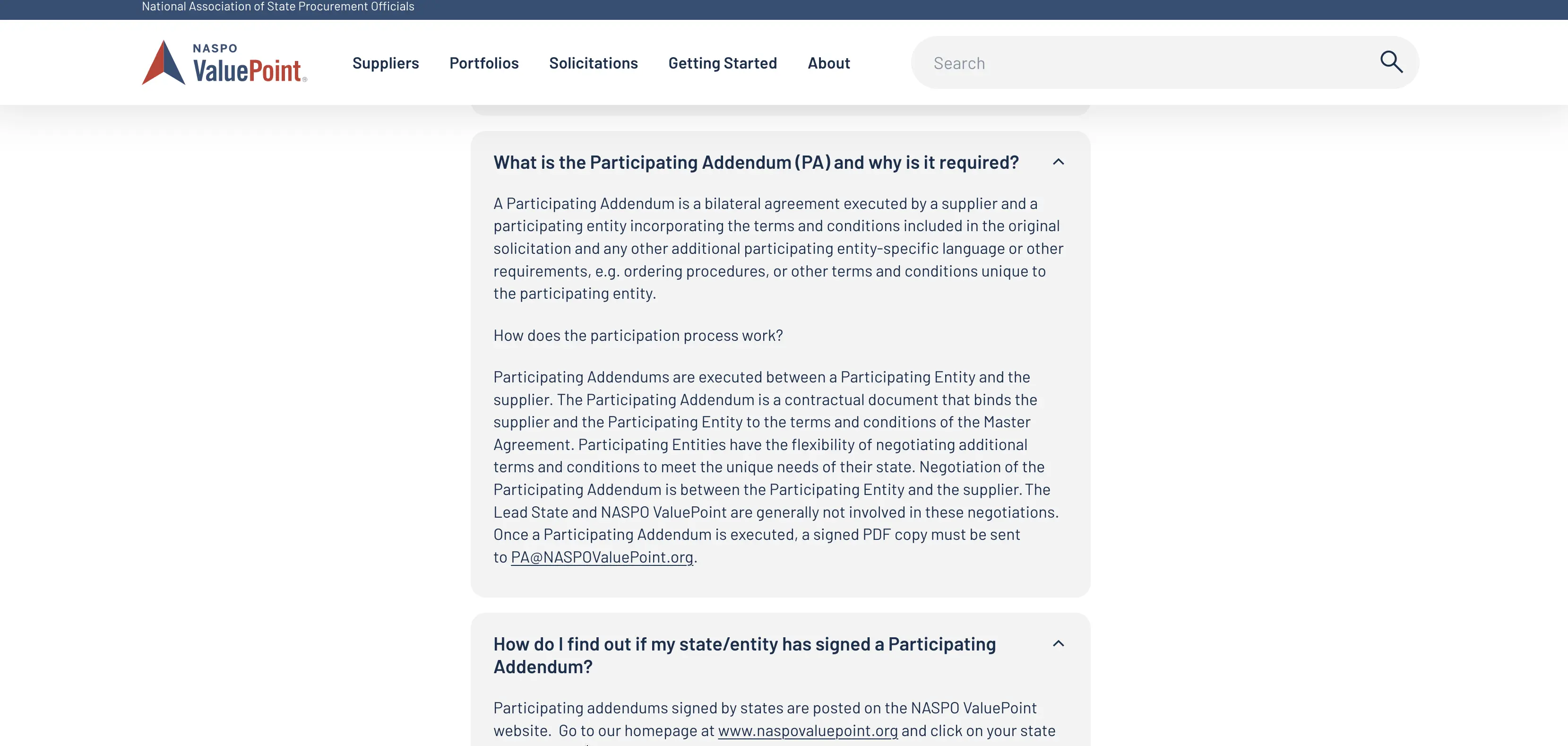
That page is the fastest way to check, before a first outreach message, whether a given master agreement already covers the state a target agency sits in.
SLED account qualification checklist
Use this before committing outbound time to a SLED account. An account that fails more than one of these checks is not ready for active pursuit yet.
Account has:
[ ] A budget signal within the last twelve months (a board vote, a grant award, or a published line item naming your product category)
[ ] A verified contact with a role that touches the purchase (program owner, IT department, or procurement office), not just a general information address
[ ] No competitor contract in place that runs more than twelve months past today
[ ] A procurement path identified: standalone RFP, or an existing cooperative vehicle your company already holds
[ ] A fiscal year calendar mapped, so outreach timing lines up with the agency's planning window rather than its deadline
Next step if the account passes: log the budget signal source and date, assign a fiscal year checkpoint three months before the agency's year end, and confirm which cooperative vehicle, if any, applies before the first outreach message goes out.
What happens between a verbal yes and a signed SLED contract
A SLED buyer saying yes to a proposal is not the same as a signed contract, and the gap between the two involves paperwork a commercial deal never touches.
Before a purchase order gets issued, most agencies require proof of insurance at specified coverage levels, a completed vendor registration or W9 on file with that specific agency (registering in one state does not carry over to another), and in some cases a performance bond for contracts above a set dollar threshold. None of this is negotiable the way commercial contract terms sometimes are; it is a compliance checklist, and a vendor that has not prepared it in advance can lose weeks after the yes is already given.
Common mistakes first time SLED sellers make
Treating SLED like one big account. A win with one city government tells you nothing about how a school district two counties over will buy. Each entity inside SLED sets its own rules, even when they sit in the same state. Grant Hayzlett, president of a firm that sells exclusively into this market, has written publicly about new entrants treating the acronym as a single buyer instead of three separate ones with three separate rulebooks.
Ignoring the compensation mismatch. A sales rep paid on a standard quarterly quota structure will look like they are missing target for two or three quarters on a SLED patch, even while pipeline is building normally, because the cycle simply runs longer than a commercial one. Reps and managers who plan on target earnings around a SLED account list need a longer ramp built into the comp plan, not a shorter one.
Showing up after the budget is set. Outreach that starts once an RFP is published is competing against vendors who were already in the room during the planning phase months earlier. Most SLED fiscal years run July through June, which sets a predictable buying rhythm once mapped against a normal outreach calendar.
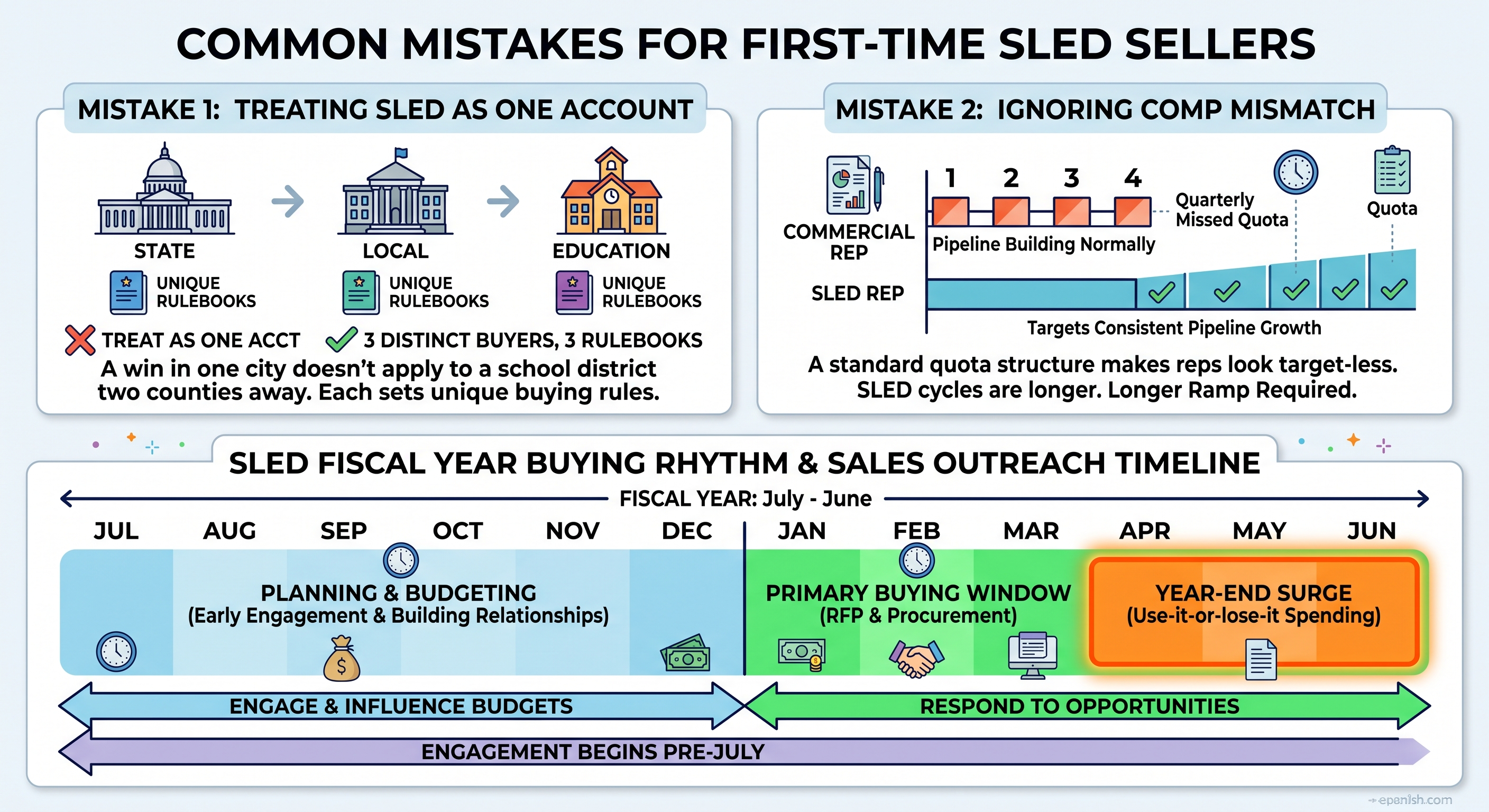
The takeaway is the same for every state that runs this calendar: outreach that starts in the autumn lands ahead of budget planning, and outreach that starts after June is already chasing a budget someone else influenced.
Skipping the compliance paperwork until after the yes. As covered above, insurance certificates and vendor registration take real time to assemble; starting that process only after a verbal agreement adds weeks a competitor without the same gap does not lose.
According to Yonatan Pistiner, CEO and co founder of SLED.AI, the same fragmentation that makes SLED harder to map also cuts down the number of vendors competing for any single bid, since most competitors give up on the research before a bid ever gets to them.
FAQs
Is SLED the same thing as the public sector?
No. Public sector is the broader category; SLED is the part of it that excludes the federal government. Federal agencies buy under a separate rulebook, the Federal Acquisition Regulation, that does not apply to state, local, or education purchases.
Do I need a GSA Schedule to sell to SLED?
No. GSA Schedules are a federal contracting vehicle. SLED buyers use state term contracts, cooperative purchasing agreements such as NASPO ValuePoint or Sourcewell, or direct agency level bids instead.
How long does a SLED sales cycle usually take?
Most sources put the range at six to twenty four months, with education procurement often running toward the longer end because of board approval schedules. Emergency purchases can close in weeks, but they are the exception, not the plan to build a pipeline around.
Can a small company compete for SLED contracts?
Yes. Many agencies specifically use cooperative purchasing and set aside programs to keep smaller vendors competitive against large incumbents, and a smaller vendor's ability to move faster on paperwork is a real advantage once a relationship is established.
Is SLED the same as SLG?
No. SLG refers to state and local government only. SLED adds education as a distinct third segment, which is why the two acronyms are not interchangeable in a public sector sales conversation.
Where this leaves a first time SLED seller
SLED is not one market to learn once. It is three procurement systems, three budget calendars, and thousands of individual buying entities that happen to share one acronym. The fastest path in is rarely a cold RFP response; it is a verified account list, a fiscal year timed outreach plan, and a cooperative purchasing vehicle that turns a months long bid into a purchase order.