

Outbound sales is when a rep contacts a prospect first, through cold calling, cold emailing, or social selling, instead of waiting for the prospect to reach out. Research from RAIN Group found that 82% of buyers accept meetings with sellers who reach out to them, so the model still works when a rep runs it well.
What you need before you start
This article covers what outbound sales means, the stages a rep moves through, the metrics worth tracking, and a checklist for a first outreach cadence. It does not cover inbound sales in depth, and it does not cover how to pick outbound sales software, since that is a separate decision with its own set of tools to compare.
Before you start, you need three things:
A clear ideal customer profile (ICP): the company size, industry, and problem you solve, written in one sentence.
A list of accounts that match that profile, with a real named contact for each one.
One channel you can run consistently for at least three weeks, since a single week rarely produces enough sends to judge anything.
This fits a B2B outbound sales motion where a rep or a small team owns the first touch with a prospect. It is not built for a single freelancer sending one email a week, or for a team that only takes inbound requests.
Outbound sales vs inbound sales
The difference comes down to who reaches out first. In outbound sales, the seller initiates contact with a prospect who has not shown interest yet, using cold calling, cold emailing, or social selling. In inbound sales, the buyer finds the company first, usually through content, search, or a referral, and contacts the seller.
Outbound sales gives a team direct control over who ends up in the pipeline, since a rep chooses the accounts instead of waiting for the right ones to show up. Inbound sales tends to convert at a higher rate per lead, since the buyer already has some interest, but it depends on a steady flow of people finding the company on their own.
Most B2B teams that are serious about hitting a number run both at once: inbound for the leads that show up on their own, outbound for the specific accounts a team wants that will not show up any other way.
An outbound sales strategy usually names the accounts worth that direct effort, since not every account is worth a rep's time chasing.
Inbound sales is the reverse of outbound, and it is only one of several closely related terms in the same vocabulary; a fuller breakdown of b2b sales terms that come up in real deals covers the rest.
Outbound sales is the half where you pick the accounts and start the conversation, which is why the data quality question arrives before the messaging question does.
The outbound sales process, stage by stage
The outbound sales process usually runs through four stages: prospecting, outreach, qualification, and closing. Each stage has its own goal, and skipping one is the most common reason an outbound sales effort fills a pipeline with the wrong leads.
Prospecting
What happens: A rep, often called an outbound sales representative or a sales development representative (SDR), handles the lead generation work for this stage: building a list of accounts and contacts that match the ideal customer profile, using filters like company size, industry, and location. A rep confirms each contact's name, title, and email before adding them to the list, instead of guessing at who to reach out to.
Done when: The list has verified contact information for every account, not just a company name and a guess at who might work there.
Outreach
What happens: The rep contacts each prospect through cold calling, cold emailing, or social selling, often using more than one channel for the same account.
Done when: Every prospect on the list has received at least one real attempt at contact, logged with the date and the channel used.
Qualification
What happens: The rep asks a small number of direct questions to confirm the prospect has a real need, a budget, and the authority to decide, before booking a full demo.
Done when: You can say in one sentence why this prospect is worth a meeting, or you can say why they are not and move on to the next account.
Closing
What happens: The rep runs the demo or pitch, handles objections, and asks directly for the next step, whether that is a contract, a trial, or a second meeting.
Done when: The prospect has a specific next date on the calendar, or the deal is marked lost with a real reason attached to it.
Outbound sales metrics worth tracking
A handful of numbers tell you whether an outbound sales motion is working before a single deal closes.
Reply rate shows whether the message is landing. A 2026 B2B cold email benchmark report put the platform wide average reply rate at 3.43%, and treats anything above 5% as solid and above 10% as strong for most industries.
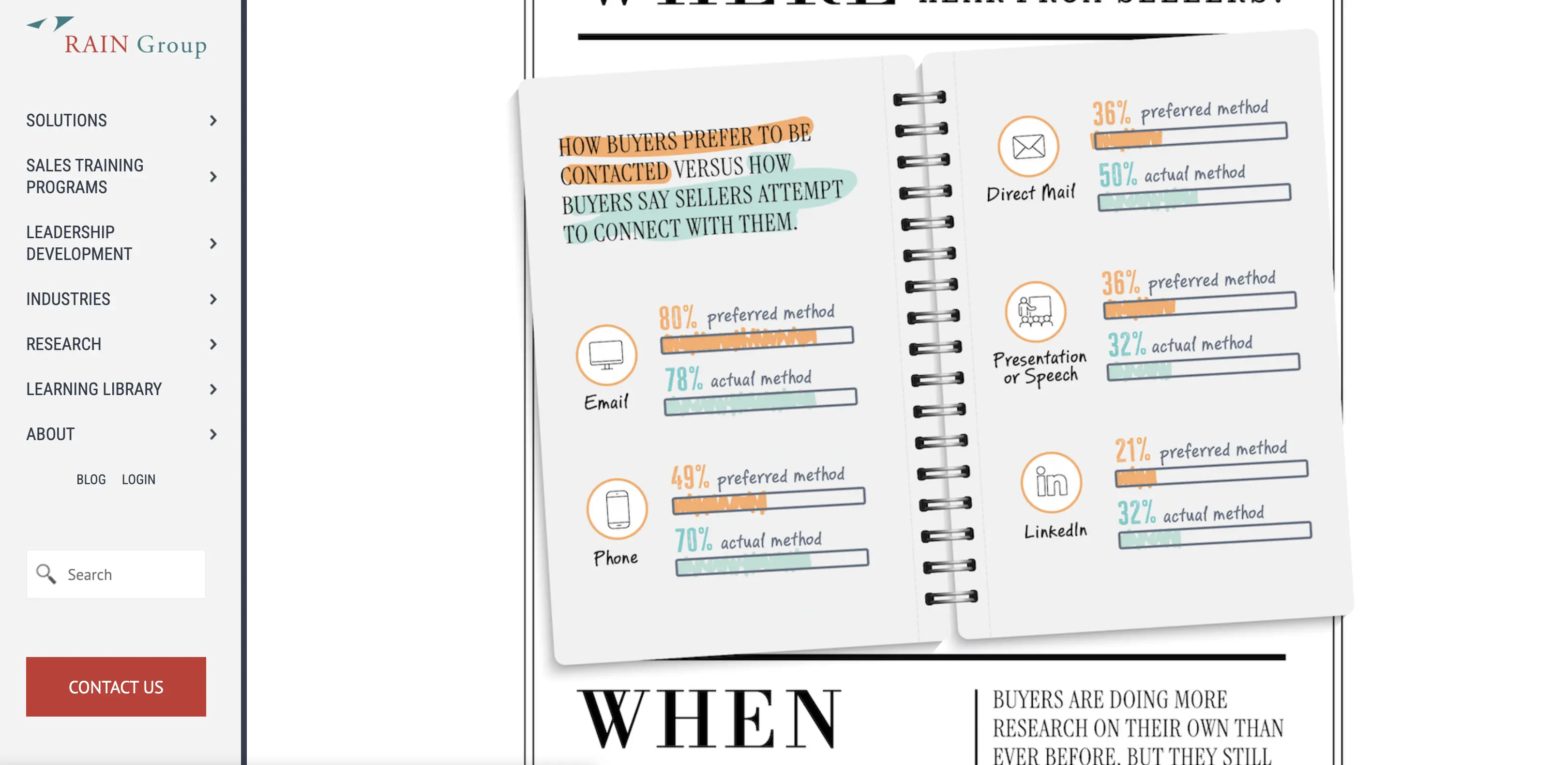
Meeting acceptance rate shows whether a rep is reaching the right person once a reply comes in. Research from RAIN Group found that 82% of buyers accept meetings with sellers who reach out to them. That figure means the harder problem in most outbound sales motions is getting a reply at all, not getting a yes after one arrives.
Pipeline is the total value of qualified opportunities a rep has created. Win rate is the share of those opportunities that close. Track reply rate and meeting acceptance weekly, since they move fast and point to a broken message or a bad list quickly. Track pipeline and win rate monthly, since they take longer to shift and react more to changes in the qualification and closing stages.
A first touch outbound checklist
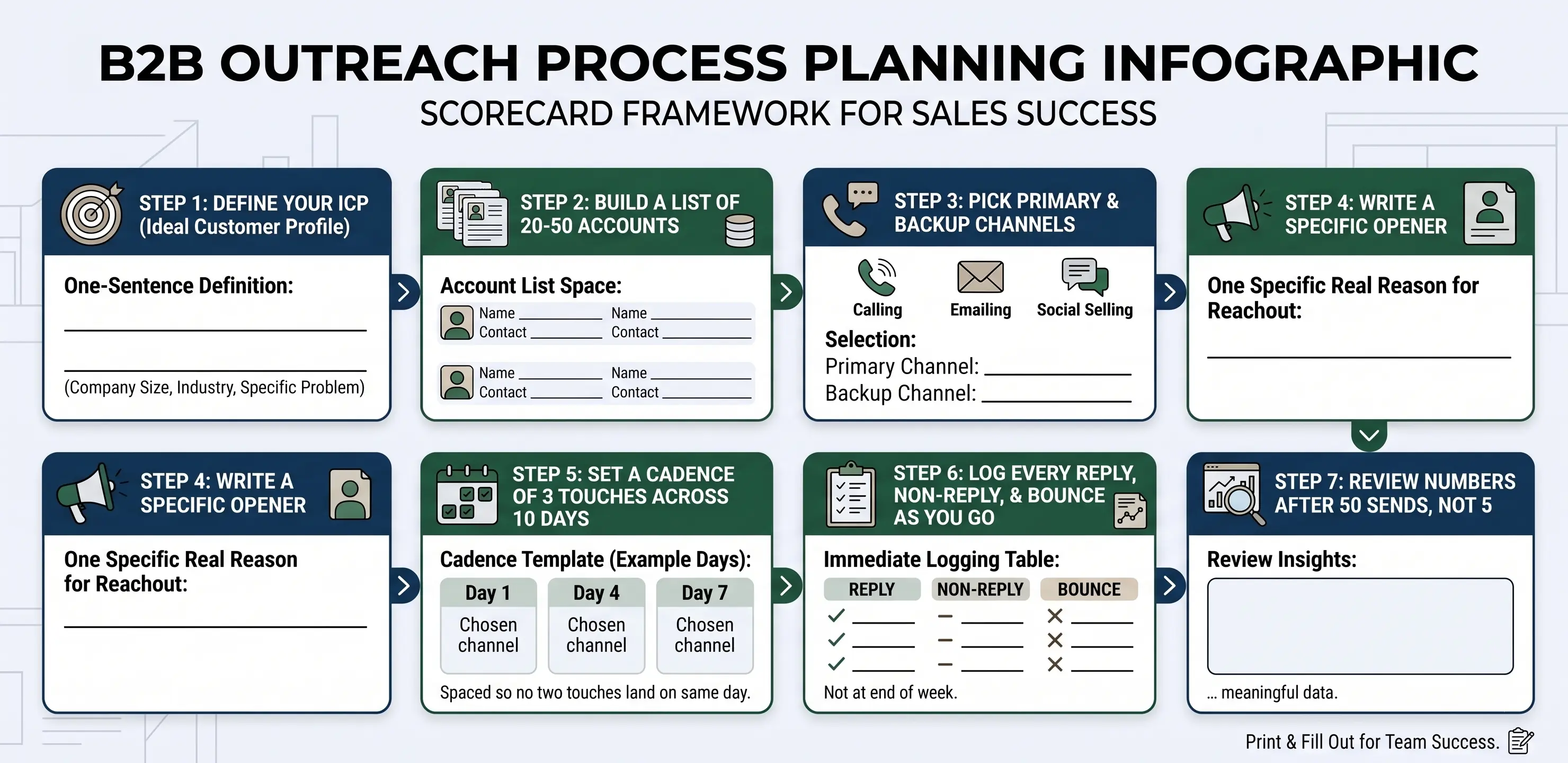
Copy this checklist and run it as your first outbound sales cadence:
Write your ideal customer profile in one sentence: company size, industry, and the specific problem you solve.
Build a list of 20 to 50 accounts that match it, with a real named contact for each account.
Pick one primary channel, cold calling, cold emailing, or social selling, and one backup channel.
Write an opener that names one specific, real reason you are reaching out to this account.
Set a cadence of three touches across ten days, spaced so no two touches land on the same day.
Log every reply, non reply, and bounce as you go, not at the end of the week.
Review the numbers after 50 sends, not after five, since five sends rarely tell you anything real.
Common outbound sales mistakes and the fix
Sending the same generic message to every account.
A message with no specific detail about the recipient reads like the other dozens in their inbox that day, which is a large part of why the average cold email reply rate sits at 3.43%. The fix: name one real, specific detail about the account in the first line, before you ask for anything.
Giving up after a single touch.
One cold email or one cold call is not a cadence, and most replies come from a later touch, not the first one. The fix: run three touches across ten days on every account, instead of a single attempt.
Treating cold calling as something to apologize for.
In a widely read post in r/sales, a retired 30 year sales veteran described walking up to a reception desk with a plain, direct line: telling the receptionist exactly what you do and admitting you are not sure who to ask for. The post drew over 5,700 upvotes and 476 comments, and the advice holds up: most receptionists will point a confident, honest caller in the right direction. The fix: stop opening with an apology, and open with a plain statement of why you are calling.
Skipping qualification and going straight to a demo.
A demo booked with someone who has no budget or no authority to decide wastes time on both sides and inflates a pipeline with deals that were never going to close. The fix: confirm need, budget, and decision authority in a short conversation before you book anything.
FAQs: What is outbound sales?
Is outbound sales the same as cold calling?
No. Cold calling is one channel inside outbound sales. Outbound sales also includes cold emailing and social selling, and most outbound sales motions in 2026 use more than one channel for the same account rather than relying on calls alone.
What is the 3 3 3 rule in sales?
It is shorthand some trainers use for an outbound cadence: a small number of attempts, spread across a few weeks, using more than one channel, before a prospect gets marked unresponsive. Exact numbers vary by trainer, but the idea is consistent: give an outbound sales attempt more than one shot before you drop it.
Do you need AI tools to run outbound sales well?
No, though a growing share of teams use one for part of the process, usually drafting a first pass email or transcribing a call. The tool speeds up a step. It does not replace the ideal customer profile work or the qualification questions a rep still has to ask directly.
How do you build an outbound sales team?
Start with one person who owns the full cycle, from prospecting to a booked meeting, before splitting the role into a prospecting specialist (an SDR) and a closer (an account executive). Splitting too early, before you know your own reply and meeting acceptance numbers, makes it hard to tell which half of the team is underperforming.
Is there a template or example I can copy?
The seven step outbound cadence checklist in this article works as one: copy the steps, fill in your own ideal customer profile and channel choice, and run it as written for your first cadence. As an example, an account matching an ICP of "50 to 200 employee logistics companies" might get a cold email that opens by naming a specific shipping route the company runs, followed by two more touches across ten days if there is no reply.
What is the difference between outbound sales and outbound marketing?
Outbound sales is one to one: a rep contacts a specific named prospect directly. Outbound marketing is one to many: ads, direct mail, or broad email sends to a wider list without individual research on each recipient.
Where this leaves you
Outbound sales rewards a rep who runs a real process instead of a string of one off attempts: a defined ideal customer profile, a list that matches it, a cadence with more than one touch, and a habit of logging what happens after each send.
A 3.43% average reply rate and an 82% meeting acceptance rate once a reply lands both show the ceiling is real, even on a cold list, as long as the process behind it does not get skipped.
Outbound sales channels compared
Channel | Speed to first contact | Personalization effort | Best use case |
|---|---|---|---|
Cold calling | Fastest, real time reply | High, needs a live opener | Time sensitive deals and senior titles who screen calls |
Cold emailing | Slower, hours to days | Medium, templated with one custom line | Scaling outreach across a large list |
Social selling | Slowest, days to weeks | High, requires a real profile view first | Warming up a contact before a call or email |