

Sales prospecting is the first stage of selling: finding people or companies that match your ideal customer profile, then contacting them before they have shown interest.
It starts with research and ends the moment a contact responds and gets qualified. After that point, the work becomes lead qualification, not prospecting.
The finding stage is where most of the tooling sits, and the sales prospecting tools that handle it are compared separately.
What this covers, and what it does not
This guide explains what sales prospecting means, where it sits in the sales process, the difference between a prospect and a lead, inbound versus outbound approaches, the four stages of a prospecting motion, how to measure it, and a copyable scorecard template.
It does not rank or review prospecting software. That is a separate guide. It also does not cover AI prospecting tools as a category. That is its own guide too.
Before you start, you need a defined target audience or ideal customer profile, at least one hour a day set aside for outreach, a place to track contacts (a spreadsheet works, a CRM works better), and one channel you can commit to consistently for two weeks before judging results.
Sales prospecting vs lead generation
A lead is anyone who has shown some interest on their own: filling out a form, downloading a guide, attending a webinar. A prospect is narrower. A prospect is a contact a seller has identified as a fit for the product, whether or not that person has shown any interest yet.
Marketing generates marketing qualified leads, or MQLs, through content, ads, and events. Sales prospecting is the seller initiated half of the funnel: it turns cold contacts into sales qualified leads, or SQLs, by adding direct outreach on top of fit. Once a contact is qualified, they move into the sales pipeline proper, and prospecting's job on that contact is done.
Inbound vs outbound sales prospecting
Outbound prospecting means the seller starts the conversation before any interest signal exists, using cold calling, cold email, or a social message. Inbound prospecting means the seller follows up on a signal the buyer already gave, a content download, a trial signup, a pricing page visit, and turns it into a qualified conversation faster than marketing alone could.
Approach | Who starts the conversation | Common channels | Typical response speed |
|---|---|---|---|
Outbound prospecting | The seller, before any signal | Cold calling, cold email, social selling | Slower, often days to weeks |
Inbound prospecting | The buyer, through a signal | Follow up email, phone, chat | Faster, often same day |
Outbound prospecting is the entry point into a wider outbound sales motion, not the whole of it. For the full process beyond just this first stage, see what outbound sales covers end to end.
How to use LinkedIn for sales prospecting
LinkedIn sits inside outbound prospecting as one specific channel. Search by job title and company size to build a shortlist, then send a connection note that references something specific about the person's role or a recent post rather than a generic pitch. Once connected, keep the first few exchanges inside LinkedIn's own messaging thread instead of jumping straight to email.
The four stages of sales prospecting
Every prospecting motion, regardless of channel, moves through the same four stages.
Stage 1: Build your ideal customer profile.
What happens: you define the traits shared by your best current customers: company size, industry, role, and the specific problem they had before they bought.
Done when: you can write your ideal customer profile in two sentences, and a colleague can use it to sort a list of ten random companies into fit and no fit.
Stage 2: Research and build your list.
What happens: you use your ideal customer profile to identify individual companies and contacts, then confirm the contact details are current. Verified contact data matters here. Cross check that address against the company's own site before the first send.
Done when: your list has a name, a role, a company, and a working email address or phone number for every contact, not just a company name.
Stage 3: Reach out using proven sales prospecting techniques
What happens: you contact each prospect through the channel most likely to reach them, cold calling, cold email, social selling, or a referral introduction, and you write the first message specific to that one contact instead of sending one script to everyone. Email subject lines for sales prospecting work best when they reference something true about the recipient's company rather than a generic offer.
Done when: every prospect on the list has received at least one personalized touch, logged with its date and channel.
Stage 4: Qualify and hand off
What happens: you ask enough questions to confirm the contact matches your ideal customer profile and has a real reason to talk now, then either book the next meeting yourself or hand the contact to an account executive.
Done when: the contact is marked qualified or disqualified in your tracking system, with a one line reason either way.
Sales prospecting for B2B teams
At many B2B companies, this entire four stage motion is one person's job: a sales development representative, or SDR. B2B prospecting also tends to involve more than one contact per company, since a buying decision usually needs sign off from several stakeholders rather than one person. That means researching and approaching two or three contacts at the same account together, not one contact at a time.
Some teams automate part of stage 2, the list building and data enrichment, while keeping the actual outreach message personal.
Fully automated messages that skip stage 3's personalization step tend to get lower reply rates, so automation works best when it saves research time rather than replacing the message itself.
SDR, account executive, and the other stakeholders in that handoff are just part of a much longer list; a fuller breakdown of b2b sales terms that come up in real deals covers the rest.
How to measure sales prospecting success
Four metrics tell you whether a prospecting motion is working.
Contact rate: the share of attempted contacts you actually reach.
Reply rate: the share of messages that get any response at all.
Meeting booked rate: the share of contacted prospects who agree to a next step.
Qualified rate: the share of booked meetings that turn into a real sales qualified lead.
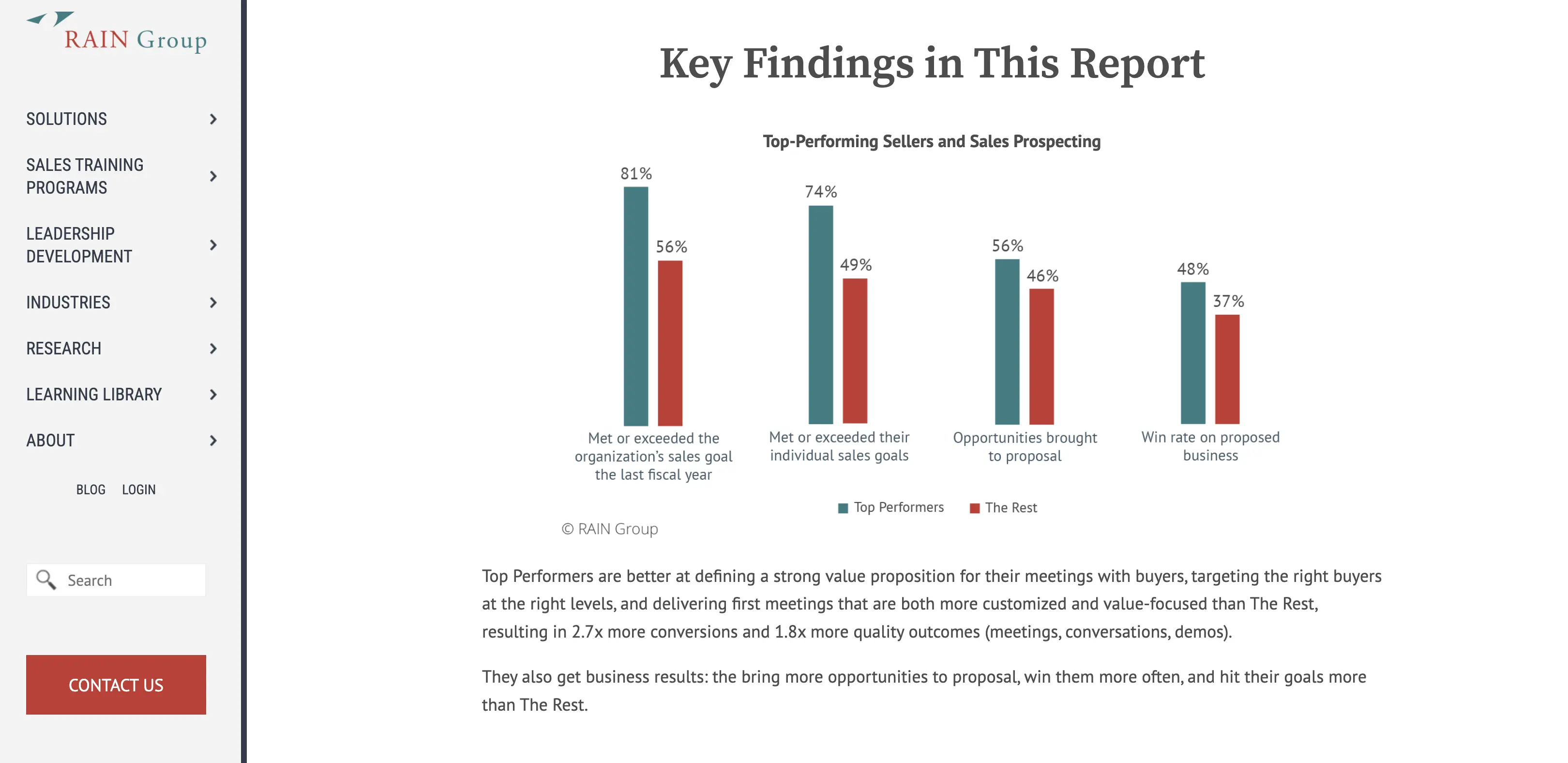
RAIN Group's research on 489 sellers who prospect outbound found that top performers produce 2.7 times more conversions than everyone else in the study. Tracking the four metrics above weekly is how you find out which stage is holding your numbers back before a full quarter goes by.
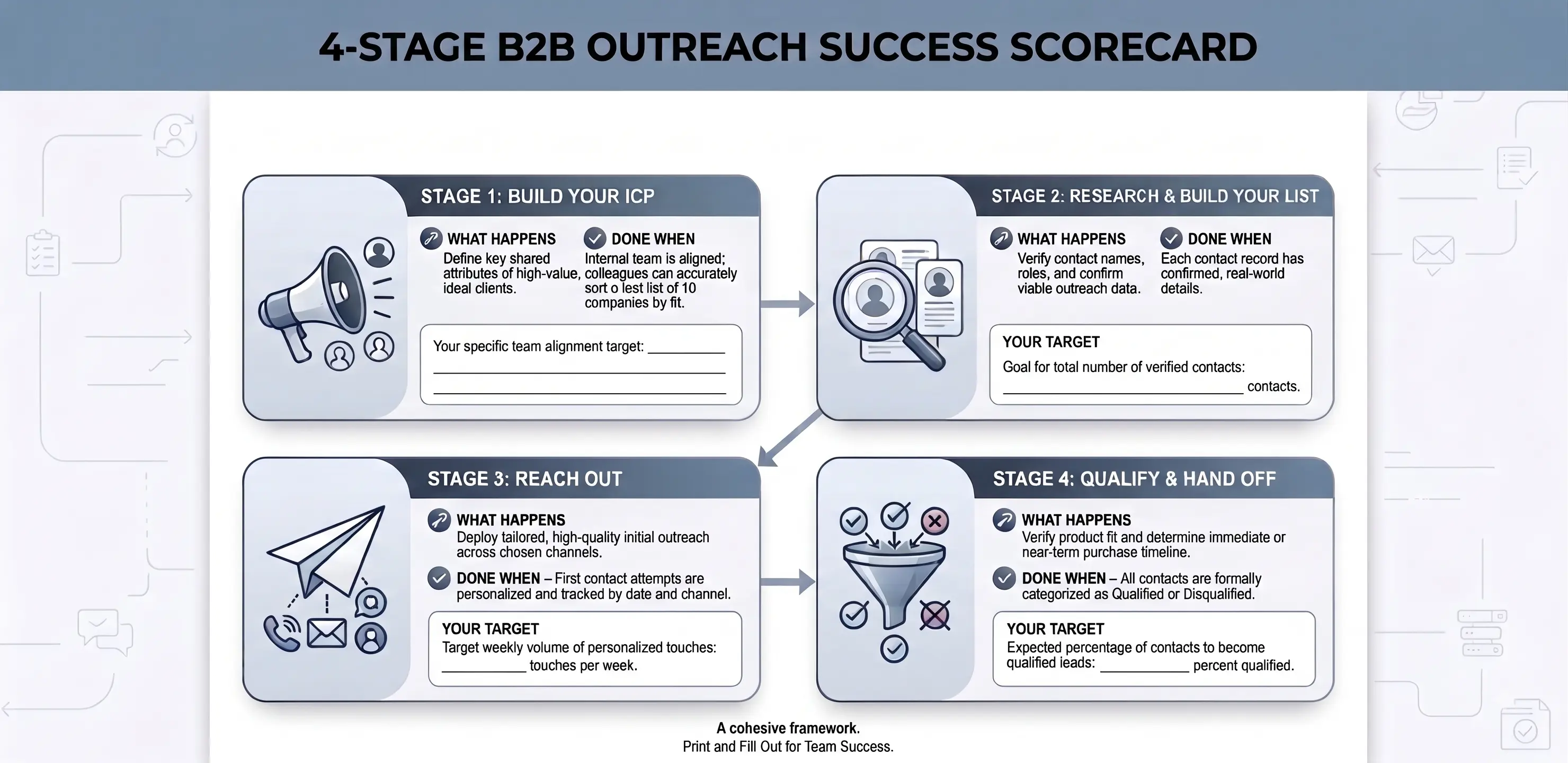
The sales prospecting stage scorecard
Copy this table and fill in your own target for each stage before your next prospecting push.
Stage | What happens | Done when | Your target |
|---|---|---|---|
1. Build your ICP | Define shared traits of your best customers | A colleague can sort 10 companies into fit and no fit | ___ |
2. Research and build your list | Confirm names, roles, and working contact details | Every contact has a real email or phone number | ___ contacts |
3. Reach out | Send a personalized first touch per channel | Every contact logged with date and channel | ___ touches per week |
4. Qualify and hand off | Confirm fit and timing, then route the contact | Every contact marked qualified or disqualified | ___ percent qualified |
Common sales prospecting mistakes and how to fix them
Most of the best practices in sales prospecting are just the fixes below, applied before the mistake happens instead of after.
Problem: The ideal customer profile is too broad, so half the list is a poor fit. Fix: rewrite the profile with a real disqualifier, a company size floor or an industry exclusion, something specific enough to remove companies, not just describe them.
Problem: Every message reads like a template. Fix: reference one true detail about the company or the role in the first line, then keep the rest of the message short. A Reddit user who analyzed 64,562 of their own cold emails over two years found that shorter, more specific messages consistently outperformed longer, generic ones, a pattern that holds across channels, not just email.
Problem: Only one channel gets used, usually email. Fix: add a second channel, a LinkedIn message or a call, so a contact who ignores one channel still has a path to respond.
Problem: Nobody tracks contact rate or reply rate, so nobody knows what to fix. Fix: log every touch in a spreadsheet or CRM field from day one, even a simple one. Salesforce's State of Sales research found that high performers are 1.7 times more likely than underperformers to use tools that log and surface this prospecting data automatically.
FAQ: What is sales prospecting
How do I create a sales prospecting strategy?
Start with your ideal customer profile, pick one primary channel you can run consistently, set a weekly contact target, and review your reply rate every week for the first month before adding a second channel.
How do I qualify leads during sales prospecting?
Ask direct questions that confirm fit and timing: does this contact match your ideal customer profile, do they have the problem your product solves, and is there a reason to act in the next quarter. A yes to all three moves the contact forward.
What role does email play in sales prospecting?
Email is usually the lowest cost, highest volume channel, well suited to a first touch and to follow ups, though it performs best paired with a call or a LinkedIn message rather than used alone.
What is the difference between a prospect and a lead?
A lead has shown some interest on their own, a form fill or a webinar signup. A prospect is a contact a seller identified as a fit, whether or not that person has shown interest yet.
How many touches does sales prospecting usually take before a reply?
There is no fixed number since it depends on channel and industry, but quitting after one attempt is the most common mistake. Plan for at least five touches across two channels before marking a contact unresponsive.
Where this leaves you
Sales prospecting is not the whole sales process, just the first stage of it: research, then outreach, then qualification, then a handoff. The four stage scorecard above gives you a way to see which of those stages is actually slowing your numbers down instead of guessing. Fill it in once with your real targets, run it for two weeks, and check which "done when" line took longest to hit.