

OTE stands for on target earnings: base salary plus the commission or bonus you would earn at 100% of quota, combined into one yearly figure. It is a target, not a guarantee. Only the base salary is promised in writing. The rest depends on hitting quota, which most reps do not fully do.
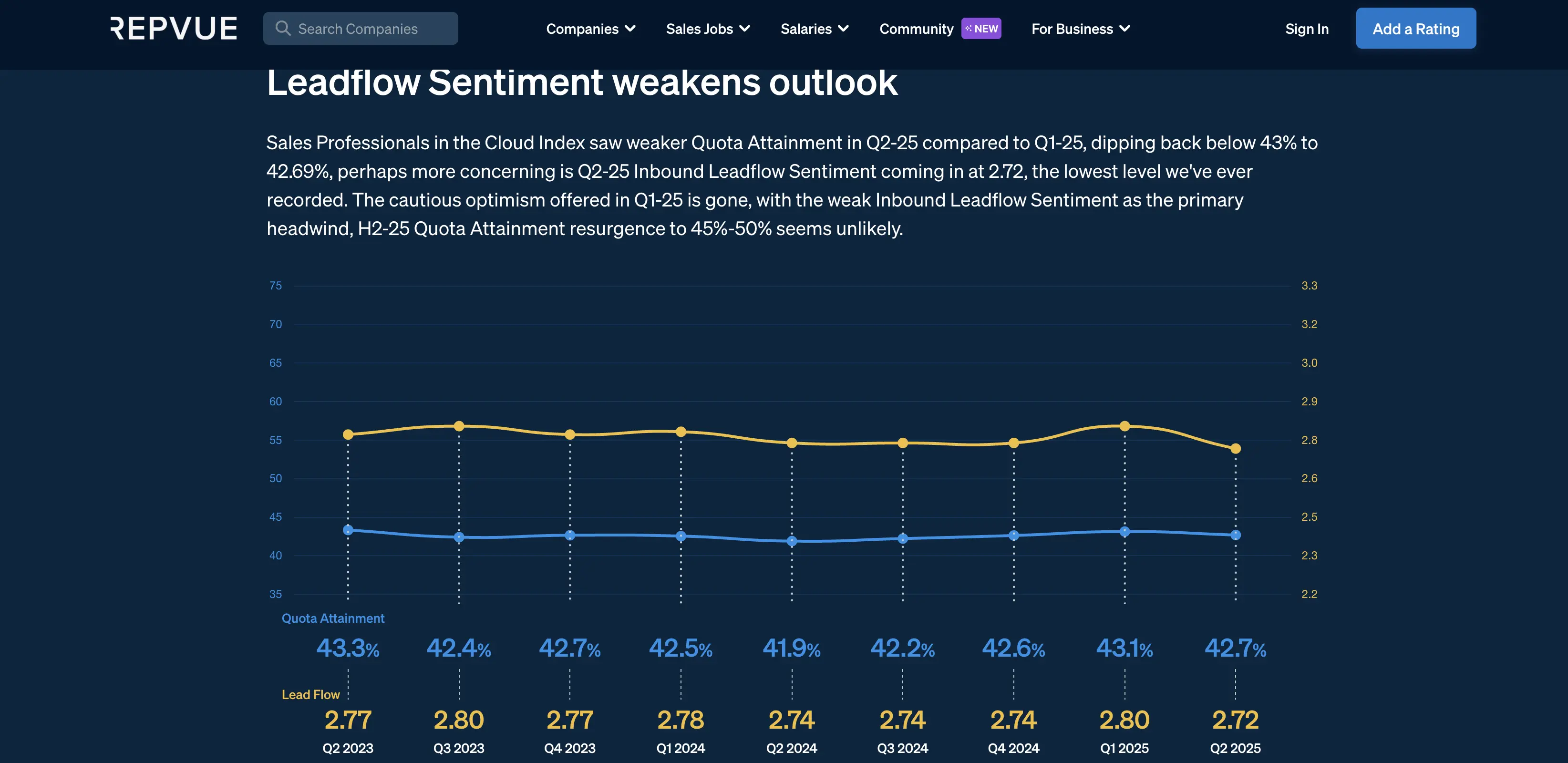
That last point is not a guess. Average quota attainment among SaaS sales reps sat at 42.69% in Q2 2025, which means the OTE figure on a job post describes a ceiling most reps do not reach, not a typical paycheck.
What you need before you read this as an offer, not a definition
If you are staring at a real job post or a real offer letter right now, you need three numbers from it before OTE means anything to you: the base salary, the total OTE figure, and the quota tied to that OTE. A recruiter who cannot give you the quota, or who dodges the question when you ask what percentage of the team hits it, has just told you something worth noting.
This works for evaluating sales, account management, and business development offers where pay splits into a fixed and a variable piece. It does not work for pure salary roles with no commission, and it will not tell you whether a specific quota is realistic for a specific territory. Only the hiring manager and the current team can answer that.
What does OTE mean in sales?
OTE means on target earnings: your base salary plus the commission or bonus you would collect if you closed exactly 100% of your assigned quota, combined into a single annual number. Companies use it in job posts because a base salary alone would understate what a good rep in that seat could take home, and a straight commission figure alone would understate the guaranteed floor.
The formula is short:
Annual base salary + annual commission at 100% of quota = OTE
A rep with a $70,000 base and $70,000 in commission at full quota has a $140,000 OTE. Nobody signs a contract that says $140,000. They sign one that guarantees $70,000 and makes the other $70,000 conditional on performance.
What OTE stands for, and what it does not include
OTE stands for on target earnings, sometimes written as on target earning or shortened to OTC when people mean just the commission half (on target commissions). OTE excludes one time signing bonuses, overtime pay, and most benefits. Equity and RSUs are usually quoted separately, not folded into the OTE line, even though a recruiter may mention both numbers in the same sentence. Short term incentive payouts work the same way: a SPIFF, meaning a sales performance incentive fund paid for hitting one narrow, time boxed goal, sits on top of your OTE rather than inside it, and it gets taxed differently from your regular commission.
What OTE compensation actually includes
OTE is a ratio, called a pay mix, between the guaranteed base and the variable piece. A 50/50 pay mix means half your OTE is base and half is commission. A 70/30 mix means 70% is guaranteed. The lower the guaranteed share, the more the role rewards a rep who beats quota, and the more it punishes one who misses it.
Pay mix | Base share | Typical role | What it signals |
|---|---|---|---|
90/10 | 90% | Support or renewal focused roles | Low risk, low upside, steady pay regardless of a single deal |
70/30 | 70% | SDR, BDR, customer success | Moderate variable pay tied to activity or pipeline, not a full close |
50/50 | 50% | Account executive, closing roles | Standard split for reps who own the full sale end to end |
100% commission | 0% | Independent or straight commission sales | No floor, uncapped upside, all risk sits with the rep |
SDR, BDR, and AE are only three of the terms a rep runs into on the way to that OTE number; a fuller breakdown of b2b sales terms that come up in real deals covers the rest.
Commission itself can be structured as a flat percentage per deal, a tiered rate that increases past 100% attainment (called an accelerator), or a rate that drops before a rep clears a minimum threshold (a decelerator, sometimes gated behind a cliff). Some plans cap total commission at a fixed ceiling no matter how much a rep sells past quota.
A capped plan is worth asking about directly, since it changes what "uncapped upside" on a job post actually means in practice.
If the SDR or BDR row in that table is the one you are evaluating, it helps to know what the role itself actually covers day to day before you judge the pay mix attached to it. A plain explanation of what a human SDR does versus an AI SDR lays out the salary, commission, and ramp time built into that seat, alongside the work that still has to be done by a person.
How OTE works, worked through with real numbers
Take a rep offered a $150,000 OTE at a 50/50 mix: $75,000 base, $75,000 commission at 100% of quota. That number looks clean on the offer letter. Here is what it looks like once you apply real performance data instead of the assumption that everyone hits 100%.
CaptivateIQ's 2025 sales compensation benchmark puts the average OTE across all sales roles at $174,000, with a median of $150,000. Meanwhile, RepVue's Q2 2025 Cloud Sales Index, covering roughly 47,000 quota carrying reps across 246 software companies, found average quota attainment at 42.69%, and 57.31% of reps missed quota entirely that quarter.
Run the $150,000 OTE rep through that average attainment rate: $75,000 base plus 42.69% of $75,000 commission is $75,000 plus $32,018, for a realistic total of $107,018, not $150,000. That gap, close to $43,000, is the distance between the number a recruiter says out loud and the number that shows up in a typical paycheck. It does not mean the job is bad. It means the OTE line on a job post is closer to a ceiling estimate than an average outcome, and treating it as your expected income is a planning mistake.
QuotaPath's Kelly O'Halloran writes that "getting sales compensation right is increasingly becoming a competitive advantage," and that logic runs both ways: it matters just as much from the seat being recruited into as it does to the team designing the plan.
The OTE reality check worksheet
Copy these fields into a note before your next interview and fill them in as you get answers. This turns a vague number into a decision you can actually make.
Base salary (the number you are guaranteed in writing): $______
OTE as stated in the offer or job post: $______
Commission at 100% of quota (OTE minus base): $______
The actual quota tied to that commission, and the time period it covers (monthly, quarterly, annual): $______
Team average quota attainment last two quarters, asked directly of the hiring manager: ______%
Ramp time before you are expected to carry a full quota, and what you are paid during it (draw or reduced quota): ______ months, $______ draw
Does the plan include an accelerator past 100%, a cap, or a cliff before payout starts: ______
Realistic estimate = Base + (Commission at 100% x team average attainment from line 5)
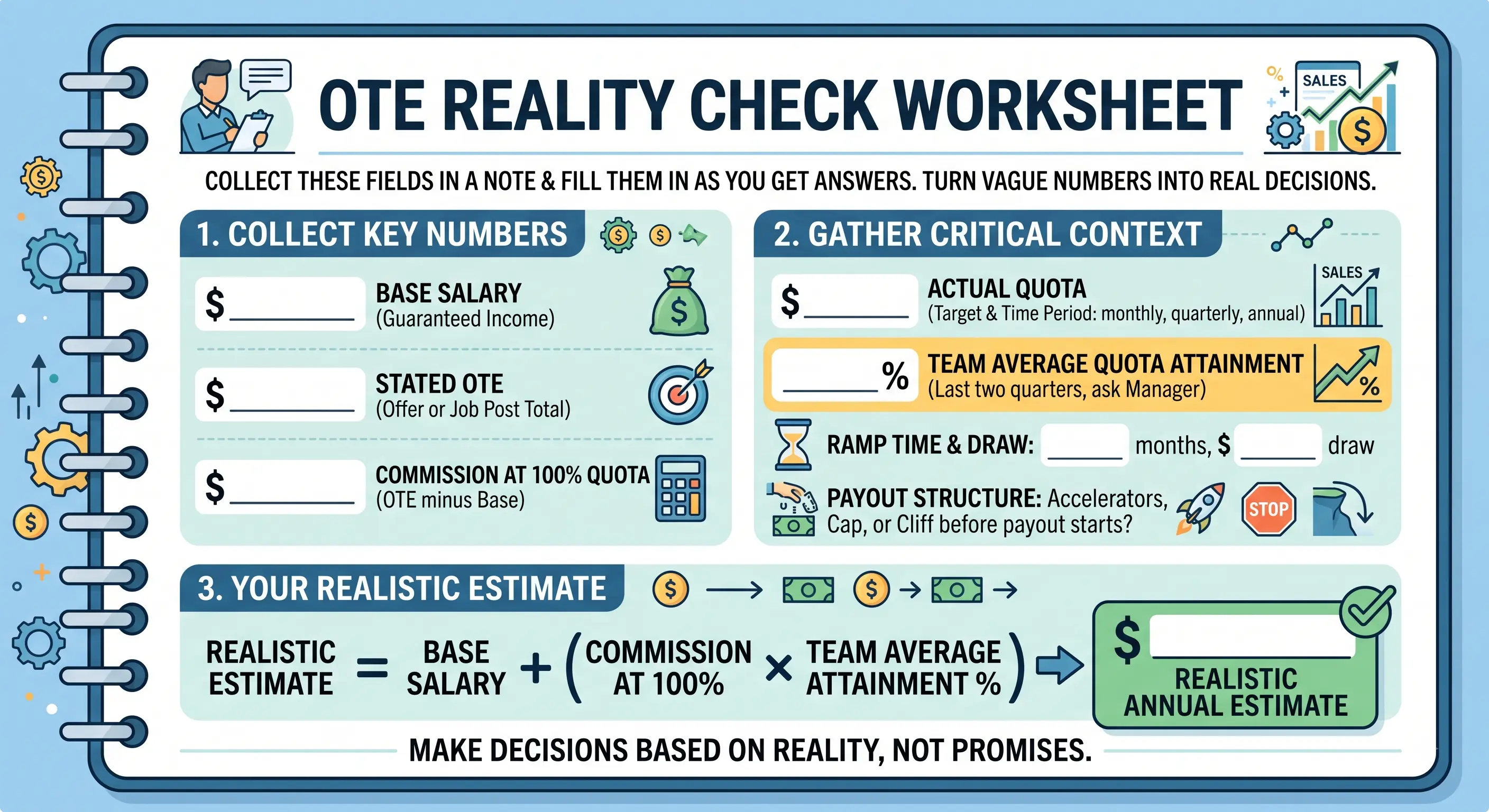
Line 8 is the number to compare against your current pay, not line 2. If a hiring manager cannot answer line 5, that is itself useful information about how closely that company tracks its own comp plan.
What happens if you miss or beat your number
Missing quota does not mean missing your paycheck entirely. Your base salary is contractual and keeps arriving regardless of attainment. What shrinks is the variable piece: a rep at 60% of quota on a flat commission plan earns roughly 60% of their target commission, not zero.
Beating quota is where accelerators matter. A plan might pay a flat 10% commission up to 100% of quota, then step up to 15% on every dollar past it. That structure rewards a strong quarter more than a plan with a hard cap, where extra sales past a ceiling earn nothing further. Ask specifically whether the plan is capped, since job posts rarely mention it and it materially changes what "on target earnings" can grow into.
Troubleshooting: when the OTE number does not add up
Why does my OTE offer feel too good to be true?
It might just be unclear, not dishonest. On a real offer thread, a candidate saw a $150,000 pay range next to an OTE of $170,000 to $200,000 and could not tell whether the base was $150,000 or the full $200,000, until a reply spelled out that OTE covers base plus commission or bonus and excludes equity. That question was asked about a design role, not a sales one, but the same confusion shows up on sales offers constantly: ask for the base number in writing before the OTE figure shapes your decision.
Why won't the recruiter tell me the actual quota?
Some companies treat quota as sensitive information until an offer stage. That is common, not necessarily a red flag on its own. What is worth pausing on is a recruiter who answers a direct question about team attainment with only the OTE figure repeated back to you.
Why is my OTE lower after a territory change?
OTE is often tied to a specific book of business or territory. A new manager, a smaller territory, or a reassigned account list can lower the achievable commission even if your stated OTE and quota look unchanged on paper, because the deals available to hit that quota shrank.
FAQ: OTE meaning in sales
What does OTE stand for in sales?
OTE stands for on target earnings, the base salary plus commission a sales rep would earn at exactly 100% of quota, stated as one combined annual figure.
Is OTE the same as my salary?
No. Your salary is the base portion only, and it is the part guaranteed in your contract. OTE adds the commission you would earn at full quota attainment, which is projected, not promised.
How do I calculate my own realistic OTE?
Take your base salary and add your commission at 100% of quota multiplied by your team's actual average attainment rate, not 100%. The reality check worksheet above walks through this line by line.
What is a good OTE for a sales job?
There is no single number. CaptivateIQ's 2025 benchmark puts the median OTE across all sales roles at $150,000, but the right figure for you depends on role, industry, location, and how achievable the attached quota actually is.
What happens if I do not hit quota?
Your base salary still arrives. Your variable pay scales down with your attainment percentage on most plans, though some plans include a minimum threshold, or cliff, below which no commission pays out at all.
Before you sign
OTE is a real number with a real formula behind it, base salary plus commission at 100% of quota, but it describes a ceiling, not an average paycheck. Ask for the quota, ask for the team's actual attainment rate, and run your own numbers through the worksheet above before you compare a $150,000 OTE against your current pay. The base salary line in your offer letter is the only figure in the whole conversation you can plan a budget around with certainty.