

SPIFF stands for sales performance incentive fund, a short term cash or non cash bonus a company or manufacturer pays a salesperson for hitting one specific, time boxed goal, like moving old inventory or booking demos before quarter end. It sits on top of your regular pay, and it is fully taxable.
Not the definition you are after? If you saw spiff used to mean tidy or dressed up, as in spiff up, that is a different, much older sense of the same word. This guide covers only the sales bonus meaning.
What this covers
This explains the sales bonus meaning of SPIFF: what the term stands for, how the payout actually works, how it gets taxed, and how it differs from a commission or a bonus. It does not cover how to design or run a full spiff program for a sales team; that is a separate management topic with its own set of rules. You do not need any sales background to follow it, just a few minutes.
What SPIFF actually stands for
SPIFF is short for sales performance incentive fund. You will also see it spelled SPIF, which several sources treat as the more literal expansion of those four words, with the extra F in SPIFF added later to make the acronym easier to say. That extra letter is what is called a backronym: an acronym built to justify a word that already existed.
The word itself is older than the acronym. The Oxford English Dictionary traces spiff back to 1891, defining it then as "to allow a certain sum as commission on (an article)." An 1859 slang dictionary describes an even earlier version of the same idea: a percentage that clothing store owners paid their staff for selling old or unfashionable stock. So the acronym was invented decades later to explain a word that sales floors had already been using for a long time.
The term shows up most often in United States retail, auto, and B2B tech sales organizations, though the underlying practice, a short term bonus tied to a specific sale, exists under different names in other countries. In a business setting, the word almost always points to this sales bonus meaning rather than the older spiff up sense covered above.
How a spiff actually plays out
What happens: A manufacturer, distributor, or your own employer sets aside a fund tied to one narrow goal, not overall performance. That goal is usually something like selling a specific model before it goes out of season, hitting a unit count within a single week, or booking a set number of demos before a deadline. The company announces the target, the reward amount, and the window, then tracks who qualifies as sales come in.
Because a spiff is not part of your base pay or your regular commission plan, it can appear and disappear fast. A company might run one for two weeks around a product launch and never repeat it. That is by design: spiffs work because they create urgency that an ongoing commission structure cannot.
Done when: the window closes, qualifying sales get confirmed against the criteria, and payout goes out, either through your regular paycheck or as a separate payment from whoever funded it.
Cash spiffs versus non cash spiffs
Most spiffs fall into one of two buckets. A cash spiff is a flat dollar amount per unit or per action, paid directly, and you decide what to do with it. A non cash spiff is a gift card, a piece of electronics, event tickets, or a trip, and its value gets set by what the item would cost you to buy on the open market, not what the company paid for it wholesale.
Some programs add a tier structure on top of either type, paying more per unit once you cross a threshold, or a mystery element where the reward stays hidden until the promotion ends. The mechanics change, but the short window and the single narrow goal stay constant across all of them.
SPIFF versus commission versus bonus versus SPIV
These four terms get mixed up constantly, and the differences actually matter once tax season or a pay dispute comes around.
Term | What it rewards | Timeframe | Who usually pays |
|---|---|---|---|
SPIFF | One specific action or product | Days to a few weeks | Employer or manufacturer |
Commission | Overall sales volume or revenue | Ongoing, every pay period | Employer |
Bonus | General performance over a period | Quarterly or annual | Employer |
SPIV | Team or partner loyalty over time | Months to years | Employer or vendor partner |
A commission is a regular, expected slice of your pay tied to a percentage of what you sell. A bonus usually looks backward at a longer stretch of performance. A SPIFF looks forward at one narrow, short lived target, and a SPIV rewards sustained loyalty rather than a single push. None of the four replace each other. A well run sales comp plan usually layers a spiff on top of an existing commission structure rather than swapping one for the other.
A spiff usually sits outside the number a job post advertises as your pay. OTE, or on target earnings, only adds base salary and commission at full quota into one figure. A spiff is extra on top of that, not part of the promise printed on your offer letter.
Commission, bonus, and SPIV are only a few of the terms that come up around variable pay; a fuller breakdown of b2b sales terms that come up in real deals covers the rest.
What happens to it on your paycheck
What happens: If your employer pays the spiff, it lands on your W2 as a supplemental wage, and it is subject to the same federal income tax, Social Security, and Medicare withholding as your regular pay. When it is identified separately from your normal paycheck, the IRS applies a flat 22 percent federal withholding rate on top, and 37 percent on any amount above 1 million dollars in supplemental wages for the year, according to IRS Publication 15. Run the math on a plain 50 dollar cash spiff paid this way: 22 percent withheld is 11 dollars, leaving 39 dollars before any state tax.
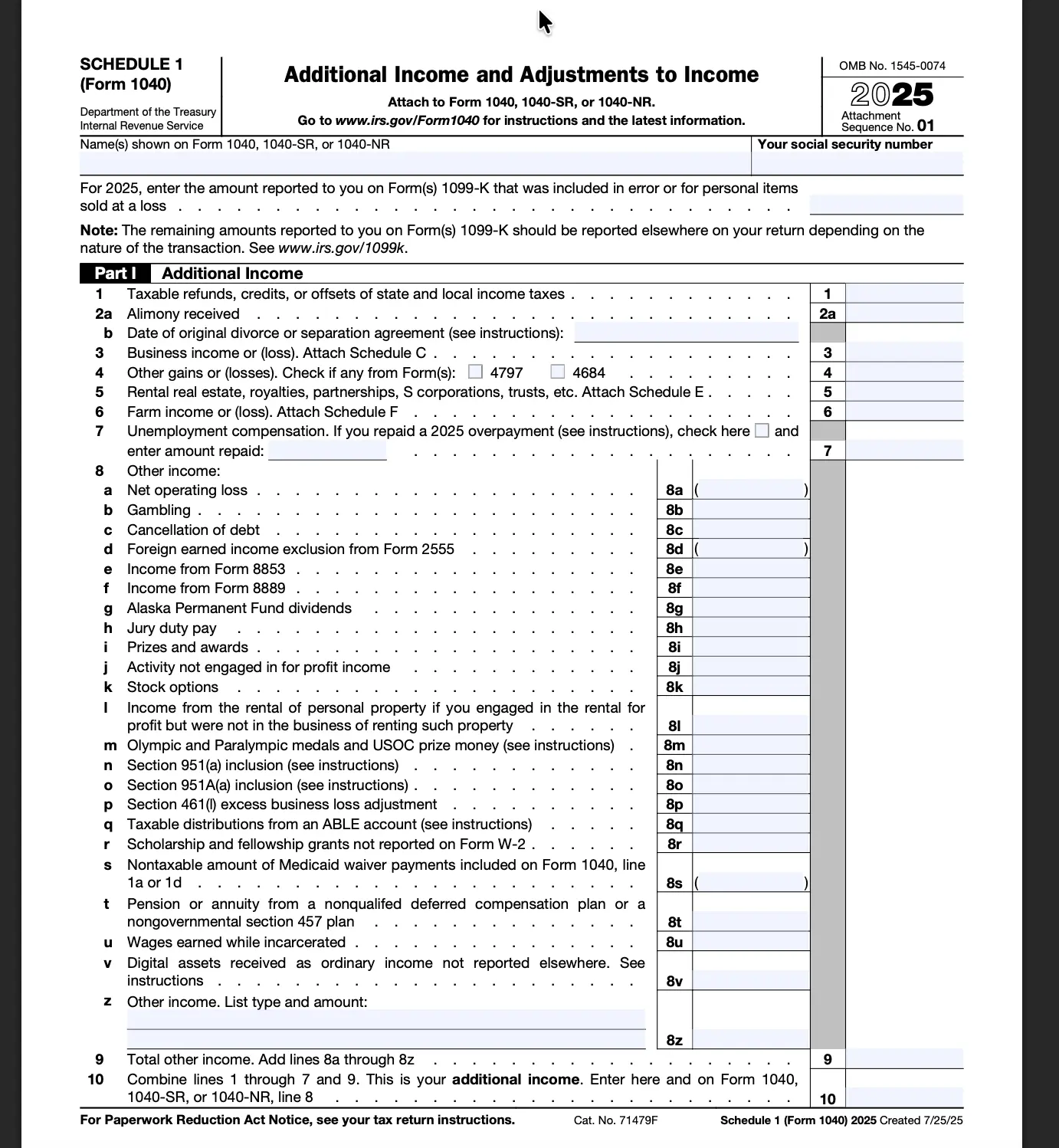
If a manufacturer pays you directly instead of routing the money through your employer, nothing gets withheld up front. You still owe full income tax on it, reported as other income, and if your sales activity counts as self employment, that income can also trigger self employment tax. The IRS is explicit in Publication 525 that bonuses and prizes for hitting sales goals, cash or non cash, count as taxable income regardless of which side of that line you fall on.
Done when: the amount shows up correctly on either your W2 or a 1099 form, and you have set aside enough to cover the tax on it, since nothing was likely withheld if a manufacturer paid you directly.
Common mistakes with spiffs
Why did my spiff payment come in smaller than the number I was promised?
Most reps forget the 22 percent supplemental withholding rate applies the moment the payment is flagged separately from regular pay. A 200 dollar spiff can arrive as 156 dollars after federal withholding alone, before state tax. Ask payroll how the payment is classified before you spend it in your head.
Why did I get a form in the mail I was not expecting?
If a manufacturer, not your employer, paid the spiff and it hit 600 dollars or more for the year, you will get a tax form reporting it as income to the IRS. That form arrives whether or not you kept your own records, so the safest move is tracking every spiff payment as you get it rather than waiting for paperwork.
Why do sales fall off right before a spiff, then spike once it starts?
Some reps hold deals open until a spiff window opens so those sales count toward the target instead of landing in a normal week. Sales leaders call this pattern sandbagging, and it shows up as an odd dip and spike in the data around every announced promotion. A thread in r/techsales asking reps about the best spiff of their careers pulled over 30 comments, and several answers described exactly this timing pattern, holding a deal for a day or two to land inside the window rather than just outside it.
Deciding whether a spiff is worth chasing
Before you rearrange your week around a spiff, run it through this check. It works whether the spiff is worth 20 dollars or 2,000.
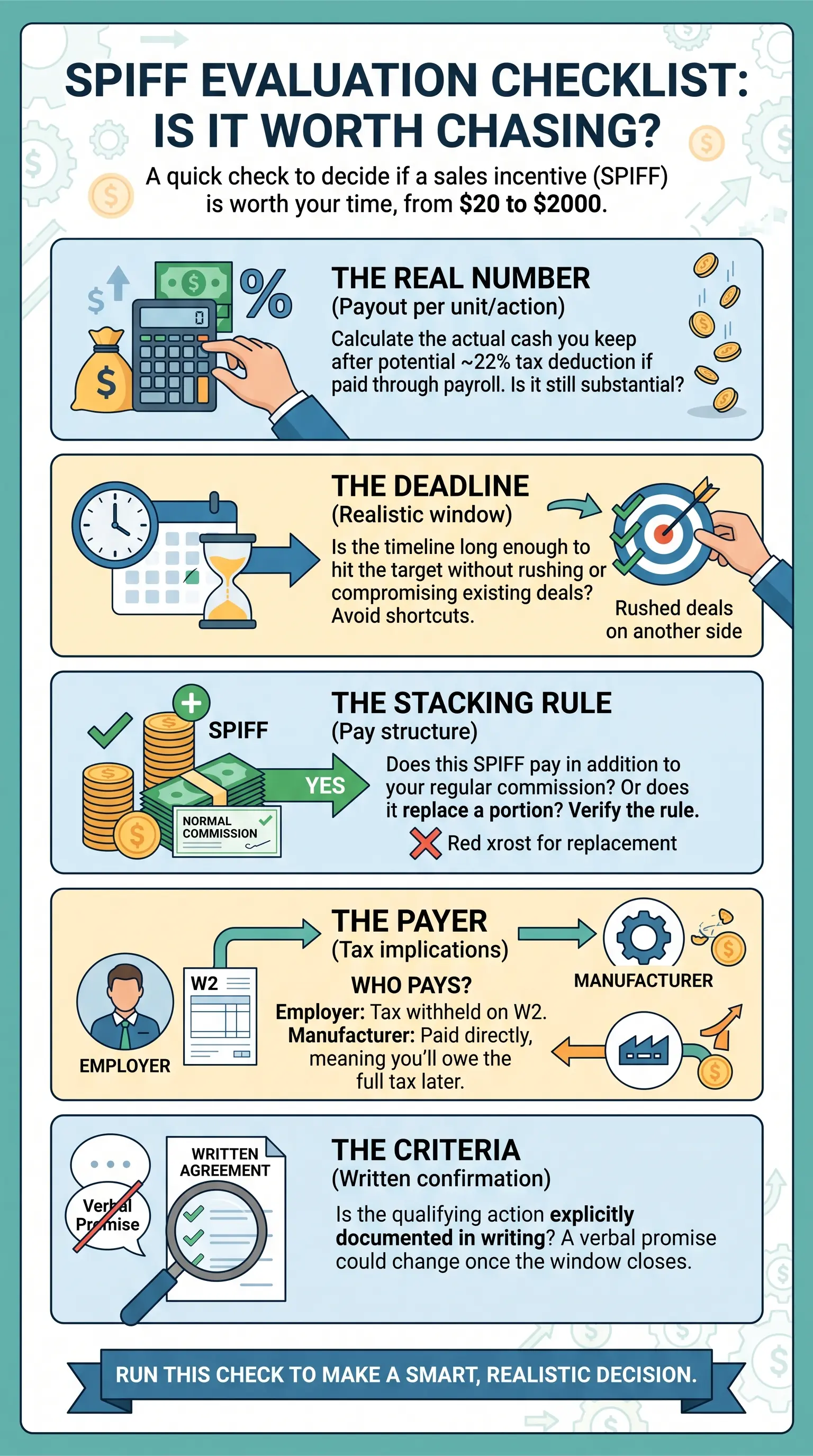
The real number. What is the payout per unit or per action, after the roughly 22 percent that disappears if it is paid through payroll as a separate item?
The deadline. Is the window long enough that you can realistically hit the target without cutting corners on deals already in progress?
The stacking rule. Does this spiff pay on top of your normal commission, or does it replace part of it?
The payer. Is your employer paying it, meaning it is withheld and shows up on your W2, or is a manufacturer paying you directly, meaning you owe the tax later with nothing set aside yet?
The criteria. Is the qualifying action written down somewhere specific, or is it a verbal promise that could get reinterpreted once the window closes?
A spiff tied to booked meetings is common on outbound and SDR teams, and it only pays out on real conversations, not attempts. An explanation of what an AI SDR actually does, stage by stage covers how those booked meeting quotas usually get built in the first place. A rep chasing that type of spiff still needs a working contact to reach before the window closes, which is the exact problem covered in a separate guide on how to find someone's email address. A bounced or wrong contact does not just waste a touch; it burns part of a window that may only run a few days.
FAQ: SPIFF meaning
What does SPIFF stand for?
SPIFF stands for sales performance incentive fund. It is sometimes written as SPIF, which several sources treat as the more literal expansion of the same four words.
Is a spiff the same as a bonus?
Not exactly: a bonus usually rewards broader performance over a longer stretch, like a quarter or a year, while a spiff targets one specific, narrow action within a short window, often just days or weeks.
Do you have to pay taxes on a spiff?
Yes, the IRS treats spiff income, cash or non cash, as fully taxable. If your employer pays it, tax gets withheld automatically. If a manufacturer pays you directly, nothing is withheld up front and you report it yourself.
What is the difference between a SPIF and a SPIFF?
They describe the same short term sales incentive. SPIF is closer to the literal acronym for sales performance incentive fund, while SPIFF, with the extra F, is the more common spelling in everyday use.
Can a spiff replace my commission?
No, a spiff is layered on top of existing pay, including commission, rather than substituting for it. If a program is presented as a replacement for your regular commission, that is not a standard spiff structure and is worth questioning directly with your manager.
Before you chase the next one
A spiff is a small, fast lever, not a raise. It rewards one specific action inside a short window, and it is worth exactly what lands in your account after tax, not the number printed on the announcement.
Knowing what the term actually stands for, how it differs from a commission or a bonus, and what happens to it once payroll or a manufacturer processes it puts you in a better spot to judge whether a given spiff is worth the extra push, and to catch it if the payout comes in lower than what you expected.