What is an AI SDR? A Plain Explanation of How It Works
AI SDR meaning explained in plain terms: what it automates, how it differs from a human SDR, plus a 5-point framework for evaluating any AI SDR platform.
 Michael Doyle10 min read
An AI SDR (AI sales development representative) is software that takes over the early, repetitive parts of outbound sales: finding prospects, sending outreach, following up, and qualifying replies, so a human seller only steps in once a lead is ready to talk. It runs on natural language processing and automation rules connected to your CRM, working around the clock instead of during one person's working hours.
What you need before you start
This section is for anyone evaluating or explaining AI SDRs, not just buyers. You don't need to be technical to follow it.
What this covers:
What an AI SDR actually does, stage by stage
How it's different from a human SDR and from an AI sales assistant
What it costs, what it needs to work, and where it breaks down
What it does not cover:
A ranked list of specific AI SDR tools (that's a separate comparison, linked below)
Setup instructions for one particular platform
Useful background before reading: basic familiarity with what a traditional SDR does (prospecting, cold outreach, qualifying leads, booking meetings) and what a CRM is.
AI SDR meaning: the short version
Strip away the marketing and an AI SDR does three things a junior human SDR does: find the right people, message them in a way that sounds relevant, and hand off the ones who reply with interest. The difference is scale and hours. A human SDR sends a few dozen personalized messages a day and stops at 6pm. An AI SDR can run thousands of touches around the clock, adjusting each message based on the prospect's job title, company, and past engagement.
Industry data backs up why teams are looking at this now: SDRs spend over two thirds of their time on tasks that aren't actually selling, which is the gap AI SDR tools are built to close (source: Salesforce).
How an AI SDR works, stage by stage
Stage 1: Prospecting and list building
What happens: The AI SDR pulls a list of accounts and contacts that match your ideal customer profile (ICP), the description of the company size, industry, and role that tends to buy from you. It usually pulls this from a connected data provider or your CRM's existing lead pool, then filters by firmographic data (company size, industry, funding stage) and sometimes intent signals, like a prospect visiting your pricing page or a competitor's site.
Done when: you have a list of contacts scored or grouped by fit, ready to enter a sequence.
Stage 2: Outreach and personalization
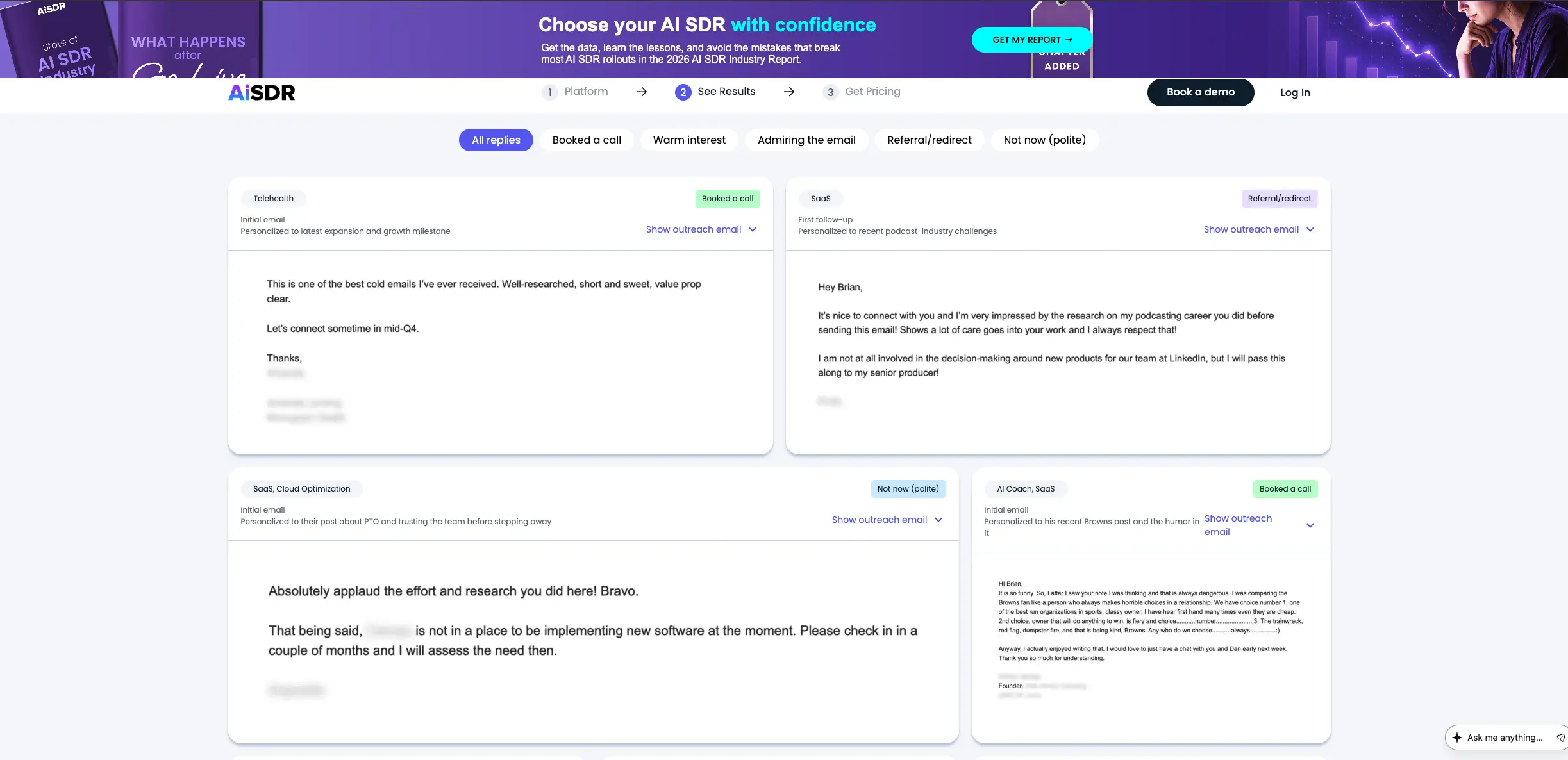
What happens: The tool drafts and sends the first message, usually email, sometimes LinkedIn or a dialer for calls. Personalization isn't just a mail merge with a first name. Better AI SDR tools pull a real detail (a recent funding round, a job change, a shared connection) and write a line that references it, then generate the rest of the message from a template your team approves.
Done when: the first touch message has gone out and a follow up cadence is scheduled.
Stage 3: Follow up and reply handling
What happens: Most replies to cold outreach aren't a clean yes or no. An AI SDR reads the reply, classifies it (interested, objection, wrong person, unsubscribe, out of office), and either answers automatically with an approved response, forwards it to a human, or removes the contact from the sequence. This is the step that separates an AI SDR from a basic email sequencing tool: it acts on what comes back, not just what goes out.
Done when: every reply has a next action, either an automated response or a flag for a human.
Stage 4: Qualification and handoff
What happens: Once a prospect confirms interest, the AI SDR asks a few qualifying questions (budget range, timeline, current tool) or checks these against CRM data it already has, then books a meeting directly on a rep's calendar or pushes a qualified lead into the CRM with the context attached. This is the handoff point where the AI SDR's job ends, and the human closer's job starts.
Done when: a meeting is on the calendar, or a fully qualified lead is in the CRM with the conversation history attached.
AI SDR vs human SDR: what actually changes
An AI SDR does not replace judgment; it replaces volume. A human SDR still decides who the ideal customer is, writes the messaging framework, and handles the conversations that need real listening, like a prospect raising a specific objection about your pricing model. The AI SDR executes the repeatable parts of that plan at a scale no person could sustain solo.
Where teams get this wrong: treating the AI SDR as a full replacement instead of a force multiplier. The category is unbundling the SDR role, not deleting it. Strategy, objection handling, and relationship building are staying with people; volume and workflow execution are moving to the software.
SDR and AI SDR are two of the terms that come up together most often in this shift; a fuller breakdown of b2b sales terms that come up in real deals covers the rest.
AI SDR vs AI sales assistant
These get confused often enough to earn their own section. An AI sales assistant supports a human rep reactively (drafting a message the rep still sends, summarizing a call). An AI SDR operates the sequence end to end with less human intervention at each step, deciding the next action itself rather than waiting for a rep to approve every message.
A simple framework for evaluating an AI SDR tool
Use this before you demo anything. Score each area 1 to 5 based on what the vendor shows you, not what they claim in a slide.
1. Data quality: Where does the contact and intent data come from? Ask for the source and how often it refreshes.
2. Personalization depth: Does it pull a real, current fact per prospect, or just insert {{first_name}} into a template?
3. Reply handling: Show me an actual reply thread the tool handled, not a demo script. Ask what happens on an ambiguous reply.
4. CRM integration: Does it write back to your CRM automatically, or does someone need to log activity manually?
5. Human in the loop controls: Can you require approval before it sends, or does it send autonomously by default? For a first deployment, approval gated sending is the safer setting.
What the recipient actually sees
From the prospect's side, a well run AI SDR sequence looks like a normal, if slightly fast, sales outreach: an email that references something true about their company, a follow up two or three days later if they don't reply, and a real person joining the thread once they show interest. A poorly run one looks like spam: generic subject lines, no reference to anything specific, and a reply that gives a robotic non answer. The gap between those two experiences is almost entirely about data quality and how tightly the reply handling is scoped, not about whether AI is involved at all.
Common mistakes and how to fix them
Mistake: Turning on autonomous sending on day one. Fix: Start with approval gated sending for the first two to four weeks so a human reviews messages before they go out. Move to autonomous once the templates and data source have proven reliable.
Mistake: Feeding it a bad or outdated contact list. Fix: Audit your data source before launch. An AI SDR sends whatever it's given, faster than a human would, so a stale list produces stale results at higher volume.
Mistake: Letting it handle every reply type, including complex objections. Fix: Scope reply handling to the simple, high frequency cases (interested, not now, wrong person) and route anything nuanced to a human. This is the single biggest driver of whether prospects feel like they're talking to something useful or something fake.
Mistake: No qualification step before booking a meeting. Fix: Build at least two or three qualifying questions into the flow before a meeting lands on a rep's calendar. Otherwise, reps spend their time on calls that should never have been booked, which is the same time waste problem AI SDRs are supposed to fix.
A recurring theme in practitioner communities is exactly this: teams that ran an AI SDR before their human outreach playbook was proven ended up with more replies but weaker meetings. SaaStr, which has run AI SDR agents across four vendors for over ten months, puts it directly: the tool "will not fix" a human sales motion that doesn't already work, and the fix is proving the human playbook first, then feeding what works into the agent. A related r/gtmengineering thread from someone who tested three different AI SDR tools over a year covers the same failure pattern from the buyer side.
AI SDR vs traditional SDR at a glance
Traditional human SDR | AI SDR | |
|---|---|---|
Working hours | Fixed schedule | Runs continuously |
Volume per day | Dozens of personalized touches | Hundreds to thousands of touches |
Judgment on complex replies | Handles nuance directly | Escalates nuance to a human |
Strategy and ICP definition | Owns this | Executes against a definition set by a human |
Cost structure | Salary, commission, ramp time | Flat monthly platform fee |
Consistency | Varies with workload and fatigue | Consistent regardless of volume |
FAQ: What is an AI SDR
How does an AI SDR work?
It connects to your CRM and a contact data source, sends personalized outreach on a schedule, reads and classifies replies, and either responds automatically or hands the conversation to a human once a prospect qualifies.
Is an AI SDR worth it?
It's worth it when your bottleneck is volume, not strategy. If your team already struggles to keep up with manual outreach and follow up, an AI SDR removes that specific bottleneck. It won't fix a weak ICP or messaging that doesn't resonate.
Can an AI SDR replace a human SDR?
Not entirely. It replaces the repetitive execution work. Strategy, complex objection handling, and relationship building still need a person, which is why most teams run AI SDRs alongside, not instead of, human reps.
How much does an AI SDR cost?
Pricing varies widely by platform and volume, typically a flat monthly fee rather than per seat, since it's replacing tasks rather than a headcount. Get current quotes directly from vendors, since this changes often.
What's the difference between an AI SDR and an AI BDR?
In most sales orgs, the terms are used interchangeably. Where companies do split them, BDR (business development representative) usually leans toward outbound only prospecting and SDR covers both inbound and outbound, but this varies by company and isn't a fixed industry standard.
Where this leaves you
An AI SDR is best understood as an execution layer for the top of your funnel: prospecting, first touch outreach, and reply triage, running at a volume and consistency a person can't match alone. The parts of selling that depend on judgment (which accounts matter, how to handle a real objection, when to walk away from a bad fit lead) still belong to a person. Getting the split right, rather than expecting the tool to do both, is what determines whether it helps or just adds noise to your pipeline.