

ICP stands for ideal customer profile. It is a written description of the type of company most likely to buy your product, get value from it, and stick around, built from the traits your best closed won accounts share: industry, size, revenue, tech stack, and the events that made them ready to buy. Sales uses it to qualify accounts before a rep ever picks up the phone.
An ICP describes a company, not a person. That distinction sounds small until a sales team spends a quarter calling on the wrong accounts because nobody wrote the filter down.
My first attempt at an ICP was one sentence: "B2B SaaS companies." It matched thousands of accounts and told a rep nothing about which ones to call first. The four stage process below, and the scored example further down, is what replaced it.
What you need before you start
Works for: any B2B sales or marketing team that has closed a handful of deals and wants to stop guessing which accounts to prioritize, or a founder building a first outbound list before much closed data exists.
Does not work for: a company with fewer than five or so customers and no clear pattern yet; guess at a narrow starting point and build the real ICP once deals close. It also is not a replacement for a buyer persona; you need both.
Before you start, you need: your CRM or a spreadsheet of past deals, fifteen to twenty closed won and closed lost accounts to compare, and one working session with a rep who talks to prospects daily. No special software required.
What is an Ideal Customer Profile in sales?
An ideal customer profile (ICP) is a written filter for account fit. It combines firmographics (industry, employee count, revenue, location), technographics (which tools a company already runs), and behavioral or situational signals (a funding round, a leadership change, a hiring surge in the role your product supports) into one shared framework everyone on the team can apply the same way.
The point of an ICP is not description for its own sake. It is a filter a rep can apply to a list in under a minute: does this account match, or is it a maybe that will eat a week of pipeline time and go nowhere.
How to build an ICP in four stages
Stage 1: Pull your best fit accounts
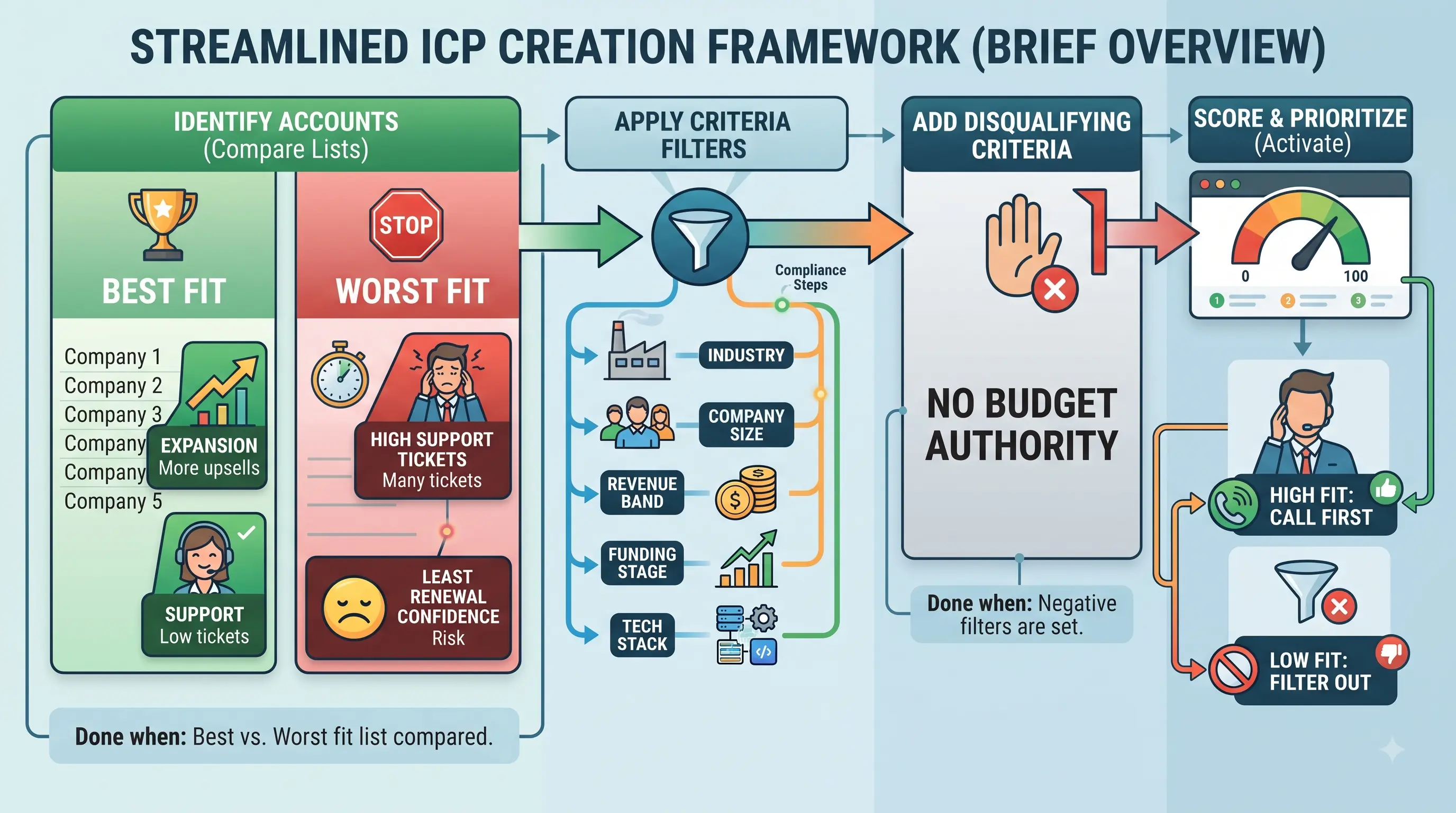
What happens: List your closed won accounts and rank them by three things: how fast they closed, how much they have expanded since, and how little they have needed from support. Salesforce's guidance on building an ICP is blunt about the alternative: assuming what makes a customer ideal without real data is the costly version of this exercise, so pull actual CRM records rather than working from a team's collective gut feeling. Pull the same list for your worst fits: longest sales cycles, most support tickets, least renewal confidence.
Done when: you have two short lists side by side, best fit and worst fit, with at least ten accounts on each.
Read also: What is firmographic data? A plain guide with a worked example
Stage 2: Turn the pattern into firmographic and technographic criteria
What happens: Compare the two lists and write down what the best fit accounts share that the worst fit accounts do not: industry, employee range, revenue band, funding stage, and which tools already sit in their stack. This is where firmographic data ICP work gets slow if you do it by hand, one company at a time. A domain search tool such as leaderr.io returns firmographic details for a company straight from its domain, which cuts the manual lookup down to seconds per account instead of a browser tab and a guess.
Read also: What is B2B Data Enrichment? A Small Team Guide with Costs and Compliance Steps
Done when: you have seven to ten firmographic and technographic criteria written down, each one backed by a real gap between the best fit and worst fit lists, not a guess.
Stage 3: Add negative filters and a floor
What happens: A B2B ICP without disqualifying criteria drifts wider every quarter, since nobody wants to say no to a lead. Write down traits that predict a bad fit even when the firmographics look close: below a minimum revenue or employee floor, already locked into a long contract with a direct competitor, or a title mismatch where the champion never has budget authority. These become deductions in scoring, not a missing checkbox.
Done when: you have at least two negative filters written down alongside the positive criteria, each one tied to a real pattern in the worst fit list from Stage 1.
Stage 4: Score, validate, and activate
What happens: Assign point weights to each criterion so the highest fit accounts score near the top of a defined scale, run your Stage 1 lists back through the model to confirm best fits score high and worst fits score low, then connect the score to what happens next: who a rep calls first, who gets an automated sequence, and who gets excluded entirely.
Read also: What is Lead Scoring, and Why do Sales Teams Stop Trusting it?
Done when: the model has been tested against real closed accounts, sales has agreed to the thresholds, and there is a date on the calendar to review it again.
ICP vs buyer persona: the difference that matters
An ICP describes the company. A buyer persona describes the person inside that company who evaluates, champions, or signs off on the purchase. One SaaS company can have a single ICP and three or four buyer personas sitting inside it: the economic buyer, the day to day user, and the security reviewer who can kill a deal nobody else objects to.
Confusing the two is the most common mix up in ideal customer profile work. A rep who memorizes a buyer persona but never checks account fit ends up pitching the right title at the wrong company: a great VP of Marketing at a 40 person company your product was never built to support.
ICP | Buyer persona | TAM | |
|---|---|---|---|
Describes | A company | A person inside that company | The entire addressable market |
Built from | Firmographics, technographics, behavior | Job title, goals, objections | Every company that could theoretically buy |
Answers | Which accounts to target | How to message the people at those accounts | How big the opportunity could be |
Common mistake | Left too broad, drifts toward the TAM | Written once and never updated | Mistaken for the ICP itself |
Buyer persona and TAM are just two of the other terms that shape how a sales team defines its market; a fuller breakdown of b2b sales terms that come up in real deals covers the rest.
A worked ICP scoring example
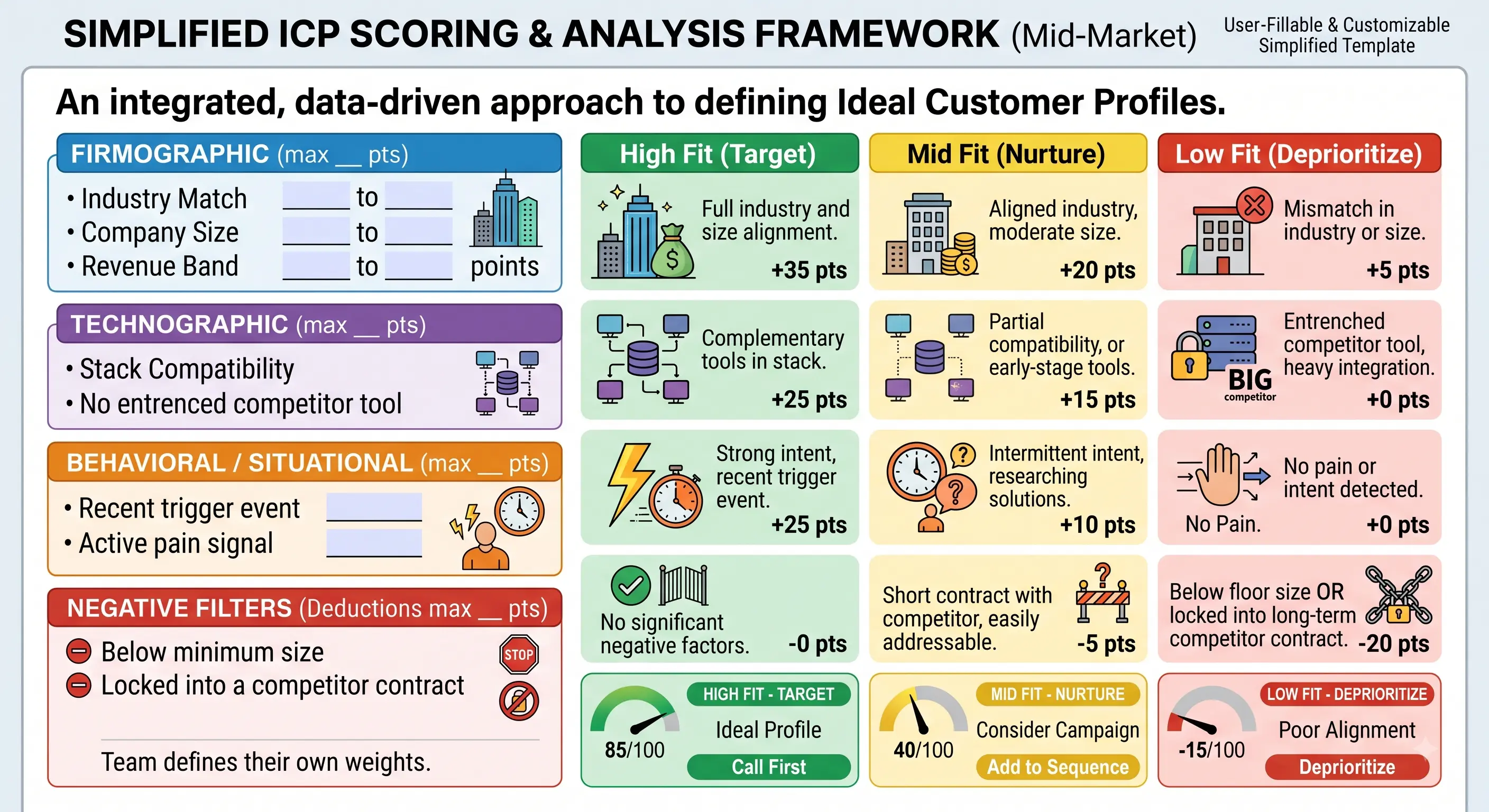
Below is one version of that template, scored against three example accounts to show what the numbers are supposed to separate. None of these are real client names; they stand in for accounts a mid market B2B SaaS team would actually see on a prospect list.
FIRMOGRAPHIC (max 35 points)
Industry match ................... 0 to 15
Company size in range ............ 0 to 12
Revenue band in range ............. 0 to 8

TECHNOGRAPHIC (max 25 points)
Complementary tool in stack ....... 0 to 15
No entrenched competitor tool ..... 0 to 10

BEHAVIORAL / SITUATIONAL (max 40 points)
Recent trigger event .............. 0 to 20
Active pain signal ................. 0 to 20

NEGATIVE FILTERS (deductions)
Below minimum size floor ......... minus 15
Locked into a competitor contract  minus 15
Scored against three example accounts:
Account 1, a Series B vertical SaaS company at 80 employees, running a complementary tool, fresh off a funding round and hiring for the role the product supports: 35 firmographic, 25 technographic, 40 behavioral, no deductions. Total: 100.
Account 2, a 20 person pre seed startup in the right industry but under the revenue floor with no trigger event: 19 firmographic, 20 technographic, 5 behavioral, minus 15 for the size floor. Total: 29.
Account 3, the right size and revenue but an adjacent industry, already two years into a contract with a direct competitor: 25 firmographic, 5 technographic, 20 behavioral, minus 15 for the competitor lock. Total: 35.
The spread is the point. Account 2 looks decent on paper, but the floor and missing trigger drag it down before a rep wastes a call. Account 3 has the size and budget, but the negative filter catches what firmographics alone would have missed.
What changes once you have a defined ICP
A defined ICP feeds three things directly. Lead scoring gets an account level fit score instead of guessed weights. Outbound list building narrows to accounts that actually match instead of a broad industry filter, the difference between a list an AI SDR platform can work efficiently and one that burns credits on dead ends. Account based marketing gets a target list worth the budget behind dedicated ABM tooling, since a tiered, fit scored account list is what ABM platforms are built to run against.
Common mistakes with ICPs
Problem: the ICP is actually a TAM.
Fix: if your stated ICP is "companies with 10 to 10,000 employees in any industry," that is a total addressable market, not an ICP. Tom Buiocchi, former CEO of ServiceChannel, summed up the fix in three words: "Segment until it hurts." His team had been targeting any retail account at a poor close rate; narrowing to large, distributed, company owned retail and food service chains fixed it.
Problem: there are no negative filters, so the ICP only ever gets wider.
Fix: every quarter without a disqualifying criterion is a quarter where a few borderline deals get added to the definition because closing something feels better than closing nothing. Write the negative filters down at the same time as the positive ones, not after the ICP has already drifted.
Problem: the ICP gets written once and never revisited.
Fix: put a recurring review on the calendar, monthly for a quick look at recent win and loss patterns, quarterly for a full pass on the criteria and weights.
Problem: everyone on the team starts from a different method.
A Quora thread asking for the best way to identify an ICP for sales prospecting has six separate answers, ranging from customer interviews to hypothesis testing to straight data analysis, with no single method winning out. That range is normal, but it is also why an ICP built by one rep from memory rarely matches one built by another rep from a spreadsheet. Fix: agree on the four stage process above as the shared method before anyone starts filling in criteria, so the disagreement happens over data, not over which approach to use.
FAQ
What does ICP stand for in sales?
Ideal customer profile. It describes the company most likely to buy, succeed with, and stay with your product, built from the traits your best closed accounts actually share.
How many criteria should an ICP have?
Most working ICPs land at seven to twelve firmographic and technographic criteria plus two or more negative filters. Fewer is rarely specific enough to filter a real list; many more is hard for a rep to hold in their head.
How often should an ICP get updated?
Review thresholds monthly against recent wins and losses, and run a full recalibration quarterly, sooner if a new product line or pricing change shifts who the product fits.
Can a company have more than one ICP?
Yes, usually when a product serves two distinct segments, such as SMB and mid market, with different pricing and buying committees. Each segment needs its own criteria and scoring rather than one blended profile that fits neither well.
Do B2C companies need an ICP?
The concept applies as an ideal customer persona rather than a company profile, since there is no firmographic account to describe. What makes a B2B ICP useful, a written filter built from real customer patterns, carries over directly.
One last check
Before this goes anywhere near a call list, run the test from the mistakes section above: could a real account actually fail your ICP. If every company you can think of would pass, the definition is still a TAM wearing an ICP's name. Narrow it until a specific, real account clearly falls outside the line, then hand the criteria to sales and put a review date on the calendar.