

B2B data enrichment is the process of adding verified information to contact and company records you already hold, using outside data sources. A name and a work email become a job title, company size, industry, tech stack, direct dial, and buying signals. It runs on a repeating cadence, because business contact data goes stale fast.
How fast? Around 22.5 percent of B2B contact records go wrong within a year, which works out to roughly 2.1 percent a month. Gartner puts the average cost of poor data quality at $12.9 million per organisation per year, a figure Cognism breaks down in its data decay analysis. That decay rate is why enrichment gets treated as plumbing rather than as a one off project.
This guide covers what B2B data enrichment adds to a record, how the process runs, what match rates and accuracy you should expect, what the four common approaches cost, and the disclosure duty that applies the moment you email someone whose details came from a third party.
Works for you, does not work for you
Enrichment works when:
You already hold records carrying at least a full name plus a company domain
The data has somewhere to land: a CRM, a spreadsheet, or a sequencer
You can act on the new fields through lead scoring, routing, or personalised outreach
You accept that it repeats on a schedule
Enrichment does not fix:
An empty database. Building a list from nothing is lead generation, a separate job
A weak ideal customer profile (ICP). Better fields on the wrong accounts still go nowhere
Duplicates and malformed records. That is data cleansing, which belongs before enrichment
Deliverability damage caused by your own domain setup rather than your list
Lead enrichment is the same process pointed at inbound form fills instead of at accounts already in your pipeline. Same stages, shorter list.
What actually gets added to a record
The types of data enrichment on offer break into five categories, and those five cover almost everything a vendor will sell you.
Firmographic data means facts about the company: headcount, revenue band, industry, headquarters country, funding stage, parent company.
Contact data means the person: verified work email, direct dial, mobile number, job title, seniority, department.
Technographic data means the software a company runs, for example its CRM, analytics tool, payment processor, or hosting provider. Teams use it to find accounts already running a product they integrate with.
Intent data means research-behaviour signals, usually bought through a data co-operative that tracks content consumption across publisher networks. It tells you a topic is being researched at an account. It rarely tells you which person is doing the researching.
First-party behavioural data is your own: pages visited, demos booked, product usage, support tickets. It costs nothing extra and gets skipped most often.
CRM data enrichment usually means the first two categories running automatically against records already sitting in Salesforce or HubSpot.
Firmographic data, lead scoring, and CRM records are only a few of the terms tied to how enrichment actually gets used; a fuller breakdown of b2b sales terms that come up in real deals covers the rest.
How the B2B data enrichment process runs, stage by stage
Four stages. Each one closes with a check, so you know it finished.
Stage 1: Pick the fields before you pick a vendor
What happens: You list the fields a rep or a workflow will really act on, and you write down what each one changes. Job title changes the message. Headcount changes the routing. Tech stack changes the offer. Fields nobody acts on are credits burned for decoration.
Done when: Every field on your list has a named use, and anything without one has been cut.
Stage 2: Match the record
What happens: The provider takes your input (name, company, domain, LinkedIn URL) and searches for the same person in its database. The share of your records that come back filled is the match rate. Input quality moves that number more than vendor choice does. Name plus company plus domain beats name alone by a wide margin.
Done when: You have a measured match rate from a sample of your own list, not a claim from a pricing page.
Stage 3: Verify before anything gets used
What happens: Matched is not the same as correct. An email can resolve to a live mailbox belonging to someone who left in March. Verification checks the mail server and, on stronger providers, cross-references title and employer against a second source. If you run this step in house rather than buying it, the available methods for how to verify an email address sit a long way apart on failure rate.
In a January 2026 test on 10,000 HubSpot contacts, a single-source API returned usable data on 68.2 percent of records, while a cascade across 15 providers returned 96.4 percent verified emails in under 11 minutes.
Done when: A test send on a sample of the enriched list holds a hard bounce rate under 3 percent.
Stage 4: Write back, then set the cadence
What happens: Enriched values go into the CRM with a source and a date stamp on each field, so a fresh record is distinguishable from a two-year-old one. Then the refresh schedule gets set by field volatility. Emails, phone numbers, and job titles move fastest. Headcount and industry barely move at all.
Done when: Every enriched field carries a "last verified" date and sits in a refresh queue with a due date.
Four ways teams run B2B data enrichment
Approach | What it costs you | Match rate to expect | Who it fits |
|---|---|---|---|
Manual research | Time. Two reps needed 143 hours to work 10,000 records in the test cited above | Very high accuracy, very low volume | Fewer than 200 target accounts |
One provider | A single subscription, simplest billing | Roughly 50 to 70 percent on contact fields | One region, one narrow ICP |
Waterfall enrichment | Per-credit spend spread across several vendors | 90 percent and above in published tests | Broad lists, or multi-region coverage |
Real-time at point of use | Per-call API cost, nothing stored in bulk | Same as whichever source sits behind it | Enriching on form fill or CRM entry |
Waterfall enrichment means querying one provider, moving to the next when a field comes back empty, and stopping the moment it fills. Tools such as leaderr.io sit in the contact data slice of that stack, finding and verifying work email addresses rather than supplying firmographics or intent.
The compliance step most guides skip
Enrich a record, then email that person, and you have obtained personal data from a source other than the individual. In the UK and EU that triggers a disclosure duty, and it is the part of B2B data enrichment that almost no vendor guide spells out.
Under GDPR Article 14 you have to tell the person what you hold, where it came from, why you hold it, and how to object. The Information Commissioner's Office sets the timing: privacy information is due within a reasonable period and, at the latest, "within one month", or at the point of first contact if you reach out sooner than that.
For B2B prospecting the usual lawful basis is legitimate interest under Article 6(1)(f). It does not need prior consent. It does need a written balancing test on file and a genuine route to object. Two practical consequences follow:
Your first email needs a source line. One sentence covers it: where the details came from, and how to opt out.
Objections have to flow back into the enrichment pipeline as a suppression list. Otherwise the next refresh re-adds the contact you just removed.
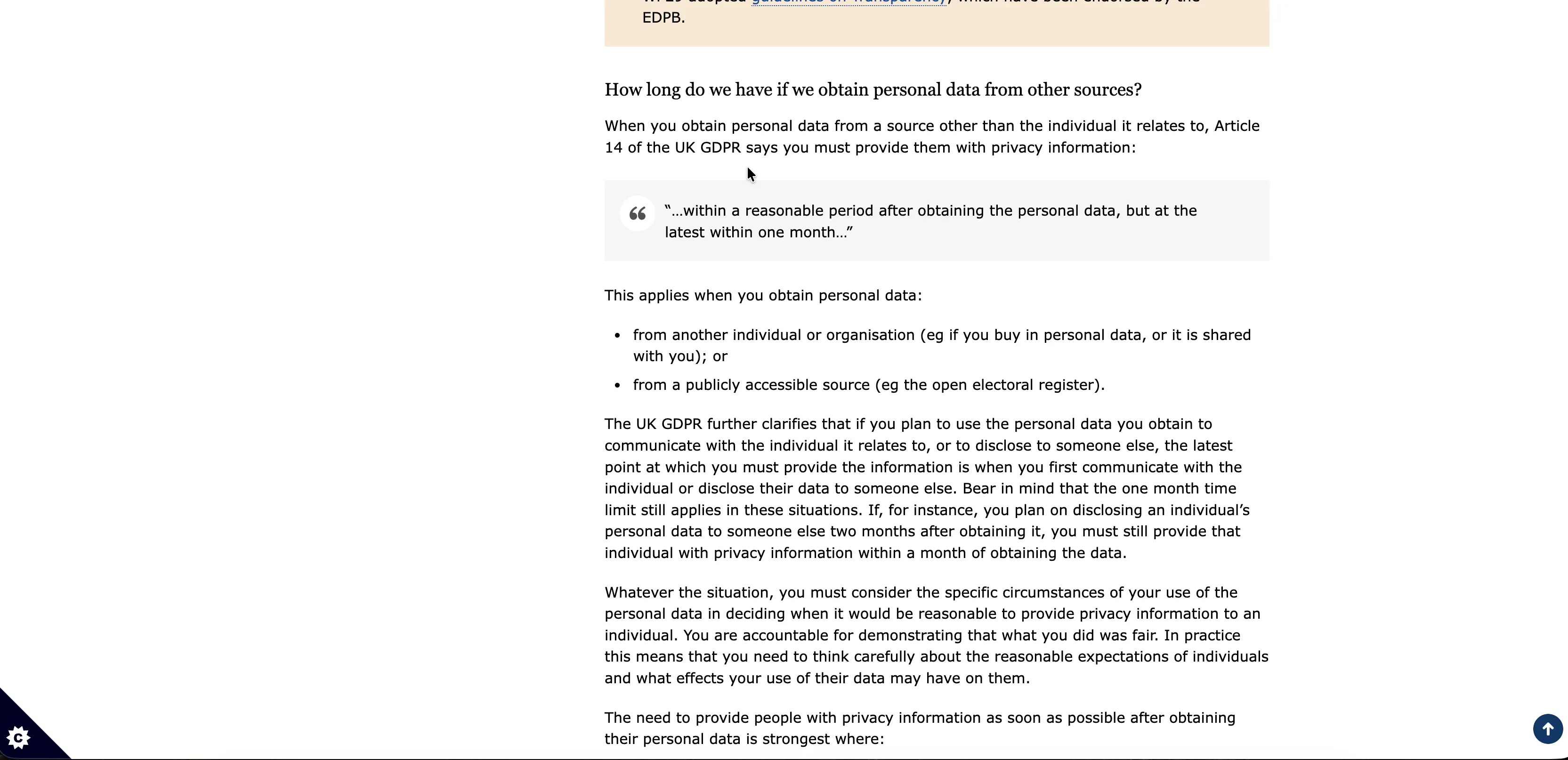 From the prospect's side, this is what enrichment looks like: an email from a stranger who knows their job title and their tech stack, with one line explaining where that came from. The source line is the difference between a message that reads as researched and one that reads as scraped.
A field checklist you can copy
Fill this in before you buy credits. Anything you cannot complete in the second column gets removed from the enrichment order.
FIELD                     WHAT IT CHANGES              REFRESH EVERY
Work email                whether the message lands    30 to 60 days
Direct dial / mobile      whether the call connects    60 to 90 days
Job title                 the angle of the message     90 days
Seniority / department    routing and sequence choice  90 days
Headcount band            segment and pricing tier     6 months
Industry                  which case study is used     12 months
Tech stack                the integration hook         90 days
Funding stage             timing of the outreach       90 days
Intent topic              which accounts move first    weekly
Anything you list with a blank middle column is a field to drop.
Measure your own decay before you buy anything
Vendor decay averages describe the whole market. Yours is a different number, and finding it takes under an hour.
Pull a random sample of 100 contact records created 12 or more months ago. For each one, check the current employer and title against a public profile, then run the email through a verifier. Count how many fail on either check. That percentage is your real annual decay rate, and it tells you whether a monthly or a quarterly cadence is the right spend.
Databases weighted toward SaaS and tech accounts come out worse than the published averages. Databases weighted toward manufacturing or government come out better.
Where enrichment goes wrong
The record matched, the email bounced. Match rate and accuracy are separate measurements, and vendors quote the flattering one. Fix: verify on a sample before a full run, and treat any hard bounce rate above 3 percent as a list problem rather than a copy problem.
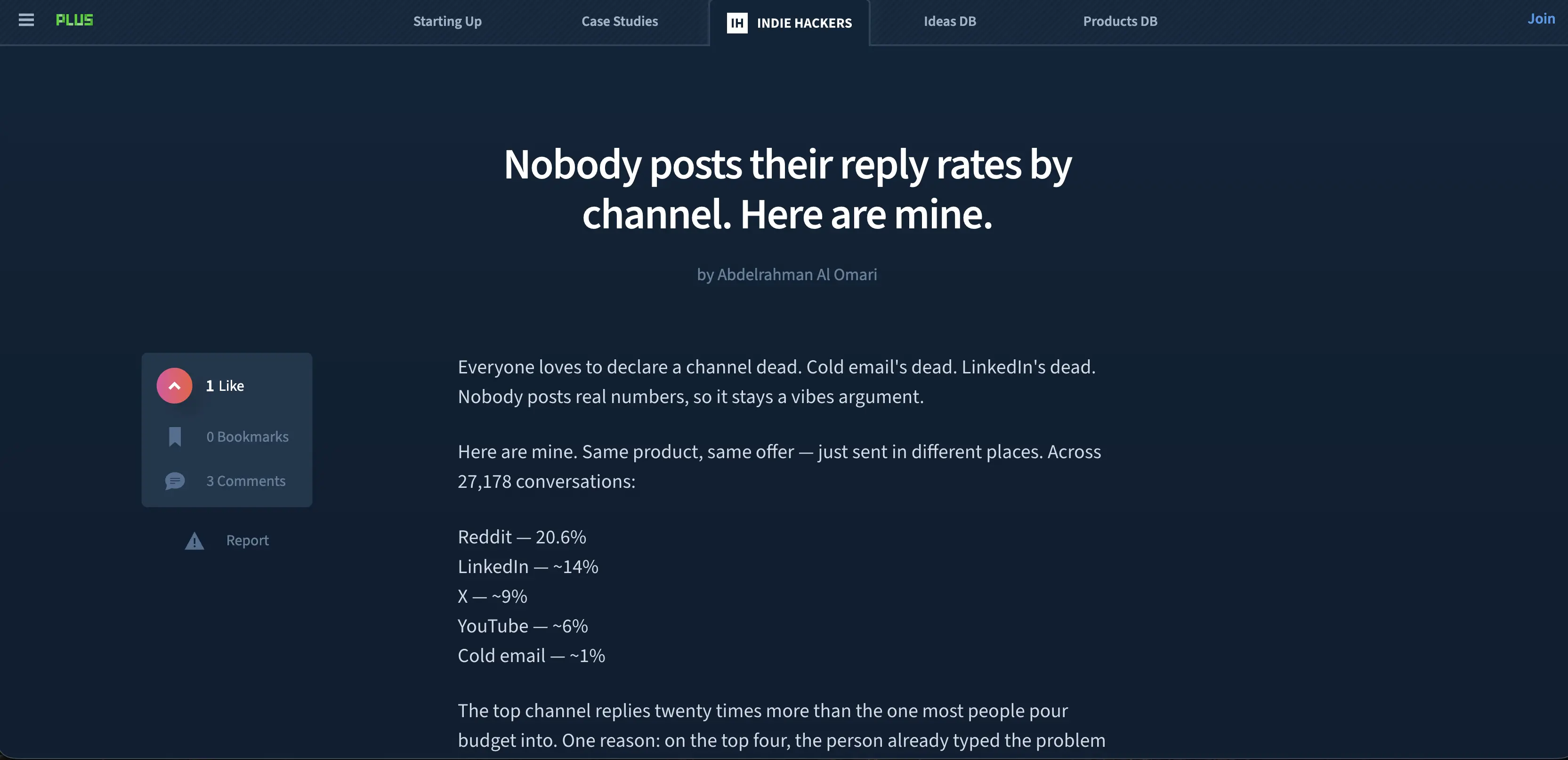
One provider, one blind spot. A single database inherits its own coverage gaps across your entire pipeline, which is why practitioners keep landing on cascades. A founder thread on Indie Hackers, What the F*** is Waterfall Enrichment? (3 likes and 4 comments, posted October 2024), works through the same logic, and the top question in the replies is the one worth asking any vendor: does the coverage hold up on niche roles, or only on the obvious titles? Fix: test two providers on the same 200 records and compare fill and bounce, not headline database size.
Enriched once, never again. A one-time pass starts decaying the day it finishes. Fix: put volatile fields on a 30 to 90 day cycle and leave firmographics alone for six months.
Enrichment sprawl. Several tools appending data into several systems, none of which agree. Fix: name one system as the source of truth, and let everything else read from it rather than write to it.
FAQ: What is B2B Data Enrichment
What is the difference between data enrichment and data cleansing?
Data cleansing repairs what you already have by removing duplicates, fixing formats, and deleting dead records. Data enrichment adds information you did not have from an outside source. Cleansing runs first, because enriching a duplicate gives you two wrong records instead of one.
How often should B2B data be enriched?
Match the cadence to the field. Emails, phones, and titles need re-verification every 30 to 90 days. Company-level fields hold for six months or more. Intent signals expire in days.
Is B2B data enrichment legal under GDPR?
Yes, when the conditions hold. Legitimate interest is a recognised lawful basis for B2B prospecting, and it requires a documented balancing test, a signed data processing agreement with your vendor, disclosure of the source at first contact, and a working opt-out.
How much does B2B data enrichment cost?
Per-record pricing runs from fractions of a cent for bulk email lookups to well over a dollar for waterfall coverage on hard-to-find mobile numbers. Seat-based platforms start near $50 per user per month. The cost that gets missed is credits spent on fields nobody uses.
What is a good match rate?
Above 85 percent is strong on contact fields, and single-source providers usually sit below that. Compare providers on your own sample, since match rates swing with region, seniority, and company size.
Where this leaves you
B2B data enrichment is maintenance work with a compliance layer attached. Pick fields you will act on, measure your own decay instead of trusting an industry average, verify before you send, and put a source line in the first email. A small verified database beats a large stale one on every measure that ends in revenue.