

A sales engineer is a technical expert who works alongside a sales team to prove that a complex product actually solves a prospect's problem. Most of that work happens in B2B sales, through live demos, technical discovery calls, and proof of concept projects, split across two halves of the job: pre sales, before the deal closes, and post sales, after it does.
Who this is for (and who it isn't)
This is for you if you're deciding whether to move into sales engineering, writing a job description for one, sitting across the table from an offer, or trying to figure out whether "sales engineer," "solutions engineer," and "technical account manager" are one job or three.
This is not a resume template, a location by location salary calculator, or a full interview prep guide.
My first live demo ran past the scheduled slot, and I still hadn't answered the one question the buyer's engineering lead actually cared about: whether the product could handle their existing authentication setup without a custom build. I had slides on integrations. I did not have an answer to that specific question, and the silence while I looked for one taught me more about the job than any onboarding deck did.
What is a sales engineer, in plain terms
A sales engineer in tech, meaning a tech sales engineer at a software or SaaS company, is the most common version of this role right now, though the same title exists in manufacturing, telecom, and industrial equipment too. A sales engineer sits between a company's product and a buyer's technical team.
The core skill is translation: taking something built by engineers and explaining, in the room, why it solves a specific business problem for this specific buyer. Some companies use the title "technical sales engineer" for the exact same role, mostly to make it clear on a job board that the position is not a pure quota carrying sales seat.
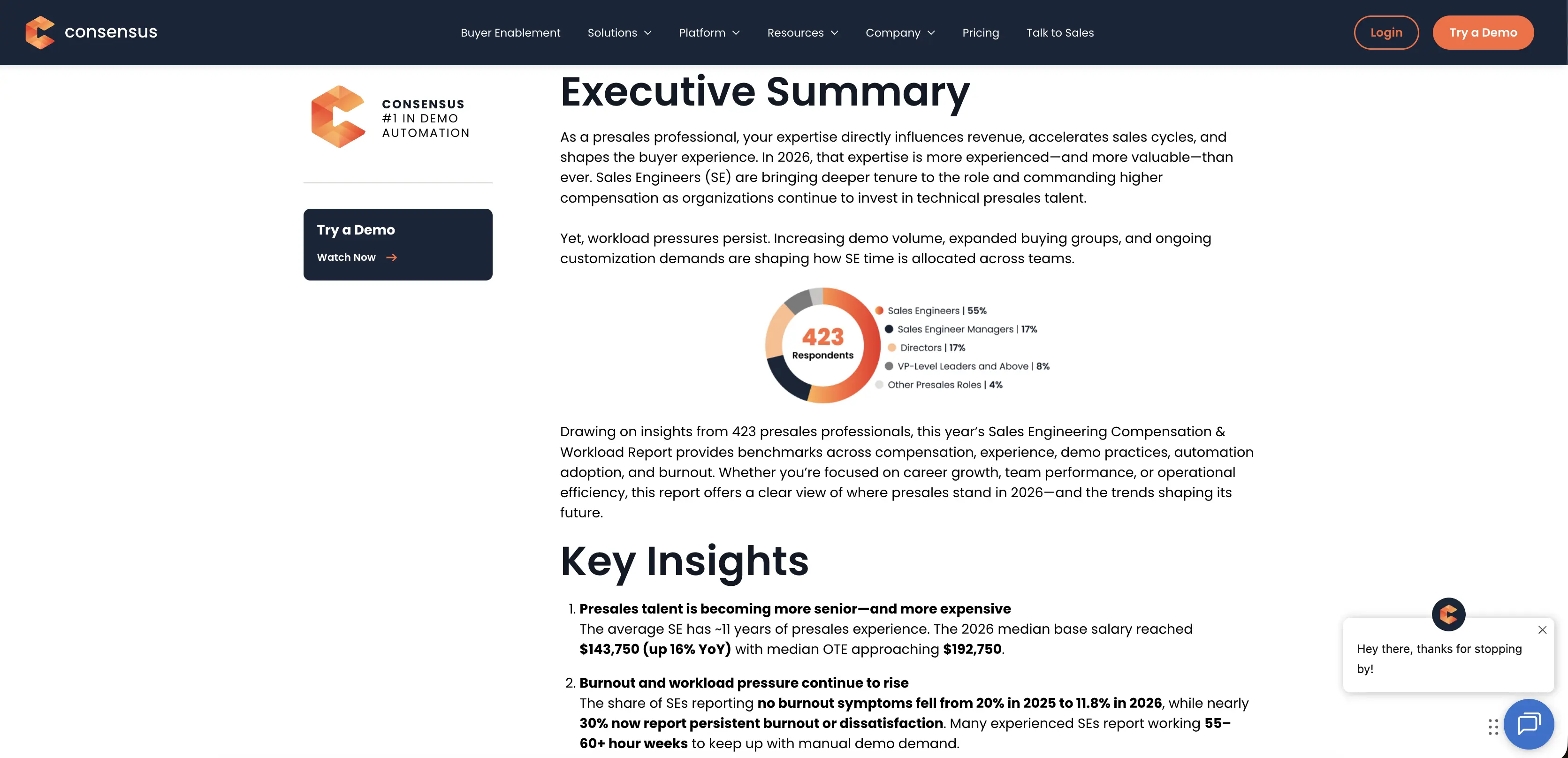
The job overlaps with a related title, solutions engineer, closely enough that at plenty of companies the two are interchangeable. Where they differ, it usually comes down to whether the role leans more into designing the technical solution or more into supporting the sales process end to end. Consensus, a presales technology company, describes a sales engineer as "a technical expert who knows how to explain difficult concepts" in ways that land with both internal teams and the buyer.
What a sales engineer actually does all day
Strip away the job title, and the daily list looks like this:
Running live product demos, usually tailored to what a specific prospect's team asked about in the prior call
Leading technical discovery: asking a prospect's engineers what their current stack looks like, where it breaks, and what a win actually looks like for them
Building and running proof of concept projects so a buyer's technical team can test the product against their own data or environment
Answering the objections a regular sales rep can't, because they require a real technical answer, not a talking point
Feeding what customers say back to the product team, since sales engineers hear the same complaint from ten different accounts before anyone else does
The job earns the phrase "technical win." Closing a deal usually needs two separate approvals: a business approval from whoever owns the budget, and a technical approval from whoever owns the risk of the thing actually working. A sales engineer owns getting that second approval. Miss it, and the best pricing in the world doesn't save the deal.
Pre sales vs post sales: the two halves of the job
Most sales engineer postings fall into one of two buckets, and the difference matters more than the shared title suggests.
A pre sales engineer works the deal before it closes: demos, discovery, proof of concept, answering the technical questions that come up during evaluation. A post sales engineer picks up after the contract is signed: installation, configuration, troubleshooting, and making sure the customer gets to a working product instead of a shelved one. Some companies split these into two separate roles entirely. Smaller companies often ask one person to do both.
The other titles you'll see for the same territory
Job boards are not consistent about naming, so the same work shows up under several labels:
Digital sales engineer: ocused on software and cloud products rather than physical or industrial equipment. A newer variant, the digital sales engineer working specifically on AI products, spends more time demoing model behavior and setting expectations than showing off a dashboard. That's a different role from an AI SDR, which automates outbound prospecting rather than running technical demos.
Sales application engineer: common in manufacturing and industrial sectors, where the "application" is a physical process the product needs to fit into.
Field sales engineer: spends more time on site with customers, handling technical issues in person rather than over a call.
Channel sales engineer and sales operations engineer: less common titles at larger companies, one working through reseller partners, the other focused on the sales process itself.
Whatever the title on the door, the question a hiring manager is trying to answer stays the same: can this person carry technical depth and a sales conversation at once.
Sales engineer vs solutions engineer vs account executive
Role | Owns | Talks mostly to | Paid mostly on |
|---|---|---|---|
Sales engineer | The technical win: proving the product works for this buyer | Buyer's technical team, own product team | Base salary plus a smaller variable tied to team or regional numbers |
Solutions engineer | Designing the specific technical solution for the buyer's setup | Buyer's technical team, implementation team | Base salary plus a smaller variable, close to the sales engineer structure |
Account executive | The business relationship and the signature | Buyer's economic decision maker | Base salary plus commission tied directly to closed deals |
At most software companies, sales engineer and solutions engineer are used for the same job. Where a company does draw a line, the solutions engineer tends to own more of the actual technical design work, while the sales engineer leans slightly more toward the sales process itself.
Account executive is only one of the other roles that gets compared against this one; a fuller breakdown of b2b sales terms that come up in real deals covers the rest.
What sales engineers get paid
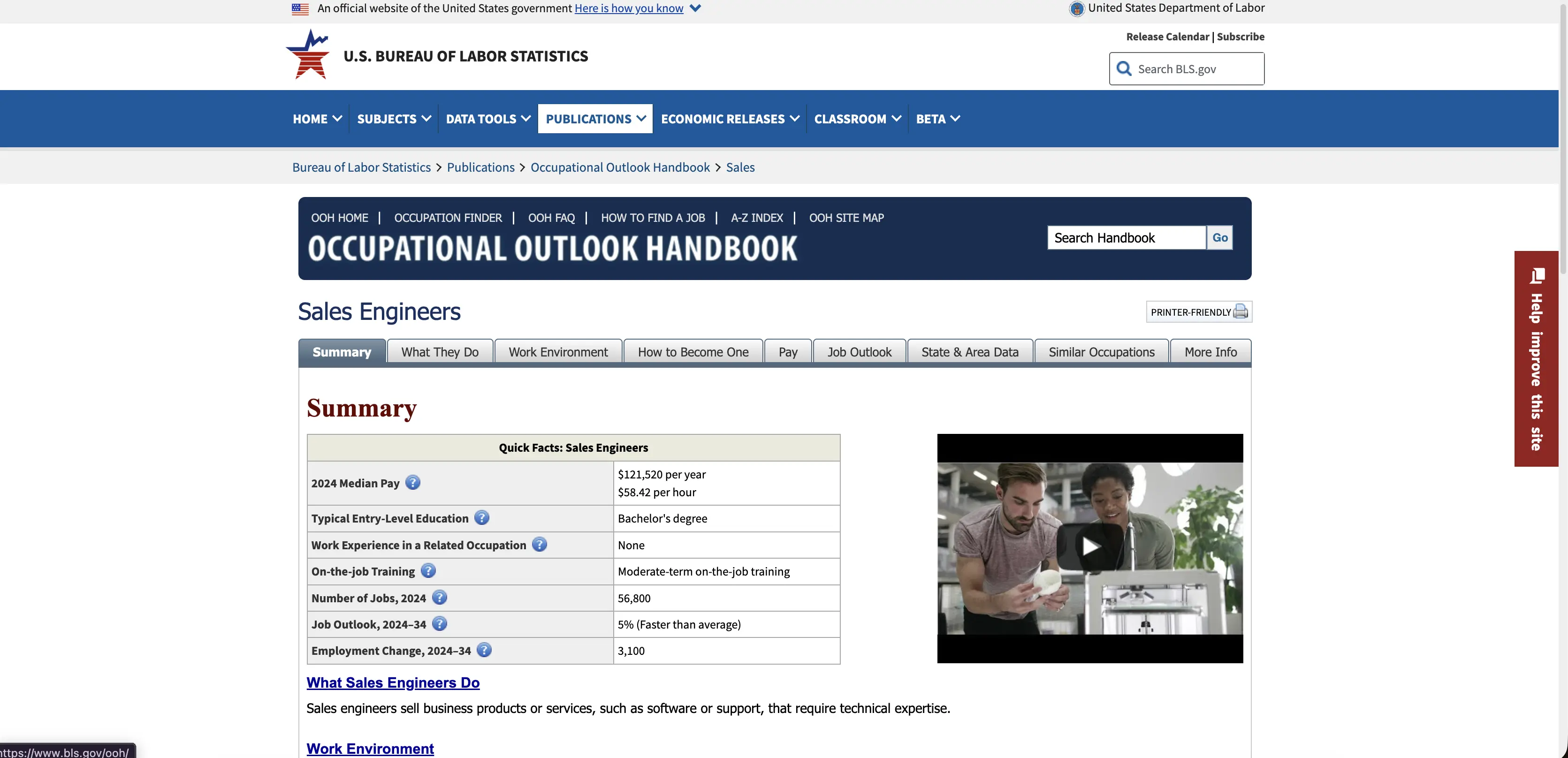
Sales engineer salary is the question most people ask first, so here's the current, sourced answer. The median annual wage for sales engineers was $121,520 in May 2024, according to the U.S. Bureau of Labor Statistics Occupational Outlook Handbook, with the middle 80 percent earning between $70,580 and $202,670 a year. The Bureau projects 5 percent employment growth from 2024 to 2034, faster than average, with about 5,000 openings a year, mostly from people leaving the occupation rather than the role disappearing. Software publishers pay the highest median among top employing industries, at $137,650.
Pay is not all salary. On a professional discussion thread where working sales engineers compared notes, one described the split this way: base salaries commonly run from $100,000 to $250,000, with variable compensation adding another 10 to 30 percent on top, often tied to a team or regional quota rather than an individual number the way an account executive's commission works. Know that structure before you compare a sales engineer offer against a straight sales role, since the two aren't paid the same way even when the base numbers look close.
How to become a sales engineer
Stage 1: Get the technical foundation. What happens: Most sales engineers enter with a bachelor's degree in engineering, computer science, or a related technical field. A smaller number enter through hands on experience instead, most often as a developer, implementation consultant, or technical support specialist. Done when: You can hold a real technical conversation with an engineer about how a product works, not just what it does.
Stage 2: Get sales reps, not just a sales title. What happens: Work a role that puts you in front of prospects and forces you to handle objections, even a business development representative seat rather than a sales engineer seat. Done when: Objection handling stops feeling like a script.
Stage 3: Add certifications that match your industry. What happens: Engineers working toward a Professional Engineer license sit the Fundamentals of Engineering exam through the National Council of Examiners for Engineering and Surveying, then the Professional Engineering exam after several years of experience. On the sales side, the Certified Professional Sales Person (CPSP) certification demonstrates sales specific training. Neither is required everywhere, but both remove doubt from a hiring conversation. Done when: You can point to a credential instead of just asserting the skill.
Stage 4: Keep learning after you're hired. What happens: Products change fast enough that a sales engineer who stops learning falls behind inside a year. Ongoing product training and recertification cycles are part of the job, not optional extras. Done when: A prospect's technical question about a recent product change doesn't catch you off guard.
The sales engineer role snapshot
Before you accept an offer, or before you post a sales engineer job description, run it against this checklist. It exists because "sales engineer" gets used loosely enough that two postings with the same title can describe two different jobs.
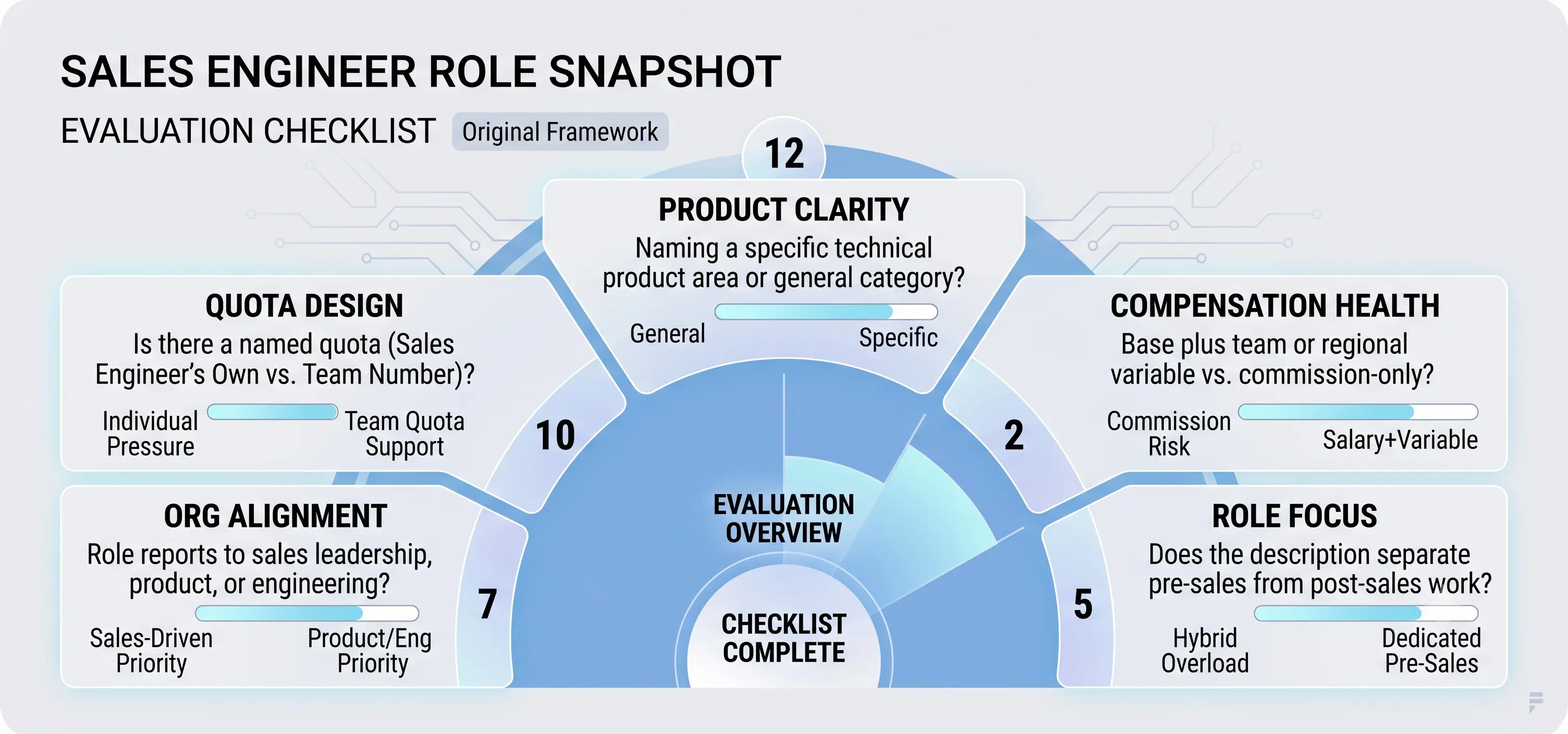
Does the posting name a specific technical product area, or just say "technical products" in general?
Is compensation structured as base plus team or regional variable, or does it read like a disguised commission only sales role?
Does the description separate pre sales work from post sales work, or does it quietly expect both from one person?
Does the role report into sales leadership, product, or engineering? That reporting line tells you a lot about where the company's priorities actually sit.
Is there a named quota, and if so, is it the sales engineer's own number or a team number they support?
What the prospect sees when this goes right, and when it doesn't
A prospect's technical lead doesn't see your title. They see one of two things: someone who answers their actual question, or someone who redirects to a follow up email. The first builds the technical win. The second usually starts a quiet countdown on the deal.
Some common ways this goes wrong, and the fix:
Problem: The demo covers features nobody in the room asked about. Fix: Spend the first five minutes of discovery asking what the buyer's team is trying to solve, then build the demo around that instead of a fixed script.
Problem: A technical objection catches you without a real answer. Fix: Say so directly, get the detail you need, and follow up with a precise answer instead of an improvised one. A wrong answer given confidently costs more trust than an honest "let me confirm that."
Problem: You're doing post sales cleanup work that was never scoped. Fix: Get the pre sales and post sales split written into the role before you take it, not after the first support ticket lands on your desk.
Search "sales engineer Reddit" or browse professional forums, and this comp and workload confusion comes up constantly. On one such thread on the professional network Blind, a working sales engineer summed up the day to day as "a lot of meetings with clients and account executives to answer questions and be a resource," often alongside a professional services group handling installation work, which matches the data above more closely than most polished career pages do.
Reaching the right technical stakeholder before that first discovery call is its own problem. Some sales engineering teams lean on a tool like leaderr.io to find the right contact's email address and verify it before sending anything, rather than finding out mid demo that they booked the wrong buyer.
Frequently asked questions
What does a sales engineer do all day?
A sales engineer spends most of a working day on product demos, technical discovery calls with a prospect's engineering team, and proof of concept work, with the rest going to internal product feedback and, for post sales work, installation and troubleshooting support.
What is the difference between a sales engineer and a solutions engineer?
At most software companies the two titles describe the same job. Where companies do separate them, the solutions engineer usually owns more of the technical design work while the sales engineer leans more toward supporting the sales process directly.
What is the difference between a pre sales engineer and a post sales engineer?
A pre sales engineer works the deal before it closes through demos and technical discovery, while a post sales engineer takes over after signing to handle installation, configuration, and ongoing troubleshooting.
What is a digital or AI sales engineer?
A digital sales engineer focuses on software and cloud products rather than physical equipment, and the newer AI focused version of that role spends more of its time demoing model behavior and setting accurate expectations about what an AI system will and won't do reliably.
Where this leaves you
The title tells you less than the reporting line, the quota structure, and the pre sales versus post sales split do.
Read past the job title on any posting you're evaluating, technical or hiring side, and check it against what's actually being asked of the person in the seat. That's the difference between a role that matches what you read online and one that quietly turns out to be a different job.