

A sales lead is a person or company that has shown real interest in what you sell, usually by giving contact details or taking an action such as requesting a demo. That single sign of interest is what separates a lead from a prospect, who a seller identifies as a fit before any interest appears on its own. From there, leads move through three stages: marketing qualified, sales accepted, and sales qualified.
What you need before this definition is useful
Knowing the definition is the easy part. Putting it to work day to day takes three things: a definition your marketing and sales teams both agree on, a way to record where each lead came from, and a simple set of questions for deciding when a lead is ready for a sales conversation. This article builds a copyable version of that last piece.
This covers the sales and marketing sense of the term, for anyone building or running a pipeline. It does not cover the retail job title that happens to use the same two words. If you searched for a store position at a clothing or shoe retailer, this is not that page.
Who this helps: marketing managers building a lead definition their sales team will actually use, reps and SDRs who inherit leads and need to sort them fast, and founders running both functions at once.
How a sales lead differs from a suspect and a prospect
What happens: Three words get used almost interchangeably in sales conversations, and mixing them up causes real damage to a pipeline report. A suspect fits your target market on paper, with nobody contacted yet. A prospect is a suspect a seller has actively identified and decided to pursue, whether or not that person has shown any interest back.
What is sales prospecting covers the four stages that turn a suspect into a qualified prospect. A sales lead is different from both, because a lead has done something. It filled a form, replied to an email, attended a webinar, or asked a question. That single action is what separates a name a seller built from a lead the business earned.
Done when: you can look at any contact and say whether it is a suspect, a prospect, or a lead, and name the one thing that makes it so.
The three lead qualification stages: MQL, SQL, and SAL
What happens: Not every lead is ready for a sales call. Most teams sort leads into three qualification stages as they move closer to a real conversation.
A marketing qualified lead, or MQL, has engaged with content such as a guide or a webinar and shown initial interest, but nobody has confirmed budget, authority, or timing yet.
A sales accepted lead, or SAL, sits next. It is an MQL that marketing and sales have both reviewed and formally agreed to hand off, even though the exact criteria for that agreement vary by company and are usually the most flexible of the three stages.
A sales qualified lead, or SQL, has been checked against need, authority, and timing and is ready for a direct conversation with a rep. HubSpot describes an SQL this way: "a prospect who's been vetted and deemed ready for a direct conversation with sales." Teams that qualify before handoff see a real difference in outcomes. HubSpot's own glossary reports that quality focused pipelines convert at two to three times the rate of volume based ones.
Done when: every lead on your list carries one of these three labels, not a vague note in a spreadsheet.
MQL, SQL, and SAL are only three of the stage names a lead moves through; a fuller breakdown of b2b sales terms that come up in real deals covers the rest.
Hot, warm, and cold leads explained
What happens: Temperature is a separate scale from MQL, SAL, and SQL. It describes how ready a lead is to buy right now, not which stage of the process it sits in.
What is a cold lead in sales?
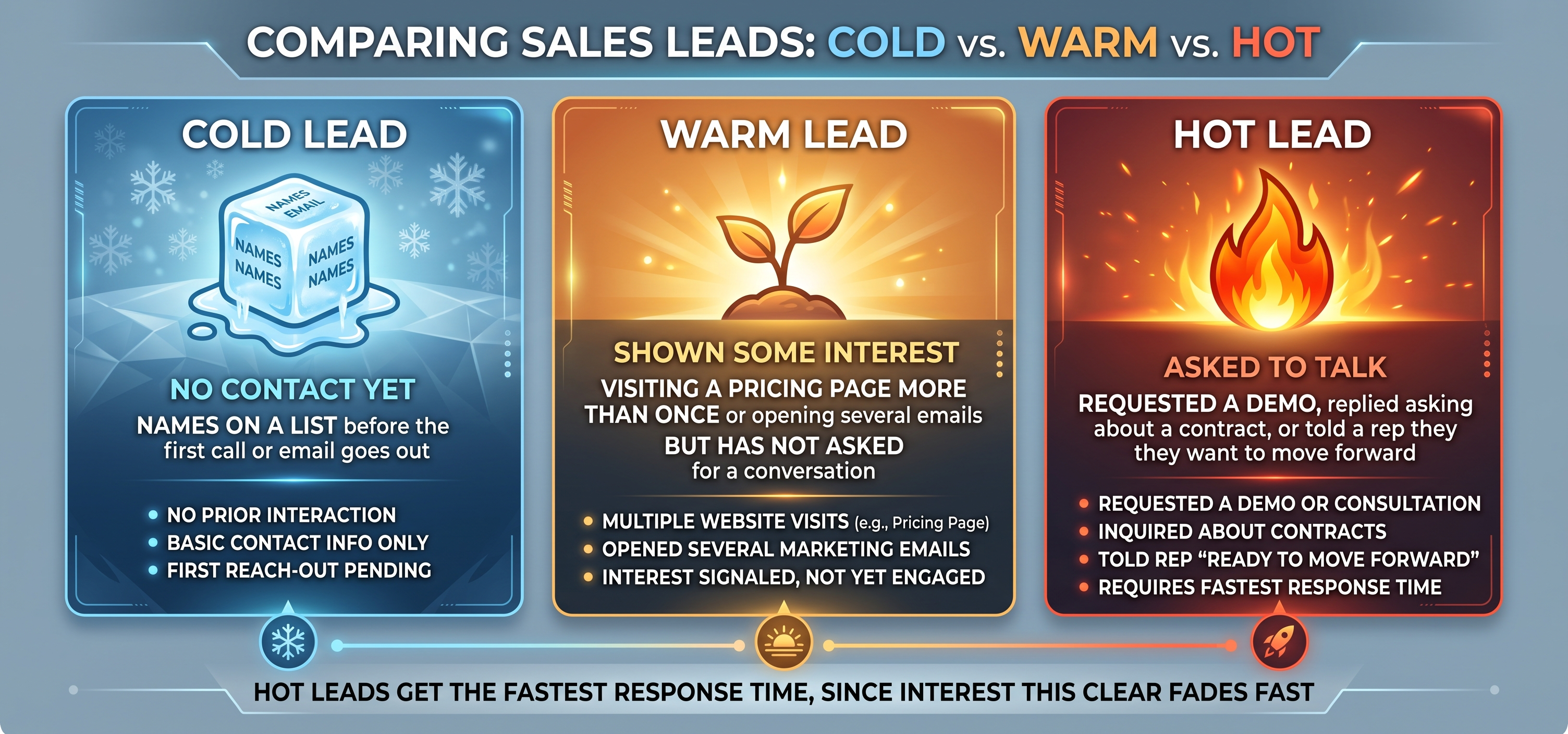
A cold lead has had no contact with your business yet. Cold leads are the names on a list before the first call or email goes out.
What is a warm lead in sales?
A warm lead has shown some interest already, such as visiting a pricing page more than once or opening several emails, but has not asked for a conversation.
What is a hot lead in sales?
A hot lead has asked to talk. They requested a demo, replied asking about a contract, or told a rep they want to move forward. Hot leads get the fastest response time on most sales teams, since interest this clear fades fast.
Done when: you can sort a batch of leads by temperature in under a minute using only the actions each one has taken.
Where sales leads come from
What happens: Leads arrive through a mix of channels, and where a lead came from should stay attached to its record for as long as that record exists.
Inbound sources include gated guides, webinar signups, free tool signups, and referrals. A sales lead generator, whether that is a form on a website or a paid ad campaign, exists to produce this inbound interest on its own.
Outbound sources come from a seller reaching a suspect first, which is prospecting rather than lead generation, though a reply to that outreach does turn the contact into a lead.
Most CRMs give leads a permanent home. In Salesforce, for example, each one exists as a Lead record with fields for source, status, and owner, separate from the Contact and Opportunity records it may become later.
Social platforms have become a real source too. Salesforce's own guide notes that 46% of B2B buyers now start their purchase research on social media before a seller ever hears from them.
Marketing and sales usually split ownership at this stage: marketing owns lead generation and the first qualification pass, sales owns the conversation once a lead is accepted.
Done when: every incoming contact has a recorded source, not just a name and an email address.
A four question framework for qualifying a lead
What happens: Skip the guesswork with four questions. Ask them about every lead before deciding whether to route it to sales.
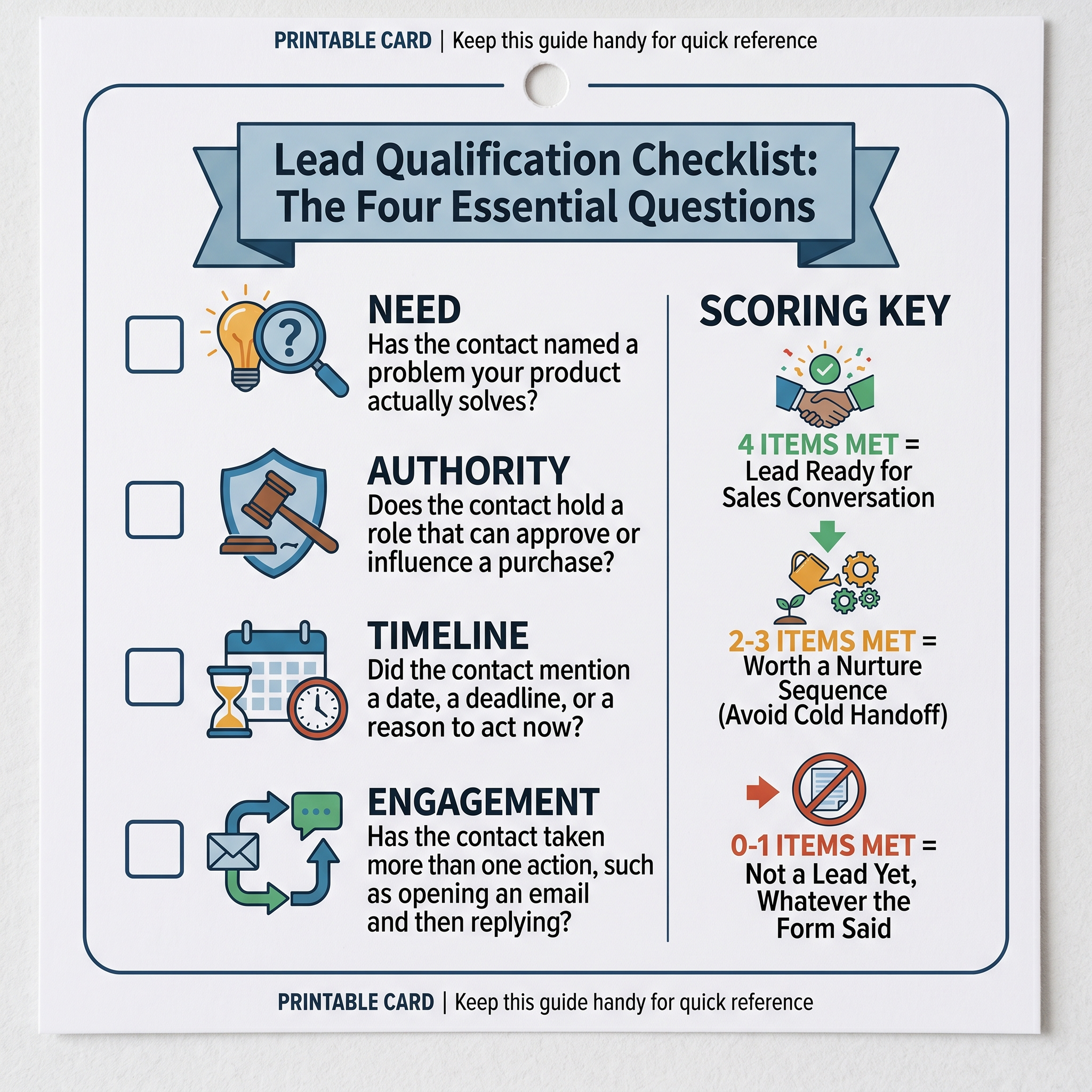
Need: has the contact named a problem your product actually solves.
Authority: does the contact hold a role that can approve or influence a purchase.
Timeline: did the contact mention a date, a deadline, or a reason to act now.
Engagement: has the contact taken more than one action, such as opening an email and then replying.
A lead that clears all four questions is ready for a sales conversation. A lead that clears two or three is worth a nurture sequence instead of a cold handoff. A lead that clears zero or one is not a lead yet, whatever the form said.
I ran this exact framework against 20 sample inbound signups, mixing clear qualification patterns like a completed demo request against noise like an accidental form fill. Five cleared all four questions, four cleared two or three, and eleven cleared one or none. Just over half the batch was not sales ready despite having a name and an email address on file, which is the gap a shared definition is supposed to close. ICP meaning in sales covers how to define the fit half of that need question before a single lead comes in.
Done when: every lead in your pipeline has a score against these four questions, and marketing and sales agree on where the cutoff for a handoff sits.
What happens after a lead is qualified
Once a lead clears the four question check, it usually moves to an SDR or an account executive for the first real conversation. What is an SDR covers what that role does day to day and how teams measure it. Before that first outreach attempt, most teams verify the contact details on file are still current. Before that first outreach attempt, most teams verify the contact details on file are still current, since a bounced email at this stage wastes the handoff. From there, the lead becomes an opportunity once the rep confirms the deal is real and has a working timeline.
Common mistakes when defining or qualifying a lead
Counting every form fill as a lead. One founder posted on Indie Hackers about running 1,300 free signups through a funnel and landing only 52 real conversions, a pattern other members in the thread agreed was normal rather than unusual for gated content. The fix: require at least one qualifying action, not just a completed form, before a contact counts as a lead.
Skipping the SAL conversation. When marketing sends MQLs straight to sales with no shared agreement on what counts as ready, reps stop trusting the leads they receive and start requalifying every one from scratch. Set an explicit shared definition for SAL the same way this article does for MQL and SQL.
Scoring every lead the same regardless of fit. A lead from a company that will never afford your product does not deserve the same handling as one from your ideal customer profile, whatever its behavior score says. What is lead scoring covers how to weight fit against behavior instead of treating them as one number.
Never revisit a lead marked not ready. A cold lead today can turn warm in three months once a budget cycle resets, so a disqualified lead needs a return date on the calendar, not a permanent close.
FAQs
What is the simplest definition of a sales lead?
A sales lead is a person or company that has shown real interest in your product, usually by giving contact information or taking an action like requesting a demo or replying to an email.
What is the difference between a sales qualified lead and a sales accepted lead?
A sales qualified lead, or SQL, has been checked against need, authority, and timing and is ready for a sales conversation. A sales accepted lead, or SAL, is the step before that: an MQL that marketing and sales have both agreed is worth pursuing.
What is a lead in sales and marketing, and who owns it?
A lead usually starts as marketing's responsibility during generation and the first qualification pass, then moves to sales once it clears an agreed threshold, most often at the SAL or SQL stage.
Is a prospect the same as a sales lead?
No. A prospect is a contact a seller identified as a fit before any interest was shown, while a lead has already taken an action that signals interest on its own.
What is a qualified lead in sales?
A qualified lead is any lead that has been checked against a set of criteria, usually need, authority, and timing, and confirmed as a realistic fit for a sales conversation rather than just a name on a list.
Keeping the definition useful day to day
A lead stops being a mystery once a team agrees on what counts as one. Write the four question check into your CRM's lead record, agree with sales on where SAL sits, and put disqualified leads on a schedule to revisit instead of leaving them to sit in a list. The definition only earns its keep once both teams are using the same one.
Stage | Who confirms it | What gets checked | Typical next step |
|---|---|---|---|
MQL | Marketing | Content engagement, basic fit | Nurture or move to SAL review |
SAL | Marketing and sales together | Whether the MQL is worth a formal handoff | Assigned to a rep or SDR |
SQL | Sales | Need, authority, timing, confirmed budget | First sales conversation |