

An SDR, or sales development representative, finds and qualifies leads, then books meetings for an account executive to close. SDRs run outbound calls, emails, and social outreach, log everything in a CRM, and get measured on activity and meetings set rather than closed revenue. Some teams now pair a human SDR with an AI SDR tool for the repetitive parts of the job.
Who this is for
This explainer is for three kinds of readers: someone weighing an SDR job offer, a founder deciding whether to hire one, and anyone who keeps seeing the term in a job posting and wants a plain answer.
It is not a cold calling script, a hiring guide with interview questions, or a deep breakdown of AI SDR software. Those are separate topics, and this piece links out to fuller AI SDR coverage once that guide is live. What you need here: five minutes, and if you are evaluating a job posting, the listing itself open in another tab.
What an SDR actually is
What happens: an SDR, short for sales development representative, is the person on a sales team responsible for the first stage of the pipeline: finding potential buyers, checking whether they fit the product, and getting a qualified conversation on an account executive's calendar. The title also shows up as sales development agent, outbound rep, or prospecting rep, and the role sits inside what is broadly called tech sales or B2B sales, most often at software companies.
An SDR is not the person who closes the deal. That job belongs to the account executive, or AE, who takes the meeting the SDR booked and runs the rest of the sales process: discovery call, demo, proposal, contract. The SDR's job ends, and the AE's job starts, right around the first qualified meeting. A close cousin of the SDR title is the BDR, or business development representative; most companies use the two terms interchangeably, though some split SDR for inbound lead qualification and BDR for outbound prospecting.
Two more terms worth knowing because they show up constantly in SDR job postings: an MQL is a marketing qualified lead, someone marketing has flagged as a decent fit based on their behavior (downloaded a guide, attended a webinar). An SQL is a sales qualified lead, someone an SDR has actually talked to and confirmed has a real need, budget, and timeline. Turning MQLs into SQLs is, in one sentence, the job.
Done when: you can explain, in your own words, the difference between what an SDR does and what an AE does, and you know what MQL and SQL stand for.
AE, MQL, and SQL are only a few of the other terms that come up around the SDR role; a fuller breakdown of b2b sales terms that come up in real deals covers the rest.
What a day as an SDR looks like
What happens: the daily rhythm of an SDR job centers on volume. Based on Apollo.io's published SDR benchmarks, a typical SDR is expected to complete 50 to 80 outreach activities a day across calls, emails, and social touches, working from a cadence, which is just a scheduled sequence of those touches spaced over one to two weeks.
Connect rates on cold calls run 2 to 5 percent, and of the people an SDR actually connects with, 20 to 30 percent turn into a booked, qualified meeting. Most SDR roles carry a monthly target of 15 to 25 qualified meetings rather than a revenue quota.
That volume runs through a small stack of tools rather than a single app. A typical SDR tech stack includes a CRM to log every touch, a dialer or sales engagement platform to run the cadence, and a prospecting or data tool that returns a verified email address and contact details for a given name and company, so an SDR is not guessing at an inbox.
As Collin Stewart, cofounder of Predictable Revenue, put it in an Apollo.io interview about consolidating an SDR stack: "We reduced the complexity of three tools into one."
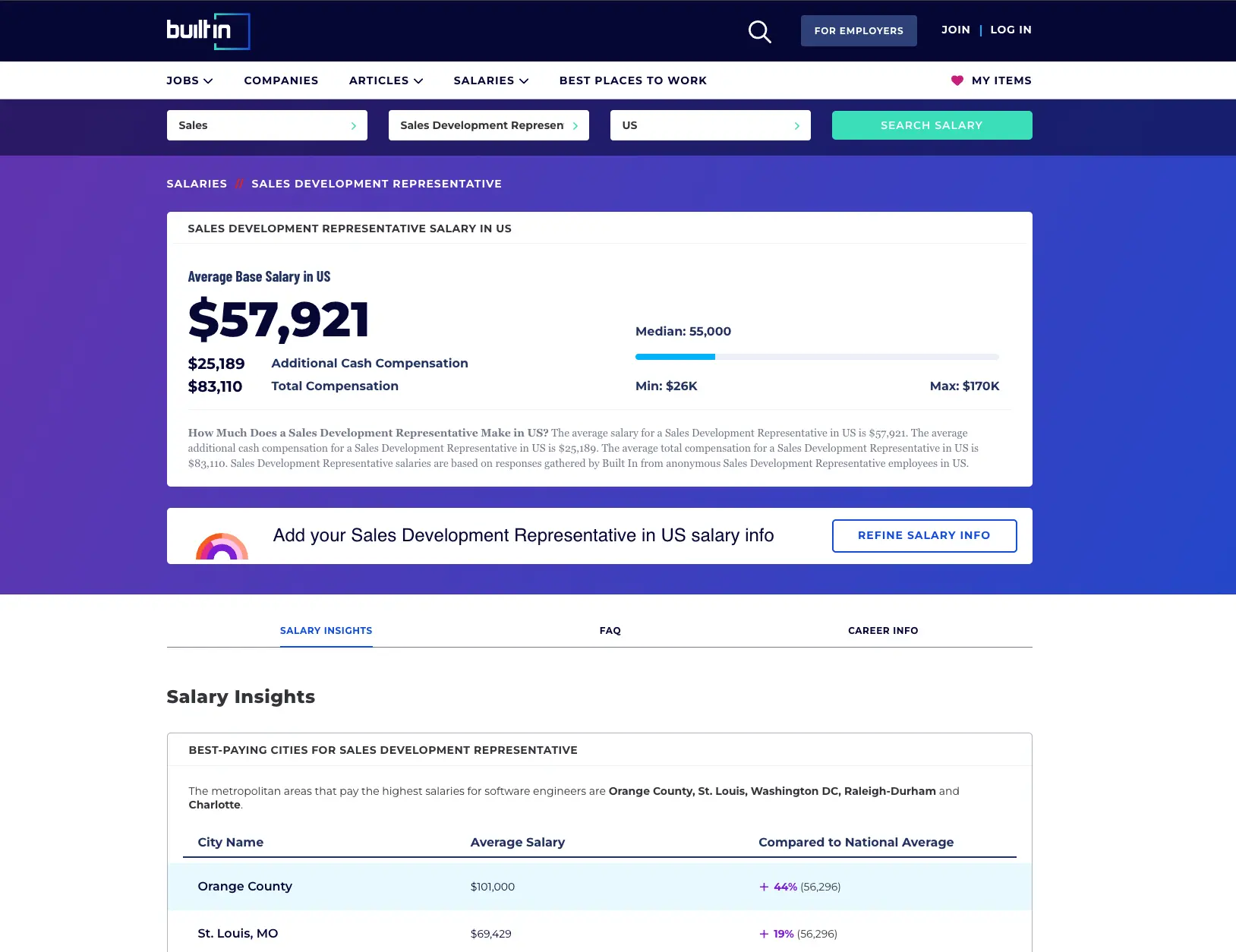
Pay for the role tracks that volume expectation. Coursera's May 2026 salary data puts the average SDR base at 62,000 dollars, rising to roughly 72,000 dollars for reps with 15 plus years in the role. I ran my own live count on LinkedIn's job board today, August 12, 2026, in about four minutes: more than 39,000 active postings for sales development representative in the United States, with 2,079 posted as new. SDR is one of the highest volume entry points into B2B sales hiring right now.
Done when: you can name the three or four tools a typical SDR touches daily and roughly what "good" activity numbers look like.
How an SDR's work gets measured
What happens: because an SDR does not close revenue directly, managers track leading indicators instead of a sales number. The core metrics, again per Apollo.io's benchmarks, are activity volume (the 50 to 80 daily touches), connect rate, meeting set rate, and meetings held that actually turn into a real sales opportunity rather than a no show or a bad fit.
A good SDR manager reviews these numbers with each rep in a regular one on one, usually weekly, looking for where the funnel is leaking: too few dials, low connect rates, or meetings that get set but do not qualify.
An SDR manager is the person who owns this whole layer: hiring and coaching a team of SDRs, setting quota and territory, and reporting pipeline created back up to sales leadership. On a small team the SDR manager may report to a VP of sales; on a larger team, to a director of sales development.
Done when: you can list the four numbers a manager checks and explain why "meetings booked" alone is not the full picture.
Where AI SDR tools fit into this
What it means: an AI SDR is software that automates the repetitive edges of the job, research, first touch outreach, and follow up sequencing, so a human SDR spends more time on the calls and replies that need judgment. It does not replace the qualifying conversation itself; it handles the volume work that leads up to it.
That distinction, automation for volume and a person for judgment, is the short answer to what is an AI SDR and how it works. For the fuller breakdown, including a framework for evaluating platforms, see what an AI SDR is.
The SDR job posting checklist
Every SDR listing claims to be a growth opportunity. Some are. Here is a copyable checklist to size up a real posting, whether you are applying for the job or writing one.
Read the posting for these details before you apply or post it:
A named quota, stated as a number of qualified meetings per month, not a vague phrase like "hit targets." A clear reporting line: who the SDR reports to, and what team the role sits on. A stated ramp or training period, ideally with a number of weeks attached, not just the word "onboarding."
A defined path out of the role, usually to AE, after a stated tenure such as 12 to 18 months. The tools listed by name: CRM, dialer, and any prospecting or data tool the team already uses. Whether the role is full cycle (some qualifying and some closing) or strictly meeting setting, since the two pay and work differently.
A base plus commission structure spelled out in dollars, not just "competitive."
If a posting is missing three or more of these, it is worth asking about them directly in the first interview rather than assuming.
What happens after an SDR books the meeting
In practice: once an SDR gets a prospect to agree to a call, the handoff to the AE usually happens through the CRM: notes on what the prospect said, why they qualify, and what they care about, attached to the meeting record.
The AE walks into that first call already knowing the prospect's situation instead of starting from zero. On more technical or complex deals, a sales engineer often joins that first call too, to handle in depth product questions the AE alone would not cover.
From the prospect's side, the experience should feel like one continuous conversation, not a repeat of the same questions with a different person.
Done when: you can describe what information should move from SDR to AE at handoff, and why a clean handoff matters to the prospect.
Common mistakes people make about the SDR role
Treating SDR work like telemarketing. An SDR qualifies fit and interest before a meeting happens; a telemarketer usually pushes straight for a sale on the call itself. Fix: judge SDR performance on qualified meetings and pipeline quality, not raw call volume alone.
Expecting an SDR to close deals. That is the AE's job. Fix: if a posting or a manager expects an SDR to also negotiate pricing and sign contracts, the role is a hybrid closer position and should be paid and titled that way.
Assuming AI SDR tools replace the role outright. The tools take over research and first touch volume, not the qualifying conversation. Fix: pair the tool with a person instead of cutting headcount to zero and expecting the same pipeline from software alone.
Ignoring the ramp period when comparing offers. A 30 day ramp and a 90 day ramp are not the same job at identical pay. Fix: ask what the ramp actually includes before comparing two offers on salary alone.
Worth reading if you are weighing the next step: in a thread on the Sales community on levels.fyi, a poster with about a year of SDR experience asked whether they were ready to move into a midmarket AE role and what to expect on pay.
A reply laid out realistic numbers: first year AE compensation in the 120,000 to 140,000 dollar range depending on location and company size, and a promotion timeline closer to 1.5 to 2 years rather than the 6 to 12 months some postings imply.
Frequently asked questions
What is an SDR training program?
An SDR training program is the structured onboarding a new rep goes through before working a full quota, usually covering product knowledge, the CRM and dialer, call and email scripts, and objection handling. Strong programs run 2 to 6 weeks and include live call shadowing before a rep works leads alone.
What is an AI SDR?
An AI SDR is software that automates prospect research, first touch outreach, and follow up sequencing so a human SDR spends less time on repetitive volume work. It works alongside a human SDR rather than replacing the qualifying conversation itself.
What is an SDR manager?
An SDR manager hires, trains, and coaches a team of SDRs, sets their quota and territory, and reports pipeline created up to sales leadership. They are the person who reviews activity and meeting set numbers with each rep, usually weekly.
What is an AE in tech sales, and how is it different from an SDR?
An AE, or account executive, is the person who takes the meeting an SDR books and runs the rest of the sales process through to a signed deal. An SDR qualifies and books; an AE demos, negotiates, and closes.
Is an SDR job entry level or a dead end?
Most SDR roles are built as entry level positions in B2B sales with a defined path to AE, not a dead end. The risk is not the title; it is joining a team with no stated ramp period, no quota transparency, and no history of actually promoting SDRs internally.
Where this leaves you
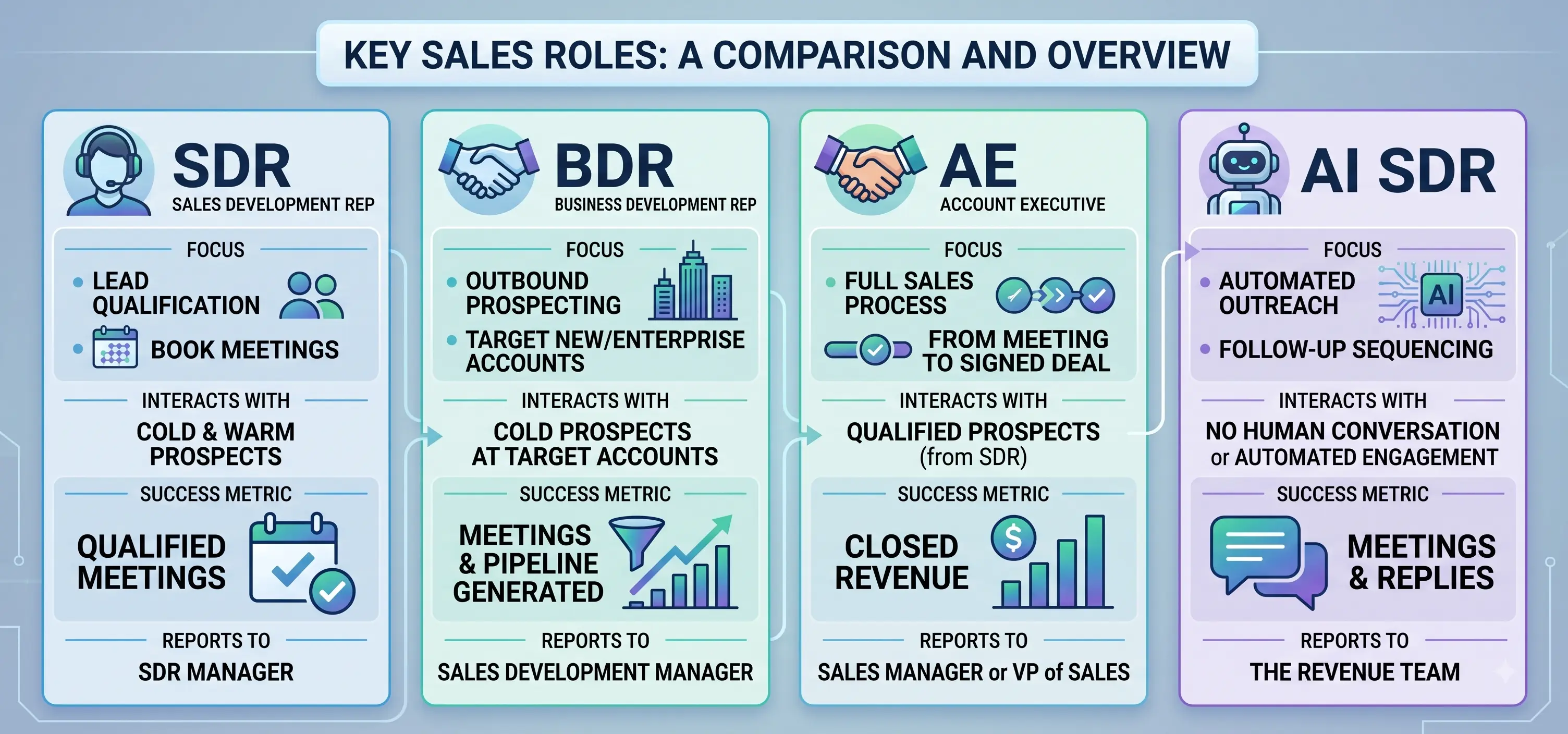
An SDR is the person who turns a name on a list into a qualified conversation, measured on activity and meetings rather than closed revenue, and increasingly working alongside AI SDR tools rather than against them. Whether you are sizing up a job offer or building a team, the checklist above and the comparison table below cover the details that a title alone will not tell you.
Role | Primary job | Who they talk to | Typical metric | Usually reports to |
|---|---|---|---|---|
SDR | Qualify inbound and outbound leads, book meetings | Cold and warm prospects | Qualified meetings per month | SDR manager |
BDR | Outbound prospecting into new accounts, often larger or enterprise | Cold prospects, often at target accounts | Meetings or pipeline generated | SDR or sales development manager |
AE | Run the sales process from first meeting to signed deal | Qualified prospects handed off by an SDR | Closed revenue against a sales quota | Sales manager or VP of sales |
AI SDR | Automate research, first touch outreach, and follow up sequencing | No direct human conversation | Meetings or replies generated | The revenue team that owns it |