Hot call vs cold call: What separates them and when to use each
A guide to hot call vs cold call in B2B sales, with a comparison table, a legal check, and a checklist for sorting a mixed call list before you dial.
 Michael Doyle14 min read
A cold call reaches someone with no prior contact. A warm call reaches someone with a light prior touch, like a form fill or a shared connection.
A hot call reaches someone who already signaled buying intent, such as booking a demo or replying to an email. The difference is what the person already knows before the phone rings.
What this guide covers
This guide is about lead temperature: cold, warm, and hot calls in B2B sales and outbound prospecting. It is written for new sales development representatives sorting their first call list, for reps who inherited a mixed pipeline from someone else, and for founders making their own outbound calls before they hire a team.
A quick note on terms, since the phrase gets reused across industries: this is not about warm transfer versus cold transfer, which describes how a call center agent hands a caller to a colleague, and it is not the emergency dispatch or HVAC service use of hot call, which means an active, urgent job rather than a lead temperature.
If you landed here from one of those contexts, this article will not answer your question. It also does not cover discovery calls, demo calls, or renewal calls in detail, which are funnel stage names rather than temperature labels, though the last of those gets a brief mention below.
Everything below assumes you already understand what counts as outbound activity in the first place. If that part is still fuzzy, a plain definition of outbound sales covers the four stage process this guide builds on.
What is a cold call
What happens: you dial a number with no signal that the person wants to hear from you. They do not know your name, your company, or why you are calling. The first ten seconds of the call carry the full weight of earning attention, since nothing has been earned yet.
Done when: the prospect either agrees to a next step, such as a short follow up call, or tells you clearly that they are not interested. Both outcomes count as a completed cold call. A call that ends in silence or a hang up before you finish your opener does not.
Cold calls face real headwinds right now. A 2026 Gartner survey of 646 B2B buyers found that 67 percent of B2B buyers now prefer a rep free purchase experience, which is the backdrop any cold caller is working against before they even dial.
What is a warm call
What happens: you dial a number that has some prior contact with your company. Maybe they filled out a form, downloaded something, or a colleague of theirs mentioned your product. You are not a stranger, but you also are not someone they are expecting to hear from today.
Done when: the prospect recognizes the connection you reference and either continues the conversation or asks a clarifying question about who you are. If they show no memory of the prior touch at all, treat the rest of that call like a cold call.
What is a hot call
Some teams call this hot calling instead of a hot call, but the meaning is the same either way.
What happens: you dial a number that has taken a specific, recent action that signals intent, such as requesting a demo, replying to an email with a question, or visiting a pricing page more than once. The prospect is often expecting the call, or close to it.
Done when: the call moves toward a concrete next step, a proposal, a second meeting with a decision maker, or a stated timeline. A hot call that ends without any of these usually means the signal that made it hot was misread.
Hot call vs cold call vs warm call, side by side
Feature | Cold call | Warm call | Hot call |
|---|---|---|---|
Prior contact | None | Light touch, such as a form fill or mutual connection | Direct signal, such as a demo request or repeat pricing page visit |
Typical opener | Introduction and reason for the call | A reference to the prior touch | A reference to their specific action |
Rejection rate | Highest | Moderate | Lowest |
Best used for | New market entry, cold lists | Leads warmed by marketing activity | Leads who effectively asked to be contacted |
Look at the prior contact row above before you decide which script to open with. It is the single column that determines everything else in the table: your opener, your tone, and how much explaining you owe the person before you ask for their time. It also tends to move the connect rate, the share of dials that end in an actual conversation rather than voicemail or a hang up, in the same direction as the rejection rate moves.
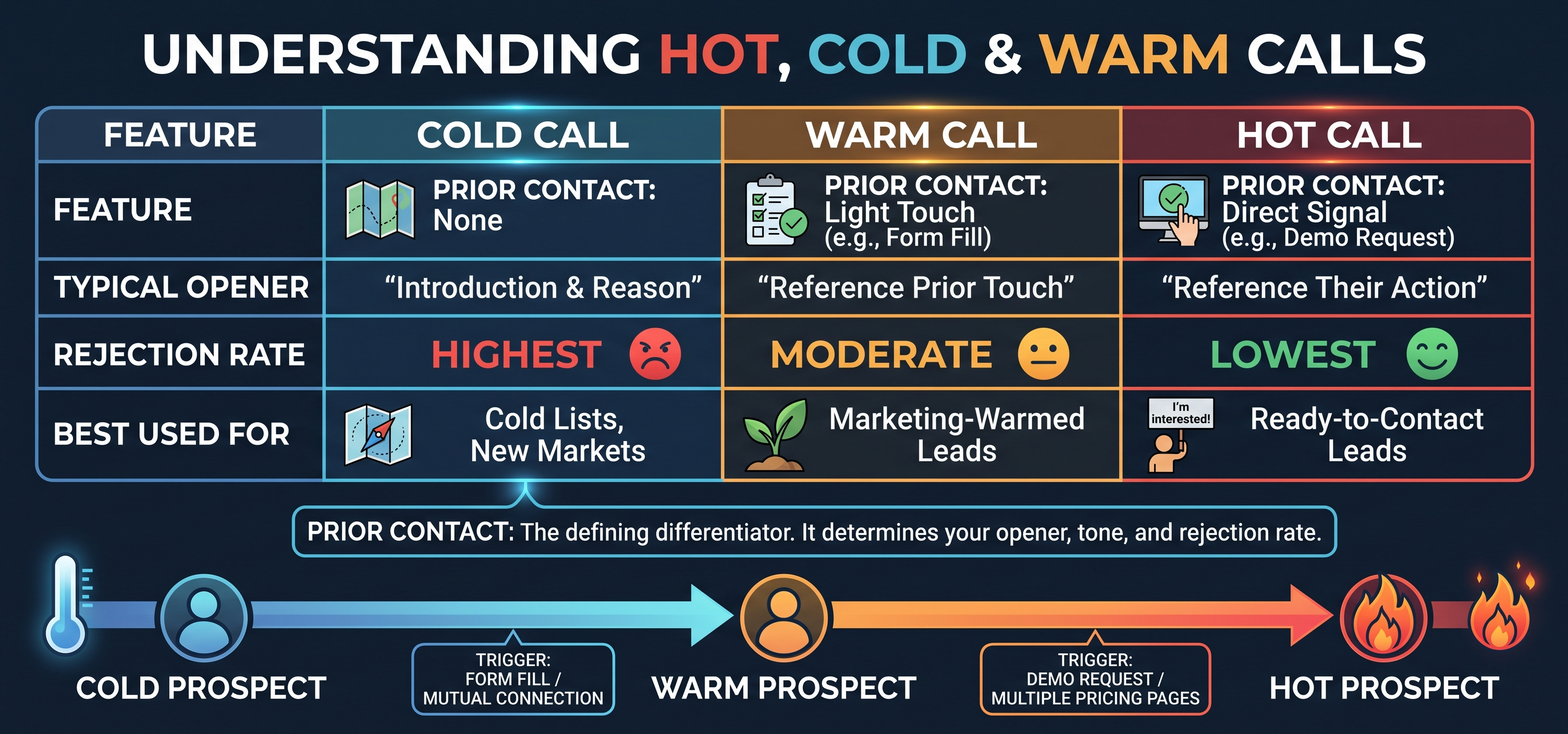
That progression is rarely automatic. A lead does not warm up on its own. Something specific has to happen before a warm lead turns into a hot call candidate.
Cold call, warm call, and hot call are only three of the terms tied to how a contact gets prioritized; a fuller breakdown of b2b sales terms that come up in real deals covers the rest.
What actually turns a warm lead into a hot call
What happens: most CRM systems separate a marketing qualified lead, or MQL, someone who showed general interest, from a sales qualified lead, or SQL, someone judged ready for a sales conversation.
That handoff is usually governed by a lead score, a running point total built from actions like email opens, page visits, and content downloads. When the score crosses a set threshold, the lead moves from marketing qualified to sales qualified, and that is the moment a warm call becomes a hot call candidate.
Done when: the lead has both a qualifying score and a specific, timestamped action tied to it. A high score alone is not enough. A prospect who opened ten emails but never clicked anything is still warm, not hot, because nothing they did points at an actual next step.
A useful gut check before you dial: can you name the one action that moved this person from your list of warm leads into today's call block? If you cannot name it, you are about to make a warm call while believing you are making a hot one, and your opener will be wrong for the person on the other end.
What the person on the other end notices
A cold call recipient hears an unfamiliar name and has to work out, in real time, why a stranger is calling. Their guard is up before you finish your first sentence, and any reference you make to prior contact that did not happen breaks trust immediately.
A warm call recipient recognizes the connection you mention, even loosely, and that recognition buys you a longer runway before they decide whether to stay on the line. They are listening for you to confirm what they already half remember.
A hot call recipient is often the one who created the signal in the first place, by booking the demo or asking the question. They tend to treat the call as a follow through on something they started, not an interruption, which changes what they expect from the first thirty seconds. They want you to already know why you are calling.
How to sort a mixed call list before you start dialing
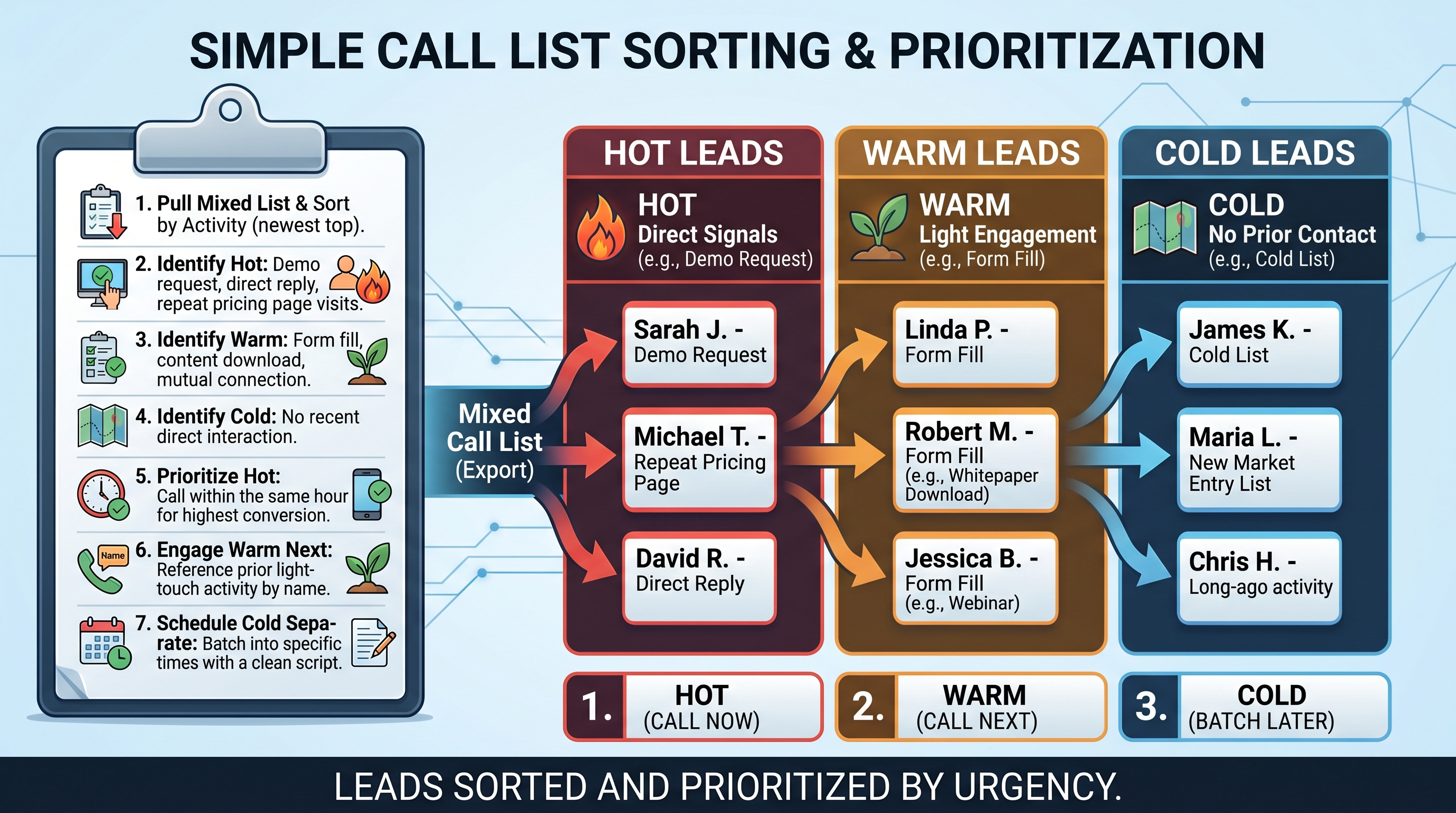
What happens: most call lists are not purely cold, warm, or hot. They are a mix, often exported from a CRM with no sort order applied. Working through them in the order they were exported wastes your best calling hours on leads that need the least urgency.
Done when: your list is split into three blocks, hot leads called first while the signal is fresh, warm leads called next, and cold leads called last or batched into a separate block entirely. A list that is still one undifferentiated column is not done.
Use this checklist to sort a list before your first call of the day.
Call list triage checklist

1. Pull the list and sort by last activity date, newest first
2. Flag any lead with a demo request, reply, or repeat pricing visit as hot
3. Flag any lead with a form fill, download, or mutual connection as warm
4. Everything left over is cold
5. Call the hot block first, ideally within the same hour the signal came in
6. Call the warm block next, referencing the specific prior touch by name
7. Batch the cold block into a separate time slot with a fresh script
A list sorted this way turns a flat export into three separate calling sessions, each with its own script and its own tone, instead of one long session where every call sounds the same.
The urgency behind sorting hot leads first is not just about the caller's convenience. BNI's 2023 survey of over ten thousand members found that referrals close 38 percent faster than leads from other sources, which tracks with what happens to warm and hot leads generally: the closer the prior connection, the shorter the path to a decision.
A sales development representative juggling a full call block does not have time to rediscover that pattern lead by lead. That is a large part of what an SDR's day actually involves, and it is exactly why sorting the list first, rather than dialing top to bottom, matters as much as the calls themselves.
What to log after each call ends
What happens: the three call types do not just need different openers, they need different follow up timing. Treating them the same after you hang up is where a lot of the value from a hot call gets lost.
Done when: every call has a disposition logged in the CRM before you move to the next one, with a follow up date attached.
A cold call that did not close usually goes into a longer nurture cadence, with the next touch scheduled five to seven days out. A warm call gets a shorter gap, aiming for a follow up within twenty four to forty eight hours while the reference point is still fresh. A hot call gets same day follow up whenever possible, sometimes a proposal sent within the hour, since the signal that made the call hot can cool off fast if nothing lands in their inbox that day.
This logging step is also where these calls connect back to the broader prospecting process. Sales prospecting runs in four stages, and a call without a logged outcome effectively resets the prospect back to an earlier stage, even if the conversation itself went well.
Is cold calling legal in the US
Business to business cold calling is largely exempt from the National Do Not Call Registry, and the separate Telephone Consumer Protection Act, usually shortened to TCPA, mainly targets autodialed and prerecorded calls rather than a live rep dialing a business line by hand.
The Federal Trade Commission's guidance on the Telemarketing Sales Rule states that most phone calls made to a business to solicit sales from that business fall outside the Do Not Call provisions, which is why B2B sales teams can generally call company lines without checking the registry first.
That exemption has limits worth knowing before you build a list. It applies to genuine business to business solicitation, not to calls that are aimed at a consumer through a work number.
Several states also apply their own call recording consent rules, and some require both parties to agree before a call is recorded, so confirm your state's rule before you turn on a recorder by default. This is general guidance, not legal advice, so check current requirements for your state, and for any state your prospects are based in, before you finalize a calling process.
The four types of calls sales teams actually track
Most comparisons stop at three: cold, warm, and hot. In practice, CRM setups usually track a fourth category too, the account call, meaning a call to an existing customer about renewal, expansion, or a support escalation that a sales rep handles directly. It behaves differently from the other three because the relationship, and often the contract, already exists, so the opener and the goal of the call are both different again.
Sorting your activity into these four buckets, rather than three, makes call reporting more accurate, since a renewal conversation logged as a hot call will skew your hot call conversion numbers without actually being comparable to a first time buyer signal.
Common mistakes that turn a hot call cold
Opening with a cold calling script on a warm or hot lead. A prospect who booked a demo does not want to hear a generic introduction built for a stranger. Reference the specific action that brought them onto your list in the first sentence, not the third, and save objection handling for people who have not already raised their hand.
Waiting a day or more to call a hot lead. Buying intent has a short half life. A demo request called back the next morning often gets a noticeably cooler reception than the same request called back within the hour.
Not logging the outcome before the next call. When a disposition is missing, the next rep who touches that lead repeats the same opener and the same pitch, which reads as careless to a prospect who already had that exact conversation once.
These mistakes show up outside formal sales writing too. One founder on Indie Hackers described giving up on cold calling after four attempts, not because of high rejection, but because the calls felt like an imposition regardless of how the conversation actually went. Commenters on the post pointed at the same fix covered above: starting from a warmer entry point, whether that is an existing connection, a referral, or a prior online interaction, rather than a flat, unsolicited dial.
The comment count on that post is a small but real signal: the discomfort described there is common enough that over twenty other people had something to add.
Frequently asked questions
What does hot call mean in sales?
A hot call is a call made to someone who has already shown clear buying intent, such as requesting a demo, replying to an outreach email, or visiting a pricing page more than once. The signal, not just interest in general, is what makes it hot rather than warm.
What is the difference between a warm call and a cold call?
A warm call goes to someone with some prior contact, like a form fill, download, or shared connection. A cold call goes to someone with no prior contact at all. The warm call earns a longer opening window because the person recognizes something about the connection you reference.
How many touches before a lead counts as warm?
There is no fixed number that applies everywhere. Most teams set a lead score threshold built from actions like email opens, content downloads, and page visits, and a lead crosses into warm once it passes that threshold, not after a specific count of touches.
Can a call move from cold to hot in one conversation?
Yes. If a prospect who had no prior contact asks for a demo or a proposal during the call itself, that same conversation has effectively produced a hot signal, even though it started cold. Log it as hot from that point forward for follow up purposes.
Choosing the right call for the lead in front of you
The label matters less than the accuracy behind it. A call sorted correctly gets the right opener, the right urgency, and the right follow up window, and a call sorted wrong wastes the one advantage that lead temperature was supposed to give you. Sort the list first, dial the hot block while the signal is fresh, and log every outcome before the next call starts.