

Sales enablement is the ongoing process of giving reps the content, training, coaching, and technology they need to have better conversations with buyers and close more deals. It is not a single event or a one time onboarding session. Most teams run it through a dedicated sales enablement manager or team, working across sales, marketing, and product.
The global market for sales enablement platforms was valued at 6.0 billion dollars in 2025 and is projected to reach 21.2 billion dollars by 2033, a compound annual growth rate of 17.3 percent, according to Grand View Research's sales enablement platform market report.
That growth reflects how many companies now treat sales enablement as its own function, not a side project for sales operations. This guide covers what sales enablement does, who owns it, how to build and measure a strategy, and how it differs from sales training, sales operations, and revenue enablement.
What this guide covers
This is a plain English explainer, not a product walkthrough. It works whether you are a rep trying to understand what your enablement team does, a manager building a program from scratch, or a leader deciding whether to hire for the role.
What you need before you start: a sense of your sales team's biggest bottleneck (ramp time, win rate, content reps ignore), and access to whoever owns content, training, or CRM data at your company. This guide does not cover specific software setup steps or vendor comparisons, which get their own dedicated pages.
What sales enablement actually does
At its simplest, sales enablement gives sales organizations the information, content, and tools that help sellers sell more effectively, a definition close to how Gartner frames it on its public sales enablement resource. In practice that means four ongoing jobs: building and maintaining a library of sales content, running onboarding and continuous training, coaching reps on live calls and deals, and reporting on which of that work actually moves revenue.
Sellers spend an average of ten hours per week tracking down, comparing, or revisiting content to send buyers, according to enablement software vendor Seismic. That single number explains why most enablement programs exist in the first place. Reps do not need more content. They need less time spent finding the right piece of it.
Why sales enablement matters
Without it, reps improvise. Every new hire builds their own pitch and their own sense of what content works, and most of that guesswork is effort a documented process would have solved once for the whole team.
A working enablement function also gives leadership a place to look when a deal stalls: was it the rep, the content, or the process. That diagnostic value, more than any single content library, is what separates a real enablement function from a shared folder of old slide decks.
What is a sales enablement manager?
A sales enablement manager is the person responsible for building and running the enablement program day to day. Common tasks for a sales enablement specialist include auditing existing sales content, running onboarding for new reps, coordinating with product marketing on new release messaging, coaching reps on call recordings, and reporting enablement metrics to sales leadership.
Without a dedicated manager, these tasks usually fall to sales operations and the head of sales, which is why enablement work often gets deprioritized when the quarter gets busy.
Build a sales enablement strategy
A sales enablement strategy is the plan that connects your enablement work to a specific, measurable outcome instead of a general goal like better selling. Four stages cover most of what a working strategy needs.
Stage 1: Pick one measurable goal.
What happens: Choose a single metric that enablement should move, such as ramp time for new reps, win rate on forecasted deals, or average deal size. Resist the urge to target all three in the first quarter. Done when: You have one goal, one number, and one deadline written down.
Stage 2: Name the behavior that needs to change.
What happens: Look at your best performing reps and identify what they do differently in calls, follow up, or objection handling that ties to the goal. Done when: You can describe the target behavior in one sentence a new hire would understand.
Stage 3: Build the content and training around that behavior.
What happens: Create or update the specific assets (a call guide, an objection handling doc, a short training module) that teach and reinforce the behavior, rather than refreshing your entire content library at once. Done when: The new material exists in the tool reps already use daily, not a separate portal they have to remember to check.
Stage 4: Review and adjust every quarter.
What happens: Check whether the target metric moved, ask reps what they actually used, and cut anything nobody touched. Done when: You have a short, current answer to "did it work" and a revised goal for the next quarter.
What are the elements of a sales enablement strategy?
A complete strategy usually documents six things: the goal and metric, the target audience (which reps or segments), the content and training assets involved, the tools those assets live in, who owns updates, and the review cadence. Missing any one of these is the most common reason a strategy exists on paper but never changes how reps actually sell.
The one page sales enablement plan
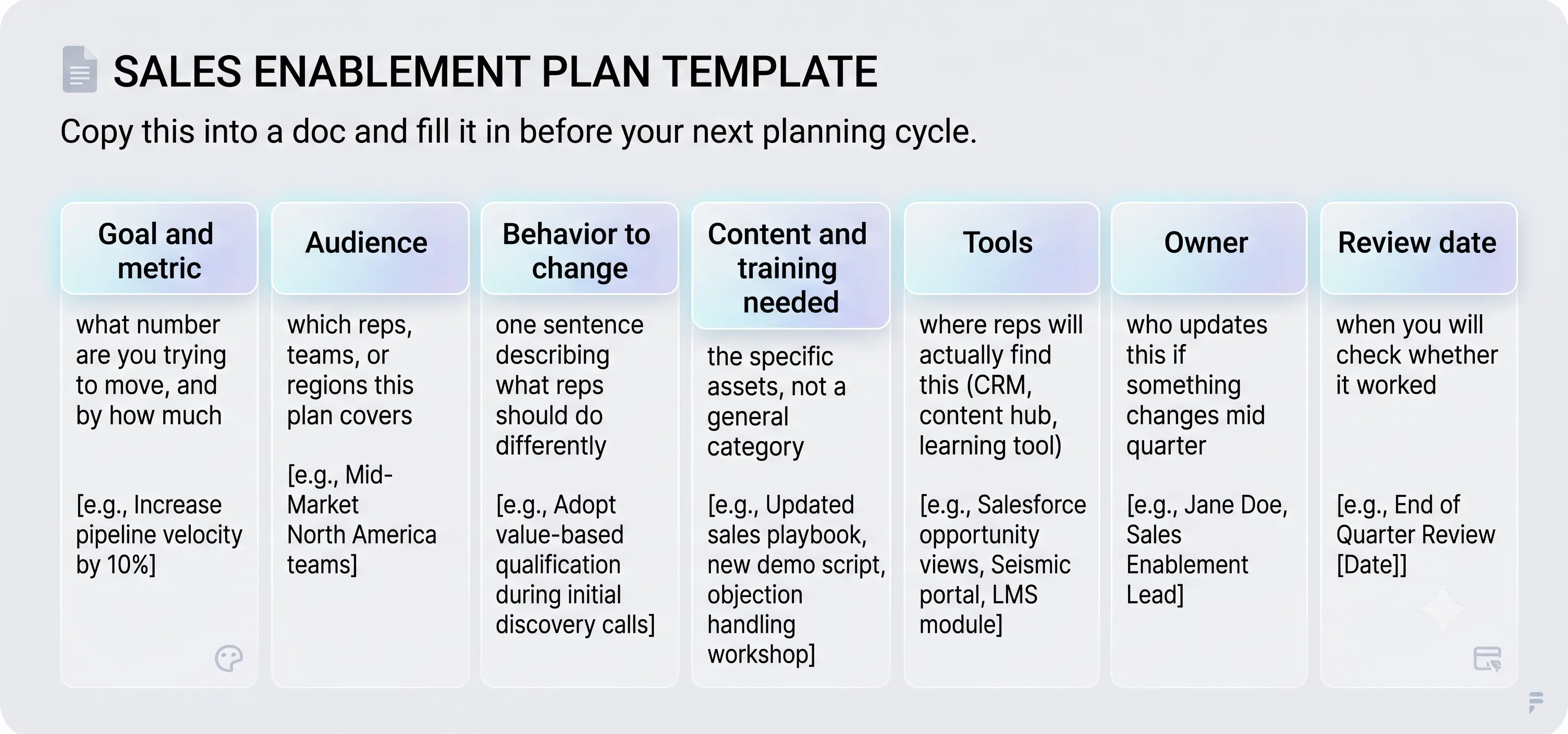
Copy this into a doc and fill it in before your next planning cycle.
Goal and metric: what number are you trying to move, and by how much
Audience: which reps, teams, or regions this plan covers
Behavior to change: one sentence describing what reps should do differently
Content and training needed: the specific assets, not a general category
Tools: where reps will actually find this (CRM, content hub, learning tool)
Owner: who updates this if something changes mid quarter
Review date: when you will check whether it worked
Building the first version of this plan for a single product launch took hours spent drafting the first plan. Getting reps to actually open it without a reminder took most of a full quarter, not a week, which matched what one r/b2b_sales thread on defining sales enablement described about slow adoption.
Sales enablement tools and technology
What is sales enablement software?
Reps and enablement teams generally pull from several categories rather than one: a CRM for pipeline data, a content hub for collateral, a call recording and coaching tool, a learning tool for training, and increasingly a prospect data and enrichment tool such as leaderr.io to keep outreach lists current. Sales enablement content, the case studies, one pagers, and call guides reps send to buyers, still needs a home in one of these systems or it goes unused, echoing the Seismic finding above.
Reps and enablement teams generally pull from several categories rather than one: a CRM for pipeline data, a content hub for collateral, a call recording and coaching tool, a learning tool for training, and increasingly a prospecting or contact data tool such as leaderr.io to keep outreach lists current. Sales enablement content, the case studies, one pagers, and call guides reps send to buyers, still needs a home in one of these systems or it goes unused, echoing the Seismic finding above.
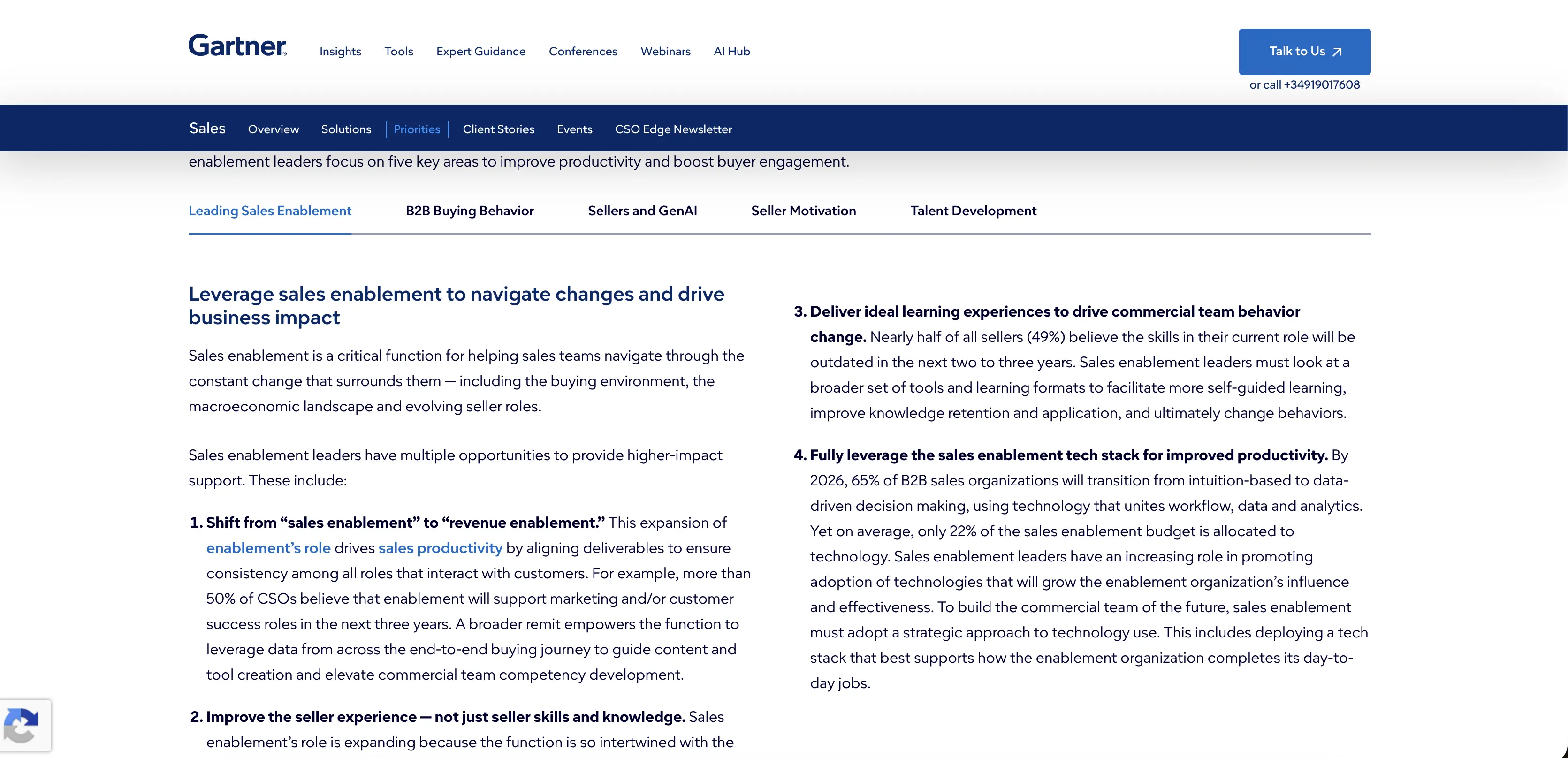
Artificial intelligence is changing this stack quickly. AI sales enablement tools now draft call summaries, suggest next best content mid deal, and flag coaching moments automatically instead of waiting for a manager to review a recording. Sales enablement automation, the narrower term for rule based workflows like auto assigning onboarding tasks or flagging a stalled deal for review, is a related but smaller piece of the same shift. Neither replaces the strategy work above. Both just make the plan easier to run at scale.
How to measure sales enablement
Stage 1: Set a baseline.
What happens: Before changing anything, record your current ramp time, win rate, average deal size, and sales cycle length. If your team also scores leads, pull that data too since a documented lead scoring process often reveals whether enablement is reaching the right reps at the right stage. Done when: You have four numbers written down with the date you measured them.
Stage 2: Track the metric tied to your strategy.
What happens: Pull the specific number from Stage 1 of your strategy (see the plan above) every two to four weeks rather than waiting for quarter end. Done when: You have at least three data points to see a trend, not just a single snapshot.
Stage 3: Connect the number to what changed.
What happens: When the metric moves, check it against what training, content, or coaching shipped that period so you can tell what actually caused the change. Done when: You can say, in one sentence, which specific enablement work is linked to the result.
Myth versus reality
The myth: enablement is a support function that exists to make content and stay out of the way. One blunt line from a Reddit thread on r/techsales put it as "those who can't do, teach, and those who can't teach do sales enablement." The reality is closer to the opposite. Enablement that only produces content without tying it to a measured behavior change is exactly the version that earns that reputation. Enablement tied to a specific metric tends to survive budget cuts that hit the content only version first.
Sales enablement vs sales training vs sales operations vs revenue enablement
Function | What it owns | Timing | Typical owner |
|---|---|---|---|
Sales enablement | Content, training, coaching, and the tools that connect them to daily selling | Ongoing, ties to specific revenue goals | Sales enablement manager or team |
Sales training | Teaching specific skills or product knowledge | Usually a one off event or scheduled session | Sales enablement or a dedicated trainer |
Sales operations | Systems, territory design, quota setting, and process | Ongoing, focused on infrastructure not content | Sales operations or RevOps |
Revenue enablement | Aligning sales, marketing, and customer success across the full buying cycle | Ongoing, broader scope than sales alone | Revenue operations or a revenue enablement lead |
Sales training is usually one off, while sales enablement is continuous and includes training as one piece of a larger system. Sales operations manages the infrastructure sellers work inside (quotas, territories, CRM configuration), while sales enablement manages what sellers know and say.
Revenue enablement is the broadest of the four, extending enablement's approach across marketing and customer success instead of sales alone.
Sales training, sales operations, and revenue enablement are three of the other terms that get confused with this one; a fuller breakdown of b2b sales terms that come up in real deals covers the rest.
Common mistakes in sales enablement
Mistake: Publishing content nobody asked for. Fix: Before creating a new asset, ask three reps what they actually needed on their last three calls. Build that first.
Mistake: Measuring activity instead of outcomes. Fix: Track completion of a certification less than you track whether reps who completed it hit their number afterward. Activity metrics feel productive and tell you almost nothing about impact.
Mistake: Running enablement as a single launch instead of a cycle. Fix: Put a review date on every piece of content and training when you create it, not after someone complains it is outdated.
Sales enablement FAQs
What is sales enablement training?
Sales enablement training is the specific, scheduled instruction (a certification, a new hire course, a product launch session) that sits inside a broader sales enablement program. It is one input into enablement, not a synonym for it.
What is sales enablement automation?
Sales enablement automation refers to rule based workflows, like auto assigning onboarding steps or flagging a deal for coaching after a stall, that remove manual admin work from an enablement program without changing its underlying strategy.
Is sales enablement the same as revenue enablement?
No. Sales enablement focuses on equipping the sales team specifically, while revenue enablement applies the same approach across sales, marketing, and customer success to manage the full buying cycle.
What is a sales enablement program?
A sales enablement program is the ongoing, budgeted version of a strategy, meaning the standing team, tools, and review cadence a company commits to rather than a single project with an end date.
What content does sales enablement usually include?
Common sales enablement content includes case studies, product one pagers, objection handling guides, competitive battlecards, and call guides, organized so a rep can find the right piece in under a minute during a live conversation.
Where this leaves you
Sales enablement only earns its keep when it is tied to one measurable goal, reviewed on a set schedule, and built from what reps actually need rather than what is easiest to produce. Start with the one page plan above, pick a single metric, and give it one full quarter before deciding whether it worked.