How to build a sales pipeline that never runs dry
Build a sales pipeline with clear stages, entry and exit rules, and a coverage ratio that keeps deals moving instead of quietly stalling before they close.
 Michael Doyle12 min read
Building a sales pipeline means defining the stages a deal moves through, setting a clear entry and exit rule for each one, filling the top with prospects who match your ideal customer, and tracking the total against a coverage target of three to four times your quota.
Most pipelines fail quietly. They look full on a dashboard while the deals inside them are stalled, unqualified, or months past the date anyone should have closed them.
What you need before you start
Whether you are building a sales pipeline from scratch or fixing one that already exists, four things need to be in place before the first deal enters it. Skip one and the board fills up with noise instead of signal.
A defined ideal customer profile, so "prospect" means something specific rather than anyone who filled out a form
A place to track deals, whether that is a spreadsheet, a free CRM, or a paid one
A list of the stages a deal actually passes through in your sales process, in the order they happen
A quota or revenue target to build coverage against
If you sell into a regulated industry such as insurance or financial services, add a compliance checkpoint as its own stage rather than folding it into an existing one.
If you sell to enterprise accounts, expect more stages and a longer stay in each.
If you are a founder or a first sales hire selling on your own, everything below still applies.
Start with three stages instead of five and add more once you have twenty closed deals to learn from.
Build the stages around how your buyers decide
Sales pipeline stages are the backbone everything else in this guide hangs off, so get these right before touching metrics or tools. A stage should describe what the buyer just did, not what your team wants to do next. "Sent proposal" describes your action.
"Reviewed proposal and asked about price" describes theirs, and it tells the next rep exactly where the conversation stands. Here is what that looks like laid out as a board, five stages wide.
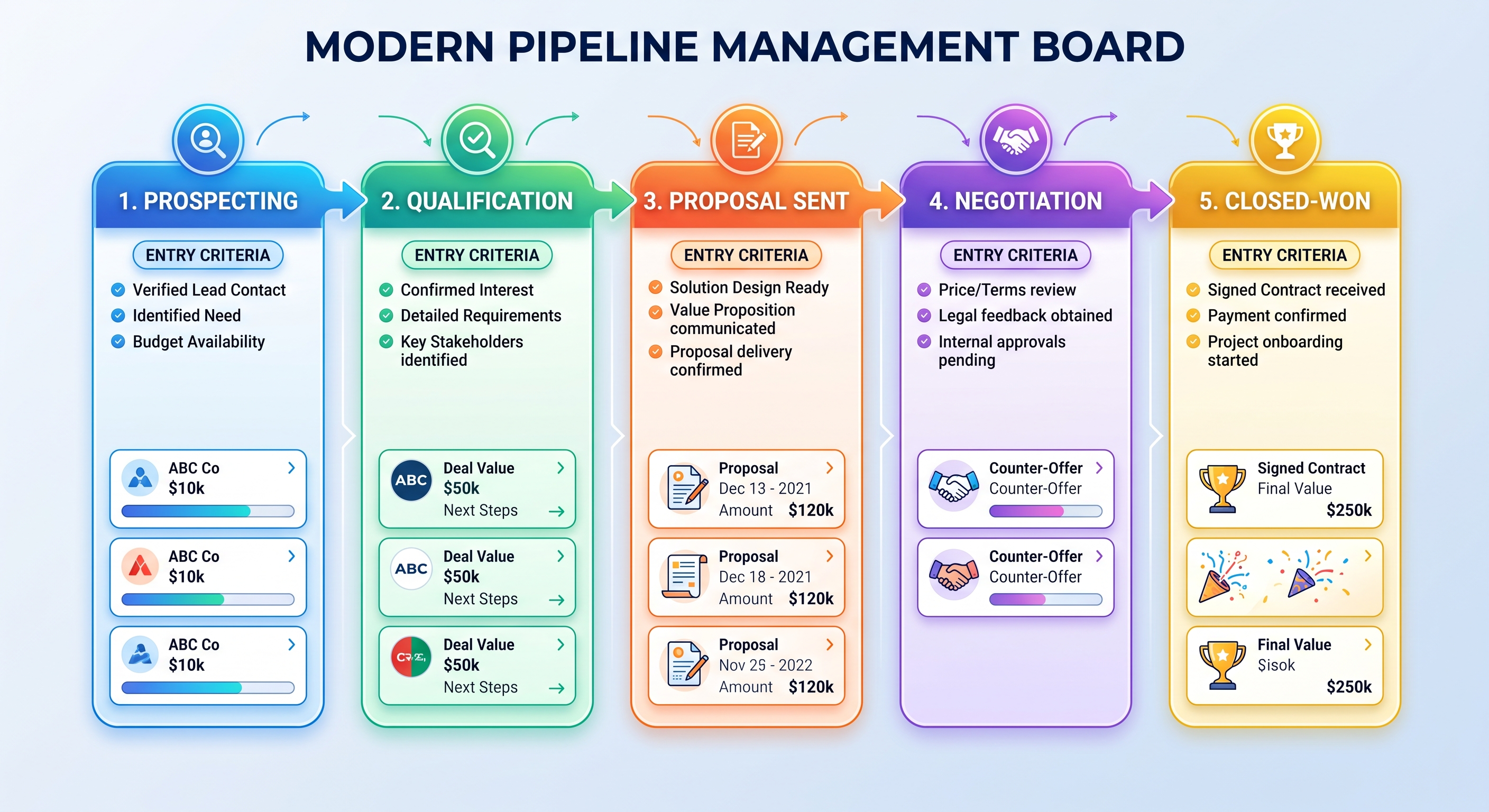
That layout is the test: every stage name describes the buyer, and every column carries a number that changes weekly.
Name stages after buyer behavior, not your internal process
Write each stage as a sentence the buyer would recognize. Prospecting becomes "identified as a fit." Qualified becomes "confirmed budget and timing."
This single change stops reps from parking deals in a stage just because they personally finished their part of the work.
Write an exit rule for every stage
A deal cannot leave a stage until it clears a specific, checkable condition. No condition means no rule, and a stage with no rule becomes the place deals go to die.
Write the rule down. Post it where the pipeline lives. Enforce it every week.
Fill the top before you worry about the middle
A pipeline with clean stages and nothing entering it is a spreadsheet, not a pipeline. Filling starts with outreach aimed at your ideal customer profile, not a generic list of anyone with an email address, and it starts before the first deal is ever marked qualified.
In an interview describing the early outbound system he built at Salesforce, Aaron Ross, the company's former VP of sales operations who went on to found Predictable Revenue, credits a repeatable outbound motion rather than one lucky deal. The lesson holds today: pipeline is a system you build, not a number you wait for.
How many prospects you actually need to hit quota
A 2026 pipeline generation benchmark cited by Clari puts a reasonable pipeline coverage ratio at three to four times your quota, adjusted for your actual win rate.
A twenty five percent win rate needs closer to four times coverage. A fifty percent win rate can run on two times. Pull your own win rate from your last two closed quarters before you pick a number, since a borrowed ratio built on someone else's close rate will send you chasing the wrong volume.
I opened a blank pipeline for a new territory at the start of one quarter and logged two hundred and forty outbound touches across five weeks. Forty two contacts replied.
Nine turned into qualified conversations that met the entry bar above. Two closed before the quarter ended. That funnel shape, not a textbook ratio, is what told me how much top of pipeline volume the next quarter actually needed.
That coverage number only means something once it is turned into a forecast for the period, which is where sales pipeline forecasting picks up.
Qualify before it counts as pipeline
A contact is not a pipeline deal until you can answer four questions: do they have budget, does someone with authority know about the conversation, is there a real need, and is there a timeline. A scoring system built on your own closed deal data keeps this consistent across reps instead of leaving it to gut feel.
Move deals with rules, not hope
Deals stall when the only thing moving them is a rep remembering to follow up. Replace memory with a trigger: a specific action that either advances a deal or flags it for review.
Set a trigger for every stage change
Pick one signal per stage that forces action. A proposal sent without a reply in seven days triggers a check in call, not a wait and see. A meeting booked automatically moves the deal to qualified. Automation helps here, but the rule works even on a plain spreadsheet if someone actually checks it.
Run a weekly review in under 30 minutes
A short, consistent review catches stalled deals before they go cold. Confirm these five things every week rather than doing a deep audit once a quarter:
Every deal has moved stage or has a next step dated this week
Deals with no activity in fourteen days are flagged or removed
Stage counts are checked against the coverage target from above
One deal per rep is spot checked against its exit criteria
Lost deals carry a reason code before they leave the board
Spreadsheet or CRM: which to use while your pipeline is small
You do not need a CRM on day one. You need somewhere to see every deal and its stage at once, and a spreadsheet does that for a single rep managing under twenty open deals.
Option | Setup time | Cost | Automation | Best for |
|---|---|---|---|---|
Spreadsheet | Under an hour | Free | None, updates are manual | One rep with under twenty open deals |
Free CRM tier | Half a day | Free up to a seat limit | Basic stage reminders | A small team ready to stop copying rows by hand |
Paid CRM | A few days including setup | Monthly, per seat | Triggers, reporting, multiple pipelines | A team that needs forecasting across reps |
What columns a spreadsheet pipeline needs
Six columns cover it: contact name and company, current stage, next step, next step date, deal value, and a lost reason field left blank until it is needed. Nothing else earns a column until the basic sheet is slowing someone down.
When to graduate from a spreadsheet to a CRM
Move once any of three things happens: you cross twenty open deals per rep, more than one person needs to update the same pipeline, or you need a forecast number you can trust rather than one you eyeball.
Platform choice at that point usually follows what your team already touches daily.
Platform | Where stages live | Note |
|---|---|---|
Google Sheets | One tab, one row per deal | Fastest start, fully manual |
HubSpot | Deals object, drag and drop board | Free tier covers a single pipeline |
Salesforce | Opportunity stages | Built for multiple pipelines and custom forecasting |
Zoho CRM | Deals module | Strong fit for teams already on Zoho for email |
A five stage pipeline template you can copy
This sales pipeline example covers a typical B2B deal. Copy the five stages, then adjust the exit criteria to match your own sales process before you use it.
Stage | Entry criteria | Exit criteria |
|---|---|---|
Prospecting | Contact matches your ideal customer profile and has a live need | Contact details confirmed and one relevant reason to reach out is documented |
Qualified | Contact has replied and confirmed budget, authority, need, and timing | A meeting or call is booked on both calendars |
Proposal | Meeting happened and you understand their must have requirements | Proposal or quote sent with a price and a next step date |
Negotiation | Buyer has reviewed the proposal and raised specific terms | Verbal agreement reached on price and start date |
Closed | Contract signed, or deal marked lost with a reason code | Deal removed from active pipeline and logged for reporting |
The follow up and volume rules nobody spells out
Two named rules answer questions reps ask constantly and rarely get a straight answer to: how often to follow up, and how much raw volume actually turns into one booked meeting.
What the 2 2 2 rule means for follow up timing
The 2 2 2 rule spaces three follow up touches at two days, two weeks, and two months after a call or meeting. Each touch has a different job.
The two day touch recaps what was discussed while it is still fresh. The two week touch delivers something useful, a case study or a direct answer to a question raised on the call.
The two month touch closes the loop, either with a renewed pitch or an honest ask about whether the timing has changed. Spacing the touches this way keeps outreach from feeling like pressure while making sure a deal never goes silent by accident.
What the 10 3 1 rule means for prospecting volume
The 10 3 1 rule sets an expectation for raw prospecting math: ten qualified prospects lead to roughly three meaningful conversations, and those three conversations lead to one booked meeting.
Treat it as a starting ratio, not a guarantee. If your own numbers run worse than ten to one, the fix is almost always list quality rather than more volume at the same quality.
Common pipeline mistakes and the fix
Most pipeline problems trace back to one of four repeatable causes.
Symptom | Cause | Fix |
|---|---|---|
Deals sit in one stage for months | No exit rule was ever written for that stage | Add one checkable exit rule and move or close every deal that fails it this week |
The pipeline looks full but nothing closes | Contacts were added before they were qualified | Only count a deal once budget, authority, need, and timing are confirmed |
The forecast is wrong every month | Deals carry an assumed close rate instead of a tested one | Pull your own win rate per stage from the last two closed quarters |
Reps stop updating the board | Updating the pipeline takes longer than the deal is worth tracking | Cut the stage count and required fields until an update takes under a minute |
Laid out across the funnel instead of a table, the same four stall points look like this.
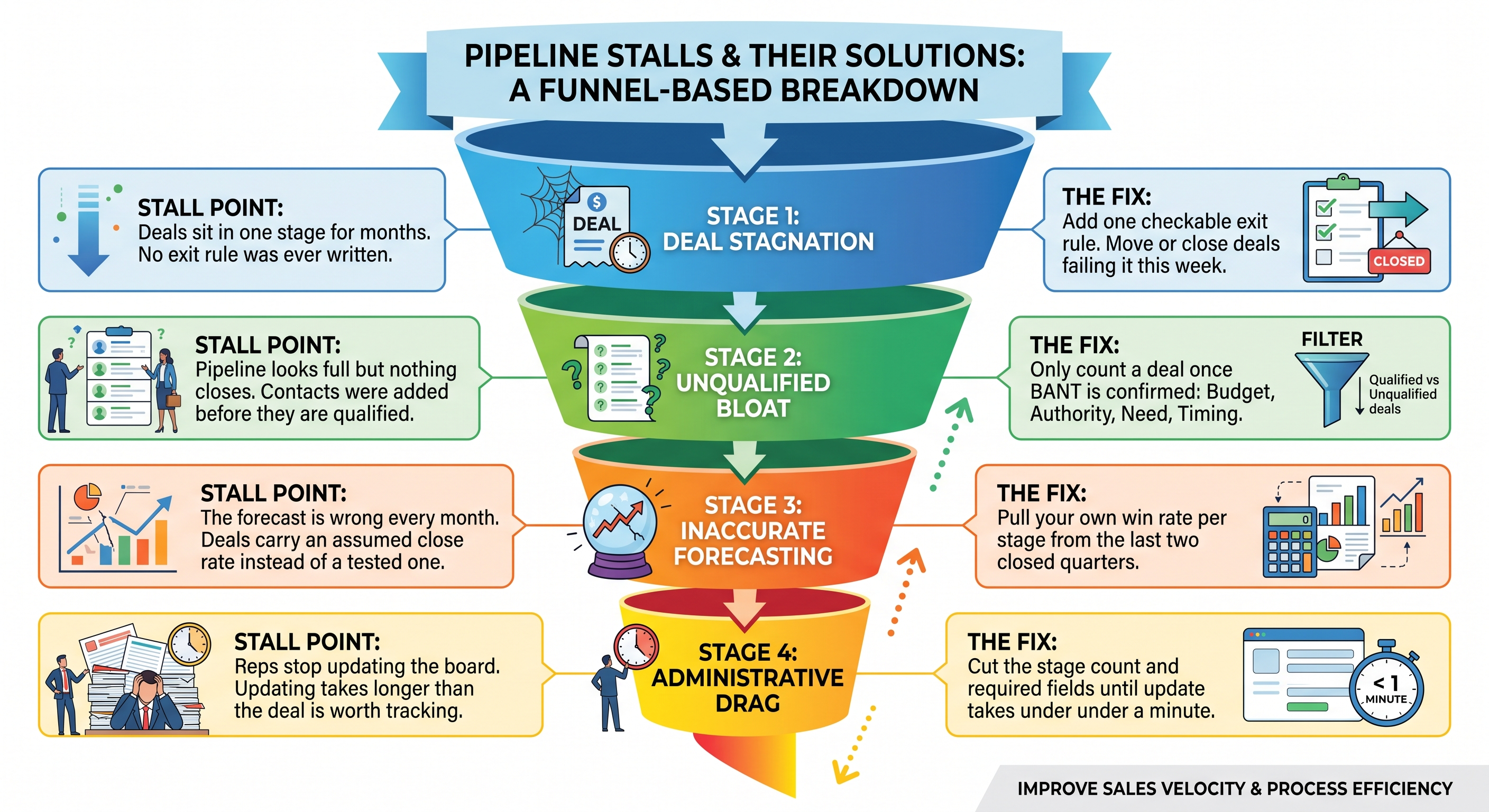
That stall pattern is exactly what the table above is meant to catch before it repeats next quarter.
A discussion among independent founders on an Indie Hackers thread about sales pipelines reflects the same pattern from the other direction: people who start tracking deals for the first time consistently find that the tracking itself, done consistently, matters more than which tool holds it.
FAQs
How long does it take to build a sales pipeline
A workable pipeline with clean stages can be set up in an afternoon. Filling it with enough qualified deals to see a real close rate takes longer.
In the territory example above, the first closed deal landed nine weeks after the pipeline opened, with qualified conversations starting to appear around week four.
What is the difference between a sales pipeline and a sales funnel
A pipeline tracks individual deals through stages you control, from a sales team's point of view. A funnel measures the conversion rate of a larger group moving through those same stages, usually from a marketing point of view.
What each of those stages actually looks like, from awareness through the final decision, is worth a closer look on its own.
How many stages should a sales pipeline have
Three to five stages covers most sales processes. Fewer stages are easier to keep accurate. Add a stage only when you need to measure something specific at that point, such as a legal review or a technical evaluation.
Do all deals need to move through every stage in order
No. A deal can skip a stage when the buyer arrives already qualified, such as a referral with a confirmed budget. It should never skip the exit rule itself, only the stage that rule would normally sit in.
Where to go from here
A healthy sales pipeline only earns its keep once the stages, the rules, and the weekly review are all running at the same time. Build the stages first, add the coverage math once real deals are moving, and let the weekly review catch what memory alone would have missed.
Once the pipeline is filling, the next question is what it will close, which means picking a sales projection formula that survives messy data and deciding whether forecasting software is worth paying for yet.
Guidance and sources reviewed August 27, 2026.
About the author
Michael Doyle writes about B2B sales at Leaderr. He covers prospecting, cold outreach, sales data, and pipeline building, with a focus on what actually works for SDRs, founders selling on their own, and small sales teams. Connect with him on LinkedIn.