Sales forecasting software: how to choose without guessing on cost or accuracy
Sales forecasting software compared by team size, forecasting method, and hidden setup costs, plus how to verify a vendor's accuracy claim before signing.
 Michael Doyle14 min read
Sales forecasting software turns pipeline and deal data into a predicted revenue number, replacing spreadsheets and rep guesswork.
Only 45 percent of sales leaders trust their current forecast, according to Gartner. The right tool depends on your team size, your forecasting method, and your budget, not a single ranked list of vendors.
Software only helps once the pipeline underneath it is structured, so if your stages are still loose, start with how to build a sales pipeline that holds its shape.
What this guide covers, and who each part is for
This guide covers software built to predict revenue from deal and pipeline data, not software that forecasts market demand or warehouse inventory. Those solve a different problem.
I requested pricing from five sales forecasting vendors that listed nothing but "contact us." The fastest reply came back in four hours. The slowest took nine days. Three of the five quotes included a setup fee, somewhere between 1,200 and 6,000 dollars, that never showed up on the public pricing page. That gap between the sticker price and the real cost runs through most of what follows.
Read on if any of these sound like your team:
A founder or a one to three person sales team still tracking deals in a spreadsheet.
An individual sales rep or SDR who needs a personal pipeline number, not a company wide model.
A sales operations or revenue operations lead running forecasts for ten to fifty reps.
An enterprise or multi region sales organization reconciling forecasts across several pipelines.
An agency managing forecasts for more than one client account at once.
What sales forecasting software actually does
Sales forecasting software connects to your CRM, pulls deal stage, close date, and deal value for every open opportunity, then applies a forecasting method to output a predicted revenue number for a chosen period.
Most tools update that number automatically as reps update their deals, using the same trigger based automation already used to handle other repeatable sales tasks, instead of a manager chasing down a spreadsheet by hand.
The category overlaps with AI sales forecasting software when a tool adds a statistical layer on top of rep judgment, flagging deals that look at risk based on stalled activity or a missing next step. That layer still needs clean input data. Feed it messy stage names and it forecasts the mess right back at you.
A CRM is not a forecasting tool
A CRM and a dedicated forecasting tool are not the same thing. A CRM stores the contacts, the deal stages, and the activity history that a forecast is built from. See what a CRM actually tracks day to day for the full picture. A dedicated forecasting layer adds the modeling, the multiple pipeline rollups, and the historical comparison that most CRMs handle only at a basic level.
Forecasting versus projection, and why the words get mixed up
A sales forecast predicts revenue from deals already sitting in the pipeline, using data your reps have entered today. A sales projection usually starts further out. It models revenue under a set of assumptions, sometimes with no live pipeline behind it at all, the way a new business plan projects year one revenue before a single deal exists.
The tools in this guide handle the first job. A handful also handle the second, and the difference matters the day a board asks for one and a sales manager delivers the other.
Sales forecasting software by team profile and forecasting method
Most vendor pages rank tools in one list, best to worst, with no separation by method or company size. A team of three ends up looking at the same shortlist as a fifty person revenue org. Match your profile first. The tool, and the setup work behind it, changes with it.
Team profile | Method that fits first | What breaks without dedicated software | Tools built for this profile |
|---|---|---|---|
Founder or a 1 to 3 person team | Simple pipeline based forecasting | The founder is the forecast, and the number leaves with them once they get busy | Pipedrive and similar lightweight CRMs with a built in pipeline view |
Individual rep or SDR | Weekly self reported pipeline forecasting | The personal number gets buried inside a team roll up | HubSpot Sales Hub's rep level forecast view |
Sales operations or RevOps, 10 to 50 reps | Historical plus pipeline blended forecasting | A manager spends a day each month reconciling spreadsheets against the CRM | Clari or a similar forecasting layer connected to the CRM |
Enterprise or multi region, 50 plus reps | Multivariable and scenario forecasting | One region's number cannot be compared to another because each manager forecasts differently | Anaplan or Salesforce's native forecasting for large scale roll ups |
Agency managing multiple client pipelines | Segmented forecasting, one model per client | Client budgets blend into one number nobody can defend in a client meeting | A tool built for multi pipeline segmentation, such as Gong Forecast or Aviso |
The SDR row above covers the personal number a rep tracks day to day. See what an SDR's targets actually look like for how that role's number differs from a full team quota.
The forecasting methods behind the tools
Every comparison chart in this category throws around terms like "AI driven model" or "multivariable analysis" without saying what they mean. Four methods matter here. Each one works differently, and each breaks in a different way.
Method | Plain meaning | Data it needs | Where it tends to break |
|---|---|---|---|
Pipeline or funnel based | Each open deal gets a probability based on its stage, then those probabilities get added up | Deal stage, deal value, close date | Falls apart when reps do not move deals through stages consistently |
Historical or trend based | Looks at what closed in past periods and projects forward from that pattern | At least a year of clean closed deal history | Misses sudden shifts: a new product launch, a lost major account, a new competitor |
Multivariable or regression based | Combines several inputs, deal size, rep tenure, season, deal source, into one statistical model | A large enough dataset for the model to find a real pattern instead of noise | Needs more history than most small teams have collected yet |
Intuitive or qualitative | A manager's judgment call, sometimes backed by a confidence rating from each rep | Rep and manager experience, mostly informal | Most exposed to gut feel and sandbagging, so it works best as a check on a model, not a replacement for one |
The pipeline or funnel based method above is the same calculation walked through step by step, with a worked example, in sales pipeline forecasting.
How to verify a vendor's accuracy claim before you buy
Every vendor in this category cites an accuracy percentage somewhere on its homepage. Ninety percent, ninety five percent, sometimes higher. Almost none of them say what the number measures, over what period, or against what baseline. A claim like that is marketing copy until you can check it.
Four questions get past the marketing copy:
What does the percentage actually measure: total pipeline value, or only deals a rep already marked as committed?
Over what time window was it calculated? One strong quarter reads nothing like a two year average.
Can you name one reference customer in my industry and my company size who will talk about their real number?
Can we pilot against our last two closed quarters before we sign anything?
A vendor that answers all four without steering the call back toward a demo is worth taking seriously. One that cannot name the measurement window chose the number for the homepage, not from real forecasts.
What sales forecasting software actually costs
Most pricing pages in this category say "contact us" instead of a number, which is exactly what happened with the five quotes mentioned earlier. Nine days is its own cost. The fees that showed up after that number are the ones worth planning for before a call, not during one.
Setup and onboarding fees, usually triggered by connecting more than one CRM instance or migrating deal history older than two years.
Per seat and per license creep, triggered when a company buys a starter tier for five reps, then adds reps one at a time at a higher rate than the original deal.
Add on modules and integrations, often billed separately for a second CRM connection, a data warehouse sync, or a custom report builder.
Data migration or historical import fees, charged once, usually flat rate, for pulling years of closed deal history into the new system.
Clari's own pricing page is a fair example of the pattern.
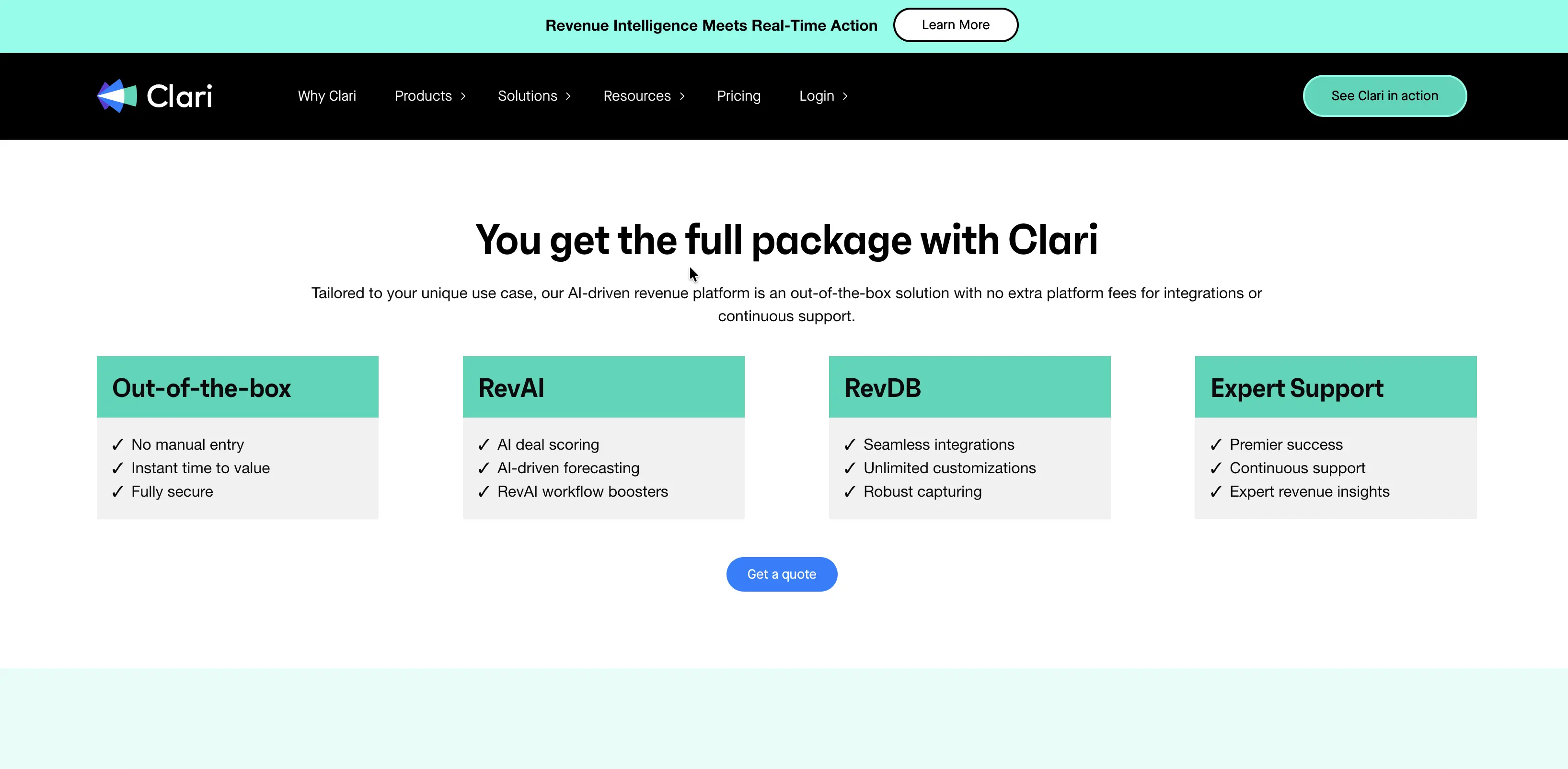
No price appears anywhere on it. That is the industry norm in this category, not an exception, which is exactly why the questions below matter before a call, not during one.
Where the fee shows up first
A quote that looks clean at the top often separates onboarding into its own line once a sales engineer scopes the account. That is where the earlier fee range shows up. A starter tier priced for five reps rarely stays priced that way either.
Teams that grow add seats one at a time, usually at a higher rate than the original volume discount. Ask for both numbers in writing, at your current headcount and your headcount a year out, before a contract locks in a rate.
Free and low cost ways to test forecasting before you pay
Before any of the above, most teams already have two free options sitting on a laptop. Neither replaces dedicated software once a team scales, but both are worth trying first.
Spreadsheets and a sales forecast template
A spreadsheet handles small deal volume fine and costs nothing beyond the time it takes to build. The risk shows up as volume grows. Close inspection of real world spreadsheets found errors in 94 percent of them, according to research compiled for the European Spreadsheet Risks Interest Group.
A forecast built on a spreadsheet with one broken formula looks confident and reports the wrong number, with nothing to flag that it is wrong.
Asking an AI chat tool to model your pipeline
A general purpose AI chat tool can take a pasted list of deals and produce a rough weighted forecast in minutes, useful as a gut check on a small pipeline. It has no live connection to your CRM, so the moment a deal closes or slips, the estimate is out of date until someone pastes the list again. Use it as a check, nothing more.
Some platforms also offer a real free tier for a handful of users, rather than a trial that expires. Check the seat cap and the pipeline size cap before counting on it next quarter.
A buying readiness checklist before you request a demo
Check every item below first. Most sales calls move faster once the answers are already written down.
You can name the forecasting method your team needs: pipeline based, historical, multivariable, or a blend.
You know whether your CRM's stage names and close dates are actually kept current.
You have a headcount projection for the next twelve months, not just today's seat count.
You have asked for the accuracy percentage's measurement window, not just the headline number.
You have a written list of every add on module your use case will need.
You know where your pipeline data will be stored and how long the vendor keeps it after you cancel.
You have checked the vendor's independent rating on a site such as G2 or Capterra, not only its own case studies.
You have set aside time for a pilot against your last two closed quarters before signing a multi year contract.
You know who on your team owns keeping deal stages current, since no tool fixes that on its own.
Common mistakes that break a sales forecast
Most forecasts fail for the same few reasons. The software is rarely the actual problem.
Trusting an accuracy number you cannot verify
This one is covered in more depth earlier: a percentage with no measurement window attached is not a fact yet. Teams that skip the four verification questions tend to find out the real number during their first bad quarter, not before signing.
An independent rating site is one more check worth running before signing anything.
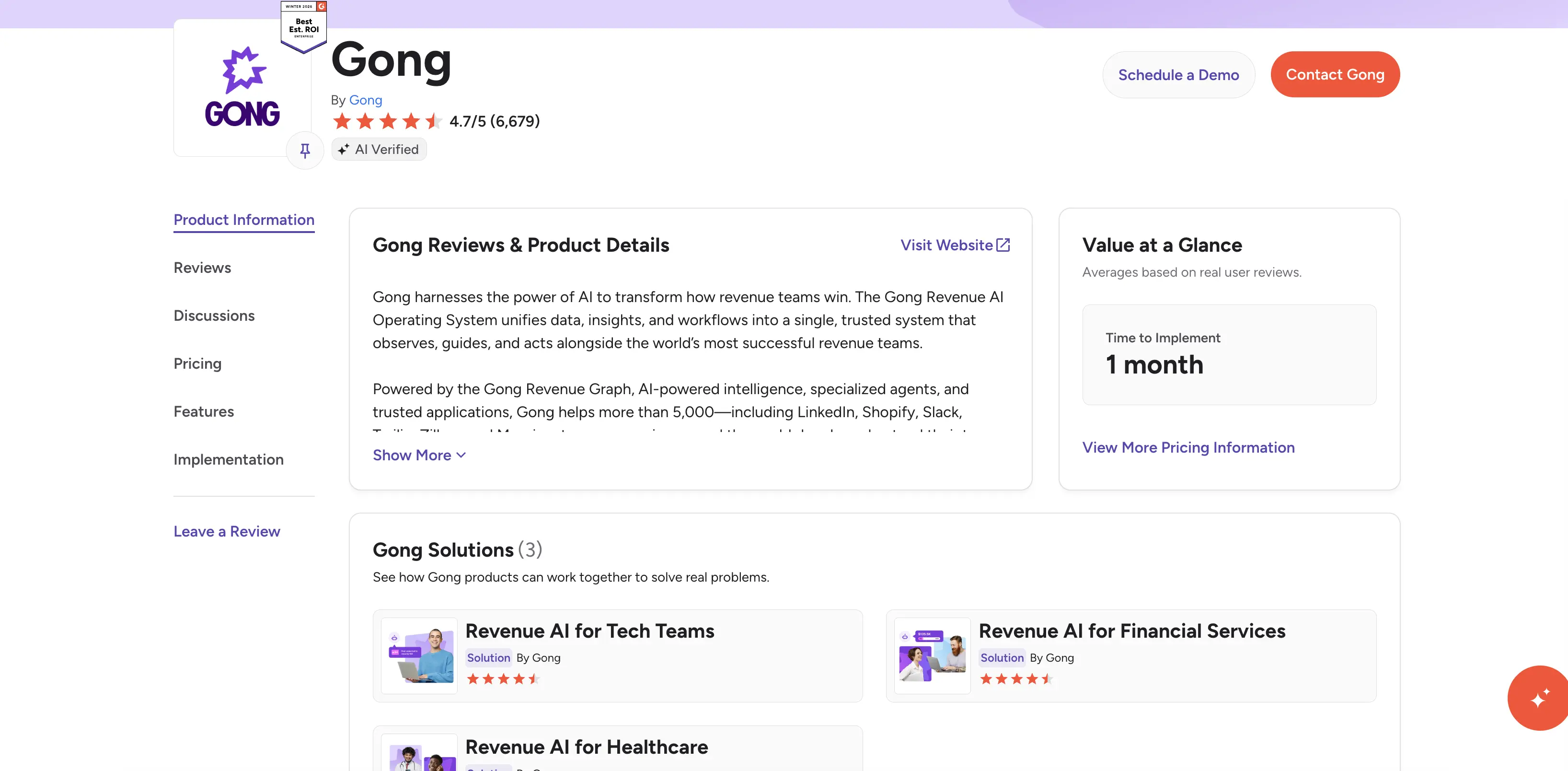
None of those scores replace a pilot on your own data. They are still a faster way to catch a vendor whose case studies look stronger than its actual user base.
Feeding the model messy CRM data
Only 47 percent of respondents in the same Gartner research believed their organization's data was high quality. A forecasting layer built on inconsistent stage names and missing close dates inherits every one of those problems.
Clean the CRM before switching software, not after. Otherwise the new tool just automates the same bad number, faster.
On Indie Hackers, founder Aytekin Tank described watching revenue problems late, after they had already grown, because nothing was flagging what next week's number was likely to look like before it happened. The post drew close to thirty comments from other operators describing the same lag between a problem starting and someone actually noticing it.
Mistake | Why it happens | Fix |
|---|---|---|
Trusting an unverified accuracy claim | The percentage measures something different from what a buyer assumes | Ask the four verification questions before a contract, not after |
Feeding the model messy CRM data | Stage names and close dates drift out of date without anyone noticing | Run a data quality pass during rollout, not months later |
Treating a CRM's native forecast as enough | Basic CRM forecasting often skips historical comparison and multi pipeline rollups | Compare what it reports against what the team actually needs first |
Skipping a pilot before a multi year contract | The sales cycle rewards signing fast in exchange for a discount | Insist on testing against two closed quarters first, discount or not |
FAQs: Sales Forecasting Software
Can small businesses benefit from sales forecasting tools, or is this only for enterprise?
Yes. A founder or a small team gets less from the multivariable modeling built for a fifty person org and more from a simple pipeline based view that flags which deals are actually going to close this month. Company size mostly changes which method fits, not whether forecasting software is worth using.
How much does sales forecasting software cost?
Pricing is rarely public. Entry tiers for small teams often start at a few hundred dollars a month. Enterprise deployments with multivariable modeling and multi region rollups run into five figures a year, before the setup and per seat fees covered earlier.
Can sales forecasting software integrate with my current CRM?
Most dedicated tools connect to major CRMs through a native integration or an API, syncing deal stage, value, and close date automatically. Confirm the integration exists for your specific CRM version before signing.
How long does it take to implement sales forecasting software?
A setup connecting one clean CRM instance can run two to four weeks. Migrating years of deal history or connecting more than one CRM extends that, sometimes past two months.
What's the difference between sales forecasting software and a CRM?
A CRM stores the deals, contacts, and activity a forecast is built from. Dedicated forecasting software adds the modeling layer on top: probability scoring, historical comparison, and multi pipeline rollups that most CRMs only handle at a basic level.
Where your shortlist goes from here
Match your team profile and your forecasting method first. Let cost and accuracy verification narrow the shortlist after that, not before it.
Buyers are asking the same four verification questions more often now, and the category is shifting toward tighter CRM integration and clearer accuracy reporting because of it. A vendor that already answers them unprompted is usually the one worth a real pilot.
Guidance and sources reviewed August 28, 2026.
About the author
Michael Doyle writes about B2B sales at Leaderr. He covers prospecting, cold outreach, sales data, and pipeline building, with a focus on what actually works for SDRs, founders selling on their own, and small sales teams.