Sales funnel stages: where deals stall and how to fix each one
See all six sales funnel stages explained in plain language, with a win probability table by stage and a worksheet for spotting exactly where deals stall.
 Michael Doyle14 min read
A sales funnel has four core stages: awareness, interest, decision, and action. Guides that report five, six, or seven stages are usually splitting decision into evaluation and negotiation, or adding a retention stage at the end.
The stage a deal sits in should describe a specific buyer behavior, not a date on a calendar.
A recent pipeline stage analysis from Optifai puts win probability at 40 percent once a deal clears discovery, rising to 85 percent once it reaches negotiation.
That gap is where most stalled deals actually sit.
What you need before you start
Stage definitions only work once someone has agreed on three things: what counts as a lead, what a deal must do to move forward, and who owns each handoff.
Skip this and two reps will call the same deal by two different stage names on the same call.
This works whether the funnel sits in a spreadsheet or inside a CRM, and it fits more than one type of seller:
A founder selling alone, who needs stage boundaries mainly to know what to do next.
An SDR booking meetings for someone else to close, who owns the earliest stages only.
A small team sharing one pipeline, where stage names have to mean the same thing to everyone using them.
An agency running funnels for clients, who needs a definition a client can read without a walkthrough.
It does not require picking a stage count first. Pick the buyer behaviors first, then count how many stages that takes.
What this covers: the core stages, how MQL and SQL map onto them, where a sales pipeline stops matching a sales funnel, and who should own each handoff.
What it does not cover: how to build stage automation inside a specific tool, since that depends on the platform.
How many stages does a sales funnel actually have
There is no single correct count, and that is the actual source of most of the confusion around this topic.
The four stage model
Awareness, interest, decision, action. This is the base model almost every other version expands from. A prospect learns you exist, engages with something you published or said, weighs whether to act, then acts or does not.
The six and seven stage models
Six stage models usually split decision into evaluation and negotiation, or add retention as a sixth stage after the sale closes. Seven stage models go further and separate prospecting from qualification as two distinct early stages, since a name in a spreadsheet and a name that has answered a discovery call are not the same thing.
Pick a stage count by counting the distinct decisions a buyer makes, not by copying a template. A four person sales team selling one product usually needs four or five stages.
A team selling to enterprise accounts with procurement and legal review often needs six or seven, because those extra reviewers create extra decision points a stage count has to reflect.
The diagram below lines up the four, six, and seven stage versions side by side so it is clear which stages are actually new and which are just a split of one earlier stage.
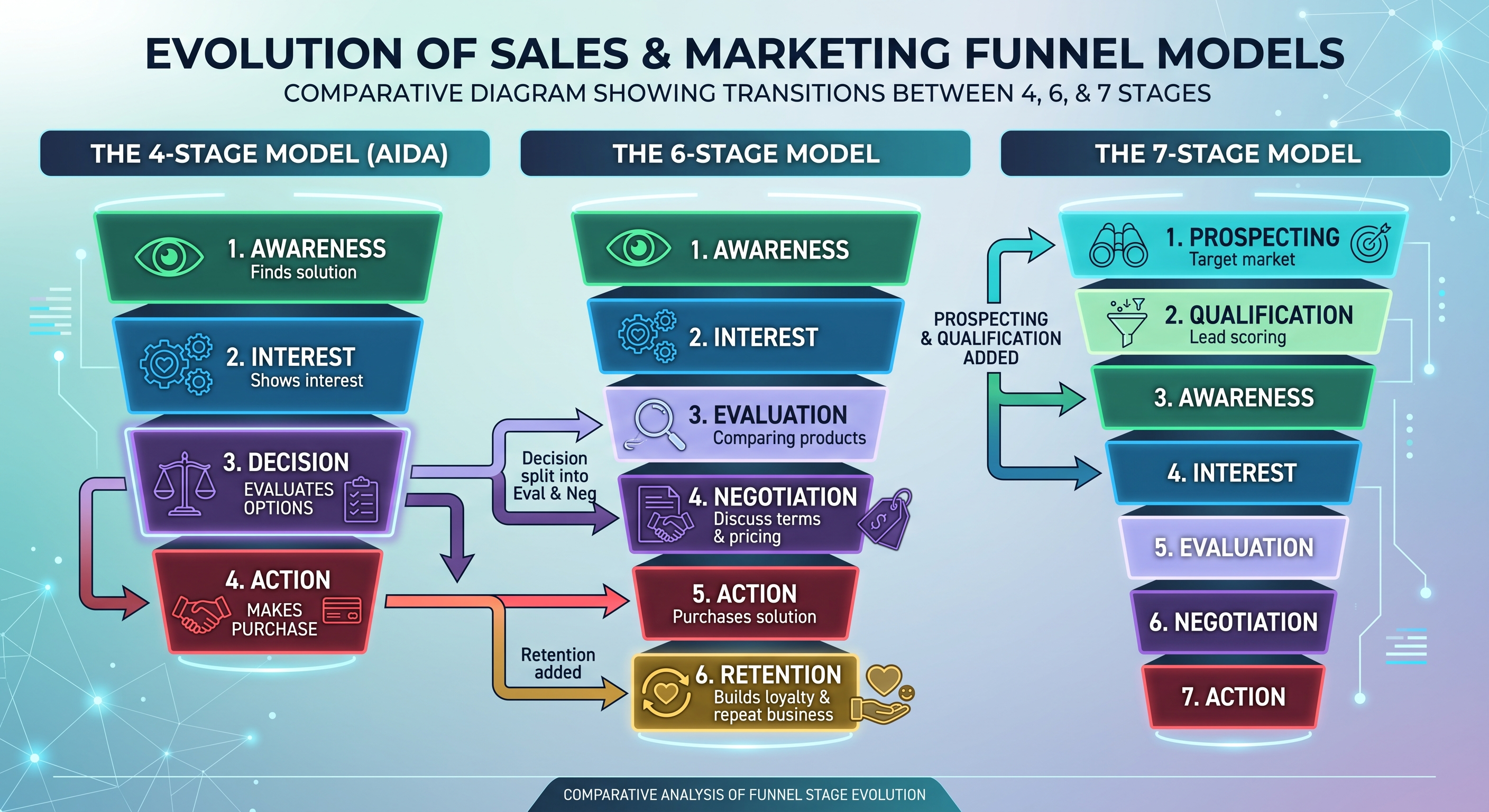
Once the three versions sit next to each other, most of the apparent disagreement between guides turns out to be relabeling, not a real difference in how a deal actually moves.
Stage 1: Awareness
A prospect finds out a solution to their problem exists. This happens through content, referrals, paid search, or a cold outreach sequence that reaches the right person at the right time. Nothing has been asked for yet.
The exit signal is engagement, not interest. A prospect who reads one article has not entered the funnel. A prospect who requests something, replies to an ICP matched outreach message, or attends a webinar has moved into a stage that a funnel should track.
Stage 2: Interest
The prospect has engaged and now wants specifics. Questions shift from general ("what does this do") to particular ("does this work for a team our size"). This is where a name becomes a real lead rather than a suspect, and where most teams first apply an ICP filter to confirm the account is worth pursuing at all.
Volume drops sharply here on purpose. A funnel that shows no drop between awareness and interest is not filtering, it is counting page views as pipeline.
Where MQLs and SQLs fit inside the funnel
Marketing qualified lead and sales qualified lead are not funnel stages themselves. They are qualification labels that sit on top of the stages above, and mixing the two up is one of the most common reasons a funnel report looks wrong to the people reading it.
A lead becomes an MQL once it clears fit and behavior criteria, usually somewhere inside the interest stage. It becomes an SQL once a sales rep confirms the fit by hand, which usually happens at the boundary between interest and consideration.
A sales accepted lead, or SAL, marks the moment a rep formally takes ownership, which is the real handoff point a funnel needs to track, not the label change itself.
Stage 3: Consideration
The prospect is actively comparing options, including doing nothing. They are reading case studies, running a trial, or asking for a demo. This is the widest gap between what marketing content and sales content need to do, since a case study works here in a way a top of funnel blog post does not.
A March 2026 Gartner sales survey found that 67 percent of B2B buyers now prefer a rep free buying experience during this stage. That is not a reason to disengage. It is a reason to make the content this stage needs easy to find without a rep in the middle of it.
Stage 4: Decision
The prospect has narrowed the field and is now negotiating specifics: price, terms, implementation timeline, who signs. This stage moves fastest when the earlier stages did their job, and stalls hardest when they did not, since a rep negotiating with someone who never confirmed budget authority is negotiating with the wrong person.
Gartner Senior Principal Analyst Alyssa Cruz put the underlying shift plainly: "Sellers must remain helpful while keeping the experience low friction." A proposal that gets read rather than filed away, with a specific price attached to a specific scope, is what keeps this stage moving instead of stalling it.
Stage 5: Action
The deal closes, or it does not. Both outcomes end the stage. A closed lost deal still carries information a funnel should capture: which stage it stalled in last, and why, since that pattern is what improves the stage before it next quarter.
Treat a closed lost deal the same way a closed won deal gets treated: log a reason, not just a status. "Went quiet" is not a reason. "Chose a competitor on price" or "budget got cut before signature" are reasons, and only those give the earlier stages something specific to fix.
Stage 6: Retention and expansion
B2B funnels that stop at the close miss the highest margin stage. A five percent gain in retention has been shown to lift profit by a wide range depending on the business, sometimes dramatically, which is why teams selling recurring contracts treat this as a sixth stage rather than a separate process.
Sales funnel stages compared with sales pipeline stages
A funnel tracks the buyer's experience. A pipeline tracks the seller's activity on a specific deal.
Both describe the same process seen from two different angles, and the confusion between them is one of the most searched questions on this topic for a reason: most teams use the words interchangeably until a report breaks because of it.
A pipeline view is what shows up inside a CRM record, one deal at a time, while a funnel view sits in reporting and forecasting instead.
What you are measuring | Sales funnel view | Sales pipeline view |
|---|---|---|
Unit tracked | All prospects at each stage | One deal at a time |
Shape | Narrows as prospects drop off | Deals move forward or get marked lost |
Owned by | Marketing and sales together | The individual rep |
Lives inside | Reporting and forecasting tools | A CRM record |
Answers | How many prospects convert | Where this specific deal stands today |
Once you separate the two views, building the pipeline side becomes its own task. Setting one up stage by stage starts from the same buyer behaviors covered above, just organized around one deal at a time instead of the whole group.
How default stage names differ by CRM and by sales method
Stage names are not standardized across tools or methodologies, which is a second, smaller source of the same confusion covered above.
Common CRM pipeline stage names
A generic funnel names its stages after buyer behavior. A CRM pipeline usually names its stages after seller activity instead, since the tool exists to track what the rep does next.
Funnel stage | Typical Salesforce label | Typical HubSpot label |
|---|---|---|
Awareness and interest | Prospecting | Appointment scheduled |
Consideration | Qualification, needs analysis | Qualified to buy |
Decision | Proposal, negotiation | Presentation scheduled |
Action | Closed won, closed lost | Contract sent |
Where Miller Heiman fits
Miller Heiman sales methodology is not a funnel stage model. It is a qualification and account strategy framework that sits inside the consideration and decision stages, focused on identifying every buyer involved in a deal rather than naming the stages themselves.
A team can run a four stage funnel and a Miller Heiman style qualification process at the same time, since one names the stages and the other names the people inside them.
Who owns each stage
A stage without a named owner is a stage nobody is accountable for, which is why deals stall at the handoff points more often than inside a single stage.
Where SDRs stop and AEs start
An SDR usually owns awareness through the point a prospect agrees to a first meeting. Past that point, an account executive owns interest through decision, since qualifying financial and technical fit in depth is a different skill than generating the first response.
Where AEs hand off to customer success
Once a deal closes, ownership should move to whoever manages the account after the sale, even on a small team where one person plays both roles. Naming that handoff, even informally, is what keeps the retention stage from being the stage nobody actually runs.
What each stage is worth: win probability by stage
Not every stage carries equal weight toward a closed deal, and treating them as equal is a common forecasting mistake.
Pipeline stage | Win probability | What changes to earn it |
|---|---|---|
Discovery | 40 percent | Confirmed pain and budget authority |
Qualification | 55 percent | Confirmed fit against your ICP |
Proposal | 70 percent | A specific price attached to a specific scope |
Negotiation | 85 percent | Terms under active discussion, not just price |
Closed won | 100 percent | Signature received |
These figures come from Optifai's published win rate analysis by sales stage and will shift by industry and deal size.
The pattern that holds across most B2B teams is the shape of the curve, not the exact numbers: probability rises fastest between proposal and negotiation, which is where a stalled deal is most worth a direct check in.
That progression is what a forecast should be checked against before a deal gets called anything close to certain.
The mechanics of that check, weighting each open deal by its stage probability and rolling it into one number, are covered in sales pipeline forecasting.
A copyable stage definition worksheet
Fill in one row per stage before rolling a funnel out to a team. A stage without an exit criteria and a named owner is not a stage yet, it is a label.
Stage name: Entry criteria (what moved the prospect in)
Exit criteria (what moves them to the next stage)
Owner: Target time in stage
Exit metric to track:
Copy this block once per stage. Six stages, six filled rows, one shared definition the whole team can point to during a pipeline review.
What changes once your funnel stages are defined
Reporting gets sharper first. A funnel that used to show one big drop from lead to close starts showing exactly which stage loses the most prospects, which turns a vague coaching conversation into a specific one.
Forecasting improves second, since a deal's stage now maps to a real win probability instead of a guess.
A rep calling a proposal stage deal "basically closed" can be checked against the 70 percent figure above rather than taken on faith.
Common mistakes that stall a funnel
Most stalled funnels fail in a small number of predictable places.
Symptom | Likely cause | Fix |
|---|---|---|
Deals sit in one stage for weeks | No target time in stage was ever set | Add a target time to the worksheet above and flag anything past it |
Reports show deals skipping stages | The CRM report only counts deals that pass through every stage in order | Change the report to count deals that passed through any stage, not all of them |
Sales and marketing disagree on stage names | No shared definition exists, so each side built its own | Run the worksheet above as a joint session, not a handoff document |
The skipped stage problem above is common enough to have its own thread on the HubSpot Community forum, where a user asked how to handle funnel reporting once deals stopped moving through stages in order.
The fix that resolved it: reconfigure the report to count any stage passed through, rather than requiring every stage in sequence.
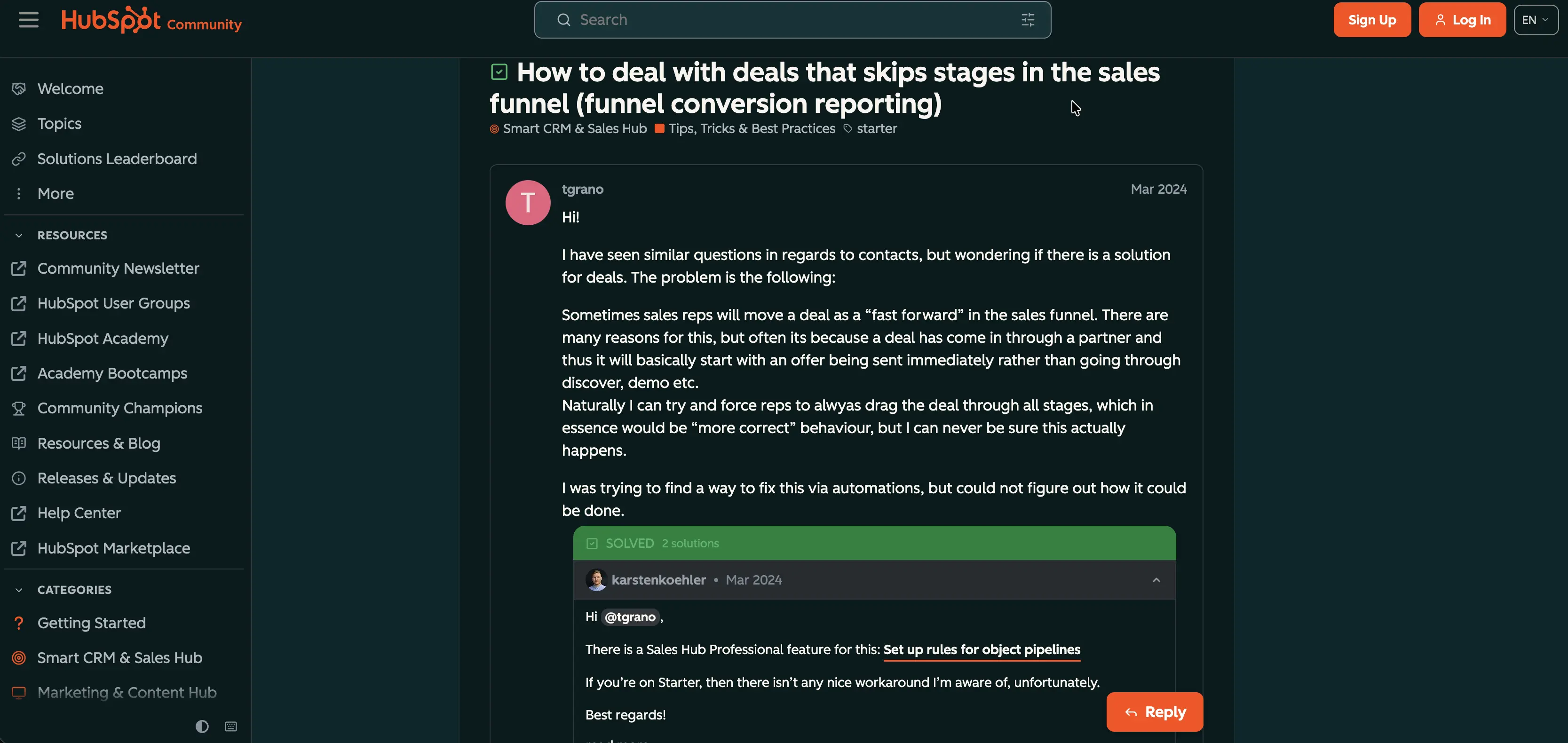
That thread is a useful gut check: if a report setting alone can cause this much confusion, a shared stage definition is worth writing down before the reporting gets blamed.
FAQ
What is the 10 3 1 rule in sales?
It is a pipeline coverage guideline: keep roughly 10 opportunities active for every 3 that reach a serious proposal stage, aiming for 1 to close. It is a coverage ratio, not a funnel stage model, and it works alongside whichever stage count a team already uses.
What is a 7 stage sales cycle?
A 7 stage version usually separates prospecting from qualification as two distinct early stages, then keeps consideration, proposal, negotiation, closing, and retention as the remaining five. It suits teams with a distinct handoff between an SDR and an account executive.
What is a sales funnel in digital marketing?
In a digital marketing context, the funnel usually starts earlier, at ad or content impression, and ends at the marketing qualified lead handoff rather than at a closed deal. Sales picks up the funnel from there.
How do I structure a sales team around funnel stages?
Match roles to stage ownership rather than the reverse. An SDR owns awareness and interest, an account executive owns consideration through action, and a named owner, even a shared one on a small team, runs retention.
What is the difference between a sales funnel and a sales cycle?
A sales cycle measures time: the average length from first contact to close. A funnel measures volume and conversion at each stage. A short sales cycle and a leaky funnel can exist on the same team at the same time.
Fewer stalled deals starts with fewer undefined stages
A stage count is not the thing that fixes a stalled pipeline. A named owner, an exit criteria, and a target time in stage are what actually move a deal, and none of those three require agreeing on whether the model has four stages or seven.
Fill in the worksheet above one stage at a time, starting with whichever stage is currently holding the most deals, and the count will stop mattering nearly as much as it used to.
Guidance and sources reviewed August 27, 2026.
About the author
Michael Doyle writes about B2B sales at Leaderr. He covers prospecting, cold outreach, sales data, and pipeline building, with a focus on what actually works for SDRs, founders selling on their own, and small sales teams. Connect with him on LinkedIn.