Best cold call scripts, with real connect rate data and the legal rule first
A six part best cold call scripts framework with real connect rate data on 90,380 calls, the B2B legal rule to check first, and one copyable script template.
 Michael Doyle14 min read
A strong cold call script has six parts: an opener, a reason for the call, a value bridge, a discovery question, a way through objections, and a clear ask.
A 90,380 call dataset puts one common opener at 6.6 times the booking rate of another. Below: the full script, that data, and the legal rule for dialing a business number.
What you need before you start
This guide is for anyone about to make cold calls without a script already in hand: a new sales development representative building a first call list, a founder making their own calls before hiring a team, an agency or freelancer calling on behalf of a client, and a manager rewriting a script that has gone stale.
It assumes you already have a list of numbers and a rough idea of who you are calling. If you are still working out who belongs on that list, sales prospecting covers how to build one. It does not cover cold email or LinkedIn outreach on its own, though the close points to what to send after the call. A phone and a list are enough to start; no dialer or particular software is required.
One distinction worth settling first: not every call to a stranger is the same kind of cold. A hot call vs cold call comparison lays out how much the person on the other end already knows before the phone rings, and the script below assumes true cold, meaning no prior contact at all.
The script itself moves through six stages in a fixed order, shown below before the line by line breakdown.
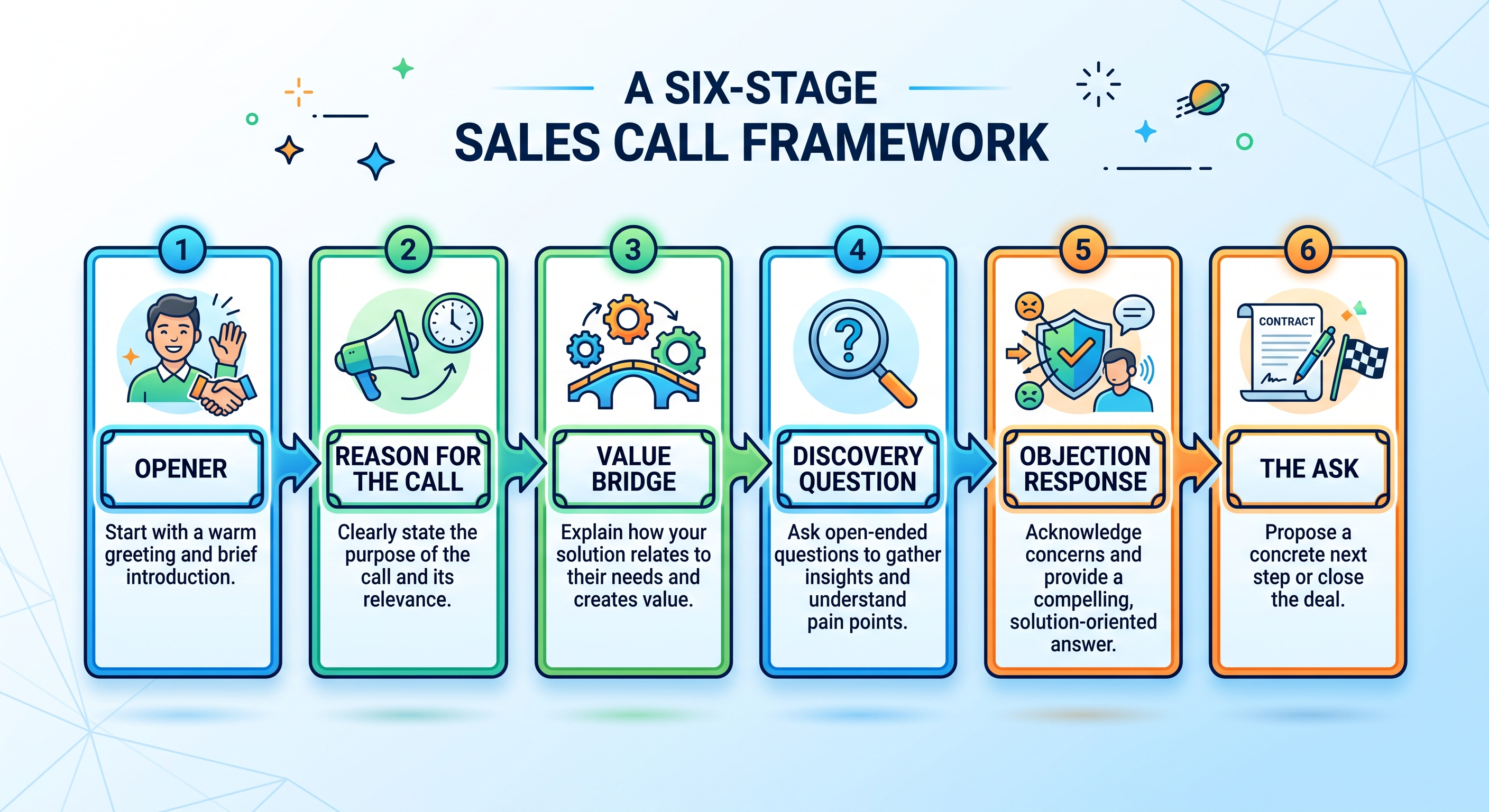
That sequence is the backbone of every call in this guide. The line by line detail comes next, starting with the four seconds that decide whether the rest of it gets heard.
The six part cold call script
Every stage below does one job. Skipping a stage does not save time, it just moves the awkward part to later in the call.
Stage one: the opener
What happens: You say your name, your company, and something that keeps the prospect from hanging up in the first four seconds. This is outbound sales at its most exposed moment, since nothing before this call has warmed the prospect up.
The exact wording of the opener changes outcomes by a wide margin. Gong's analysis of 90,380 cold calls put the success rate of "How have you been?" at 10.01 percent, a rate 6.6 times higher than the baseline opener. The same dataset put "Did I catch you at a bad time?" at a 40 percent lower booking rate than average, because it hands the prospect an easy exit before you have said anything of value.
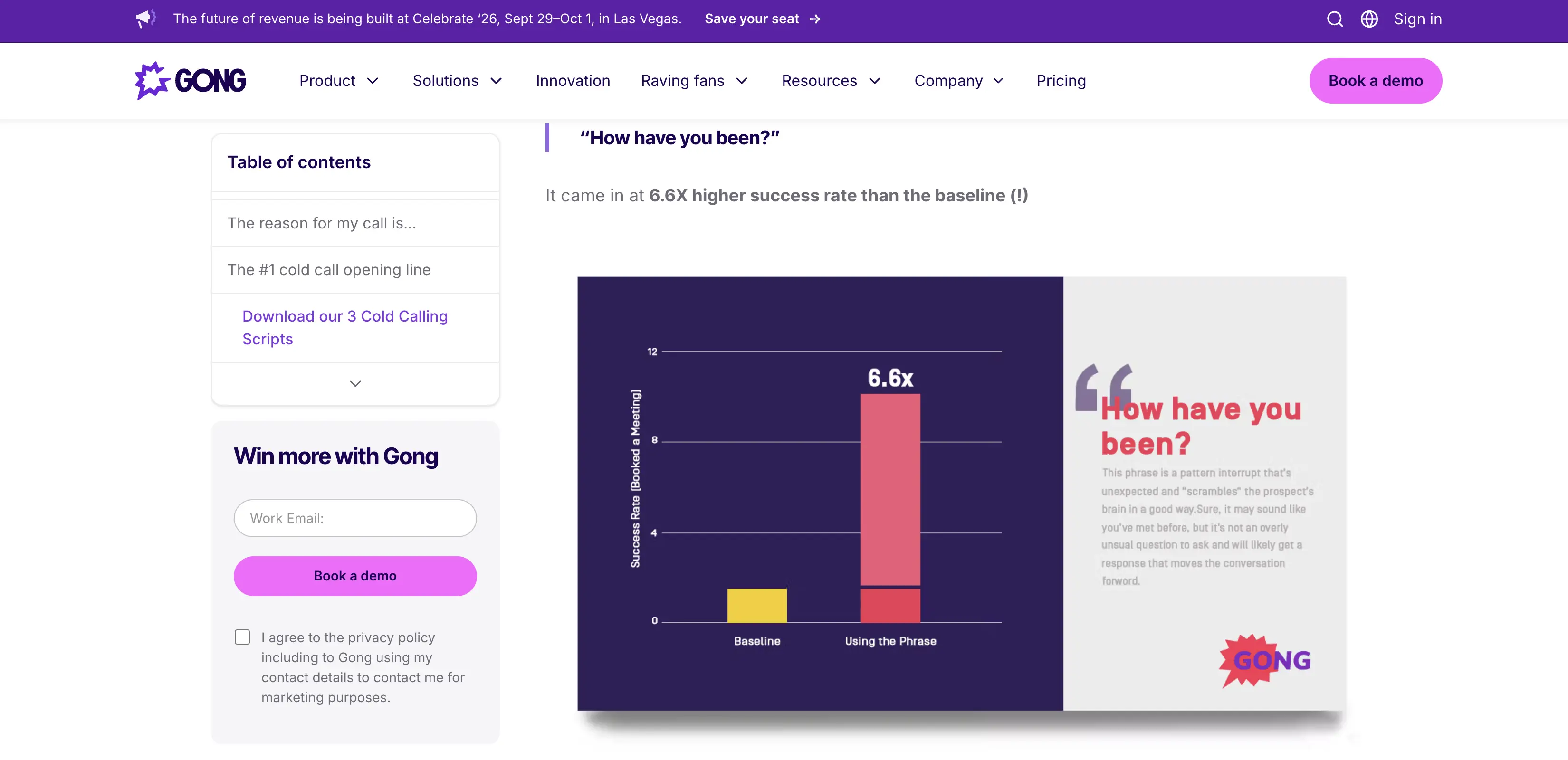
The pattern behind that gap holds up outside one dataset. As Chris Orlob, who led the research behind Gong's cold calling data, put it: "The person who asks the questions controls the conversation." An opener that asks something, even something small, keeps the prospect talking instead of reaching for the reason to leave.
Done when: the prospect has responded with more than a flat no, even if that response is confused or short.
Stage two: the reason for the call
What happens: You state, in one sentence, why you are calling this person specifically. Naming a real reason, a role change, a shared connection, a trigger event you noticed, does more work here than any clever phrase.
Done when: you have given the prospect a reason that is about them, not about your product.
Stage three: the value bridge
What happens: One sentence connecting the reason for the call to a problem you solve. This is not a pitch. It names a problem in language the prospect would use, then stops.
Done when: the prospect either confirms the problem sounds familiar or corrects your read on it, either of which keeps the call moving.
Stage four: the discovery question
What happens: You ask one open question about how the prospect currently handles the problem you named. Gong's same dataset puts the success rate above 70 percent for calls where the rep asked between 11 and 14 discovery questions across the whole conversation, well above calls with fewer or none.
Done when: the prospect has described their current approach in their own words, giving you something specific to respond to.
Stage five: the objection response
What happens: You meet the first pushback with a short answer, not a rebuttal script read word for word. Five objections come up more than any others.
"I don't have time to talk." Ask for the length of time you actually need, stated as a number, and offer to call back at a specific time if that number does not work.
"We already have a vendor for this." Ask what is working and what is not about the current setup, rather than arguing the current vendor is wrong.
"Send me an email." Agree, then ask one qualifying question before you hang up so the email you send is not a cold email to someone who was never a fit.
"We don't have budget for this." Ask when budget gets revisited, and treat the answer as your next call date rather than a dead end.
"It's not a good time." Ask when would be better, by name of month or quarter, and confirm you have permission to call back then.
Done when: the prospect has either engaged with your response or repeated the same objection a second time, which is your signal to ask for a specific next step rather than pushing further.
Stage six: the ask
What happens: You propose one specific next step; a fifteen minute call, a demo, an introduction to someone else on their team, with two time options rather than an open ended "when works for you."
Done when: you have a date on the calendar, a clear no, or a specific time to call back. All three count as a finished call.
Where to start based on your situation
Your situation | Where to start in the script above | What to change |
|---|---|---|
New rep or SDR learning the script | Read all six stages word for word for your first ten calls | Loosen the wording once the structure feels natural, not before |
Founder making your own calls | Stage two and three, since you likely already know the reason for the call | Skip formal discovery language and ask the question the way you would in conversation |
Agency or freelancer calling for a client | Stage three, the value bridge | Write it in the client's language, not your agency's, and confirm it with the client before the first call |
Manager refreshing a stale team script | Stage one and stage five | Test one new opener at a time so you can tell which change moved the numbers |
Calling into a specific industry (real estate, insurance, financial services, solar, software, freight, auto) | Stage three | Name the problem using the exact term that industry uses for it, not a general phrase |
Copy this script
The template below combines all six stages into one script you can read from or adapt. Fill in the parts in parentheses before your first call.
Hi (first name), this is (your name) calling from (your company). Do you have two minutes?

I'm calling because (specific reason: role change, shared connection, trigger event).

The reason that matters is that (one sentence naming the problem in the prospect's language).

How are you handling that today?

(Listen. Respond to what they actually said before moving on.)

Based on what you just told me, would a fifteen minute call on (day and time option one) or (day and time option two) make sense to go over how that could work?
No product name and no company specific claim appears in the template on purpose. Drop in whatever you actually sell where the value bridge line is.
What to do after the call
The call is not finished when you hang up. Three pieces of information matter more than a general note that the call happened: the exact objection raised, the exact question the prospect asked back, and whether the opener you used was the one you were testing that week.
Logging those three fields, rather than a summary sentence, is what turns ten calls into a pattern you can act on. A script only improves when you can point to which line caused which reaction, and a vague call note cannot tell you that six weeks later.
Where a call ends in genuine interest but bad timing, a phone conversation alone will not carry the relationship forward. A short message referencing the specific thing discussed on the call, sent the same day, keeps the door open, and a cold email follow up that repeats nothing from a first touch works the same way after a call as it does after an email.
A call rarely stands on its own, and the five stage cold email outreach process sets out where a dial belongs among the emails around it.
The 80/20 rule in cold calling
The 80/20 rule that comes up around cold calling is the Pareto principle applied to your call list, not a talk to listen ratio. In plain terms, a small share of the prospects on your list account for most of the meetings and revenue that come out of cold calling, and treating every name on the list with equal effort wastes time on the 80 percent that will convert at a much lower rate.
Growleady's explanation of the rule gives a concrete illustration: enterprise healthcare prospects on one list converted at 15 percent, while small retail prospects on the same list converted at 3 percent. The fix is not to call the low converting segment less politely. It is to call the high converting segment yourself and route the rest to email or LinkedIn, where the cost of reaching one more prospect is close to zero.
Is B2B cold calling legal
Cold calling a business number is legal in the United States under federal law, with one narrow exception. The Federal Trade Commission's guidance on the Telemarketing Sales Rule states that most calls between a telemarketer and a business are exempt from the rule and from the National Do Not Call Registry. The exact wording of that exemption, and the one category of call it does not cover, is worth reading directly rather than taking on faith.
That exemption is the reason a cold call to a business line does not need Do Not Call Registry clearance the way a call to a home number would, with one carve out.
The exception covers calls that try to sell nondurable office or cleaning supplies, items that get used up and repurchased, such as paper, toner, or solvents. A call selling software, equipment, or a service is not caught by that exception.
A second limit applies if your call is aimed at an individual employee's personal purchase or a charitable donation rather than the business itself; that call counts as a consumer call, not a business one, and the consumer rules apply.
State law can still add requirements on top of the federal exemption, so a quick check of the state you are calling into is worth the five minutes before a new campaign, even though the federal floor is permissive.
Mistakes that show up on real cold calls
The prospect hangs up before you finish your name. This is almost always an opener problem, not a tone problem. Test a question based opener for two weeks before concluding the list itself is bad.
The gatekeeper blocks every call. Ask the gatekeeper's name and use it. Then state your reason for the call exactly as you would to the decision maker, since a vague reason is what triggers a gatekeeper's instinct to screen you out.
The script sounds read, not said. Practice the opener and the value bridge out loud until you can say them while looking at something other than the page. Everything after stage four should be a real response to what the prospect said, not a memorized line.
No callback after a voicemail. A voicemail that asks for a callback gets one far less often than a voicemail that states a specific reason and says you will call again on a specific day. The second version turns the voicemail into a scheduled follow up rather than a request the prospect has to act on.
A long running Hacker News thread on cold calling, with 90 points and 56 comments, shows the same split every sales team runs into: people who have been cold called badly describe it as a waste of their time, while people who cold call for a living describe the same activity working when the caller did the homework and respected the length of the call. Both groups are describing the same tool used two different ways.
I once pulled twenty of my own logged calls from a single afternoon and timed each one against whether it ended in a booked meeting. The six calls that booked a next step averaged just under four minutes.
The fourteen that did not book anything averaged under ninety seconds, mostly because the prospect ended the call during the opener. Longer was not the goal. Getting past the opener was.
FAQs
What should I say when I cold call someone?
Say your name, your company, and a specific reason you are calling this person, followed by one sentence naming a problem in their language. Ask a question early rather than pitching first.
Should I read a cold call script word for word?
Read it word for word for your first several calls while you learn the structure, then loosen the exact wording once you can say each stage without looking at the page. The order of the stages matters more than the exact words.
Is telemarketing the same thing as cold calling?
No. Telemarketing usually means a scripted call selling directly to consumers, often from a call center, while cold calling in B2B sales is a rep reaching a business contact to start a conversation, not to close a sale on the call itself.
Is it better to outsource cold calling or keep it in house?
An in house rep who understands the product can adjust the value bridge on the spot; an outsourced team can dial a larger list faster.
Many teams start in house to find a script that works, then use an outsourced team to scale it.
How many cold calls does it usually take to book one meeting?
This varies widely by list quality and industry, but connect rates in the low double digits and success rates in the single digits are common even for experienced callers, which means dozens of calls per booked meeting is normal, not a sign the script has failed.
What is the best time of day to make a cold call?
Testing your own list against your own calendar beats a universal answer, since the best time depends on the roles you are calling and their industry. Track connect rate by hour for two weeks before picking a fixed calling window.
The next call is the real test
A script gets better through use, not through another round of edits before the first call happens. Pick the six stage version above, or the starting point from the table that matches your situation, and run it on the next ten calls on your list.
The objection responses and the opener wording matter, but the pattern you get from logging what actually happened on each call is what turns this script into your script.
Author Bio
Michael Doyle writes about B2B sales at Leaderr. He covers prospecting, cold outreach, sales data, and pipeline building, with a focus on what actually works for SDRs, founders selling on their own, and small sales teams.
Connect with him on LinkedIn: https://www.linkedin.com/in/michael-doyle-94aa3a430