SDR vs BDR: what each one owns and who gets a lead both are working
SDR vs BDR in plain terms: what each role owns, how titles change by company, and a routing table that says who gets a lead when both reps are working.
 Michael Doyle12 min read
At GitLab, an SDR works inbound leads and a BDR works outbound leads. Rippling's BDR posting calls the role an outbound SDR. Read the lead source before the title.
Then write one rule for who owns a lead that both reps touch, and store it in your CRM.
What you need before you start
SDR vs BDR in sales comes down to the lead source. Collect these four items first:
The titles your reps hold today and the leads each title works.
Every way a lead can reach you, for example, a demo form, an email reply, a referral, or an event list.
The CRM field that stores a lead's owner.
One manager who settles a dispute when two reps claim the same lead.
Who this is for and what it leaves out
A founder selling alone can use the hiring section to pick a first hire.
A sales lead with a small team can copy the routing table and fill in the owners.
A job seeker can use the posting checklist to read what a title covers.
Every section assumes B2B sales, where a rep books a meeting for an account executive.
Pay scales by company, job search tips and software picks are left out.
SDR vs BDR side by side
The difference between SDR and BDR shows in the first action: an SDR replies to a request, and a BDR starts the conversation.
The table compares the SDR vs BDR roles on five points, using GitLab's split of inbound and outbound work.
Point | SDR (sales development representative) | BDR (business development representative) |
|---|---|---|
Lead source | Inbound leads from people who asked to talk | Outbound prospects from accounts the company picks |
First action | Reply to the request and check fit | Research the account and send the first message |
Hand to the AE | A qualified meeting, with the buyer's stated problem | A qualified meeting after a positive reply |
Measure that fits | Time to first human reply, then meetings held | Positive reply rate, then meetings held |
When touches stop | When the buyer replies or books | When the prospect replies, books or asks to be removed |
The daily tasks of research, outreach, and booking are covered in what an SDR does.
What an SDR does with inbound leads
An SDR owns the first reply to someone who asked to talk. The rep reads the request, runs a fit check from your lead qualification process, and books the AE if the buyer fits.
What a BDR does with outbound prospects
A BDR owns outbound prospecting: the first message to a prospect who has not asked to talk. The rep builds a list of accounts that match your ICP, researches each one, and starts the outbound sales process with cold outreach.
A positive reply becomes a qualified meeting for the AE.
SDR vs BDR vs account executive: who takes the call
Both roles end at the same point: a booked meeting handed to an account executive, or AE. The AE runs the discovery call from there.
Send the buyer's stated problem, your fit notes, and any earlier outreach with the meeting.
Why the same title can mean different jobs
BDR vs SDR titles do not match from one company to the next. At some companies, SDR and BDR are the same job, and at others they are different jobs, so the meaning of each title changes with the employer.
T2D3 compared eight sources: six call the SDR inbound and the BDR outbound, and two say the reverse.
GitLab's job description library describes the SDR as the rep focused on inbound leads.
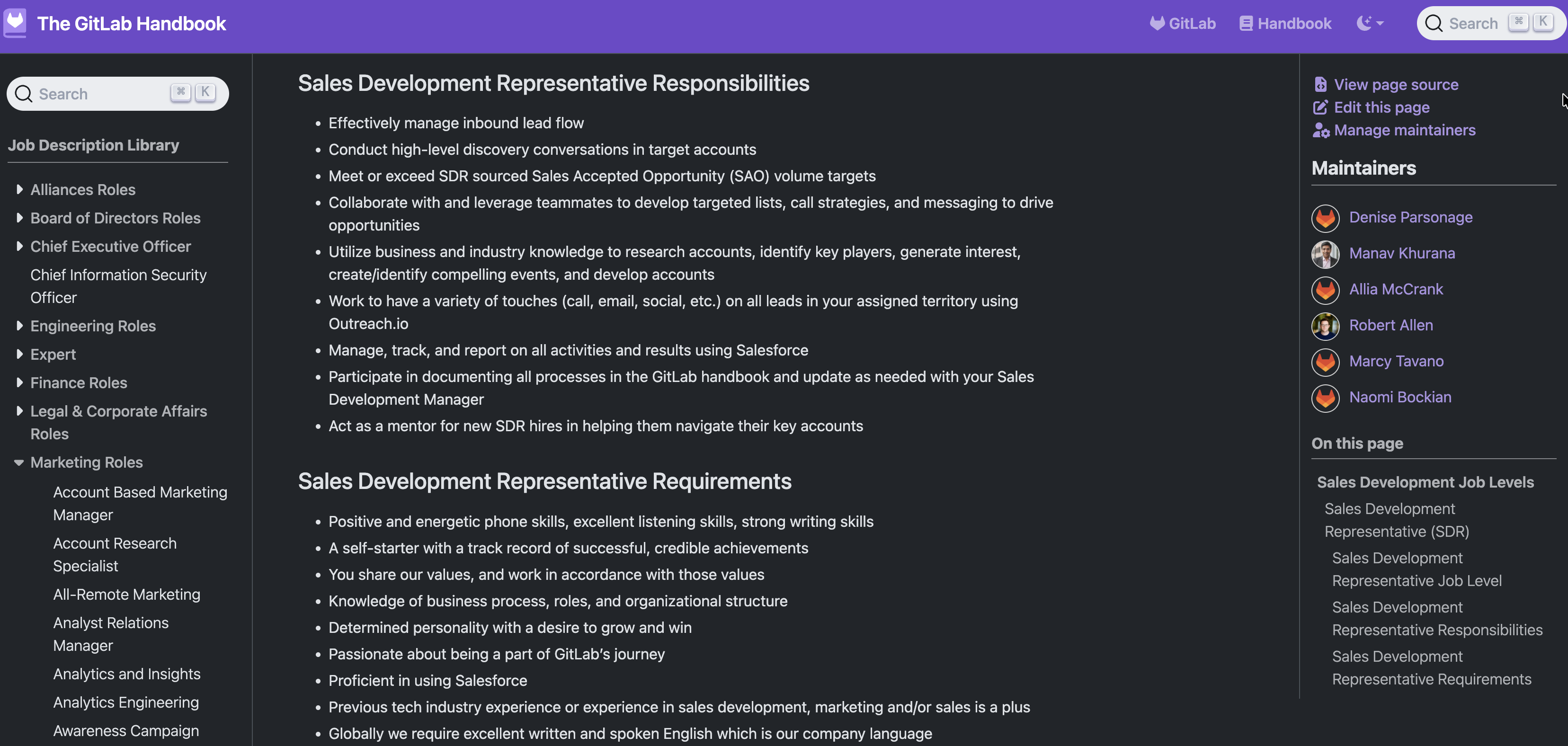
The opening lines of a posting carry the lead source, so read them first.
Rippling's BDR posting for Dublin says: "This role is for an Outbound SDR (Business Development Representative)."
The same posting says the team has two types of positions, Inbound SDR and Outbound SDR/BDR.
The table compares an inbound SDR with an outbound BDR as each company published them.
Company | Title in the posting | Lead source stated |
|---|---|---|
GitLab | Sales Development Representative | Inbound leads |
GitLab | Business Development Representative | Outbound leads |
Rippling | Business Development Representative, Polish (CEE) | Outbound, and the posting calls the role an Outbound SDR |
Rippling | Inbound SDR, named in the same posting | Inbound |
SDR vs BDR jobs: three things to read in a posting
Read these three lines before you apply or hire, whether the title says SDR or BDR:
Where the leads come from: inbound requests, outbound lists, or both.
What counts toward quota: meetings held, meetings booked, or opportunities.
Who takes the next call: an AE or the same rep.
GitLab's career path runs from SDR to BDR
GitLab's job description library lists one career path inside sales development: Sales Development Representative to Business Development Representative.
Both roles become eligible for promotion after 12 months. Read the posting before you assume a BDR sits above an SDR at another company.
Who owns a lead both reps are working
An overlap happens when a prospect in a BDR's outreach asks for a demo through the inbound form. Two reps now have a claim on one person.
Two published ownership rules
GitLab ties ownership to a status on the account. In its handbook, SDRs work MQLs from accounts marked Queued. An account that a BDR does not work recycles after 10 weeks.
When a prospect comes back directly to a BDR after the account stopped being Actively Working, the BDR moves it back to Actively Working and the lead transfers.
GitLab pays no double credit and no double compensation for one deal. For a web direct purchase, the SDR gets credit when two-way communication with the buyer happened in the 60 days before the purchase.
That exchange must be documented on the contact in the opportunity.
Salesforce's setup, as T2D3 summarizes it, points the same way: SDRs cannot handle inbound leads that the BDR organization has already engaged, and the SDR sends that prospect to the BDR.
The Salesforce detail comes from T2D3's summary, not from a Salesforce page.
Both rules keep the lead with the BDR who already works the account. I'd give it to the rep with the newest two-way conversation, and to the inbound SDR when neither rep has one.
Either choice holds if it is written down.
Two CRM fields that settle disputes
Keep two fields on every lead. Original lead source stays as it was when the lead was created. Current owner changes when the routing rule moves the lead.
Measure both roles on meetings held
Count the same output for both roles: qualified meetings that were held. A meeting that was booked and never took place should not count. GitLab's job description lists initial qualification meetings, where applicable, among the role's performance indicators.
Pair that with one more measure for each role:
Inbound SDR: time to first human reply.
Outbound BDR: positive reply rate.
Both roles: whether the AE accepts the handoff, judged by criteria you agree on before the quarter starts.
Put the count in the posting, so a candidate sees what the quota counts.
Which role to hire first
SDR vs BDR: which is better to hire first depends on the constraint you see this week. Pick the row that matches it.
What you see | Hire first | Check before you hire |
|---|---|---|
Qualified demo requests wait for a reply | An inbound SDR | Whether an existing rep can answer faster |
Inbound is thin, and one prospect segment already answers outbound | An outbound BDR | That the segment has a defined list |
Both channels are light | One rep for both, with a rule for which work comes first | The routing table below |
Meetings get booked and stall after handoff | Neither yet | Fit checks and AE capacity |
Check the SDR to AE ratio
The Bridge Group's 2025 SDR report surveyed 351 B2B companies. It lists 1 SDR for every 2.4 AEs.
The most common setup is 1 SDR to 2 AEs, used by 31% of companies.
Here is an example. Say you have 3 AEs.
At 1 SDR for every 2.4 AEs, divide 3 by 2.4.
That gives 1.25 SDRs, so start with 1.
When one rep covers both
With few leads in both channels, one rep can work both. Give that rep a written order: reply to inbound requests first, then work outbound.
Copy this lead routing table
Four cases and their owners
Use this table as a sample policy and change the owners to match your team.
Case | Owner | Next action | What to pause |
|---|---|---|---|
1. New demo request, no active outreach, no open deal | Inbound SDR | Check fit, reply, and book the AE if the buyer qualifies | Nothing |
2. New prospect at a target account who never contacted you | Outbound BDR | Research the account, start outreach, and qualify any positive reply | Nothing |
3. Demo request from a contact in active outreach | The rep with the newest two-way conversation; otherwise, the inbound SDR | Send one reply that covers the demo request, notify the other rep, and keep the outreach history | The remaining automated touches to that contact |
4. Request from an account with an open deal | The AE who owns the deal | Route the request with the contact and message attached | All automated outreach to the account until the AE checks |
Row 3 pauses the remaining touches because a sales cadence stops when the prospect replies, books, or asks to be removed.
Change row 3 to the BDR if you follow the published rules above.
Set it up in four moves
List every way a lead can arrive and write each one as a row.
Name one owner for each row.
Add the original lead source and current owner fields to your CRM.
Pause every automated touch to a contact when a second rep gets a reply.
What the buyer and the AE see after a demo request
This is an example, not a record. Say a company sells equipment rental software to landscaping firms, and row 3 gives the reply to the inbound SDR.
Day 0: A BDR sends the first cold email to the owner of a landscaping firm. The CRM logs the touch and sets the original lead source to outbound.
Day 3: The BDR sends the second email.
Day 4: The owner fills in the demo form. The CRM adds the inbound event and leaves the original lead source as outbound.
Day 4, same hour: Neither rep has a two-way conversation yet, so row 3 gives the reply to the inbound SDR. The remaining automated touches stop, and the BDR gets a notice.
Day 5: The owner sees one reply that answers the demo request and offers times. No third cold email arrives.
Day 6: The AE opens the meeting record and finds the owner's stated problem, the SDR's fit notes, and both cold emails.
Where lead routing breaks
Four failures show up when two reps share one buyer. Each has a fix you can write into the routing table.
Two replies reach one buyer. Give the case one owner and pause the other rep's remaining touches.
Both reps claim credit. Write the credit rule down and log the buyer's reply in the CRM.
The lead source gets overwritten. Keep original lead source and current owner as two fields.
A dispute has no end. Set the order for settling it before the first dispute.
GitLab's handbook sets that order: the SDR and BDR talk it through, their managers decide next, and Senior Leadership settles what is left.
Copy that order into your own rule and swap in your own managers.
In an r/sales thread titled Sales vs. Business Development, one reply says the two titles are impossible to tell apart and that only inbound versus outbound matters.
A capture from 2 January 2026 showed 25 points and 32 comments.
Common questions about SDR vs BDR
Can an SDR do outbound work?
Yes. Rippling's BDR posting says the role is for an Outbound SDR, and the same posting names Inbound SDR and Outbound SDR/BDR positions. Check each posting for its lead source.
Can one person do both jobs?
Yes, when volume is low in both channels. Give that rep a written order for which work comes first, and use the routing table so inbound requests and outbound touches do not collide.
Is a BDR higher than an SDR?
At GitLab, yes. Its listed career path runs from SDR to BDR, and both roles become eligible for promotion after 12 months.
Rippling's BDR posting calls the role an outbound SDR, so the titles do not always mark different levels.
Should I apply for an SDR or a BDR job?
Read three lines in the posting: the lead source, what counts toward quota, and who takes the next call.
Pick an inbound SDR role if you want to spend the day replying to requests, and an outbound role if you want to start conversations.
Do SDRs make more than BDRs?
The Bridge Group's 2025 SDR report lists one median for SDRs: $80K OTE, split into $55K base and $25K variable. The public summary does not break out pay by SDR and BDR title, so compare the OTE in each posting.
Is SDR an entry-level job?
It can be. GitLab's sales development path starts at SDR, and the Bridge Group's 2025 report counts 16% of its 40% median turnover as promotions. Check the required years of experience in each posting.
Give each case one owner and put it in writing
Fill in the owner column for all four cases before the next rep starts. Add the original lead source and current owner fields to your CRM.
If a case is still unclear, give it to the rep with the newest two way conversation with the buyer.
Guidance and sources reviewed 10 November 2026.