

A sales cadence is a spaced sequence of calls, emails, and other touches aimed at one prospect.
Guides disagree wildly on how many touches it needs, from 5 to over 1,000, mostly because they measure different things or repeat unsourced numbers.
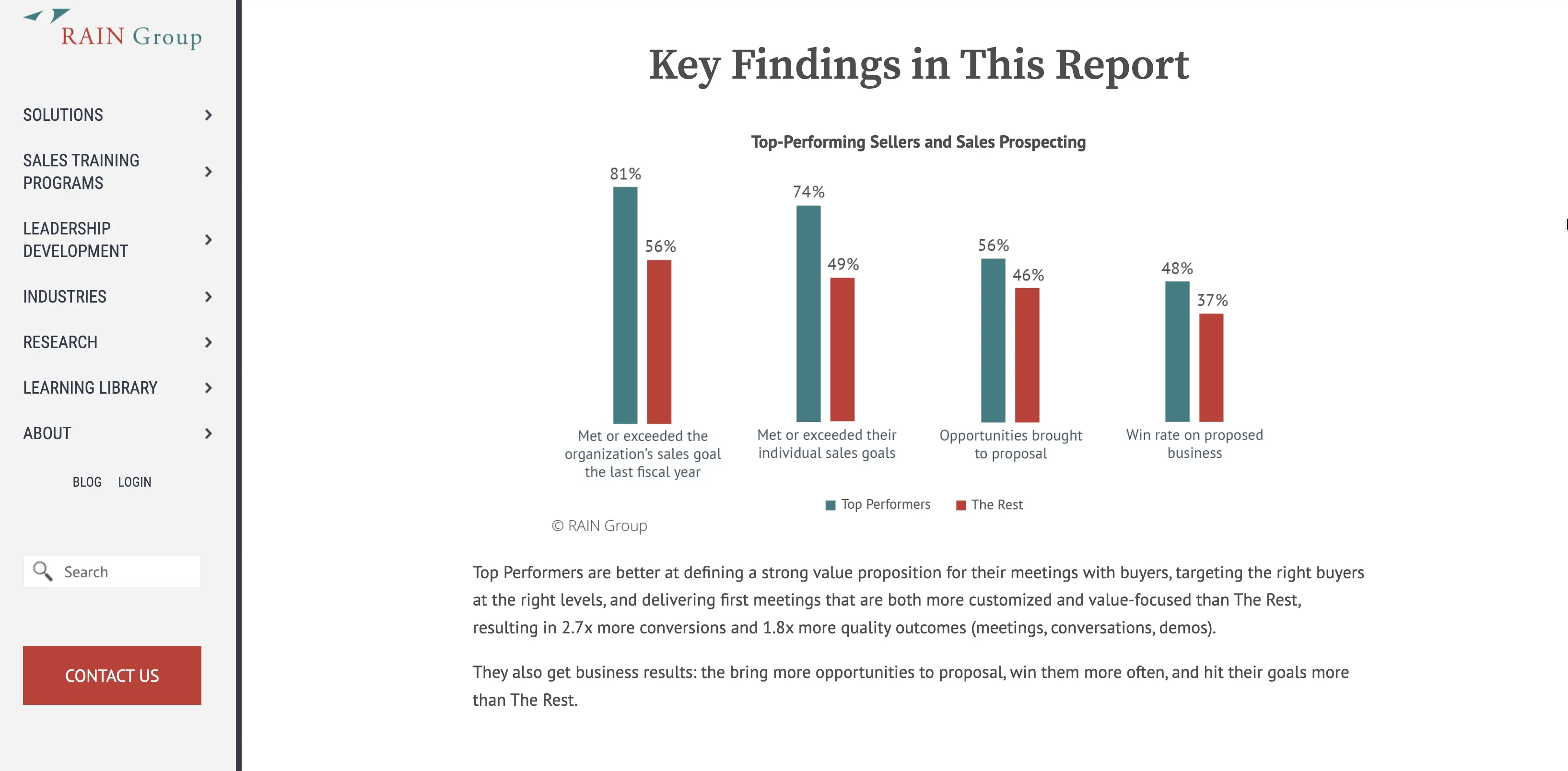
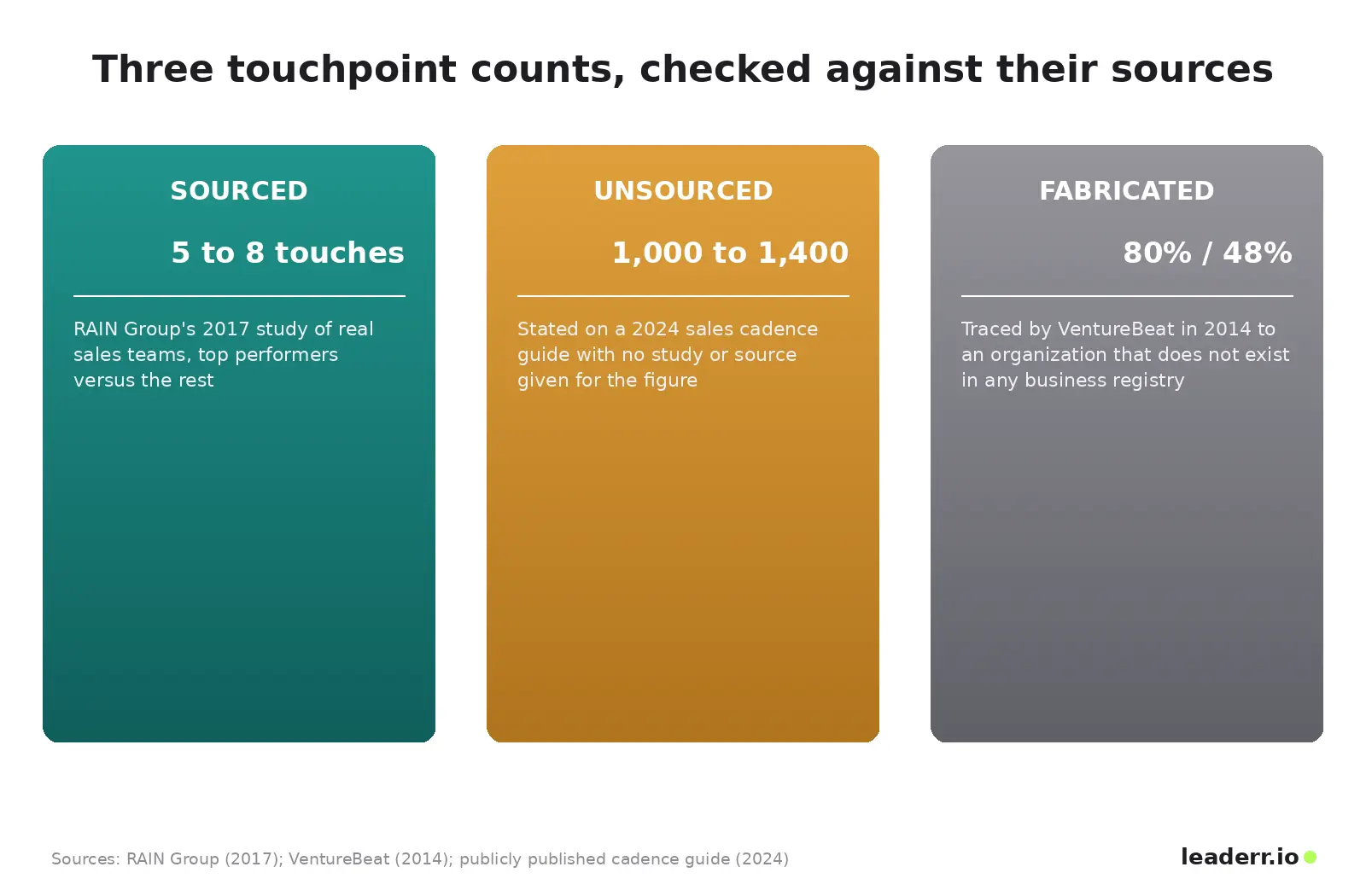
A 2017 study of real sales teams found top performers needed about 5 touches to convert a prospect; the rest of the field needed about 8.
What this term actually covers
Sales cadence vs sales sequence
The two words often get treated as interchangeable. A useful line to draw: a sequence is the software object, the scheduled steps sitting inside a CRM or a sending tool.
A cadence is the plan behind it, the reasoning for why those steps exist in that order. You can describe a cadence on a whiteboard before any tool exists to run it; once it is built and scheduled, it becomes a sequence.
Most people searching either term want the same answer: how many touches, on which channels, spaced how far apart.
There is a second confusion worth clearing up early. A quoted touchpoint count is either touches to reach one prospect in one cadence, or total touches across an entire deal once a buying committee gets involved.
Conflating the two is where most of the confusion below comes from.
Who this covers, and who it does not
This guide is for anyone building or fixing a cadence by hand: a solo founder, an SDR, or a small team without a dedicated platform. It covers touch count, channel mix, timing, and when to stop, not how to configure a specific CRM's automation feature, which changes by product.
What you need before you start:
A defined audience: a list of people who fit a real, specific reason to be contacted, not a broad title search
A way to reach them on at least two channels, usually an email address plus a phone number or LinkedIn profile
A place to log each touch and its date; a spreadsheet is enough for a first cadence
Roughly 15 to 20 minutes to plan the sequence, then a few minutes a day to run it
A first prospecting pass already carries its own baseline: five touches across two channels before marking a contact unresponsive. What follows is how to turn that baseline into a full cadence.
What a real study found
RAIN Group tracked real sales teams and measured how many touches it actually took to convert a new prospect into a first conversation.
Top performing sellers averaged 5 touches. Everyone else averaged 8.
For an existing account, both groups needed fewer: 3 touches for top performers, 4 for the rest.
The same research found 43 percent of buyers who eventually accept a meeting say it is fine for a seller to try 5 or more times before getting through.
The touchpoint number everyone disagrees about
Two other numbers circulate for the same question, and neither holds up as well.
The number nobody sourced
One widely shared guide to sales cadences states a range of 1,000 to 1,400 touches per sourced opportunity, with no study or source given for the figure anywhere on the page.
The same page separately credits a named sales trainer with a recommendation of 17 or more touchpoints, a number roughly one hundredth the size. Neither claim is reconciled with the other.
The number that was never real
The most repeated version of this statistic, that 80 percent of sales happen between the fifth and twelfth contact and 48 percent of salespeople never follow up a second time, traces to a 2014 investigation that found no trace of its claimed source; the organization it names does not appear in business registries, IRS records, or Better Business Bureau listings.
A guide to sales cadences published in March 2026 still repeats a close variant of it, crediting a different secondary source rather than the original.
Pick the channels first
A cadence needs more than one channel, since a single channel gives a prospect one chance to miss the message.
The channels worth planning around are email, phone, LinkedIn, and for higher value accounts, a short video or direct mail piece.
Voicemail counts as part of a phone touch, not a separate one.
The 40/40/20 split is one benchmark, not a rule
A common recommendation splits effort 40 percent phone, 40 percent email, 20 percent LinkedIn. That figure comes from a single company's internal benchmark for one cadence type in one article, not a tested standard.
Treat it as a starting point, not a fixed formula.
How many touches by cadence type
The right count depends on the type of contact this is, not one number that applies everywhere.
The ranges below start from RAIN Group's measured 5 to 8 touch figure and adjust for how much prior interest already exists.
Cadence type | Realistic touch range | Why |
|---|---|---|
Cold outbound, no prior contact | 6 to 10 touches over 2 to 3 weeks | Builds on the 5 to 8 touch range RAIN Group measured, with room for channel variety |
Inbound lead who already reached out | 3 to 5 touches over 1 to 2 weeks | Interest is already shown, closer to RAIN Group's existing account figure of 3 to 4 |
Enterprise deal with a buying committee | 6 to 10 touches per stakeholder, repeated across everyone involved | This is where the count multiplies into the hundreds, once several stakeholders each need their own cadence |
Restarting contact with someone gone quiet | 3 to 5 touches over 1 to 2 weeks | A relationship already exists, so it behaves like the inbound number rather than a fresh cold cadence |
Build the cadence in six steps
Step 1: Set the goal for this cadence
What happens: Decide what success looks like before picking a channel or writing a word: a booked meeting, a qualifying reply, or a completed form.
Done when: The goal fits in one sentence.
Step 2: Confirm the audience fits
What happens: Check that everyone on the list shares the specific reason for reaching out, not just a job title or company size.
Done when: Every name has a one line reason for being there.
Step 3: Choose the channels
What happens: Pick at least two channels from email, phone, and LinkedIn based on where this audience actually responds; for structuring the actual call script and opener, a separate walkthrough of cold calling structure covers that channel on its own.
Done when: Each touch in the plan has a channel assigned to it.
Step 4: Map the timing
What happens: Space touches using the table above, front loaded in the first week; daily touches read as pressure, and touches spread past a month lose momentum.
Done when: Every touch has a day number attached, counting from day 0.
Step 5: Write each touch to do a different job
What happens: The first touch introduces the reason for reaching out. The second adds one new piece of information. Later touches try a different angle or channel rather than repeating the first message.
For the email-specific version of this sequence, including subject lines and a full day-by-day layout, see the cold email follow up sequence.
Done when: No two touches in the sequence make the same point the same way.
Step 6: Set the exit rule before you start sending
What happens: Decide in advance what ends the cadence: a reply, a booked meeting, an unsubscribe request, or reaching the last planned touch with no response.
Done when: The exit rule is written down next to the sequence, not left as a judgment call for later.
A cadence you can copy
A six touch, three week starting point for a cold outbound cadence. Adjust the spacing and touch count using the table above once real reply data comes in.
Cold outbound, 6 touches, 18 days:
Day 0: Email, introduce the specific reason for reaching out
Day 3: Phone call, reference the email if it goes to voicemail
Day 6: Email, add one new piece of information not in touch 1
Day 10: LinkedIn connection request with a short personalized note
Day 14: Phone call, try a different time of day than touch 2
Day 18: Email, a short final message stating this is the last touch unless something changes
Before sending, confirm: the goal from step 1 is written at the top of the plan, every touch has an assigned channel and day, the exit rule is set, and touch 1 and touch 3 make different points rather than the same message twice.
What happens after the cadence gets a response
One meeting rarely closes the deal
RAIN Group also measured how many meetings a real opportunity takes to form, across every respondent in the study.
Just 8 percent of opportunities formed after a single meeting; 22 percent needed 2, 23 percent needed 3, another 23 percent needed 4 or 5, 15 percent needed 6 to 10, and 10 percent needed 11 or more.
A cadence that ends the moment someone replies is solving the wrong problem; the reply starts a second, longer sequence, not the finish of the first one.
When to stop or change the cadence
Signals to stop
Stop the cadence the moment a prospect replies in any form, asks to be removed, or books a meeting.
Sending scheduled touches after any of these three signals turns a planned sequence into noise.
Signals to adjust instead of stopping
A cadence with opens but no replies across the first 3 touches usually has a messaging problem, not a timing one; rewrite touch 1 before adding more touches.
No opens at all in that window points to send time, subject line, or delivery, worth checking before writing new copy.
Cadence health checklist:
Reply, positive or negative, within the first 3 touches: message is landing, keep the sequence
Opens with zero replies through touch 3: rewrite the message before adding touches
Zero opens through touch 3: check send times and delivery before touching the copy
Exit rule triggered: stop immediately regardless of how many touches remain
Mistakes that quietly break a cadence
Symptom | Likely cause | Fix |
|---|---|---|
High open rate, no replies | The message restates what the prospect already knows instead of adding something new | Rewrite touch 1 around one specific, concrete reason for the outreach |
Replies stop after touch 1 | Every later touch repeats the same pitch in different words | Give each touch a distinct job, per step 5 above |
Cadence runs past 3 weeks with no plan for what comes next | No exit rule was set before sending started | Set the exit rule in step 6, before the first touch goes out |
Same cadence used for cold and inbound leads | One sequence built for cold outreach applied to people who already asked a question | Use the touch range table above to size a shorter sequence for warmer contacts |
Jason Lemkin, the founder of SaaStr, has criticized generic multi touch sequences as "spray and pray", arguing they add touches without adding value.
His fix is not more or fewer touches, it is making each one earn the right to exist.
FAQ
How long should a sales cadence run?
Most cold outbound cadences run 2 to 3 weeks. One that runs longer than a month with no response has effectively ended, even with scheduled touches left.
Does a cadence work the same way for inbound leads?
No. Someone who already reached out has shown interest, so the table above puts inbound cadences at 3 to 5 touches over 1 to 2 weeks, shorter than the cold outbound range.
What should you track while a cadence runs?
Track opens, replies, and which touch got the response, by day and channel, not one overall percentage.
The health checklist above uses the first 3 touches as the checkpoint for adjusting.
Do you need special software to run a cadence?
No. A spreadsheet with a name, channel, and day number per touch runs a cadence as reliably as a dedicated tool, which mainly saves the time spent triggering each step by hand.
How much should each touch be personalized?
Enough that touch 1 names something specific to that person or company, not a template with a name filled in. Later touches need less new personalization as long as each still adds a different point.
Copy the range, not the number everyone repeats
The honest answer is a range grounded in one real measurement: 5 to 8 touches for a cold prospect, adjusted by how much interest already exists.
The much larger numbers circulating online either measure something different, a whole deal instead of one prospect, or in the most repeated case, trace back to a source that was never real.
Guidance reviewed 28 September 2026.
About the author
Michael Doyle writes about B2B sales at Leaderr. He covers prospecting, cold outreach, sales data, and pipeline building, with a focus on what actually works for SDRs, founders selling on their own, and small sales teams. Connect with him on LinkedIn.