

Lead qualification is the step where you decide if a lead is worth real sales time, checking fit, interest, and readiness before you build a case around it.
The step almost every guide skips comes first: check the record itself. A wrong job title or a dead work email turns a good fit into a wasted call before anyone gets to ask a single question.
What you need before you start
You do not need a CRM, a scoring model, or a marketing team to run this process. You need three things: a written definition of who this offer is actually for, a place to record what a lead answers, and someone willing to say no to a lead that does not fit.
Everything below still works if that someone is you.
The process changes shape depending on who is running it.
Situation | What changes | What stays the same |
|---|---|---|
Solo founder with no CRM | You combine both checks into one pass | Fit, interest, and readiness still all need a yes |
Small team without a dedicated SDR | Whoever answers the phone owns validation, not just the close | The order of the checks does not change |
Agency qualifying leads for a client | The client sets the pass bar in writing first | The four field check runs the same regardless of who owns the deal |
Established team with a CRM and marketing function | Marketing pre checks three of the four fields | A rep still confirms fit out loud before calling it qualified |
What counts as a qualified lead before you build anything
A lead is qualified when three things are true at once: the account fits your ICP, the person shows genuine interest rather than curiosity, and the timing is close enough to act on now. Miss any one of the three and you have a warm lead, not a qualified one.
That matters more than it sounds. Forrester's research on revenue process alignment puts the typical inquiry to closed won conversion rate for a marketing qualified lead centered process under one percent, meaning fewer than one in a hundred people who raise a hand ever become a customer.
Most of that gap is not a sales skill problem. It is leads that were never going to close being treated as if they might.
Fit, interest, and readiness, not just a form fill
A form fill tells you almost nothing on its own. Fit comes from the account: size, industry, and whether the problem you solve is one this company actually has. Interest comes from behavior: what someone asked, downloaded, or said on a call, not just that they clicked a button.
Readiness comes from timing: a budget cycle, a contract renewal, or a problem that just got worse. A lead can be a perfect fit and still be a year away from buying, which makes it qualified for later, not for a rep's calendar today.
Before any of that gets scored, it helps to know what actually counts as a sales lead in the first place, since teams that skip this step tend to argue about qualification without agreeing on what they are qualifying.
MQL, SQL, PQL, and SAL, in one place
Term | Plain meaning | Why it matters |
|---|---|---|
Lead | Anyone who has shown any interest at all, from a form fill to a business card | Not yet worth full sales time |
MQL | A lead marketing has judged as fitting the profile well enough to hand off | Signals fit, not readiness |
SAL | An MQL that sales has accepted into its own queue before fully qualifying it | The handoff point most teams skip past without noticing |
SQL | A lead a rep has personally confirmed as worth pursuing | The output of the process this article covers |
PQL | Someone already using a free or trial product in a way that signals buying intent | Common in software, rare outside it |
Fit and readiness are usually scored before a rep ever sees a record, and generation is a separate job from qualification.
Generation finds the lead. Qualification decides if the lead deserves the next thirty minutes of someone's day.
Check the record before you judge the lead
Here is the part nobody writes down: a lead can pass every fit and interest check and still be worthless if the data behind it is wrong.
A dead email, a made up job title, or a company name that does not match a real domain sails through most qualification frameworks untouched, because BANT and MEDDIC assume the record in front of you is accurate. Neither one checks it.
What a bad record does to a good fit
A rep who spends fifteen minutes qualifying a lead with a fake email has not wasted fifteen minutes. They have wasted the slot a real, reachable lead could have filled instead.
The cost shows up later, as a call that never connects or a proposal that bounces, and nobody traces it back to the record that should have been caught first.
The four field check, before anything else
Run these four checks before you spend a single minute on fit, interest, or readiness.
The name matches a real, findable person, not a placeholder or an obvious alias
The email domain matches the stated company, or the company is confirmed some other way if the domain is generic
The company itself is a real, operating business, not a defunct name or a duplicate entry
The stated job title is plausible for someone who could actually approve a deal of this size
A lead that fails any one of these goes back for a data fix, not straight to disqualified. The record might still be a good fit once it is correct.
Qualify inbound and outbound leads differently
Almost every qualification guide describes one flow and expects it to work whether the lead found you or you found them.
It does not, because the two situations start from opposite assumptions about trust.
Inbound: earn trust before you ask hard questions
Someone who filled out a form already believes you might help them. The mistake is opening with budget and authority questions before confirming what problem brought them there.
Ask about the problem first. Fit and budget questions land better once the person feels heard, not interrogated.
Outbound: earn relevance before anything else
You reached out first, so the burden of proving relevance sits on you, not the prospect. A cold contact asked about budget in the first two minutes has no reason to answer honestly, since you have not yet earned that answer.
Lead with a specific, researched reason you reached out, and move to fit and budget once the person engages back.
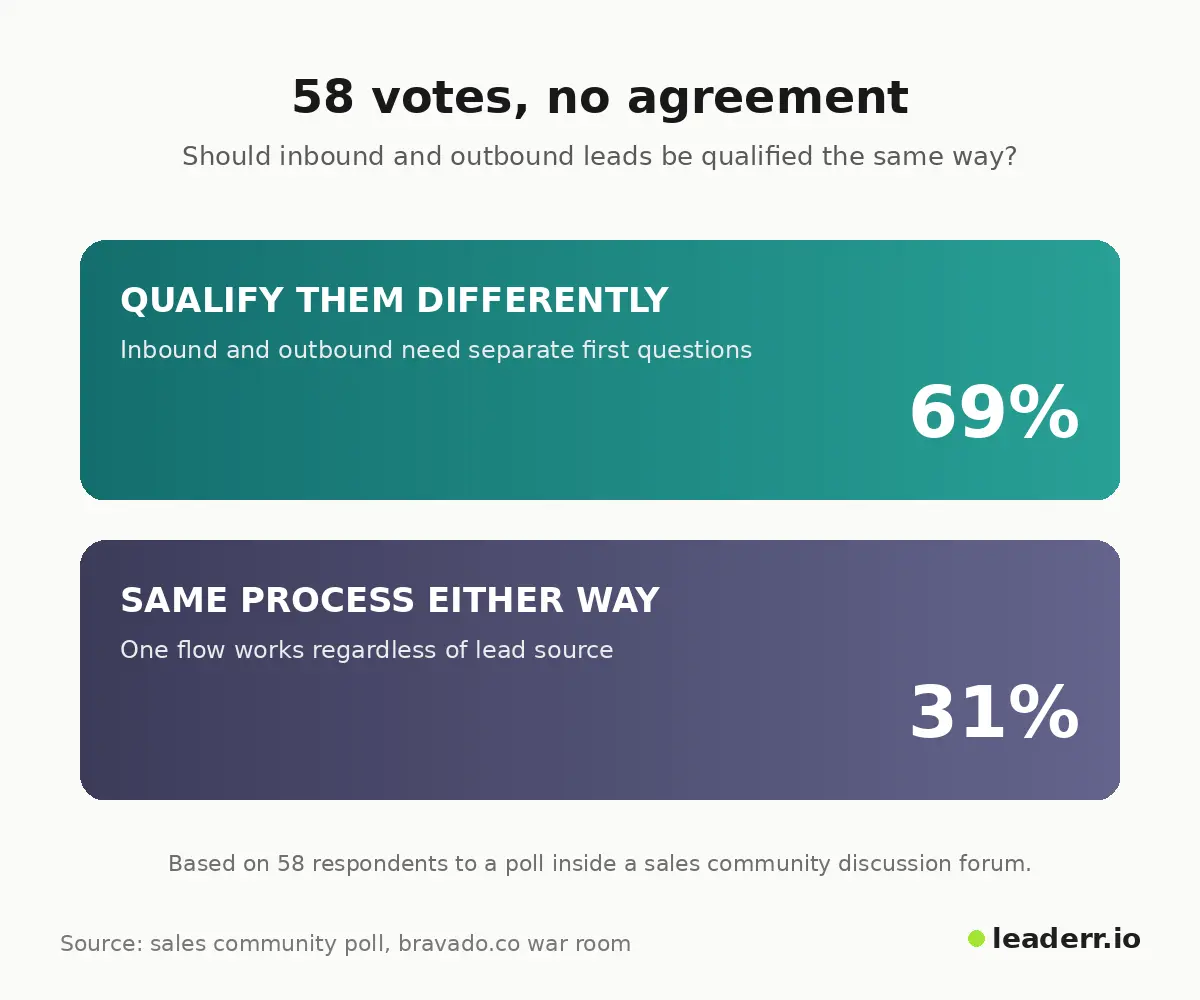
Sales professionals do not agree on how far apart these two flows should be. A poll run inside a sales community forum asked whether inbound and outbound leads should be qualified the same way.
Fifty eight people answered, and sixty nine percent said no, they treat them differently, while the rest said the process should not change based on where a lead came from.
Whichever side of that split your team lands on, agreeing on it in writing beats leaving every rep to decide alone mid call.
Pick one framework and write it down
BANT, CHAMP, and MEDDIC all try to answer the same question in a different order. The framework matters less than picking one and having sales and marketing use the same definition of qualified before anyone applies it.
Gartner's Billy Luckey, a director on the sales practice team, found in a survey that sixty two percent of respondents described their own sales and marketing functions as defining a qualified lead differently.
A framework cannot fix that. Only a shared definition can.
Framework | Checks first | Fits best | Weak point |
|---|---|---|---|
BANT | Budget and authority | Short sales cycles with one clear decision maker | Assumes the buyer already knows their own budget |
CHAMP | The challenge itself | Teams selling against a named, specific problem | Leaves authority for later, so time can go to the wrong contact |
MEDDIC | Metrics and the buyer's own process | Complex deals with several stakeholders | Slow for a quick, lower value sale |
Ask questions in this order
Once the record is validated and you have picked a framework, the order of the conversation itself decides how much you learn before the prospect gets tired of answering questions.
Confirm the record: restate the company and role back to the person and let them correct you if it is wrong
Confirm the problem: ask what prompted them to look for a solution now, not six months ago
Confirm authority and budget signal: ask who else needs to agree, not just who holds the budget
Confirm timing: ask what happens if nothing changes in the next quarter
Score and route: record the answers immediately, before the next call erases the details of this one
This is also roughly where prospecting hands a lead over for qualification rather than where the relationship starts, so a rep picking this up mid process should expect some of step one to already be answered.
Know your pass rate before you decide your bar is wrong
Nobody publishes what a normal qualification pass rate looks like, so most teams guess whether their bar is too tight or too loose.
Work backward from the Forrester figure cited earlier instead of guessing blind.
If under one percent of raw inquiries eventually close, and a reasonably run process converts qualified leads to closed deals at twenty to thirty percent, then a pass rate of ten to twenty five percent of raw leads is defensible for most B2B teams.
Under five percent usually means the bar is too tight. Over forty percent usually means it barely filters anything.
Track your own number for a full month before changing anything. A single bad week tells you nothing about where your bar actually sits.
Set a time limit, not just a step count
A qualification process with no time limit turns into a queue that never empties.
Cap it on three dimensions: the number of touches before a lead moves to nurture instead of qualification, the total number of days a record can sit in the qualification stage, and the length of the call itself.
Three touches over five business days is a reasonable default for most B2B teams. A lead that has not responded after that has told you something, even without saying a word.
Disqualify with a real script
Most teams know when to disqualify a lead. Almost none of them have the actual sentence ready to use in the moment, so reps either avoid saying it or say something vague that leaves the door open when it should close.
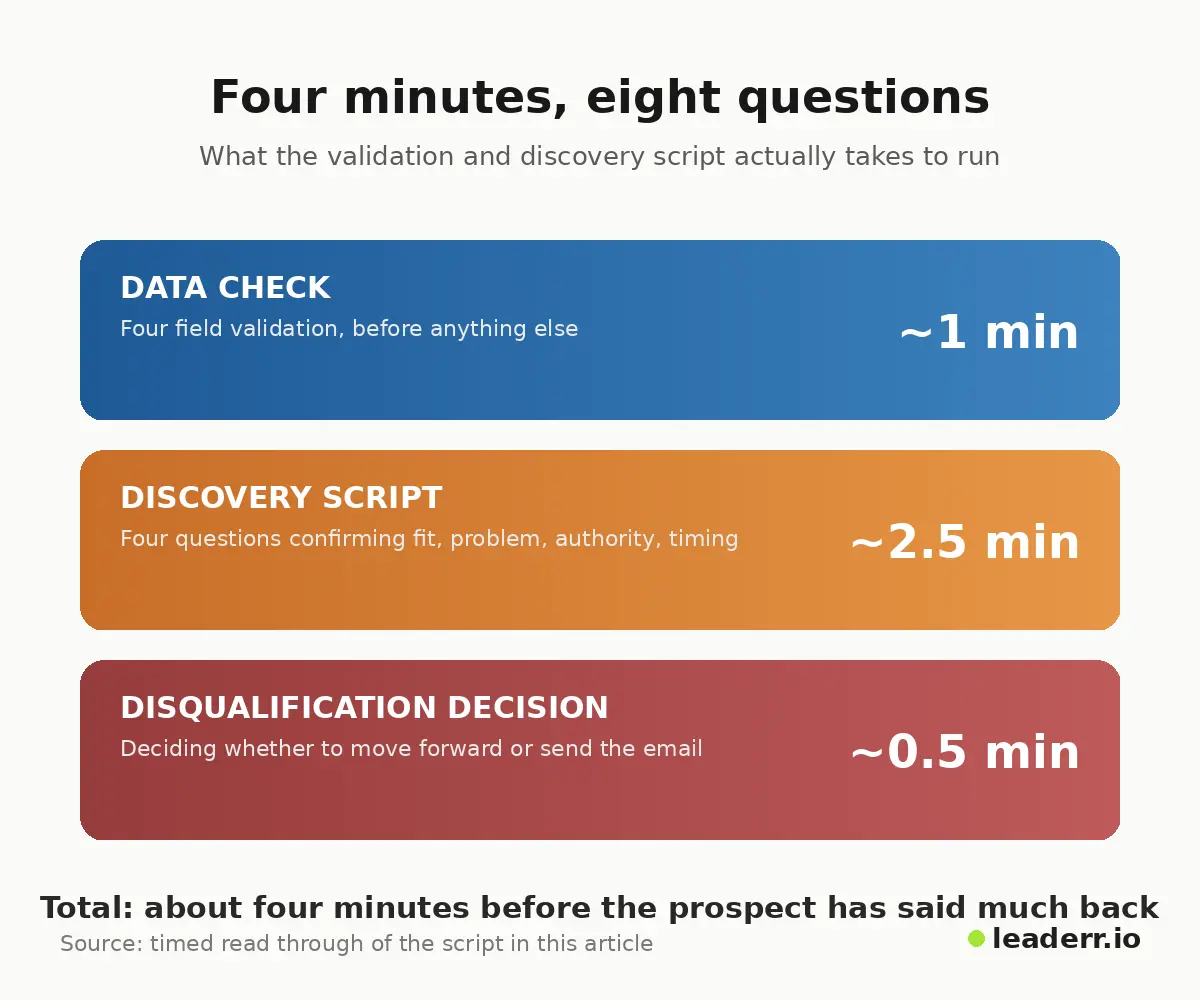
I wrote the script below and read it out loud at a normal, unhurried pace: four minutes and change to work through the four field check plus the five question order above, before the prospect has said more than a few words back.
That is the real cost of doing this properly, and it is worth knowing before you promise a rep it only takes a minute.
DATA CHECK (before the call)
Name matches a real person: yes / no
Email domain matches the company, or company confirmed another way: yes / no
Company is a real, operating business: yes / no
Job title is plausible for a deal this size: yes / no
If any answer is no, send the record back for a data fix. Do not proceed.

DISCOVERY SCRIPT (on the call)
1. "Just to confirm, you're at [company] as [role], is that right?"
2. "What prompted you to look into this now, rather than a few months ago?"
3. "Besides yourself, who else would need to agree before moving forward?"
4. "If nothing changes here in the next quarter, what happens?"

DISQUALIFICATION EMAIL (when the answer is no)
Subject: Following up on your recent inquiry
Hi [name],
Thanks for taking the time to talk this through. Based on what you shared,
this does not look like the right fit right now, mainly because [specific
reason from the call, not a generic line]. I did not want to keep you in
a process that was not going anywhere.
If that changes, or the timing shifts, feel free to reach back out.
[Sender name]
What happens after a lead qualifies and the data turns out wrong
Sometimes a lead passes every check, gets handed to a rep, and the contact information turns out to be wrong anyway, maybe the person changed roles or the email started bouncing after the fact.
The instinct is to drop it and move on. Do not.
Send it back to the validation step with a note about what was wrong, rather than back to the start of the whole process.
A lead that was a real fit two weeks ago is usually still a real fit today. Only the contact path needs fixing, not the judgment that got it there.
Where qualification breaks
Symptom | Cause | Fix |
|---|---|---|
A qualified lead goes cold right after handoff | The record was checked once at intake and never rechecked before the call | Recheck the four fields the moment a rep actually picks up the lead |
Sales and marketing keep arguing about the same lead | Each side is quietly using its own definition of qualified | Write the definition down and agree on it before picking any framework |
Reps let leads sit instead of disqualifying them | There is no script, so saying no feels awkward and gets avoided | Use a fixed script so disqualifying takes the same effort as saying yes |
A qualified lead turns out to have false company data | Qualification checked interest and budget but never the record itself | Send it back to validation instead of dropping it, noting what was wrong |
A sales community discussion on this exact topic runs long past the disagreements already mentioned.
One contributor summed up the core judgment call plainly: does the person actually agree they have the problem your product solves, not just that they answered a form.
Another pushed back on reps who send unresearched, scattershot outreach and then wonder why nothing qualifies, arguing that skipping the research is what creates most of the bad leads in the first place.
FAQs
What are the different types of qualified leads, beyond MQL and SQL?
Beyond MQL and SQL, the two most common additional types are PQL, someone whose product usage signals intent, and SAL, an MQL that sales has accepted into its queue but not yet fully qualified.
Some teams also track a service qualified lead, someone flagged by a support or success team rather than sales or marketing.
Which comes first, the lead or the opportunity?
The lead comes first. An opportunity is created only after qualification confirms fit, interest, and readiness, at which point the record moves from a lead you are evaluating to a deal you are actively working.
What's the difference between an MQL and an SQL?
An MQL is marketing's judgment that a lead fits the profile. An SQL is a sales rep's personal confirmation, after a real conversation, that the lead is worth pursuing.
One is a guess based on data. The other is a decision based on a conversation.
Is lead generation the same thing as lead qualification?
No. Generation finds the lead in the first place, through ads, content, outbound, or referrals. Qualification decides whether that lead deserves further sales time.
A team can be excellent at generation and still waste most of it without a real qualification step.
Should sales or marketing own lead qualification?
Neither should own it alone. Marketing usually owns the first pass, MQL status, while sales owns the final confirmation, SQL status, at the SAL handoff in between.
The real requirement is a shared, written definition both sides agree to before either side starts scoring anything.
Do you need software to score leads?
No. A spreadsheet and a written checklist qualify leads correctly at small volume.
Software becomes worth the cost once volume is high enough that manually applying the same checks every time becomes the actual bottleneck, not before.
The four minutes that decide whether the rest of the call matters
Everything above compresses into one habit: check the record, then check the person, in that order, every time.
Skip the first step and the rest of the process, however well designed, spends its effort on leads that were never real to begin with.
Guidance reviewed 15 September 2026.
About the author
Michael Doyle writes about B2B sales at Leaderr. He covers prospecting, cold outreach, sales data, and pipeline building, with a focus on what actually works for SDRs, founders selling on their own, and small sales teams. Connect with him on LinkedIn.