Lead generation vs demand generation: which to fund first when signups never buy
Lead generation vs. demand generation: see which to fund first, how many buyers can buy now, and a split sheet that turns your budget into two numbers.
 Michael Doyle11 min read
Fund demand generation first when few people know you. Fund lead generation first when people know you, but signups never buy.
Only about 5% of buyers are in the market at any time.
The B2B Institute's benchmark is 46% of budget on brand building and 54% on activation.
Who this is for and what to have ready
A founder on Indie Hackers reported 500 signups in 30 days and 3 paying customers, a 0.6% rate. The post's headline says none paid, and its body says 3.
The thread has 10 upvotes and 24 comments and is dated 10 May 2026. The founder's own words: signups had been treated as proof of demand, and nobody talked to users until week 8.
That distance between a signup and a buyer is the first thing to measure.
Have these ready:
Know your monthly budget for marketing and sales, even a small one.
Name a target audience in one line.
Count the names you can reach through a list, followers, or site visitors.
Pull your signups and buyers from the past three months.
Guess how long your buyers wait between purchases.
This guide fits founders setting a first B2B budget, reps who work from fills, and anyone on a small sales team. It does not pick tools or set up tracking software.
Demand generation vs lead generation side by side
Lead generation and demand generation are not the same thing. The difference between lead generation and demand generation is who each one reaches and when.
The table compares them on six rows.
Row | Demand generation | Lead generation |
|---|---|---|
Goal | Make people remember you before they need you | Collect contact details from people who show interest |
Who it reaches | Everyone who might buy, most of them not ready | People who want to act soon |
Marketing funnel position | Before interest, at brand awareness | After interest, at signup or enquiry |
Example work | Thought leadership articles, webinars, social media posts | A demo form, a signup page, gated content like ebooks |
What you track | Answers to how people found you, repeat visits | Signups, calls booked, buyers |
Payoff window | Longer | Shorter |
Both draw on one budget, so the split matters more than the labels.
Stage 1: How many buyers are in the market at any time?
What happens: You work out how many names on your list could buy this month.
Where the 95 to 5 split comes from
Peter Weinberg and Jon Lombardo of the B2B Institute set out the 95:5 rule for B2B buyers in Marketing Week on 2 September 2021. They did the research with Professor John Dawes of the Ehrenberg-Bass Institute.
About 95% of buyers are out of the market, and about 5% are in it. Their argument: "the brand that gets remembered is the brand that gets bought."
The share in the market changes with the window you look at. Their business banking example puts about 20% of buyers in the market over a year.
Over a month it is about 2%, and over two weeks about 1%.
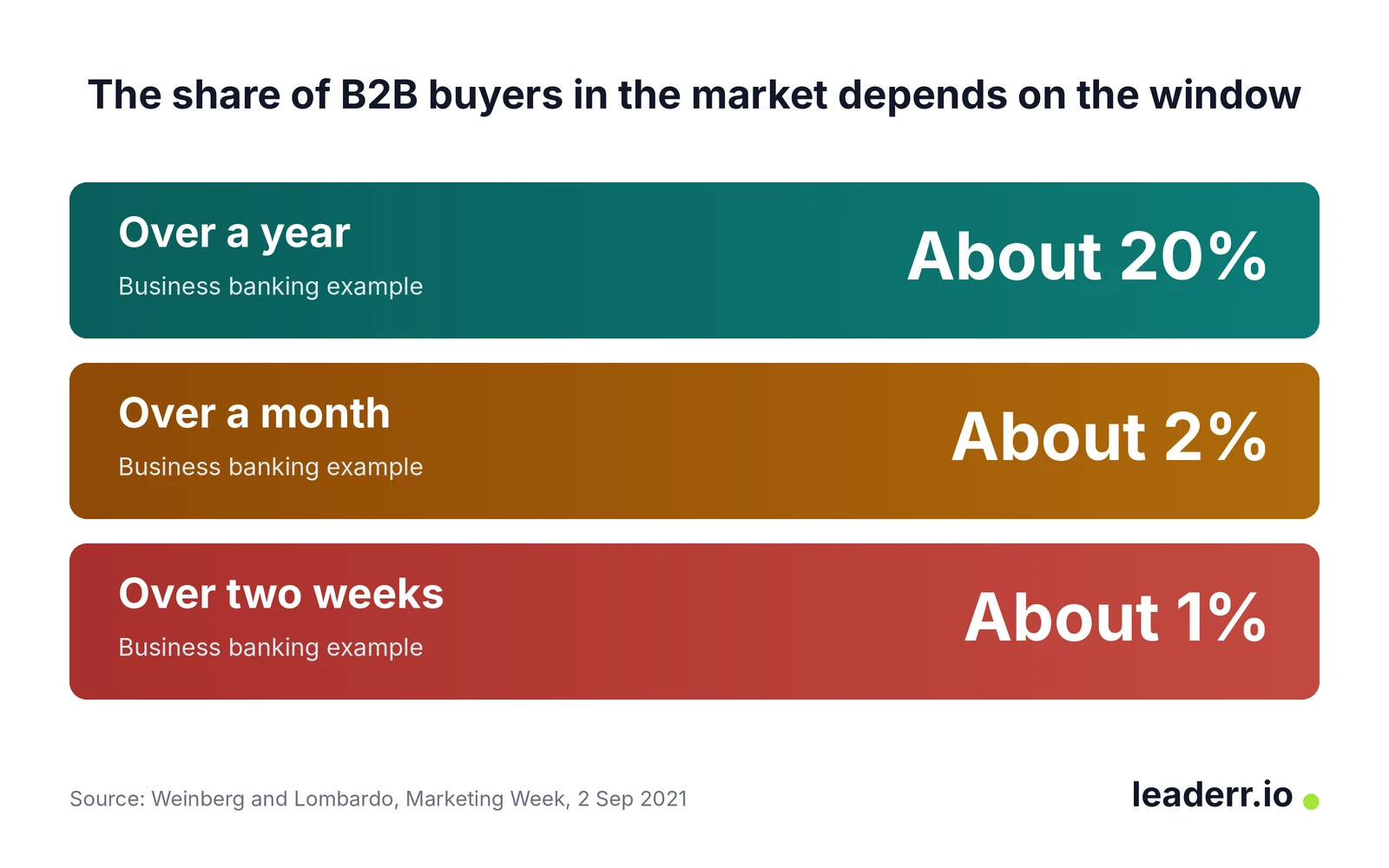
Shorter windows hold fewer ready buyers. Those figures fit a buying cycle of about five years.
One year is a fifth of five years, and one month is 1 out of 60.
A count you can run on your own list
Divide your window by the length of your buying cycle, then take that share of your list. It is a rough estimate, since it assumes buyers are spread evenly over time.
Say you sell fleet maintenance software to regional trucking firms and hold 1,000 names. The numbers are example inputs. The table compares three buying cycles over a one-month window.
Buying cycle | One month as a share | Names in the market |
|---|---|---|
5 years (60 months) | About 1.7% | About 17 |
2 years (24 months) | About 4.2% | About 42 |
1 year (12 months) | About 8.3% | About 83 |
Take the 2 year row. One month is 1 out of 24, which is about 4.2%. That share of 1,000 names is about 42, so about 958 names are not ready.
Only the 42 can buy this month. Reaching the other 958 is demand generation work.
Done when: You have one number for names in the market this month and one for names that are not.
Stage 2: Set the budget split between demand generation and lead generation
What happens: You choose how much of the budget goes to each side before you spend.
What the 46 and 54 figures cover
The B2B Institute at LinkedIn published research on 16 October 2019. It reports that B2B firms grow best with about 46% of budget on brand building and 54% on activation.
The study came from Les Binet and Peter Field. The B2B Institute presents the figures as a balance to aim for.
Brand building is the closest published term to demand generation, and activation is the closest to lead generation.
They are not the same terms, so treat the split as a starting point.
Move off the split with your own numbers
I'd hold the split for a full quarter before changing it. After that, compare signups, calls booked, and buyers with what each side cost.
If an agency runs part of the lead generation share, check how lead generation quotes compare before you commit that money.
Done when: You have a starting split written down, with a review date.
Stage 3: Which should you fund first?
What happens: You match what you see in your numbers to the side that is short.
The table compares four situations and the side to fund first for each.
What you see | What is short | Fund first | First move |
|---|---|---|---|
Few visitors, few replies, a short list | Reach | Demand generation | Publish and speak where your buyers already look |
Many signups, few buyers | Fit and follow up | Lead generation | Add one question on budget or timing to the form and call the best fits first |
Steady signups, a good share buy, growth is flat | New buyers entering your list | Demand generation | Move part of the lead generation share back to reach |
Buyers say on calls that they never heard of you | Awareness and interest | Demand generation | Ask each buyer how they found you and write the answer down |
If you can fund only one side this month, fund the side your own numbers show as short.
Many signups, few buyers
This is the founder's case above: 500 signups and 3 buyers. More traffic alone adds more signups of the same type. In lead gen, fit matters more than volume.
A form that asks about budget or timing helps separate qualified leads from curious ones. Nurture the rest with useful emails until they ask for a call.
Set a cost ceiling for each lead, so you stop paying for signups that never reach a call.
Few visitors and few replies
When few people know you, a form has little to catch. With demand gen, the first money goes to awareness and interest: useful articles and talks that answer a buyer's question.
Inbound pages can feed both sides, because the same page can carry a signup form later.
Done when: You can name the side you fund first and the number that shows it is short.
Stage 4: Plan for the whole buying group
What happens: You treat each signup as one name from a buying group.
How big is the buying group behind one lead?
A Gartner release of 7 May 2025 says B2B buying groups range from 5 to 16 people across as many as four functions. It rests on a survey of 632 B2B buyers in August and September 2024.
Gartner also found that 74% of buyer teams show unhealthy conflict during the decision. Groups that reach consensus are 2.5 times more likely to report that their deal was high quality.
A form fill gives you one of those 5 to 16 people. If you sell to a short list of named companies, you can plan around the whole group with account-based marketing.
Either way, ask each contact who else will weigh in, and write down a second name.
Where an SDR fits
In the SDR role, a rep works the names that lead generation brings in and asks each one who else is involved.
Demand generation sits with whoever owns content and outreach, which on a small team may be the founder.
Done when: Each lead on your sheet has a second name or a reason there is no group.
Your split sheet
Copy these lines into a note and fill in the blanks.
Monthly budget: $____
Demand generation share: ____% (start at 46%)
Demand generation dollars: take the percentage on line 2 of the amount on line 1, $____
Lead generation dollars: line 1 minus line 3, $____
Names you can reach: ____
Buying cycle in months: ____
Names in the market this month: line 5 divided by line 6, ____
Signups and buyers from the past three months: ____ and ____
Side to fund first, from the Stage 3 table: ____
Review date, one quarter from today: ____
Say your budget is $4,000 for the month and you start at the benchmark. Take 46% of $4,000 to get $1,840 for demand generation. The rest, $2,160, goes to lead generation.
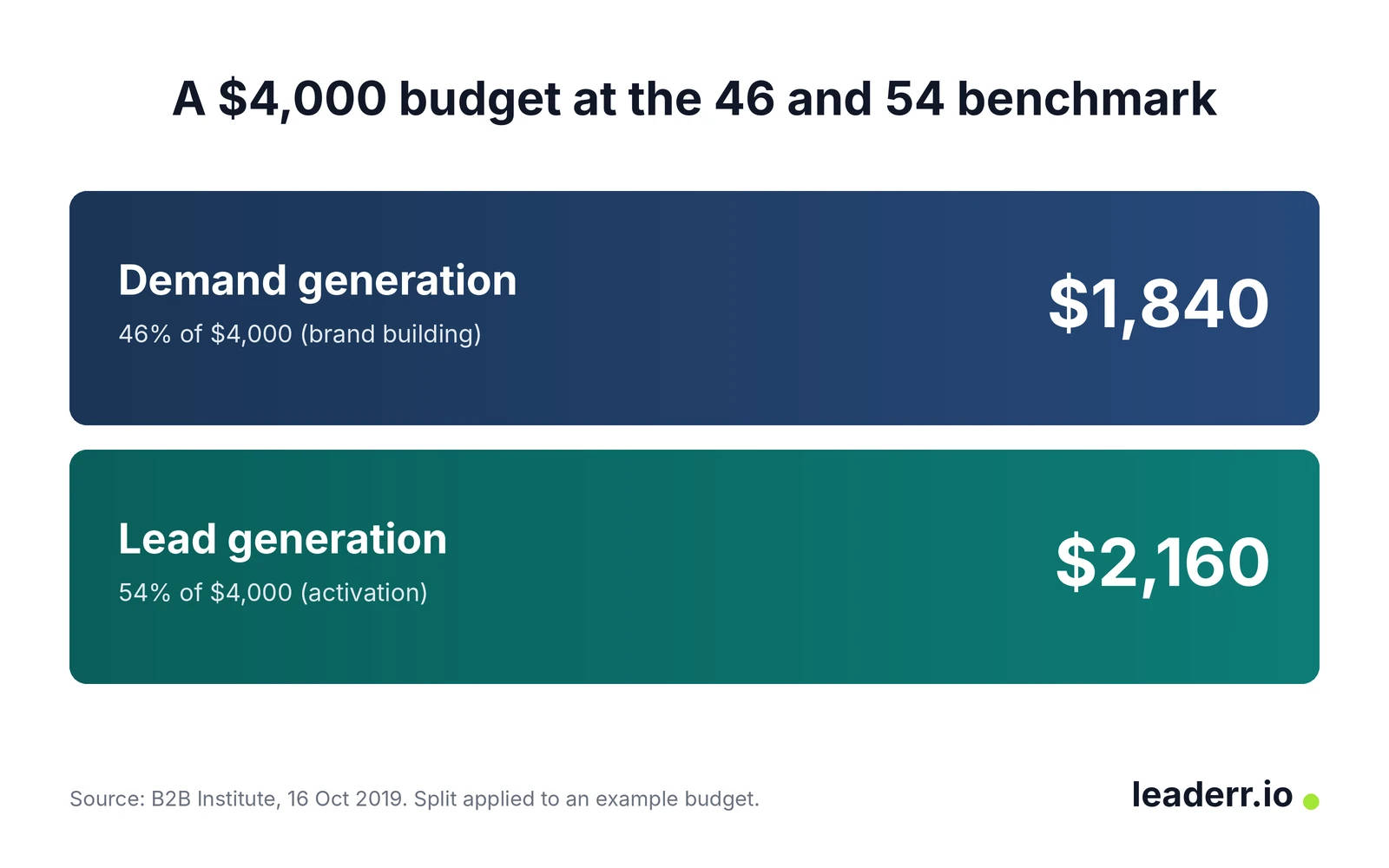
The two lines add up to $4,000, the whole budget.
How to measure demand generation without tracking software
Demand generation leaves no form fill to count, so ask people directly.
Add one open question to your signup form: how did you find this company? Read the answers each month.
Note on every sales call how the buyer found you, and count the deals in your pipeline from each answer.
For lead generation, track the conversion rates from signup to call and from call to buyer, and compare both month over month.
Pick two metrics for each side and keep them for a full quarter.
Mistakes that keep signups from becoming buyers
The biggest mistake in lead generation is counting every signup as a buyer. The table lists three mistakes, what causes each, and the fix.
Symptom | Cause | Fix |
|---|---|---|
500 signups and 3 buyers | The form catches anyone, and the market is too broad | Name one target audience and add a budget or timing question to the form |
A rep gets no reply from a form fill | The contact is one person in a group of 5 to 16 | Ask who else is involved and record a second name |
Signups slow down after a push | Only buyers already in the market were reached | Move part of the budget back to demand generation |
Frequently asked questions
Can lead generation work without demand generation?
Lead generation can work without demand generation, but only for buyers already in the market. In Weinberg and Lombardo's bank example, that is about 2% of buyers over a month.
Lead generation alone has a small group to work with.
How long until demand generation shows results?
No source gives a fixed time for demand generation to show results. In the same bank example, about 2% of buyers are in the market over a month.
A buyer may take months to need you. Judge progress by the answers to the open question on your signup form, month over month.
Should you gate content?
Gate a file only when the reader gets something worth a work email, like a template or a calculator. I'd leave explainer pages open so more people can remember you.
A gated form makes a signup, and the Indie Hackers thread above shows a signup can sit far from a buyer.
Is demand generation the same as inbound marketing?
Demand generation and inbound marketing are not the same thing. Inbound marketing draws people in with content and search, and demand generation is a goal those pages can serve.
The same inbound page serves lead generation when it carries a signup form.
Pick the short side and hold it for one quarter
Pick the side your numbers show as short. Write the split on your sheet and leave it alone for one quarter.
Your own signup, call, and buyer counts, then replace the 46 and 54 benchmark, which comes from research on B2B firms in general.
Guidance and sources reviewed 26 October 2026.