What is account based marketing, and is it worth it for a small team
What is account based marketing, and does it fit a small team? See the three types, what each level costs, which deal sizes fit, and a 10 account plan.
 Michael Doyle14 min read
Account based marketing (ABM) means you name the companies you want first, then market to each one as its own market.
ITSMA says one working group is usually 5 to 10 accounts. Vendors say ABM may not pay back on deals under $30,000.
Vendr's buyer data puts two ABM platforms at a median of $62,440 to $68,591 a year.
Who this is for, and what you need first
This guide covers what ABM means, its three types, its cost, and how to run a first group on a spreadsheet. It does not cover picking a platform, ABM jobs, or ABM courses.
It is written for founders, small teams, and SDRs who have been told to "do ABM", and for anyone new to the term.
An SDR is a sales development rep, the person who finds new buyers. If you work as one, sales prospecting will be familiar. ABM adds a fixed list.
Before you start, have these four things:
A list of companies you would like as customers, even a rough one.
A spreadsheet or a CRM. A CRM is software that stores your customer and deal records.
One person in sales who will work the same list with you.
Your average deal size, meaning how much money one customer brings you.
What account based marketing means in simple words
ABM stands for account based marketing. It is a way to sell to other businesses. An account is one company you want as a customer.
You choose the accounts first, then market to each one as its own market. ITSMA calls this "treating individual accounts as markets in their own right."
A named list instead of a pool of leads
A lead is one person who showed interest, for example by filling in a form. Usual marketing collects leads first and sorts them later.
ABM reverses that order: you name the companies, then reach the people inside them. A target account list is the sheet where those names live.
Several people decide at each company
One person rarely makes a company purchase alone. Forrester's 2026 buying report says 13 people inside the buying company and 9 outside it influence a B2B purchase on average, as Digital Commerce 360 reports.
That group is a buying committee. ABM reaches several of its members, not one contact.
Account based marketing vs demand generation and traditional marketing
Demand generation builds interest across a wide audience, then sorts out who is ready to buy.
Forrester, in an April 2018 post, treats ABM as one part of a wider demand strategy. The two can run side by side. This table sets them next to each other.
Point | Account based marketing | Demand generation |
|---|---|---|
Who you aim at | A named list of companies | A wide audience |
Where you start | The accounts | The interest you collect |
Who works on it | Sales and marketing together | Usually marketing, then sales |
The three types of account based marketing, and how many accounts each holds
ITSMA names three types and gives a size for each.
Type | Plain meaning | Accounts at a time |
|---|---|---|
Strategic ABM | A custom plan for one account | One account |
ABM Lite | One plan for a small group of similar accounts | Usually 5 to 10 |
Programmatic ABM | Software tailors campaigns across a long list | Hundreds or even thousands |
ITSMA's page lays out all three types and their account counts.
Account based marketing examples, one for each type
These examples are made up, not real campaigns. Say a company sells inventory software to restaurant chains.
Strategic: one custom plan for the biggest chain.
ABM Lite: one page and one email for eight regional chains with the same problem.
Programmatic: ads shown to set job titles at several hundred chains.
What the 5 to 10 counts
ITSMA's 5 to 10 counts the accounts worked at one time. It doesn't cap the whole program.
A team can finish one group of eight chains, then start the next.
Other sets of types
The SiriusDecisions team at Forrester names a different set: large account, named account, and industry ABM.
Wikipedia lists five: strategic, scenario, segment, programmatic, and pursuit marketing. If numbers differ between pages, check which set each uses.
Is account based marketing worth it for a small team
ABM puts more effort into each account than usual marketing does. That pays back only when each account is worth a lot. The lines below are rules of thumb.
How big a deal needs to be
Deal size is how much money one customer brings in. Sources write it as ACV, short for annual contract value. Three give a line:
RevenueHero, a software company, wrote on 23 December 2024 that ABM might not be worth the effort when ACV is under $30,000.
Userled, a software company with an undated page, gives about $30,000 as the minimum. It says deals under $10,000 almost never pay back, and a team with fewer than 3 salespeople who carry sales targets is not a fit.
The Starr Conspiracy says its ABM benchmark samples lean toward companies with deals above $50,000. It updated the page on 9 September 2026.
Set side by side, the three lines look like this.
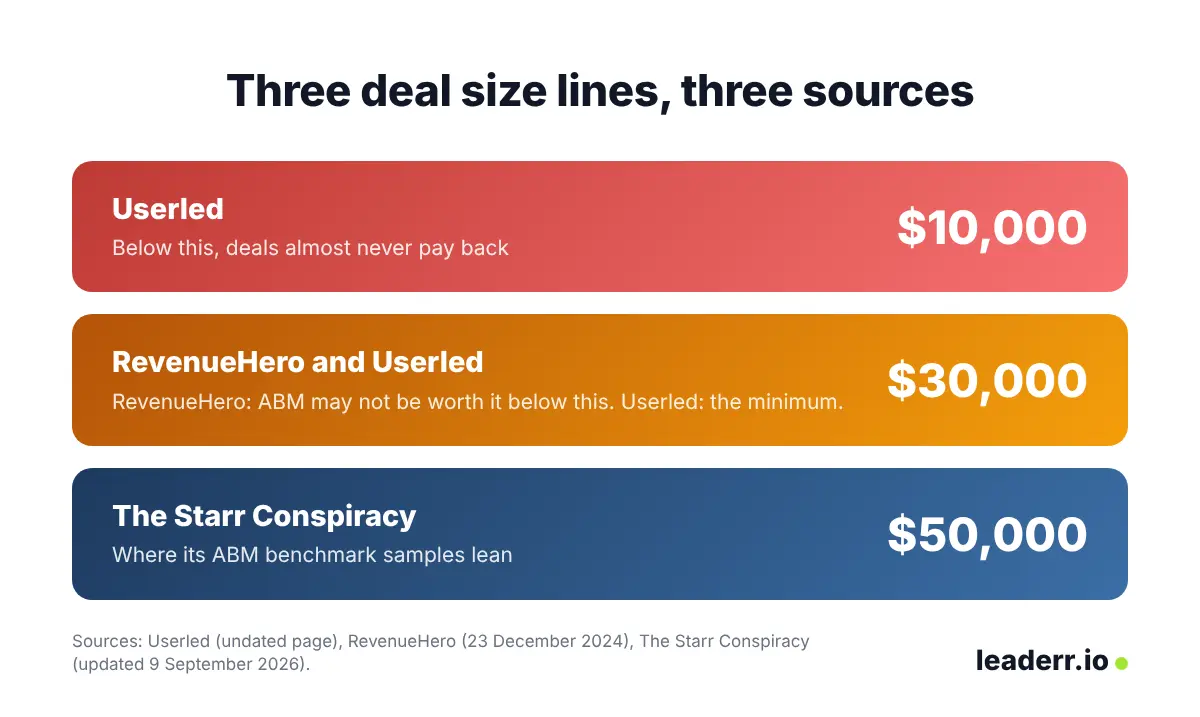
Under $10,000, the one source that names a line says ABM almost never pays back. At $30,000 or more, none of the three says to skip it. None shows the data behind its line.
What it costs at three levels
An ABM platform is software built to run ABM. A marketing suite is software that bundles many marketing tools. This table shows three levels with dated prices.
Level | What you use | What it costs |
|---|---|---|
1. Spreadsheet and CRM | A sheet and the CRM you already own | No new software cost. Your time is the cost. |
2. Marketing suite | HubSpot Marketing Hub Professional | $9,600 for the year plus a $3,000 one time fee, so $12,600 in year one |
3. ABM platform | 6sense or Demandbase | Median $62,440 a year (6sense) and $68,591 a year (Demandbase) |
How the marketing suite price adds up
HubSpot lists Marketing Hub Professional at $800 a month when you pay for the whole year, plus a $3,000 one-time onboarding fee, which is a setup charge.
The page was updated on 14 September 2026. The math: $800 a month, times 12 months, is $9,600. Add the $3,000 fee, and year one costs $12,600.
HubSpot says its ABM tools sit in its premium versions and doesn't name the plan. So $12,600 is the price of the suite, not a confirmed ABM price.
Where the platform prices come from
Vendr, a software buying platform, reports a median of $62,440 a year for 6sense. That comes from 385 purchases, with prices from $11,376 to $176,809.
For Demandbase, Vendr reports $68,591 a year from 187 purchases, with prices from $24,000 to $164,037. A median is the middle price, with half of buyers paying less. Both pages were last updated in February 2026.
Do you need ABM software?
You can start a group of 5 to 10 accounts without it. ITSMA describes Programmatic ABM as using technology to tailor campaigns at scale, which suits hundreds or thousands of accounts.
To compare platforms, read best account based marketing tools.
What is paid ABM, and can a 10-account list run it
Paid ABM means running ads aimed at the people who work at your named accounts, for example on LinkedIn.
The LinkedIn documentation says a company list needs at least 300 matched members before a campaign can serve, regardless of how many companies it holds.
It suggests at least 1,000 companies for best results. A list of 10 small companies may fall short of 300 members, so check before you plan ads.
A fit check before you spend anything
Answer yes or no to each line.
One deal brings in $30,000 or more, or you can name why a smaller deal is worth the effort.
You can name 5 to 10 companies you would be glad to win.
A salesperson will work the same list with you, and someone has set hours each week for it.
Fix each one before you spend money. If you can't say yes to the first line, wait.
A 10 account plan you can run on a CRM and a spreadsheet
This plan runs at level 1. The example reuses the inventory software company from earlier. It is made up, and its numbers are inputs, not results.
Stage 1: Pick 10 accounts
What happens: Write the traits of your best customers: size, industry, and region. Teams call this firmographic data. The short description is your ideal customer profile, or ICP. Pick 10 companies that match.
Done when: You have 10 names and one line on why each fits.
Stage 2: Name the people
What happens: For each account, list the roles that would join the buying decision. The example uses 4 roles per account. That is 10 accounts times 4 roles, or 40 people.
Done when: Every account has 4 roles, and each role has a name where you can find one.
Stage 3: Write one message for the group
What happens: Pick one problem all 10 accounts share. Write one page and one email about it, and change the first line for each account.
Done when: The page and email exist, and each account has its own first line.
Stage 4: Reach each person and log it
What happens: Contact each person on your account list. Log the date and any reply in your account sheet.
Done when: Every person on the list has a date and a status.
Stage 5: Review the group
What happens: Count the accounts with a reply and the meetings per account. Pick one change for the next group.
Done when: You know how many of the 10 accounts engaged and have chosen one change.
The account sheet, filled in as an example
Use one row per person. The first three columns hold example inputs, and the last three stay empty until you fill them.
Account | Why it fits | Role | Date reached | Reply | Meeting |
|---|---|---|---|---|---|
Chain A (example) | Runs 40 restaurants | Operations lead | |||
Chain A (example) | Runs 40 restaurants | Finance lead | |||
Chain B (example) | Runs 25 restaurants | Kitchen manager |
What happens next, and how long it takes
Here is a review schedule for the plan. The weeks are a suggestion, since no source sets a length.
When | What to check | What it tells you |
|---|---|---|
Week 1 | All 10 accounts and 40 people are in the sheet | The list is ready |
Weeks 2 to 3 | A first message has gone to every person | Whether you can keep the pace |
Week 6 | How many accounts have at least one reply | Whether the shared problem fits |
Week 12 | Meetings per account and deals opened | Whether to run a second group |
How long ABM takes to show results
The Starr Conspiracy counts a program as mature after more than 24 months in market. It also reports 18 months to reach mature performance.
Its samples lean toward large companies, so read 18 months as a benchmark for big programs, not a promise for 10 accounts.
How to measure ABM
Count accounts instead of leads. Track accounts with a reply, meetings per account, and deals opened. ABM attribution means giving credit for a deal to the account, not to one person's click.
Which account based marketing numbers to believe
Big ABM numbers circulate, and each has a source behind it or none. Here are five sources side by side.
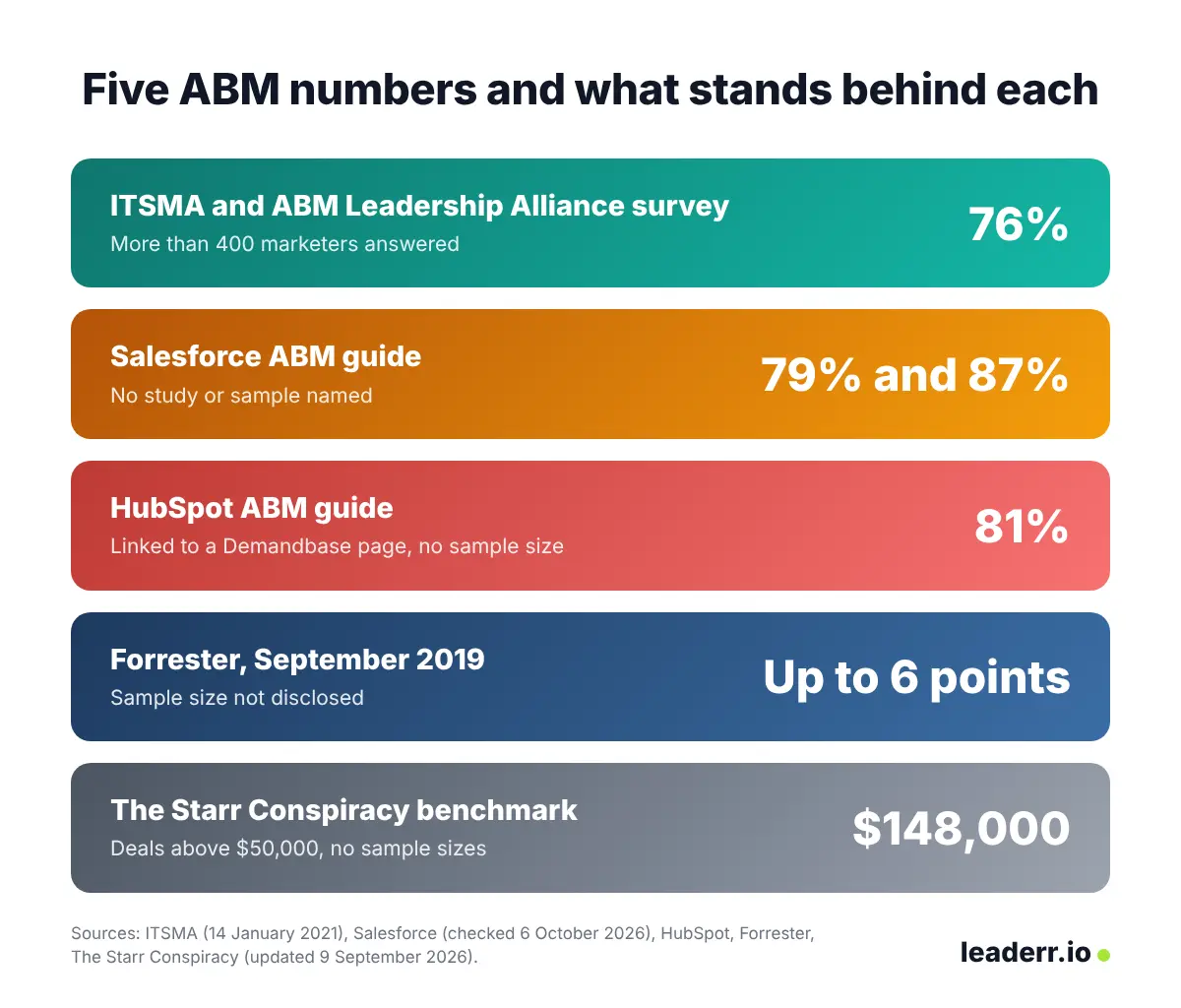
Only one of the five, the 76 percent study, states how many people answered.
Figures from a named study
ITSMA and the ABM Leadership Alliance reported that 76 percent of respondents saw higher ROI with ABM than with other types of marketing. ROI means money earned compared with money spent.
The release is dated 14 January 2021. It draws on more than 400 marketers at B2B technology and business services companies and doesn't define ROI.
Forrester wrote in September 2019 that teams with mature ABM can be as many as 6 percentage points more likely to exceed revenue goals. The post doesn't disclose its sample size.
Figures with no sample shown
Salesforce states in its ABM guide, checked on 6 October 2026, that more than 79 percent of marketers report higher ROI and that 87 percent agree ROI is higher with ABM. It names no study or sample next to either figure.
HubSpot says 81 percent of marketers who used ABM in 2024 reported higher ROI. It links the figure to a page on Demandbase's site and gives no sample size.
A benchmark that states its limits
The Starr Conspiracy reports a median closed won ABM deal of $148,000. Closed won means a deal that was won.
Its samples lean toward North America, Europe, the Middle East and Africa, and companies with deals above $50,000. It states no sample sizes and says results may not carry over to small business programs.
Where account based marketing goes wrong
A Reddit thread in r/b2bmarketing asks what ABM tactics have worked. It has more than 10 comments and is about a month old.
One reply, which shows 2 upvotes, says they split a LinkedIn campaign into groups of about 15 to 25 accounts so each ad could speak to one shared problem.
Past that size, they say, it became expensive awareness spend. They also say to recheck the list before every run, because contact data goes stale within a quarter.
This table lists four common mistakes and the fix for each.
What you see | Likely cause | What to do |
|---|---|---|
The list holds thousands of accounts | The budget fits far fewer | Split it into groups of 5 to 25 and work one group at a time |
Replies come from people who left | Contact data went out of date | Recheck every name before each run |
Your results trail a benchmark | The benchmark leans toward large companies | Compare against your own first group |
Software was bought before the list existed | A platform price covers tools, not a list | Name 10 accounts and run level 1 first |
A level 1 mistake costs your time. A level 3 mistake costs a year of platform fees.
FAQs
Is account based marketing inbound or outbound?
It can be either. Inbound means buyers find you, and outbound means you start the contact.
HubSpot says in its guide, updated 27 June 2025, that inbound lays the foundation for a strong ABM strategy by allowing efficient use of resources on high value accounts.
How do you start account based marketing?
List 5 to 10 named companies and line up one salesperson to work them with you.
Then run the five stages in this guide: pick accounts, name people, write one message, reach each person, review.
Who owns account based marketing, sales or marketing?
Sales and marketing share ABM. Give both teams the same list and review it together.
What is the opposite of account based marketing?
Broad marketing aimed at a wide audience, where you find interested companies afterward. Demand generation is the closest match, though teams can run both.
Name ten accounts before you spend anything
Write down ten companies you would be glad to win. Next to each, write why it fits and who would join the buying decision.
If you can't do that yet, buying software won't help. If you can, run the plan above on a sheet, and check the deal size lines again before you pay for anything.
Guidance reviewed 6 October 2026.
About the author
Michael Doyle writes about B2B sales at Leaderr. He covers prospecting, cold outreach, sales data, and pipeline building, with a focus on what actually works for SDRs, founders selling on their own, and small sales teams. Connect with him on LinkedIn.