

A target account list is a named, scored group of companies that sales and marketing work together on, usually 50 to 300 accounts depending on team size and rep capacity.
The right count comes from your own team, not a borrowed benchmark, and every account on it needs a stated, checkable reason for being there, not a spot earned by convenience.
Who this is for, and what you need first
This covers building and running a target account list for outbound sales and account based marketing, not a retailer's loyalty account or a bank account list.
Before you start, have three things ready: a written ideal customer profile, a place to hold the list, and an honest count of how many people will work it day to day.
Team shape | Typical starting list size | Who scores accounts | Where the list lives |
|---|---|---|---|
Solo founder or one rep | 50 to 100 accounts | The rep, in under an hour a week | A spreadsheet or CRM tag |
Small team, two to six reps | 150 to 400 accounts | Sales lead, reviewed with reps monthly | A CRM list or view |
Marketing plus sales, dedicated ABM motion | 400 to 1,000+ accounts, tiered | Marketing and sales together, weekly | A dedicated ABM or CRM segment |
What a target account list actually is, and what it is not
A target account list names the specific companies your team is going to pursue, ranked by fit and how likely each is to buy soon.
It sits between two terms people use loosely in the same breath, and mixing the three up is what lets a list balloon past anything a team can work.
Total addressable market is every company that could theoretically buy, no filter applied. An ideal customer profile is the filter itself.
A target account list is what is left once that filter runs against the market, and real names get committed to a document.
Total addressable market | Ideal customer profile | Target account list | |
|---|---|---|---|
What it is | Every company that could theoretically buy | The written filter for fit | The named, scored companies you will pursue |
Typical size | Thousands to millions of companies | Not a count, a set of criteria | 50 to 1,000+ named accounts |
Who owns it | Cited by marketing for planning | Sales and marketing together | Sales and marketing, worked by reps |
How often it changes | Rarely, unless the market shifts | Reviewed a few times a year | Reviewed and refreshed every quarter |
How many accounts you actually need
There are three different formulas for this number, and each one answers a different question. Winning by Design publishes both the top down and the bottom up version, worked in full, which is what makes the reconciliation below possible.
The top down formula starts from a revenue target. Ten closed deals a year at a 33 percent SQL to close rate needs 30 SQLs.
If a cold account converts to an SQL about 2.5 percent of the time, hitting that number takes 1,212 accounts a year, about 101 a month. This formula answers how many accounts the math requires.
The bottom up formula starts from what a rep can physically do. Working five contacts inside each account, a rep can carry about 480 accounts a year. Drop to two touches a year per contact and the same rep can carry roughly 1,200.
This formula answers how many accounts a rep can actually touch, and the answer swings five times depending on how deep each touch goes.
Run both against the same five person team and the gap makes sense instead of contradicting itself.
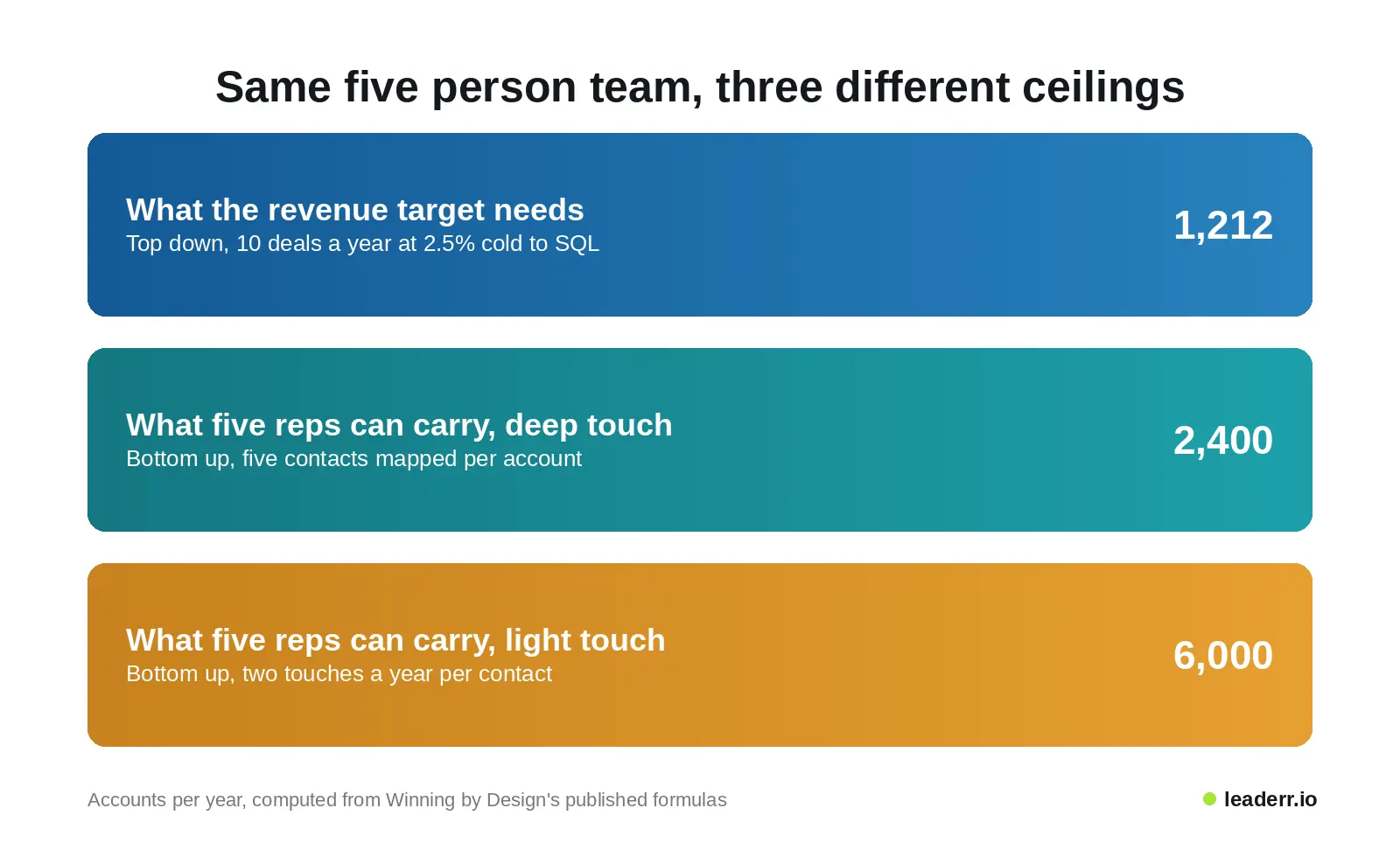
Top down says the team needs 1,212 accounts to hit its revenue target. Bottom up, at five contacts per account, says the team can carry 2,400 accounts working shallow across five reps.
At two touches a year, it can carry 6,000. These numbers describe three different constraints on the same list, and a real list size sits wherever revenue requirement and rep capacity overlap.
Building the list step by step
1. Confirm the ICP before naming a company
A list built without a written ideal customer profile is built on gut feel, and gut feel breaks down the moment someone asks why an account is on it.
2. Pull the pool of qualifying companies
Run your ICP criteria against whatever source you have. The goal is a rough pool, not a finished list.
3. Score every company against the same criteria
Fit to the ICP, a real buying signal, and reachability. No path to a contact means it does not belong yet.
4. Tier the scored pool
Give each tier a different depth of effort, covered next.
5. Assign an owner to every tier
A list with no named owner is the version that goes stale.
Tiering the list so effort matches value
A target account list can be tiered three ways, and none of the splits are wrong, they suit different team sizes.
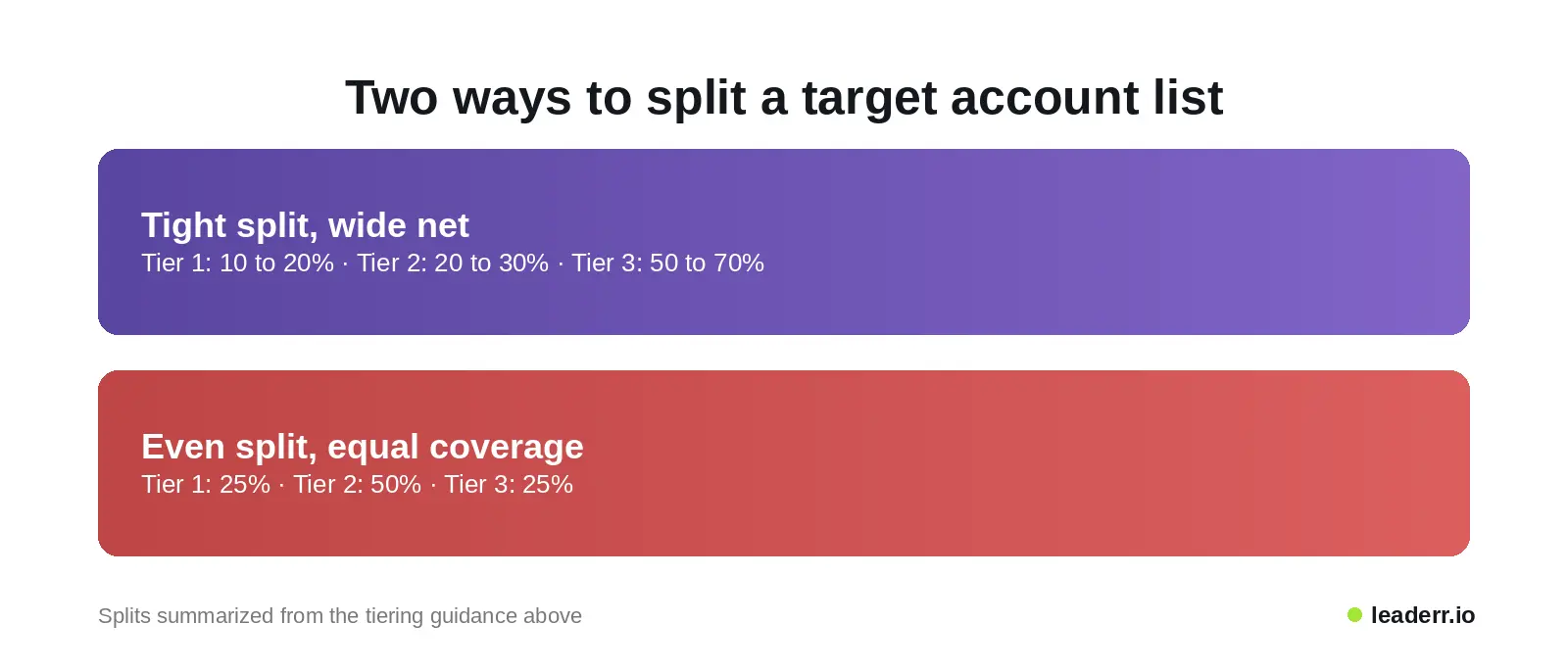
A tighter split, 10 to 20 percent Tier 1, 20 to 30 percent Tier 2, and 50 to 70 percent Tier 3, suits a wide net with light touches at the bottom.
An even split of 25, 50, 25 suits equal coverage across priority levels. A scoring band model, where the score itself sets the tier, suits a team with a real scoring system already running.
Pick the one matching how your team spends time.
Either split changes what Tier 1 actually costs in effort once you size it against the other end of the table: a real buying group.
Size each tier around what a buying group looks like on the other end. A Gartner sales survey found buying groups "ranging from five to 16 people across as many as four functions," according to Delainey Kirkwood, Principal, Research, Gartner Sales Practice.
That range is why Tier 1 accounts need contact mapping for five or more people, while a Tier 3 account worked with one shallow touch is barely being worked as an account yet.
What makes a pick defensible instead of a quiet waste of budget
An account can pass every ICP filter and still be a bad pick if nobody can say why it is being worked over similar companies left off.
That gap, technically qualified names with no stated reason for the order they are in, that is where budget leaks unnoticed, because nothing about the list looks wrong until someone checks.
A defensible pick clears four checks:
A fit score above your stated cutoff, not a guess.
A named, dated signal, not just fit: funding raised, a relevant role posted, a technology added or dropped. Fit without a signal is a company that matches on paper with no sign it is buying anything soon.
An assigned owner, one person accountable for its tier and status, not a name sitting in a shared list nobody checks.
A logged reason for its tier, written down at the time, not reconstructed later: the fit score, the signal, and who set the tier.
An account clearing all four survives a review. One clearing only one or two is a name added because it was easy to find.
What it costs to run without a dedicated ABM platform
A target account list does not require a platform: a place to score and store accounts (a CRM or spreadsheet you already have), a way to see the fit and signal data behind the score, and a way to keep the score current, either a manual check or a paid refresh.
The honest finding is less a price list and more a pattern: the storage layer prices in the open. The signal layer, tools surfacing funding events, hiring changes, and technology adoption, is far more often gated behind a sales call.
Budget real time for that call, because a public number there is the exception.
Compare that against an ABM platform: one subscription bundles all three layers, usually priced only after a demo. Doing it yourself trades your time for a lower upfront bill.
Keeping the list alive after it is built
The standard refresh rule is a calendar one: review quarterly, replace no more than 20 percent per cycle.
That rule is a ceiling on churn, not a reason to move any single account, and a calendar review with no trigger just reconfirms whatever was already there.
Four events should move an account between tiers or off the list:
A funding event, raised or lost, changes budget and urgency.
A technology change, a tool added or dropped that your product touches, changes fit either direction.
A hiring freeze or a relevant new role posted changes budget signal and who the buyer would be.
No engagement in 90 days despite outreach means the signal that put it on the list has likely gone cold.
If building the list means pulling contacts from a database, the list building guide covers a related question worth checking first: how many usable contacts an 80 percent match rate on a 500 name target actually returns.
For keeping records current between reviews, CRM enrichment covers that separately.
A defensibility check to run before every review
Run this against every account before a quarterly review, not only the ones that look uncertain.
Does this account clear the stated ICP fit cutoff, not just come close?
Is there a named, dated signal on file, not just fit on paper?
Is there one person accountable for this account's tier?
Is the reason for its current tier written down, not just remembered?
Has anything changed in the last 90 days, funding, hiring, or tooling, that should move it?
Has there been any engagement in the last 90 days?
Does its tier match the depth of contact mapping it has actually received?
Would this account survive being read aloud to someone outside the team, with no context given?
An account failing two or more gets a second look before the next cycle, not automatic removal.
Common ways a target account list quietly fails
Symptom | Cause | Fix |
|---|---|---|
The list keeps growing past what reps can work | No cap tied to rep capacity, every close enough account got added | Cap the list at your bottom up number, cut the lowest scoring accounts first |
Accounts move tiers with no record of why | No owner assigned to tier changes, no reason logged at the time | Require a one line reason on every tier change, reviewed monthly |
Accounts sit for two or more quarters with zero engagement | Refresh runs on a calendar date only, no signal based trigger | Apply the funding, tooling, hiring, and engagement triggers above at every review |
These three failure modes account for most of the trouble a target account list runs into after launch.
Each one traces back to a missing cap, a missing owner, or a missing trigger, not a bad account.
FAQs
How many accounts should be on a target account list?
There is no single right number. A solo rep can run 50 to 100 accounts, a small team 150 to 400, a dedicated ABM motion 400 to 1,000 or more.
Start from your own rep capacity, not a number written for a different team size.
How often should a target account list be refreshed?
Quarterly, replacing no more than 20 percent per cycle as a ceiling, but move individual accounts sooner when a real trigger fires: a funding event, a technology change, a hiring shift, or 90 days with no engagement.
What is the difference between a target account list and a target market list?
A target market list is closer to total addressable market, a broad set fitting a general description. A target account list is the narrower, scored, named set your team is actually working this quarter.
Can a solo founder use a target account list?
Yes. The size shrinks to 50 to 100 accounts, and one person handles scoring, tiering, and outreach, but the fit and signal criteria stay the same.
What criteria should be used to score accounts?
Fit against a written ICP, a named and dated buying signal, and reachability, a real path to a contact inside the account. An account missing any of the three is not ready to be scored.
Does account based marketing replace traditional lead generation?
No. Account based marketing targets a named, scored list with coordinated outreach, while lead generation casts a wider net and qualifies interest as it arrives. Most teams run both.
The number matters less than the reason behind it
A target account list built to hit a specific number still fails if the accounts on it cannot be defended one at a time. The size question gets the attention because it has a clean answer to argue about.
The defensibility question is the one that decides whether the list earns the time a team spends working it.
Guidance reviewed September 18, 2026.
About the author
Michael Doyle writes about B2B sales at Leaderr. He covers prospecting, cold outreach, sales data, and pipeline building, with a focus on what actually works for SDRs, founders selling on their own, and small sales teams. Connect with him on LinkedIn.