Lead generation services: how to compare quotes and avoid a bad contract
Compare lead generation services by cost per held meeting. Get a worked example, a 90 day pilot plan and a contract term sheet to fill in before you sign.
 Michael Doyle13 min read
Compare every quote with one number: the total you pay, divided by the meetings that took place.
In the worked example below, a $ 5,000-a-month quote costs $500 per meeting on paper, and $1,500 once setup, tools, no-shows, and poor fits are counted.
Ask for a 90-day pilot before you agree to a long-term.
What you need before you ask for quotes
The FTC CAN-SPAM guide for business says that "you can't contract away your legal responsibility to comply with the law."
An agency can send your emails, but you keep the duty. The contract matters as much as the price.
Start with a price ceiling for one meeting. How to set the most one lead can cost covers the steps, using your customer value, your margin, and the share of meetings that become customers.
Then gather four more things:
A written description of the buyer you want: job title, company size, and country.
One person who answers every meeting request within two days.
A CRM, or a shared sheet, that you own and the provider can write to.
A three-month budget you can afford to lose if the test fails.
This guide fits B2B lead generation services, where an outside team books meetings between you and other companies.
Lead generation services suit founders, sales leads, and small business owners who have a pipeline gap and no one to run outbound this quarter.
MSP and other IT services firms follow the same path.
Local and regulated sellers need one more check.
If you are a contractor, a real estate agent, an insurance agency or a law firm, ask whether each lead goes only to you and whether you can send a bad one back.
This guide does not rank providers, rate vendors or cover buying a contact list.
Compare quotes by cost per held meeting
Quotes arrive in different units, so the headline prices do not line up.
Convert each one to the same unit before you compare.
What each quote counts, and what can still fail
Providers sell leads, booked meetings, held meetings, or qualified meetings.
Each unit leaves a different gap between the price you see and a customer you can win.
The table lists each unit, the next thing that can fail, and the proof to ask for.
The quote counts | What can still fail | Proof to ask for |
|---|---|---|
A lead | The person never replies, or is the wrong buyer | The reply itself, with the sender's job title |
A booked meeting | The person does not show up | An accepted calendar invite from the buyer |
A held meeting | The person cannot buy what you sell | Short meeting notes from your own team |
A qualified meeting | The provider's test is looser than yours | Your written test, applied by you |
Price every quote at the held meeting row.
Write your own test for a qualified meeting, using what a qualified lead is, and put that test in the contract.
The cost per held meeting formula
Four steps give you one number for every quote:
Add the retainer for every month of the term.
Add the setup fee.
Add the tools you pay for, for every month.
Divide the total by the meetings that took place.
Worked example: one quote, four prices
Take one example quote. These numbers are example inputs, not a result anyone got.
The retainer is $5,000 for each month. Over 3 months, that is $15,000.
The setup fee is $3,000, and you pay it once at the start.
Tools cost $1,000 for each month, so 3 months of tools is $3,000.
The total is $15,000 plus $3,000 plus $3,000. That is $21,000.
The agency books 30 meetings. Of those, 21 take place, and 14 fit your test.
The table prices the same quote four ways.
What you count | Meetings | Cost for each meeting |
|---|---|---|
Retainer only, booked meetings | 30 | $15,000 divided by 30 is $500 |
Full cost, booked meetings | 30 | $21,000 divided by 30 is $700 |
Full cost, held meetings | 21 | $21,000 divided by 21 is $1,000 |
Full cost, qualified meetings | 14 | $21,000 divided by 14 is $1,500 |
The card below puts the four prices side by side.
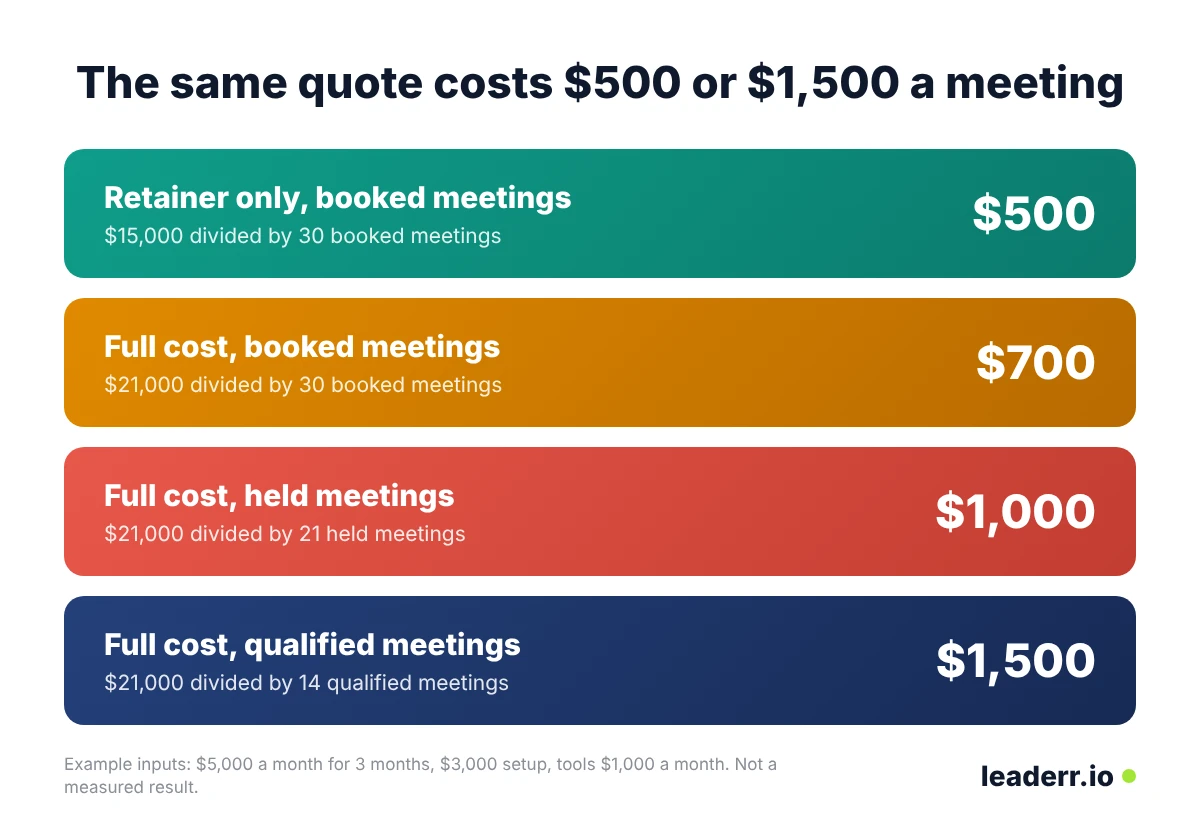
The same three months cost $500 a meeting or $1,500 a meeting, depending on what you count.
Agency or in-house SDR
Outsourced lead generation services and an in-house SDR fill the same gap in different ways.
Price both over the same 3 months.
What an SDR costs in year one: a worked example
A hire gives you one person, and what an SDR does day to day sets how much one person can cover.
The Bridge Group surveyed 351 B2B companies for its 2025 SDR report, published in February 2025.
It reports median on-target earnings of $80K, an average ramp time of 3.0 months, and an average tenure of 1.9 years.
Say your hire earns that $80,000 median. Say tools, hiring costs, and a manager's time add $30,000 more, which is an example input.
The first year then costs $110,000, or about $9,167 per month.
For 3 months, that is $27,500, spent while the new SDR is still ramping.
When an agency is the better first step
I'd start with an agency when no one can run outbound this quarter, and you want a market test before you hire.
I'd hire when a message has worked, and the agency's cost per held meeting stays above your ceiling.
The 1.9-year average tenure is a reminder that a hire can leave, so keep ownership of the lists and sequences either way.
Pick the pricing model
Four pricing models cover most quotes. The table shows what you pay for and who carries the risk in each.
Model | You pay for | Who carries the risk | Check before you agree |
|---|---|---|---|
Monthly retainer, done for you | The provider's time and program, whatever the output | You | A written meeting target and a right to stop after the pilot |
Pay per lead | Each lead that passes the provider's test | Shared | Who writes the test, and whether you can return a lead |
Pay per meeting, also sold as appointment setting | Each meeting booked, or each one held | Shared | Whether the price counts booked or held meetings, and who confirms a no show |
Hybrid | A smaller retainer plus a fee for each meeting | Shared | Whether setup and tools sit outside both |
Match the model to what you can check
Outbound lead generation services quoted by agencies often use a retainer. I'd pick the model by what you can check.
If you cannot confirm who showed up, do not pay per meeting. If you cannot write a test for a good lead, do not pay per lead.
A quote may cover email only, or it may add phone and LinkedIn lead generation services.
Ask which channels the price includes.
Lead generation services cost: the ranges agencies publish
SalesAR's September 2026 pricing guide puts a managed outbound program at $2,500 to $15,000 or more a month, and up to $25,000 for multi-channel programs.
It prices a held meeting at $150 to $400 for mainstream B2B buyers, $400 to $700 for mid-market and enterprise buyers, and $1,000 or more for C-suite buyers.
SaaS Hero's 2026 pricing guide adds setup fees of $1,500 to $5,000 and tools at $500 to $2,000 a month.
Neither page cites a study. SalesAR gives no source, and SaaS Hero points to another agency's site.
Use the ranges to spot a quote that looks far off. Then add setup and tools to every headline price before you divide.
Contract terms to demand
A lead generation services agreement should settle three things: length and notice, what you own, and who carries each sending duty.
Length, notice and renewal
SalesAR's guide says retainers run 3 to 12 months. I'd ask for a first term of 90 days with a written review on day 90.
After that, ask for month-to-month terms and 30 days' notice to stop.
Add a clause that blocks any auto-renewal unless you confirm it in writing.
What you own when you leave
Ask for each item below in writing.
The checklist covers what you should hold when the contract ends.
The lead list and every reply, in a file you can export
The messages and sequences written for you
The sending domains and mailboxes, or a written plan to move them
The CRM or sheet where every lead and meeting is logged
Phone numbers, dialer accounts, and ad accounts the provider set up
Your opt-out list
A 30-day window to export all of it after the contract ends
If the provider owns the sending domain, its sending history stays with the provider, and you start from zero after you leave.
Your legal duty stays with you
The same FTC guide adds that both the company whose product is promoted and the company that sends the message may be held legally responsible.
Each email in violation can draw penalties of up to $53,088.
Item 8 of that guide, Monitor what others are doing on your behalf, covers this case.
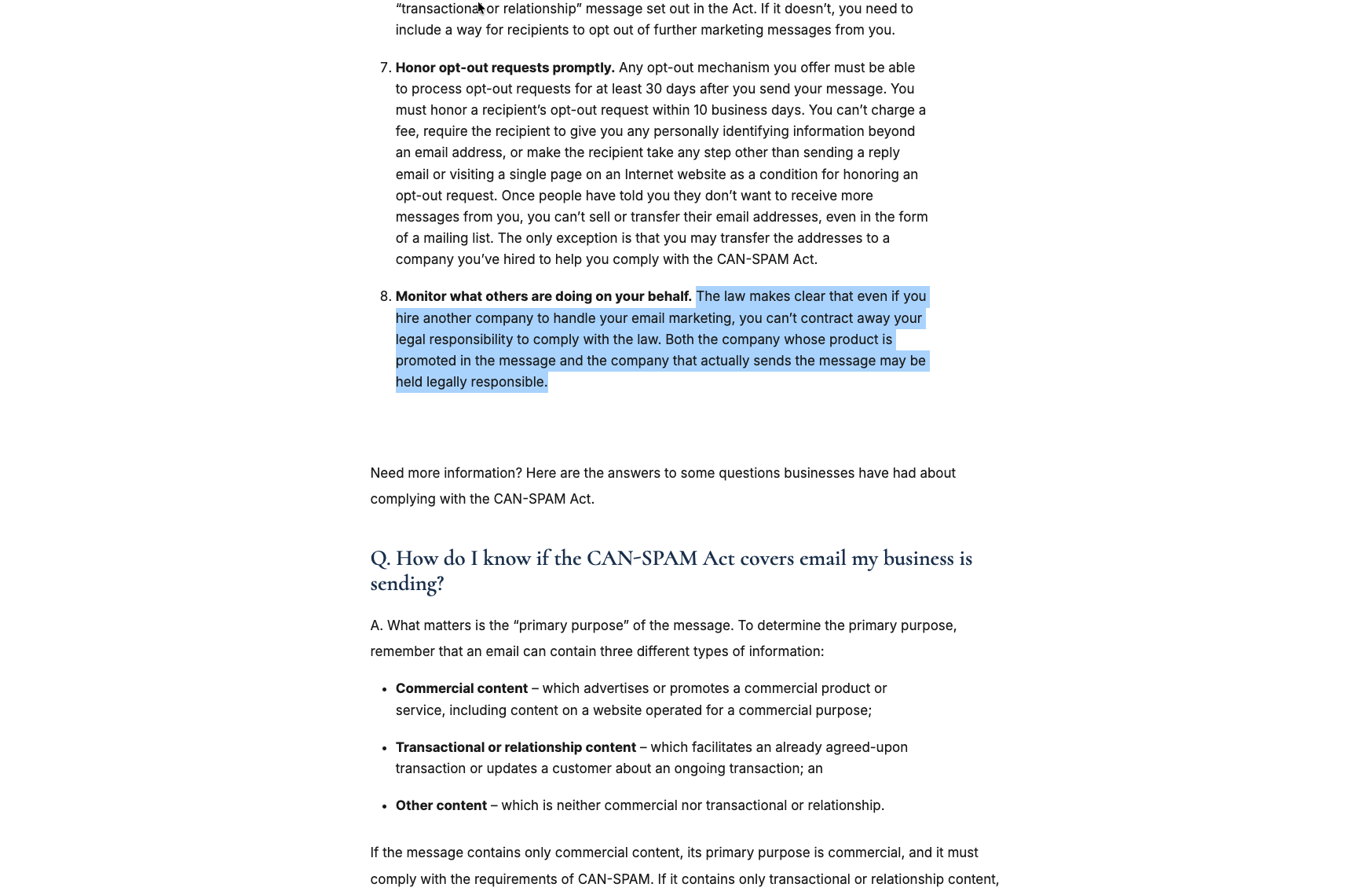
Name one person in the contract for each sending duty: the opt-out line, the handling of opt-out requests, and the postal address in each email.
The sending rules for the US, Gmail, Yahoo, and the UK set the limits each duty must meet.
Run a 90-day pilot with four checkpoints
Agency sites claim first results anywhere from 7 to 90 days, usually without data. Set your own checkpoints so the claim does not matter.
The table lists what to ask to see and when to stop.
Checkpoint | Ask to see | Continue if | Stop or fix if |
|---|---|---|---|
Day 14 | Domains, a list sample, and the first messages, all approved by you | The sample matches the buyer you described | Titles, company sizes or countries are wrong |
Day 30 | Replies, bounces, spam complaints, and booked meetings in your CRM or sheet | Sending stays inside Gmail and Yahoo limits and replies are coming in | Complaints rise, or sending pauses |
Day 60 | Booked and held meetings side by side, with notes | Held meetings are on pace to meet your ceiling | Many no shows or poor fits |
Day 90 | Total cost divided by held meetings | At or under your ceiling | Over your ceiling |
The card shows the four dates as one line.
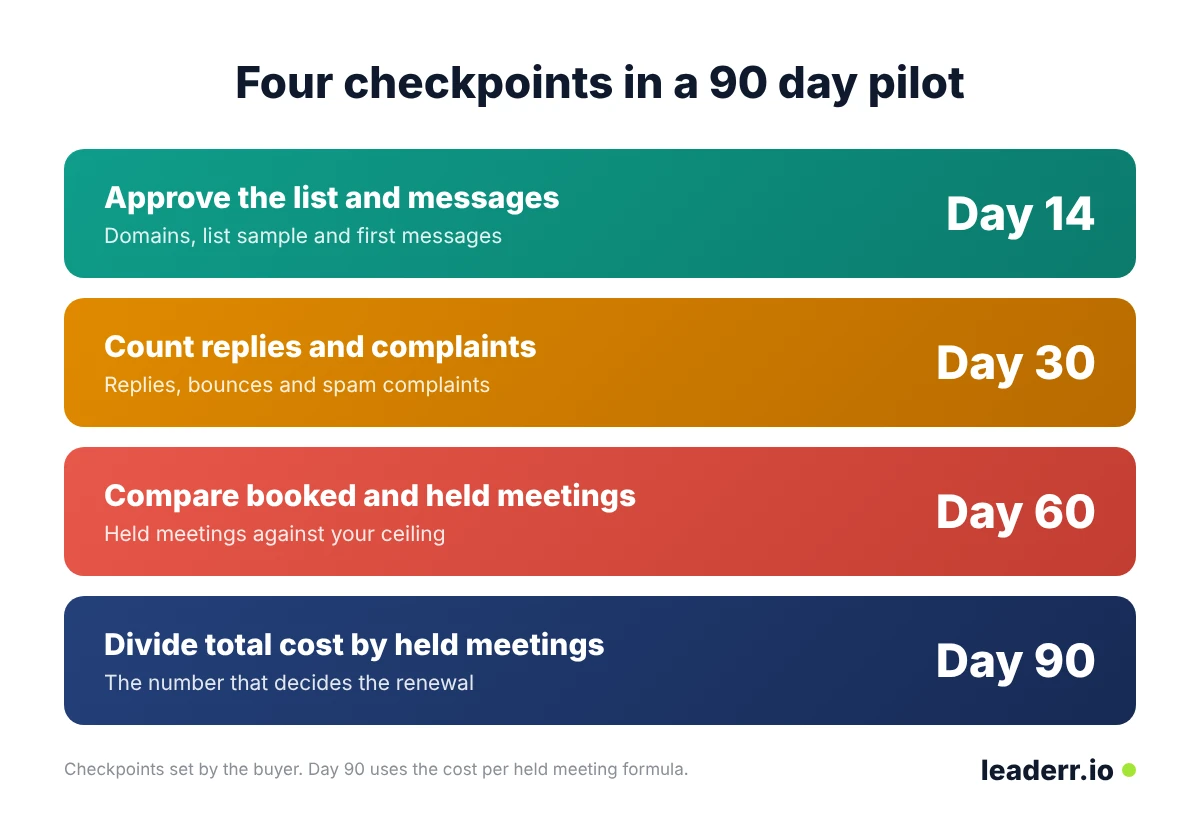
Each date has one question, and day 90 has the number that decides the renewal.
Copy this term sheet and question list
Fill in the term sheet with each provider's answers. Ask the six questions on the first call.
Agency term sheet (fill in before you sign)

Price: retainer $____ a month. Setup $____ once. Tools $____ a month, paid by ______.
Unit: price is per [booked / held / qualified] meeting. Proof of each: ______.
Qualified meeting test, written by the buyer: ______.
First term: 90 days. Review date: ______. Stop rule: ______.
After day 90: month to month. Notice to stop: ____ days. Auto renewal: none without a written yes.
Buyer owns at exit: lead list, replies, messages, domains, mailboxes, CRM export. Export within ____ days.
Sending duties: opt out line written by ______. Opt out requests handled by ______. Postal address in each email: ______.
Returned or rejected leads: allowed within ____ days. Credit or refund: ______.
What does your price count: leads, booked meetings, or held meetings?
Who writes the test for a qualified meeting?
What sits on top of the retainer: setup, tools, or data?
Who owns the domains, mailboxes, and lists if I leave?
Can I send back a lead or a meeting that fails the test?
Which clients that started in the past 12 months can I speak with?
What happens after day 90
The day 90 number decides the next step. The table pairs each result with an action and the clause that supports it.
Result at day 90 | What to do | Clause to use |
|---|---|---|
At or under your ceiling | Renew month to month and set a review date | Month to month term with 30 days' notice |
Over your ceiling, good fits | Ask for a changed list or message for 30 days, then check again | Credit for meetings that fail your test |
Over your ceiling, poor fits | Stop | Notice period and the 30-day export window |
Common mistakes and how to fix them
The table lists four failures that show up after signing, with the cause and the fix.
Symptom | Cause | Fix |
|---|---|---|
The report shows many meetings, but your calendar is empty | The price counts booked meetings, not held ones | Price them again on held meetings with the formula, and ask for an accepted invite for each |
Calls go to the wrong buyers | No one wrote down the test for qualified | Put your test in the contract, and ask for credit on meetings that fail it |
Bills continue after you stopped | Auto renewal with a long notice period | Ask for month-to-month terms and a written stop date |
Outreach stops on the day the contract ends | The provider owned the domains and mailboxes | Own the domains from day one, or agree a written handover |
A 2013 Hacker News thread with 7 points and 2 comments asked whether anyone had used lead generation services with success.
One commenter listed questions to ask first, including whether returned leads are allowed and whether fees can be tied to booked appointments.
The thread is old, and the same questions sit in the term sheet above.
FAQs
What are lead generation services?
Lead generation services are outside providers that find possible buyers for you and hand over contact details or booked meetings.
They differ by what they hand over, so a price per lead and a price per meeting are never the same thing.
How much do lead generation services cost?
Agency pages quote $2,500 to $15,000 or more a month for managed outbound, plus setup and tools.
A better number is your total cost divided by held meetings.
In the worked example in this article, $21,000 over 3 months and 21 held meetings gave $1,000 for each held meeting.
Do lead generation services work?
They work when the buyer list, the message, and your follow-up match.
A 90 day pilot with a stop rule shows whether that holds in your market, and a promise from a sales page does not.
Which lead generation service is best?
No single provider fits every seller, so a ranked list would mislead you.
Shortlist three providers, ask each the six questions above, and compare them on cost per held meeting, written ownership terms, and how closely their test for a qualified meeting matches yours.
Reliable lead generation services put those answers in writing.
Sign the pilot, not the year
Write your price ceiling for one held meeting. Send the six questions to three providers, and fill in a term sheet for each provider. Sign only a 90-day pilot.
On day 90, divide the full cost by the held meetings. If the answer is above your ceiling, stop. If it is at or under your ceiling, renew month to month.
Guidance reviewed 15 October 2026.
About the author
Michael Doyle writes about B2B sales at Leaderr. He covers prospecting, cold outreach, sales data, and pipeline building, with a focus on what actually works for SDRs, founders selling on their own, and small sales teams. Connect with him on LinkedIn.