Lead generation for tech companies: A step by step process
A five stage process for lead generation for tech companies: firmographic filters, buying committee mapping, channel fit, lead scoring, and security review.
 Michael Doyle14 min read
Lead generation for tech companies works best as four linked stages: build a firmographic and technographic profile, map the buying committee, pick channels that fit your price point, and score leads on real signals.
A fifth factor, the security review technical buyers add before signing, decides whether any of it holds. Skip a stage and volume rises while quality falls.
The contact sourcing step in this process runs on tooling, and the options are set out in a roundup of the sales prospecting tools.
What you need before you start
This process works whether you are a solo founder doing it yourself, an SDR working a defined territory, or a small team without a dedicated operations function. It assumes B2B, not consumer software, and a product with a real price tag, not a free app monetized through ads.
Before you start, you need three things. First, a rough hypothesis about who buys your product now, even if it is just "companies like your first five customers." Second, a way to look up company websites, job postings, and public funding or revenue data, since several of the filters below depend on that.
Third, patience: building a working profile and testing it against real prospects takes weeks, not an afternoon, because you are validating filters against actual replies and closed deals, not guessing once and moving on.
This guide covers B2B tech, software, and IT companies selling to other businesses. It does not cover consumer app growth, and it does not cover generating leads for a lead generation agency's own client roster, which is a different problem with different economics.
Stage 1: Build the profile with firmographic and technographic filters
What happens: You define which companies are worth contacting before you contact anyone, using company level traits (firmographic data) and evidence of what software and infrastructure a company already runs (technographic data). Industry, employee count, and funding stage tell you who exists. Job postings, engineering blog activity, and public tech stack clues tell you who is actively investing in the problem you solve.
Most firmographic filters lean hard on employee count as a proxy for budget, and that proxy breaks specifically in tech. A headcount band built for manufacturing or professional services assumes revenue and staff grow together. Software companies routinely break that assumption.
Linear, the project tracking tool, ran on 118 employees in 2026 while carrying a 1.3 billion dollar valuation and roughly 100 million dollars in annual recurring revenue, according to company financial data compiled by Latka, last updated July 3, 2026. The company profile page behind that figure is public, so here is exactly what it shows.
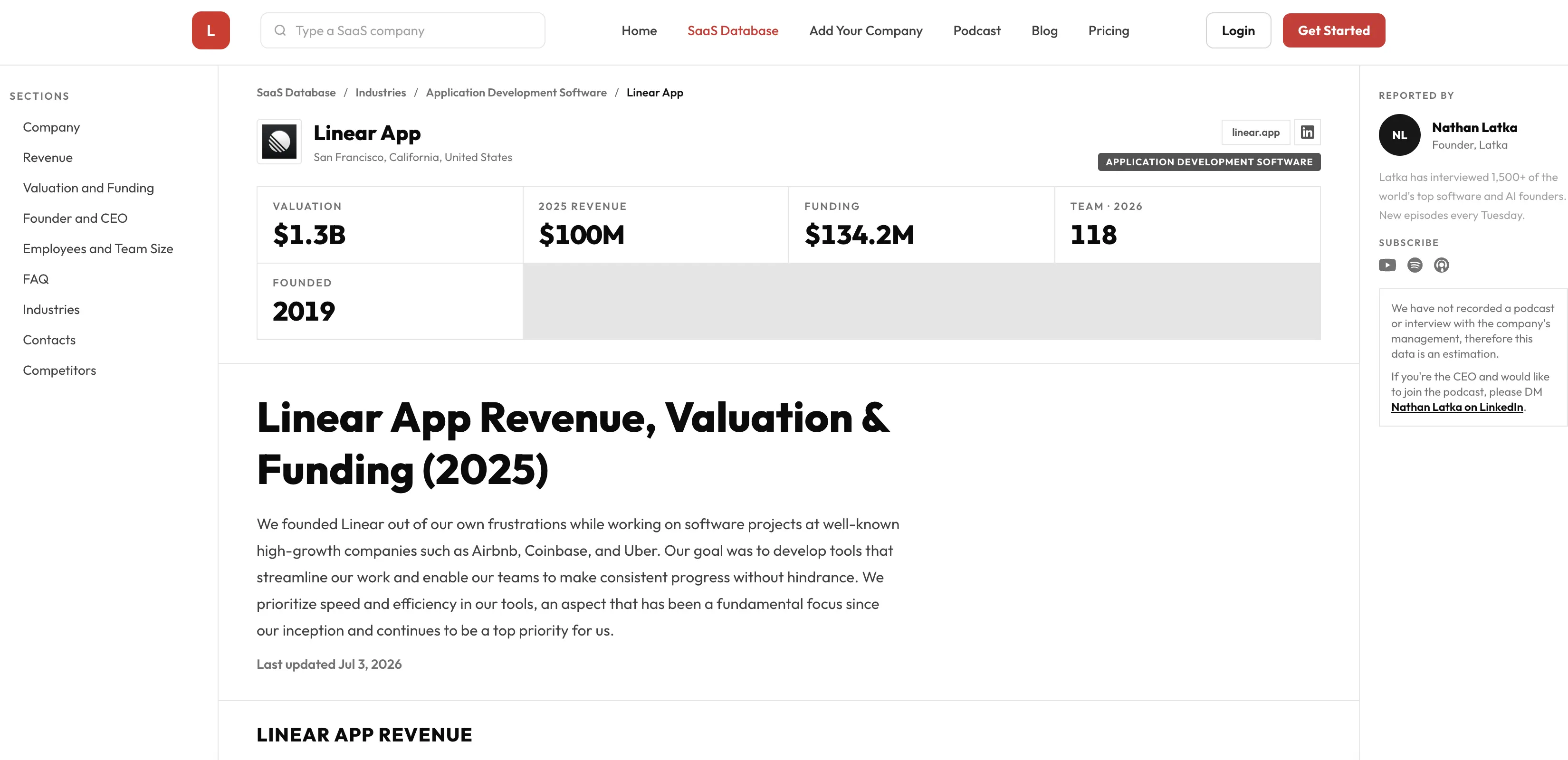
That page confirms the two numbers above can be checked directly rather than taken on faith, and it is not a small company by budget or by buying authority, even though a 150 person minimum headcount filter would screen it out. A useful firmographic filter for tech buyers weights funding stage, revenue signal, and hiring velocity in specific roles above raw headcount.
Airtable shows the opposite pattern for contrast: 947 employees against 478 million dollars in estimated annual recurring revenue and an 11.7 billion dollar valuation, per the same financial database, also updated July 3, 2026. Two companies, both worth targeting for many B2B tools, with headcounts eight times apart.
Employee count alone tells you almost nothing about which one can sign a five figure contract, and that gap between headcount and buying power is the reason a technographic layer matters more in tech sales than in most other industries.
To build the technographic layer, check three things for each company on your list: open job postings for the roles that would use or approve your category of product, any public engineering blog or changelog activity in the last quarter, and stack clues visible in job descriptions, including which cloud provider, CRM, or data warehouse they mention wanting experience with.
A company hiring three platform engineers and running a public API changelog is a stronger technographic fit than one with a static "careers" page from two years ago, regardless of what either one's employee count says.
For a fuller walk through of how firmographic data separates a fit from a maybe, including the four stage scoring method behind it, the dedicated guide covers the mechanics this section only summarizes.
Before any of this filtering makes sense, it also helps to be clear on what an ideal customer profile actually is and how it differs from a buyer persona, since the two get confused constantly and solve different problems.
Done when: You have a written filter, not a mental one, with specific ranges for industry, funding or revenue signal, and at least two technographic signals, applied to a real list of 20 to 50 companies you would actually want as customers.
Stage 2: Map the buying committee inside the account
What happens: Once you know which companies fit, you need to know who inside each one actually moves a deal. For B2B technology purchases, that is rarely one person. A May 2025 Gartner sales survey found that buying groups run from five to 16 people across as many as four different functions, and that groups reaching internal consensus were two and a half times more likely to report a high quality deal.
Delainey Kirkwood, principal research at Gartner's sales practice, put it plainly: getting a buying group to agree, not just reaching one champion, is now a central job for anyone running B2B sales, according to the May 2025 buyer conflict survey.
For a tech product specifically, that group usually splits into four recognizable roles. The economic buyer controls budget and cares about cost, risk, and how the purchase ties to a business result. The technical evaluator, often an engineering lead or architect, cares about integration effort, reliability, and whether the tool creates work for their team later.
The end user, frequently a developer or analyst, cares about whether the tool is pleasant to use daily and whether it fits their existing workflow. The security or procurement reviewer, who may not appear until late in the process, cares about none of the above and instead checks data handling, access controls, and contract terms.
Laid out visually, the split between these four roles becomes easy to plan messaging around:
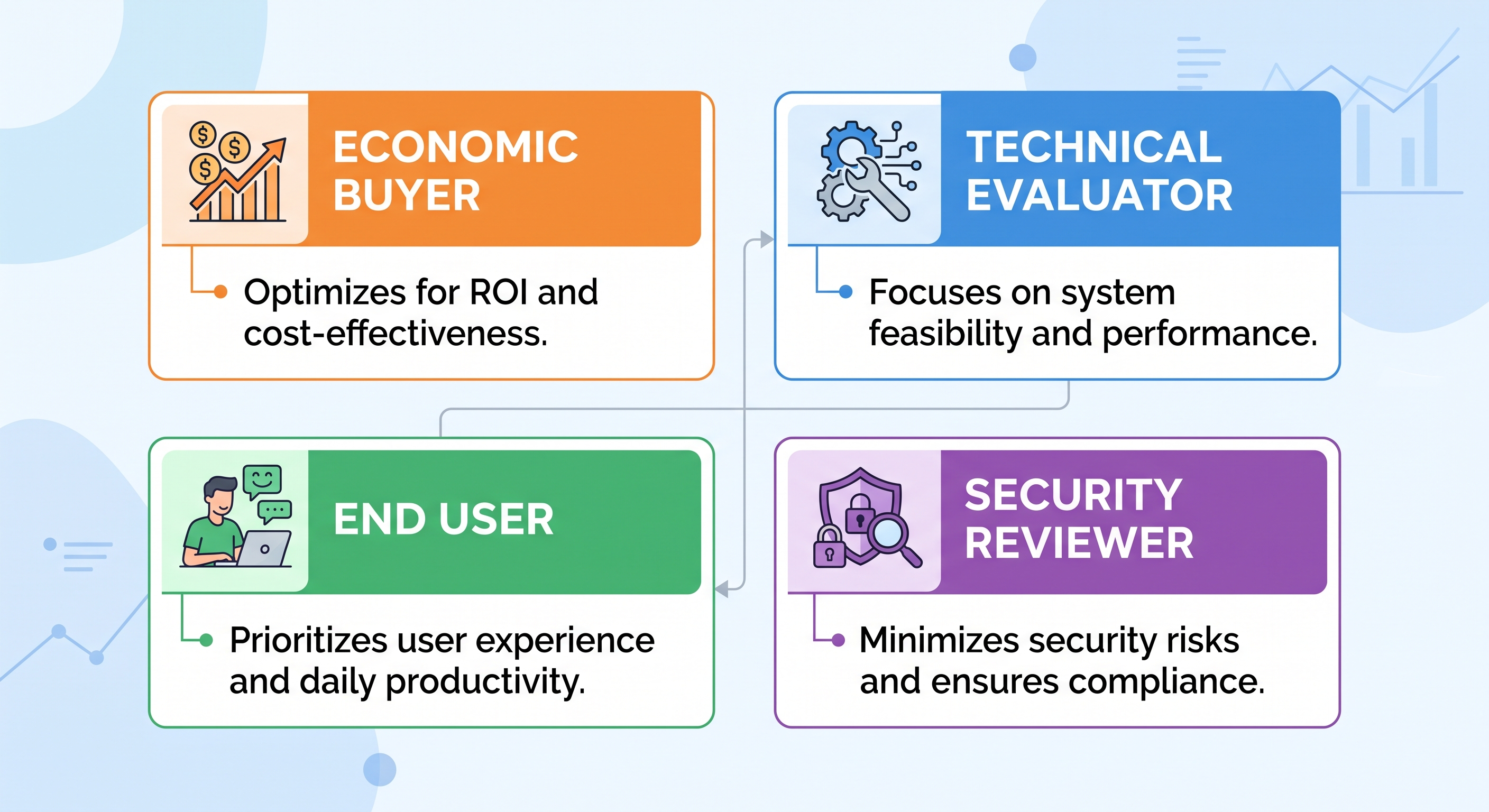
The diagram above is worth building into your own outreach planning, because messaging aimed at only one of these four roles tends to stall once it reaches the others. A cold email that speaks entirely to cost efficiency will not move a technical evaluator who is worried about migration effort, and a demo built entirely around developer experience will not answer a procurement reviewer's questions about data residency.
Content and messaging that map to all four roles convert faster through committee review than content built for one role and hoped to travel.
Knowing what a sales development representative does day to day helps clarify who on your team should be having which of these four conversations, since the economic buyer conversation and the technical evaluator conversation usually need different people or at least different scripts.
Done when: For each active opportunity, you can name a real contact, or at least a job title, mapped to each of the four roles, not just the person who first replied to your outreach.
Stage 3: Choose channels that fit your price point and audience
What happens: With a profile and a committee map, channel choice becomes a fitting exercise instead of a guessing game.
Lower priced, high volume products (self serve trials under a few hundred dollars a month) generally do better on content, search, and product led signals, since the buying group is often one or two people who can decide without a formal review.
Picking the channel is the easy half, and the five stage cold email outreach process covers the list, sending setup and sequence work that decides whether the email channel returns anything.
Higher priced products, especially anything needing the security review from Stage 2, do better on a mix of outbound and account based marketing, since a five to 16 person buying group rarely assembles itself around inbound content alone.
Channel | Best for | Time to first result |
|---|---|---|
Cold email and LinkedIn outreach | Reaching a named technical evaluator or economic buyer directly | Two to four weeks |
Content and search | Attracting self serve trial signups and early stage research | Three to six months |
Account based marketing | Coordinating messaging across a full buying committee at target accounts | Two to six months |
Webinars and product demos | Moving warm leads from interest to a scheduled evaluation | Four to eight weeks |
Referral and word of mouth | Converting existing customers into new accounts inside the same buying group's network | Ongoing, compounding |
None of these replace each other. A company selling a six figure platform to enterprise buying groups will lean on outbound and account based marketing, and still needs a content presence for the technical evaluators who research quietly before any call happens.
Done when: You have picked one primary channel and one supporting channel for this quarter, not five channels run at 20 percent effort each.
The ICP and technographic fit worksheet
Copy this into a spreadsheet and fill one row per company on your target list.
Company:
Industry:
Employee count (context only, not a hard cutoff):
Funding stage or estimated ARR:
Job postings signal (role, count, posted in last 90 days):
Public tech stack or infrastructure clue:
Engineering blog or changelog activity (yes/no, last date):
Economic buyer (name or title):
Technical evaluator (name or title):
End user (name or title):
Security or procurement reviewer (name or title, if known):
Fit score (1 to 5, weighted toward technographic signal over headcount):
Run this against 20 real companies before trusting it. A filter that has never been tested against real replies is a guess with a spreadsheet attached.
Stage 4: Score and route what converts
What happens: A demo request or a trial signup is not a lead, it is a signal that still needs routing. The moment someone converts, three things need to happen fast: the record needs to reach the right person, that person needs enough context to respond without asking the prospect to repeat themselves, and the first reply needs to go out before the prospect has moved on to a competitor's page.
Research on lead response timing has repeatedly found that contacting a new lead within five minutes produces far higher qualification rates than waiting even thirty minutes, because interest decays fast once someone closes the tab.
That decay curve is worth seeing laid out on a timeline, since it explains why a same day reply still counts as slow:
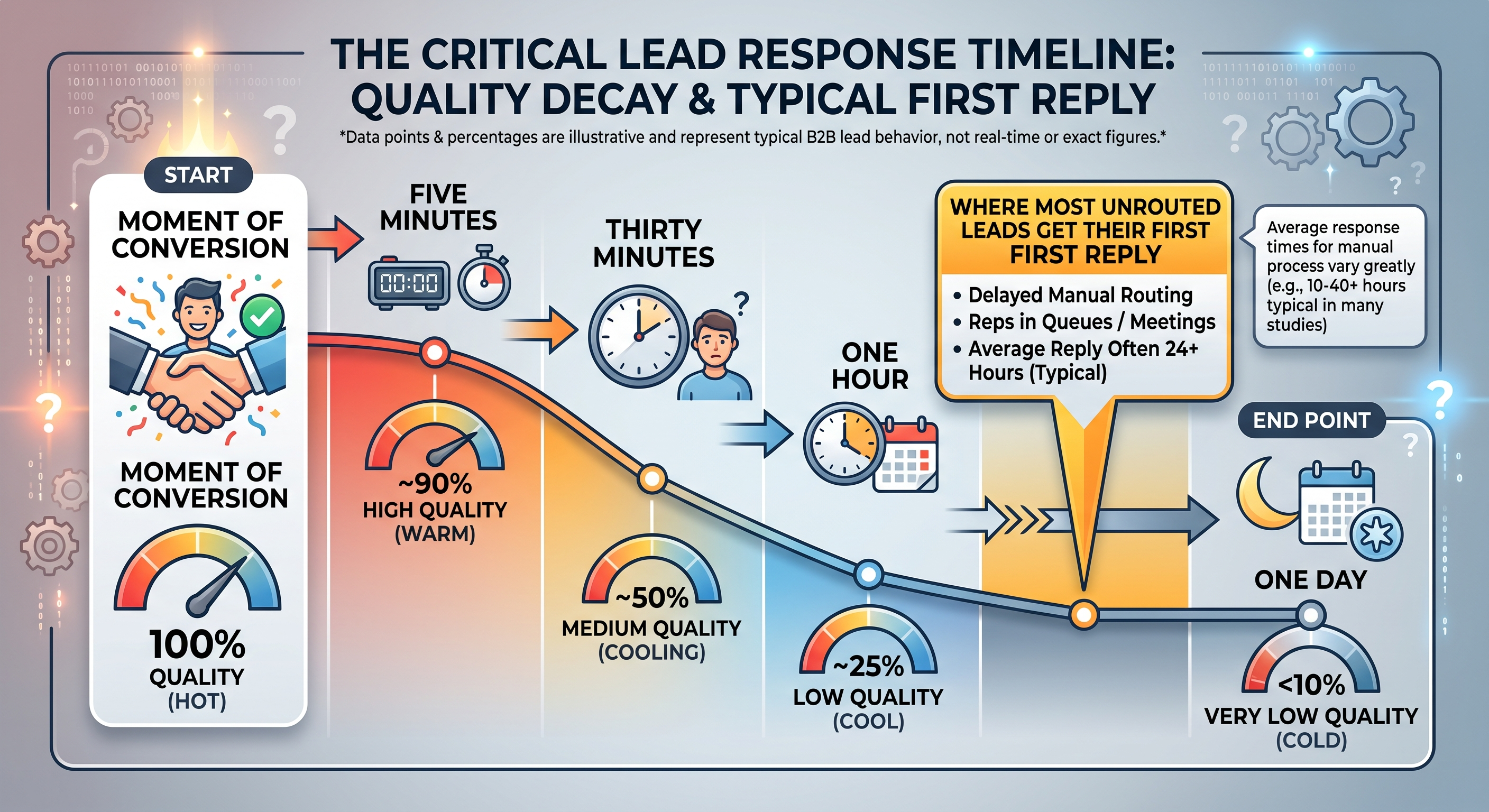
The timeline above is the reason routing gets its own stage instead of being treated as an afterthought to Stage 3: a channel that produces a signal nobody answers quickly has not actually produced a lead yet.
For a self serve trial, the routing question is different from a demo request form. A trial signup with no product usage in the first three days is a weaker signal than one with no usage but a job title matching your economic buyer role, and both are weaker than a signup who invited a teammate, since inviting someone else is one of the clearest usage signals that a real evaluation is underway. Score trial signups on what they do inside the product, not only on the fact that they signed up.
Done when: Every converted lead has an owner within the same business day, and that owner can see the same firmographic and technographic context gathered in Stage 1 without digging for it.
Troubleshooting
Leads stall in a security review that appeared out of nowhere.
This usually means the security or procurement reviewer from Stage 2 was never mapped, so nobody prepared for their questions in advance.
Fix it by asking your existing customers what their security review process looked like and building a short answer sheet, covering data handling and access control basics, before the next enterprise deal reaches that stage instead of scrambling once it does.
Engineers and technical evaluators ignore messaging that would work on an economic buyer.
A message built around cost savings or business outcomes reads as generic marketing to someone evaluating integration effort and reliability.
Rewrite the version aimed at technical evaluators around specifics they can verify: what the integration actually touches, what happens on failure, and what changes for their team day to day.
There is no repeatable profile yet, so paying for lead generation feels like a bet with no data behind it.
This is common before the first ten or so customers exist to build Stage 1's filter from.
One founder working through exactly this question, weighing paid lead sourcing against building first customers through an existing network, raised it directly in a small founder community and got a consistent answer back: personal network and community outreach outperformed paid sourcing at that earliest stage, a pattern echoed across a thread on Indie Hackers with several other founders facing the same choice.
The practical fix is sequencing: use network and community outreach to find the first handful of customers, then build the Stage 1 profile from what they actually have in common, then bring in paid lead sourcing once that profile exists.
Every trial signup gets treated as sales ready, and the team burns out chasing signups who were only browsing.
This is the Stage 4 scoring problem showing up as a morale problem.
A signup with a matching job title and product usage is not the same lead as a signup with a personal email address and no login since day one. Apply the usage based scoring from the earlier stage before anyone picks up the phone, not after.
Frequently asked questions
Is lead generation worth it for a small tech company?
Yes, but the channel mix should match company stage. Early stage companies, before a repeatable profile exists, often get more from personal network and community outreach than from paid lead sourcing, since there is no established filter yet to make paid volume efficient.
What is the difference between a marketing qualified lead and a sales qualified lead?
A marketing qualified lead has shown interest, including downloading content or attending a webinar, but has not been checked against your ideal customer profile or buying committee fit. A sales qualified lead has passed that check and is ready for a direct conversation with a specific person mapped to a role.
How long does lead generation take to produce results for a tech company?
It depends on the channel. Outbound and cold email can produce first conversations within two to four weeks. Content and search generally take three to six months before volume becomes meaningful, since search visibility compounds rather than appearing immediately.
Do you need paid tools to build a working lead generation process?
No. The profile and scoring worksheet in this guide can be built in a spreadsheet using public job postings, company websites, and manual research. Paid tools save time once volume grows, but they are not required to test whether a filter works.
How do tech companies get their first leads before they have a sales team?
Through founder led outreach to a personal and professional network, plus targeted participation in communities where the target buyer already spends time, rather than broad paid campaigns aimed at an unproven profile.
Building the process, not just the list
None of these four stages work in isolation, and the security review from the troubleshooting section below is not optional once a deal grows past a single buyer. A perfect firmographic filter with no buying committee map produces contacts who cannot say yes alone. A well mapped committee with the wrong channel produces polite silence. Channels chosen correctly but scored on form fills instead of usage produce a sales team chasing browsers instead of buyers. Build the stages in order once, then revisit Stage 1 every quarter as your own customer base changes what a good fit actually looks like.