Lead enrichment: what it costs and how accurate the data is
Lead enrichment explained with real per contact pricing, a federal decay rate, four ways to run it, and a scorecard to test any provider's accuracy claims.
 Michael Doyle12 min read
Lead enrichment adds missing facts, a job title, a company size band, a verified email, to a lead record as soon as it arrives.
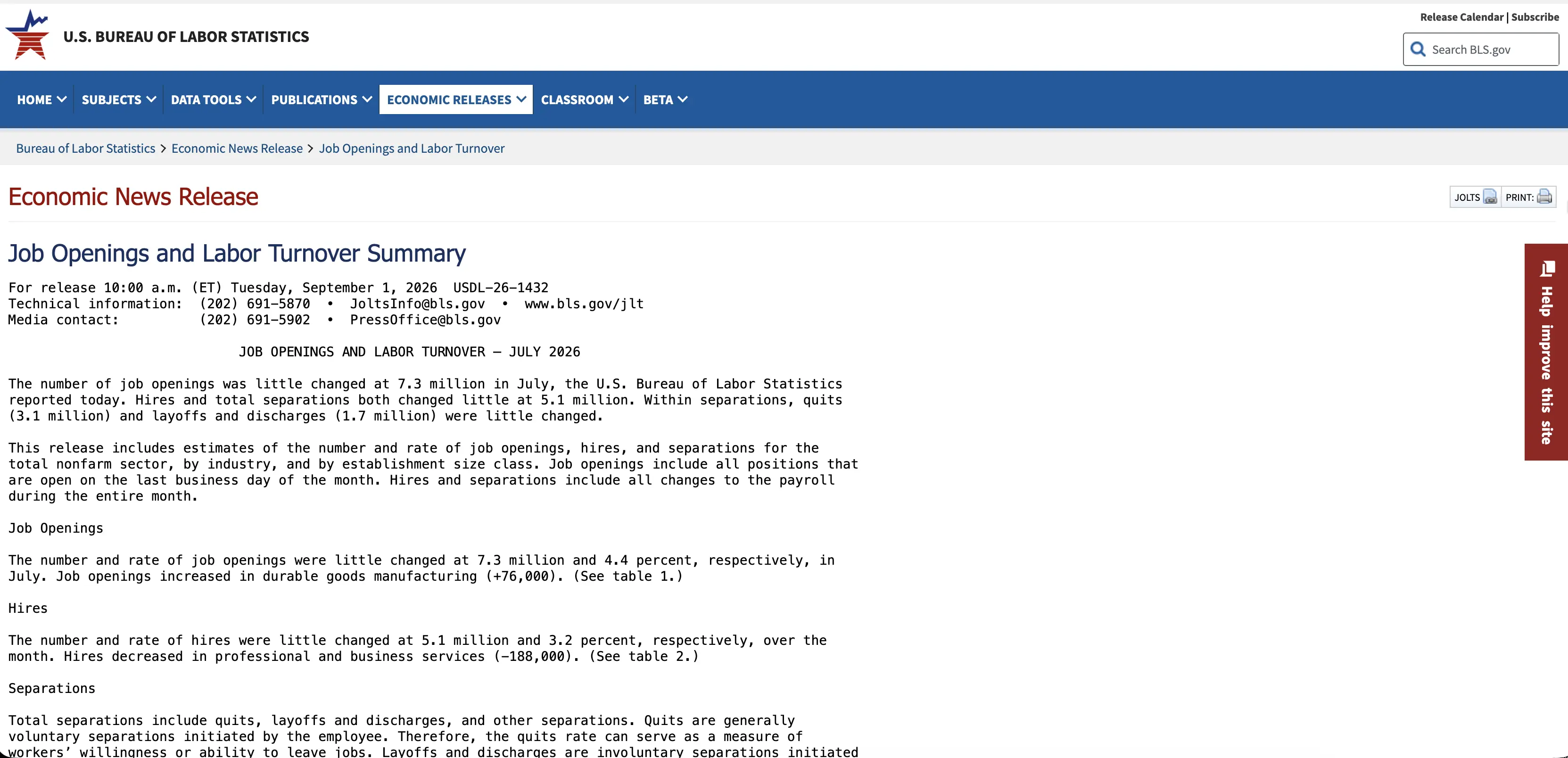
About 1.9 percent of the US workforce quit a job in July 2026 alone, per federal data.
That is why an enriched record starts going stale before your rep even calls it.
Lead enrichment is one branch of a wider practice, and the cost and compliance rules that apply across all of it are set out in what B2B data enrichment involves
What you need before you start enriching leads
The right setup depends on team size, budget, and where leads come from. Before picking a method, confirm the following.
A source of new leads. Enrichment has nothing to add to if no form fills, list uploads, or account lists exist yet.
A defined set of fields you actually use. Job title, company size, industry, and a verified email cover most sales workflows. Everything past that is often unused.
A place enriched data lands. A CRM, a spreadsheet, or a sequencing tool all work; the fields just need to match.
A privacy basis for appending personal data, covered later in this guide.
Time or budget for a provider. A solo founder with two hours a week and an enterprise team with a data engineer both do this, at sharply different speeds, and the segment sections below split out where each one starts.
What lead enrichment actually adds to a record
Most raw leads start bare. A name and an email are all a form fill usually gives you. Enrichment fills in the rest from public records, verified databases, and behavioral signals.
The core fields fall into a few groups: contact details (direct email, phone, verified title), firmographic facts (headcount, revenue band, industry, funding stage), demographic details (seniority, department, location), technographic signals (software stack, hiring posts for certain tools), and intent or behavioral data (recent page visits, content downloads, review site activity).
What is firmographic data covers the firmographic group in full with a worked scoring example, and what is B2B data enrichment walks through how a record gets matched and verified stage by stage at the account level.
This guide stays at the lead level: one form fill or one cold list entry, scored and routed, not a whole account database.
How lead enrichment works, stage by stage
Capture the trigger record
What happens: a form fill, a list upload, or a manually added contact creates a bare record with a name and usually an email.
Done when: the record exists in the CRM or sequencing tool with a unique ID, even if every other field is blank.
Match against enrichment sources
What happens: the enrichment tool searches its own database, and sometimes a chain of several databases, for a record matching the email domain or the name plus company pair.
Done when: a match returns with a confidence score, or the tool reports no match found.
Score and fill the gaps
What happens: matched fields get written into the record, and a lead score gets calculated from the completed profile against your ideal customer profile.
Done when: every priority field defined in the scope step is either filled or marked unavailable, and a numeric or tiered score exists.
Route the lead
What happens: based on the score and the fields, the record moves to a rep, a nurture sequence, or a hold list.
Done when: an owner or a workflow has picked up the lead within the window your team commits to, often under an hour for a high score inbound fill.
Lead enrichment vs lead scoring
The two get used together so often that teams blur them into one step. Enrichment fills in facts about a lead. Scoring turns those facts into a number that ranks leads against each other.
How lead scoring works breaks down how a points based model gets built; the short version here is that enrichment has to run first, since a score built on blank fields is just a guess wearing a number.
What accuracy claims actually mean
Every enrichment vendor publishes an accuracy number. Every one is self reported. No published match rate for this category has been tested by anyone outside the company selling the tool.
That gap matters more than it looks, because a published rate and a rate on your own list can differ by a wide margin depending on industry, region, and how recently the source data was refreshed.
A more useful question than "how accurate is this tool" is "how accurate is this tool on records like mine." Ask a provider for a free sample enrichment against fifty of your own real leads, then check the returned emails yourself with a separate verification pass before you count anything as a match.
A vendor unwilling to run that test on your data, rather than a canned demo list, is telling you something on its own.
Inbound form fills versus outbound cold lists
They are not the same job. Inbound and outbound leads start from different places and need different handling.
An inbound form fill already has consent to be contacted and usually a work email, so enrichment there is mostly about filling gaps: company size, the right department, a direct phone number if your process uses one.
Speed matters most, since a fast response to a fresh inbound lead converts far better than a slow one.
Outbound cold list entries have no existing relationship and often started as a name and a company, not an email. Enrichment there has to do more work, finding a valid email and confirming it is deliverable before a single message goes out, and it carries a heavier compliance burden since the person never opted in.
Treating both lists through the same enrichment settings wastes the speed advantage on the inbound side and skips a real risk check on the outbound side.
How fast enriched data goes stale
Nobody enriches a list once and forgets it on purpose. Here is a number to work from for how quickly an enriched lead record actually decays.
The number behind the decay
The Bureau of Labor Statistics reported a 1.9 percent quits rate for July 2026, covering roughly 3.1 million people who left a job that month alone.
Compounded across twelve months, that puts close to one in five working adults changing employers within a year, before counting promotions, department moves, or company acquisitions that also break a record without anyone quitting anything.
What a refresh schedule needs to cover
A list enriched once and never touched again is wrong for a meaningful share of its rows before the quarter ends.
A quarterly refresh on high value segments and a light monthly check on titles and departments for active pipeline accounts covers most of the gap without paying for a full re enrichment every week.
Lead enrichment for a team of one or two people
Running the same process at a smaller scale, without a dedicated operations person, is realistic for a solo founder or a two person sales team.
Start with the free tier of a single point tool rather than a stack of several. Free tiers commonly cover a few dozen to a few hundred lookups a month, enough for a founder doing outbound personally rather than blasting a large list.
Enrich only the leads you are about to contact this week, not a full database up front; a small, current list beats a large, stale one every time you are the only one working it.
Weigh each new lead against what your ideal customer profile actually says before it gets enriched at all, since a two person team wastes real money enriching contacts that were never a fit to begin with.
Skip technographic and intent data at this stage. Contact details and firmographic facts answer almost every qualification question a one or two person team actually asks before a call.
Four ways to enrich a lead, compared
Approach | Typical cost | Speed to result | Accuracy ceiling | Setup effort |
|---|---|---|---|---|
Manual research | Time only, no software cost | Minutes per lead | Depends entirely on the researcher | None |
Single point tool, credit based | Free tier to roughly sixty dollars a month | Seconds per lead | Limited to that one provider's database | Low, sign up and search |
Multi source waterfall stack | Roughly one hundred dollars a month and up | Seconds per lead, multiple sources checked in sequence | Highest, since a miss on one source falls through to the next | Moderate, several accounts to connect |
Outsourced managed service | Priced per project or per record, usually higher per contact | Days, not seconds | Depends on the vendor's own sourcing | Low for you, higher for the vendor |
A waterfall setup, where a lookup falls through a chain of sources until one returns a match, is the approach behind most of the higher accuracy claims in this space.
It costs more than a single tool and takes longer to configure, which is why the smaller team section above starts with one point tool instead.
What it actually costs to enrich a lead
Budgeting for this is hard. Pricing pages across this category mostly say "contact sales," leaving nothing to plan against before you commit.
A few providers do publish real numbers: a pricing comparison published in January 2026 lists UpLead at ninety nine dollars a month for one hundred seventy credits, which works out to roughly fifty eight cents per enriched contact.
The same roundup lists Apollo's free tier at unlimited email credits but only sixty mobile credits a year, Datanyze's free tier at ten credits a month with paid plans starting around eighty dollars, and Pipl at thirty seven dollars a month for a personal plan up to seventy seven dollars for a business plan.
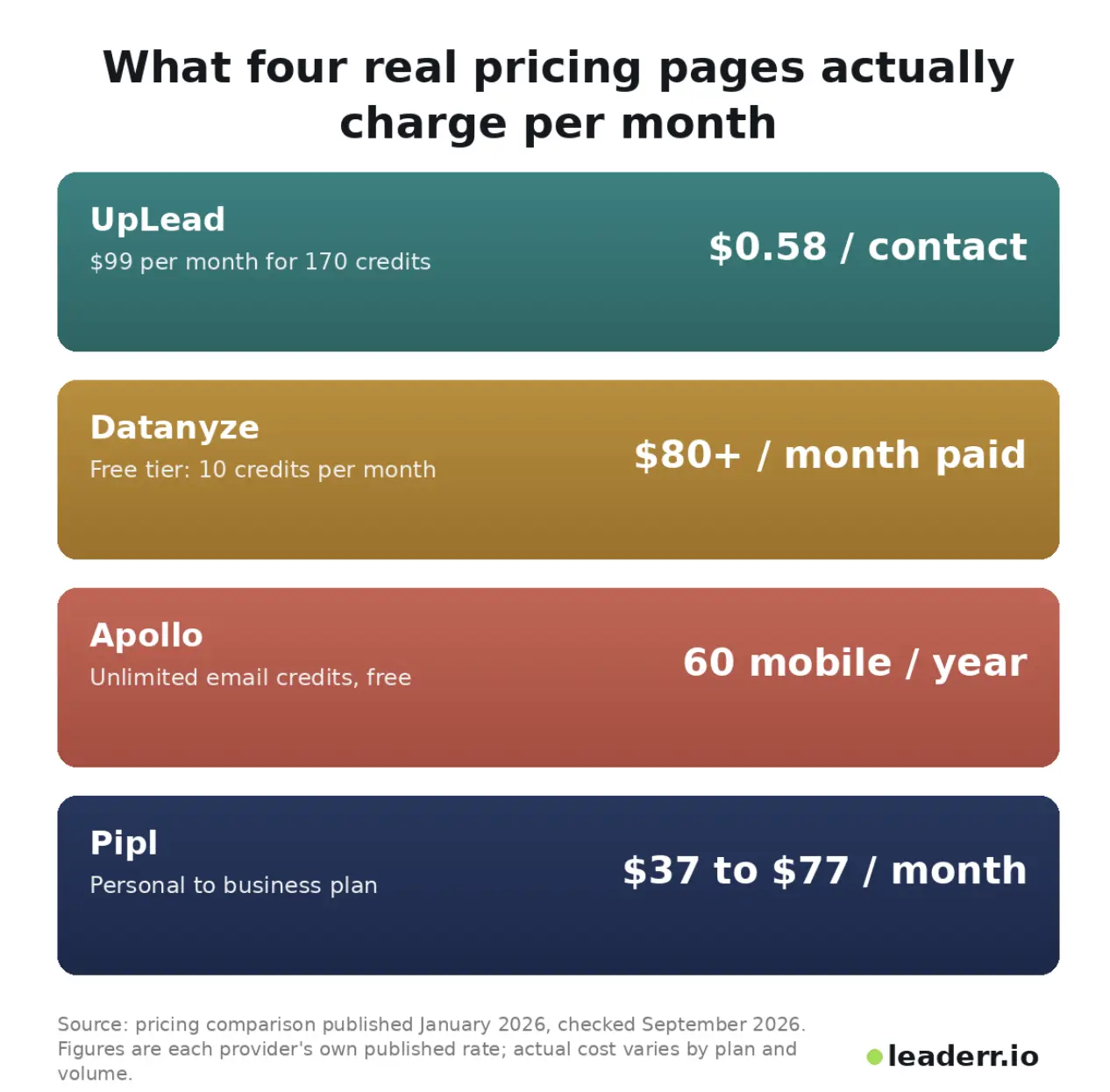
None of those numbers will match every provider in the category, since pricing changes and plans vary by volume commitment.
The pattern holds regardless: per contact cost on a credit based plan usually lands somewhere between ten cents and a dollar once you divide the monthly fee by the credits included, and that math is worth doing before signing anything priced as a flat platform fee.
A scorecard for evaluating a lead enrichment provider
Copy this and score each provider you are considering from one to five on every row, using your own trial data rather than the vendor's demo.
[ ] Match rate on fifty of your own real leads, tested yourself, not the vendor's sample list
[ ] Cost per enriched contact once the monthly fee is divided by included credits
[ ] Refresh frequency, meaning how often the vendor re checks a record already in its database
[ ] Field coverage against the specific fields your team actually uses, not the full list the vendor advertises
[ ] Compliance documentation, meaning a clear answer on lawful basis for the regions your leads come from
[ ] Export and integration fit with the CRM or sequencing tool already in place
[ ] Support for a real sample test before you commit to a contract
A provider that scores well on four or five rows and poorly on the rest is still a bad fit if the weak rows are the ones your team depends on daily.
Common mistakes with lead enrichment
Mistake | Why it happens | Fix |
|---|---|---|
Enriching every lead in the database at once | A new tool gets connected and someone runs it against everything | Enrich only leads entering active pipeline stages, then expand once the cost per contact is confirmed |
Trusting a vendor's published accuracy rate as is | The number looks precise, so it feels verified | Run your own fifty lead sample test before counting on any published rate |
Treating inbound and outbound the same way | One enrichment setting gets applied to every list by default | Route inbound and outbound through separate rules, since the risk and speed needs differ |
Never refreshing a record after the first enrichment | Refresh is treated as a one time setup step | Set a quarterly refresh on active accounts at minimum, tied to the job change rate above |
Sizing the enrichment spend to leads actually entering a sequence, rather than the whole list, is the fix that clears the first mistake in the table above on its own.
Lead enrichment FAQ
Is lead enrichment GDPR compliant?
It can be, but compliance depends on having a lawful basis for processing the personal data being appended, not on the enrichment tool itself.
Article 6 lists six lawful bases for processing personal data, and legitimate interest, the one most B2B teams lean on for enrichment, still needs a documented balancing test plus an easy way for a contact to object.
What is the biggest mistake teams make with lead enrichment?
Enriching an entire database before qualifying which leads are worth contacting. It burns budget on records that never reach a rep and delays enrichment on the leads that matter this week.
Does lead enrichment require a CRM?
No. A spreadsheet or a sequencing tool works for a small team, as long as the enriched fields land somewhere a rep can see them before the call.
What happens if no enrichment data is found for a lead?
Most tools return a no match result rather than a guess. Treat those leads as unverified rather than dropping them; a missing match often means a smaller company or a newer domain, not a fake lead.
What to check before your next enrichment bill
Run the math in this guide against whatever you are paying today: cost per credit, refresh frequency, and a real sample test against your own leads rather than a vendor's demo list. A provider that will not run that test on your data is asking you to trust a number nobody outside their own company has checked.
Sources reviewed September 7, 2026.
About the author
Michael Doyle writes about B2B sales at Leaderr. He covers prospecting, cold outreach, sales data, and pipeline building, with a focus on what actually works for SDRs, founders selling on their own, and small sales teams.