Best times to send cold emails and how fast replies arrive
A review of reply rate data covers the best times to send cold emails, including the exact day, hour, and time zone that matter most, and three timing rules.
 Michael Doyle11 min read
Cold emails get the most replies when they land Tuesday through Thursday, between 10 am and 12 pm in the recipient's local time zone. A second smaller window opens between 6 am and 9 am for people who check their inbox before the workday starts.
Monday mornings and Friday afternoons consistently underperform because inboxes are either flooded or already checked out for the week.
What you need before you start
Before picking a send time, gather three things: the recipient's time zone, a sense of their role and how they check email, and a list clean enough that a good time slot is not wasted on a dead address.
This applies whether you are a founder sending your first ten outbound emails, an SDR running a daily sequence, or an agency scheduling sends for several client accounts at once. Freelancers and small teams without a scheduling tool can still apply the same day and hour windows manually.
A tested cold email template still needs a send time that matches when the reader is actually looking at their inbox, so timing and message quality work together rather than as separate problems.
What this does not cover: marketing newsletters sent to a list that opted in, or transactional emails triggered by a user action. Those follow different rules because the recipient already expects the message.
Timing advice also lands differently depending on where in the process a message sits. A cold email is the first touch in the four stages of sales prospecting, and the send time guidance below applies most directly to that first touch rather than to a warm lead already in conversation.
Why the day of the week changes your reply rate
What happens: Reply rates rise from Monday to a peak around Tuesday or Wednesday, then fall off toward the weekend. A 2026 benchmark report from Instantly, covering campaigns run between January 1 and December 18, 2025, found Wednesday delivered the highest engagement of any weekday, while Friday produced the most automatic out of office replies as recipients wound down for the week.
Monday carries a different problem: volume. A founder who tracked 400 of his own sends on Indie Hackers found Monday emails pulled in 22 percent fewer opens than the same message sent on a Wednesday at 11 am, and settled on a Tuesday through Thursday, 10 am to 12 pm window after the test.
Done when: You have picked a weekday in the Tuesday to Thursday range for the first send in a sequence, and you know which day you are avoiding and why.
The chart below lines up the weekday pattern described above so the Monday drop and the midweek peak are easy to compare at a glance.
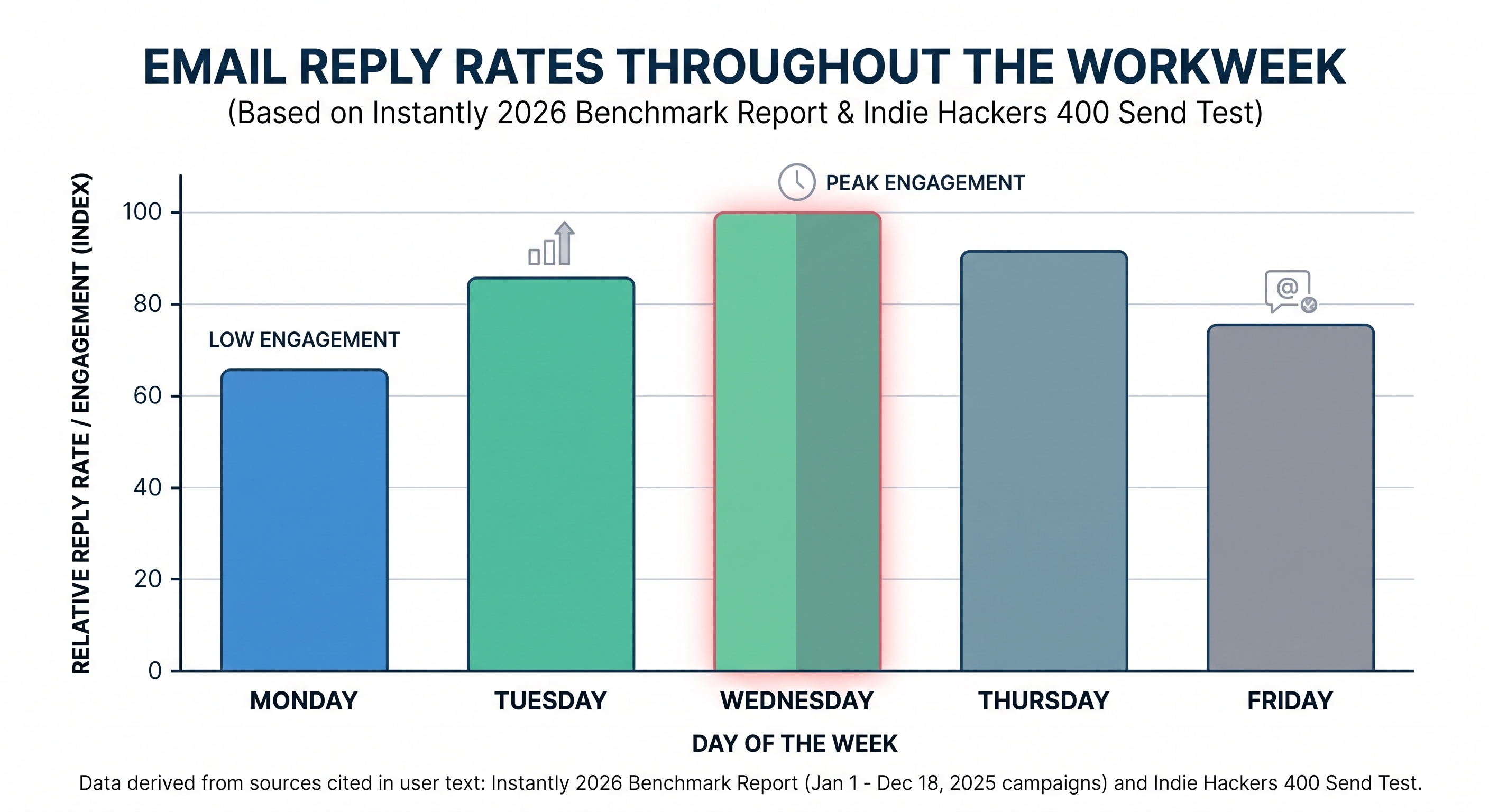
The shape of the chart matches both cited sources: a slow Monday, a midweek peak, and a Friday drop as attention shifts to the weekend.
The hour that matters more than the day
What happens: Two hour windows outperform the rest of the day. The first runs from 6 am to 9 am, when early risers clear their inbox before meetings start. The second, wider window runs from 10 am to 12 pm, after the first meeting block but before lunch pulls attention away.
A third smaller window opens from 1 pm to 3 pm, right after lunch. Evenings and late nights consistently underperform for a professional inbox, since the message competes with personal email and gets buried before the next workday.
Finding the recipient's time zone
A company's address, a phone number's area code, or a LinkedIn location field will usually get you close enough. When none of those are available, sending toward the middle of the recipient's country or region, rather than guessing a single city, keeps the message inside a reasonable window even if the exact time zone is wrong by an hour or two.
Done when: You know the recipient's time zone within one hour of accuracy, and the send is scheduled inside one of the two main windows rather than at a fixed hour in your own time zone.
Best send windows by day and hour
Window | Time | Why it works |
|---|---|---|
Early risers | 6 am to 9 am, recipient time | Read before the first meeting, less inbox competition |
Prime window | 10 am to 12 pm, recipient time | After the morning rush, before lunch distraction |
After lunch | 1 pm to 3 pm, recipient time | Attention returns, before the afternoon wind down |
Avoid | Monday before 9 am | Highest inbox volume of the week |
Avoid | Friday after 2 pm | Attention already shifting to the weekend |
Three rules that shape cold email timing decisions
Timing a cold email well means more than picking a day and hour. Three named rules come up around cold outreach, and each one changes a different part of the timing decision.
It sits inside a larger sequence, and the five stage cold email outreach process decides how much a good send window is worth in the first place.
The 30/30/50 rule
This rule splits a cold email into three parts by weight rather than by clock time: roughly 30 percent personalization that shows real research on the recipient, 30 percent value proposition that states a specific benefit, and 50 percent call to action that removes friction from the next step.
A message built this way earns the open a good send time gives it, instead of wasting the window on a generic pitch.
The 3 email rule
If a thread runs past three exchanges without reaching a decision, the rule says to move the conversation to a call, a meeting, or a live chat instead of continuing by email. Applied to cold outreach, this sets a natural stopping point for a follow up sequence: once three real exchanges have happened, more emails at the right hour stop being the answer.
The 12 second rule
Research on inbox behavior puts the average time a recipient spends deciding whether to engage with a new message at around 12 seconds.
That is the entire window for a subject line and opening line to earn a full read, which is why the hour you send matters less if the recipient is distracted the moment it lands, and more if they are between tasks with a clear 12 seconds to spend.
Best times to send cold emails for jobs, internships, and research asks
Timing shifts when the goal is not a sale but a reply from a specific person: a hiring manager, a professor, or a recruiter. Recipients in these roles tend to clear their inbox earlier in the day than a typical sales prospect, since students and job seekers are often emailing outside normal business hours themselves.
For a job or internship outreach email, Tuesday through Thursday still holds, but the window shifts slightly earlier, toward 8 am to 10 am recipient time, before a hiring manager's day fills with interviews and meetings. The approach mirrors cold emailing a hiring manager directly for a role that has not been posted yet, where a short, specific message outperforms a mass send regardless of hour.
For a summer research request sent to a professor or lab, early morning works well for a different reason: academic staff frequently answer email before undergraduate office hours begin, often between 7 am and 9 am. For outreach aimed at a specific finance or banking contact, the same early window applies, since these roles tend to start reviewing email well before the market opens.
A three step process for picking a send window
Confirm the recipient's time zone using their company address, phone area code, or public location.
Choose a weekday between Tuesday and Thursday for the first send, and note the alternate day in case the sequence needs a resend.
Schedule the send for 10 am to 12 pm recipient time, or 6 am to 9 am for a role that tends to check email early, such as a hiring manager, a professor, or a founder.
Laid out as a single flow, the three steps show how a time zone check and a weekday choice come together into one scheduled window.
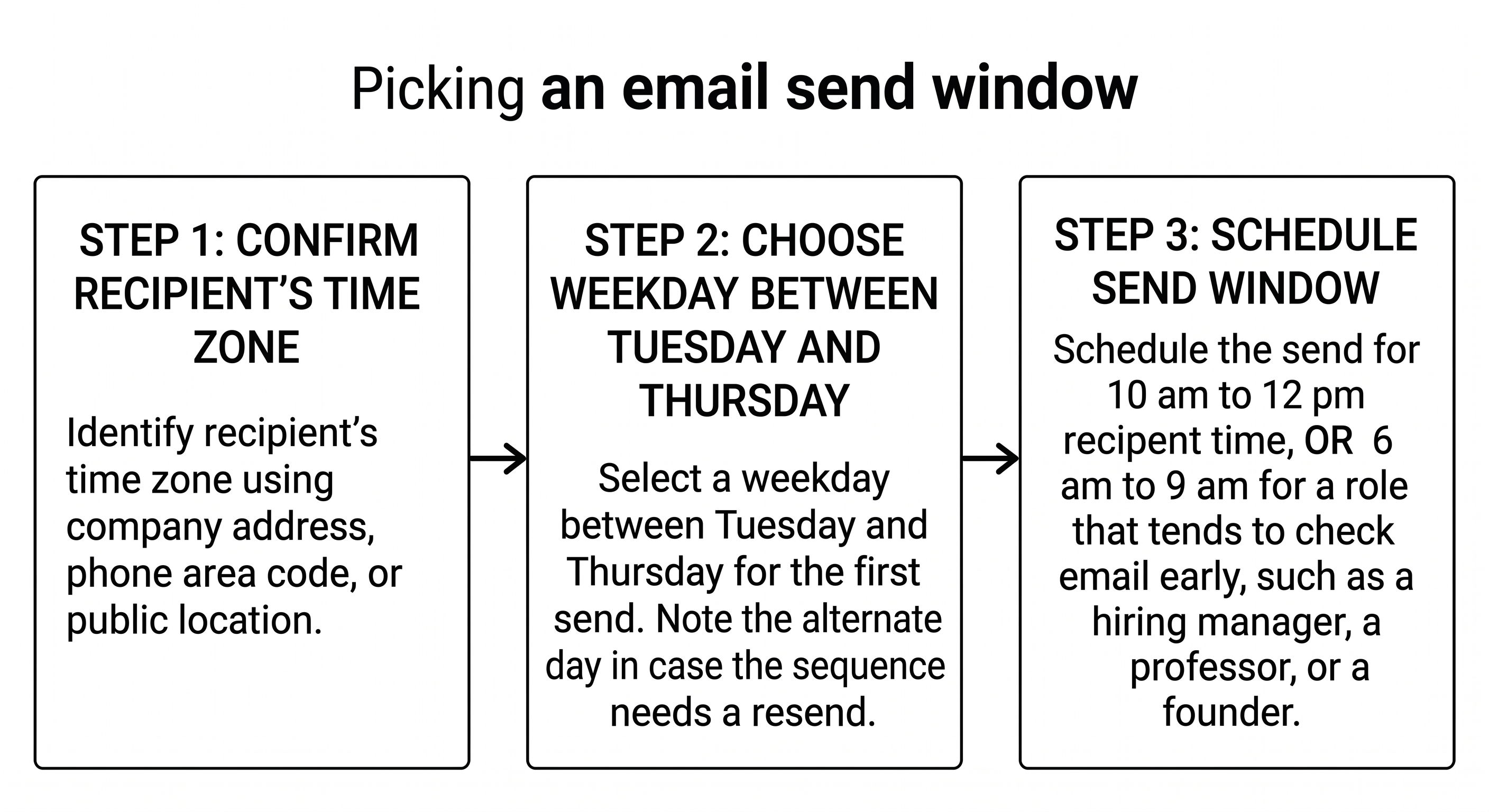
Each box in the flow maps directly to one of the three steps above, so the send window comes from a short checklist rather than a guess.
What happens after you hit send
What happens: Once a cold email lands, most of the decision happens fast. A study from Cience tracking reply timing found 19 percent of eventual replies arrive within the first hour, growing to 77 percent within 12 hours of the send.
Reply volume then drops sharply: the same data shows 87 percent of total replies to a sequence arrive on day one after a message, with only 5.5 percent more coming in on day two, and the full sequence reaching 99.5 percent of its eventual replies by day seven.
That decay curve is why a structured follow up sequence sent on specific days after the first message, rather than a single send and a long wait, captures replies the first email's send time alone cannot.
Done when: You have a follow up scheduled within three to four days of the original send, timed to the same day and hour windows as the first message.
Common mistakes that undo good timing
Sending a Monday morning blast. A message sent before 9 am on Monday competes with the highest single volume moment of the week. Move the same send to Tuesday or Wednesday and the open rate difference shows up within a single test.
Guessing the recipient's time zone instead of checking it. A message sent at 10 am your time can land at 7 am or 1 am for the recipient, missing every window described above. A company address or phone area code takes under a minute to check and removes the guess.
Treating send time as the only variable that matters. One founder who tested this directly, after settling on a Tuesday through Thursday, 10 am to 12 pm window through 400 of his own tracked sends, still needed a subject line and opening line built for the 12 second window described above. The right hour cannot fix a message that gives a reader no reason to keep reading.
The post itself lays out the Monday to Wednesday comparison in the founder's own words, which is worth seeing in the original before applying the same test to a different list.
The finding lines up with the weekday chart earlier in this guide: a Monday send loses opens before the message is even read.
FAQs: Best times to send cold emails
Should you send cold emails on weekends?
Saturday and Sunday sends generally see lower open rates for a B2B inbox, since most recipients are not actively checking work email. A weekend send is not likely to hurt a sequence, but it rarely outperforms a Tuesday through Thursday send in the same sequence.
Does send time matter more than what the email says?
Send time alone does not matter more than what the email says, since a generic message sent at the perfect hour still gets ignored inside its first 12 seconds of attention. The 30/30/50 rule above is a useful check on the message itself before worrying further about the clock.
What is the best time to send a follow up after a cold email gets no reply?
Three to four days after the original send, at the same hour window, works for a first follow up. A second follow up around day seven to nine catches most of the remaining replies, based on the reply decay pattern described earlier in this guide.
Is there a single worst time to send a cold email?
Late evening and overnight sends perform worst across nearly every dataset, since the message gets buried under everything that arrives before the recipient checks their inbox again. Monday before 9 am and Friday after 2 pm come next, for volume and attention reasons rather than time of day alone.
Where this leaves your send schedule
The day and hour windows above hold across most B2B outreach, but the exact minute matters less than getting three things right at once: a real time zone, a message built on the 30/30/50 split, and a follow up sequence timed to the reply decay pattern rather than a single guess.
Once those three are in place, moving a send from a guessed hour to a confirmed window is a small change that shows up in the numbers within the first week of testing it.