B2B email database: How to tell verified data from a marketing claim
A guide to b2b email databases: what a record contains, how the four verification methods work, and what a real subscription actually costs.
 Michael Doyle13 min read
Almost every provider on the market calls its records "verified." Six methods hide behind that one word, and only two of them actually catch a fake address before it reaches your sending domain.
A B2B email database is a paid or subscribed collection of business contact records, usually a name, a work email, a job title, and a company, sold or licensed for outreach.
Records range from ninety cents to well over a dollar each once you factor in seat and platform costs.
What separates a usable database from a bounce machine is not the sales page. It is the verification method underneath it, and that is rarely explained anywhere you can read before you buy.
What you need before you evaluate a b2b email database
You do not need a signed contract to start this process. You need three things on hand, plus a clear read on who owns compliance once contacts start landing in your outbound tool.
What you need on hand
Before you request a sample file:
Your ideal customer profile, written down: industry, headcount band, and title level, not a vague sense of "decision makers"
A sending domain that is at least a few weeks old, not a fresh purchase you plan to blast on day one
A rough budget range and whether you are paying per seat, per credit, or per record
Someone on the team who signs off on data compliance, even if that is just you
That last point matters more than it looks. A purchased list still has to follow the same rules as a list you built yourself, and the FTC's own compliance guide spells out exactly what those rules cover.
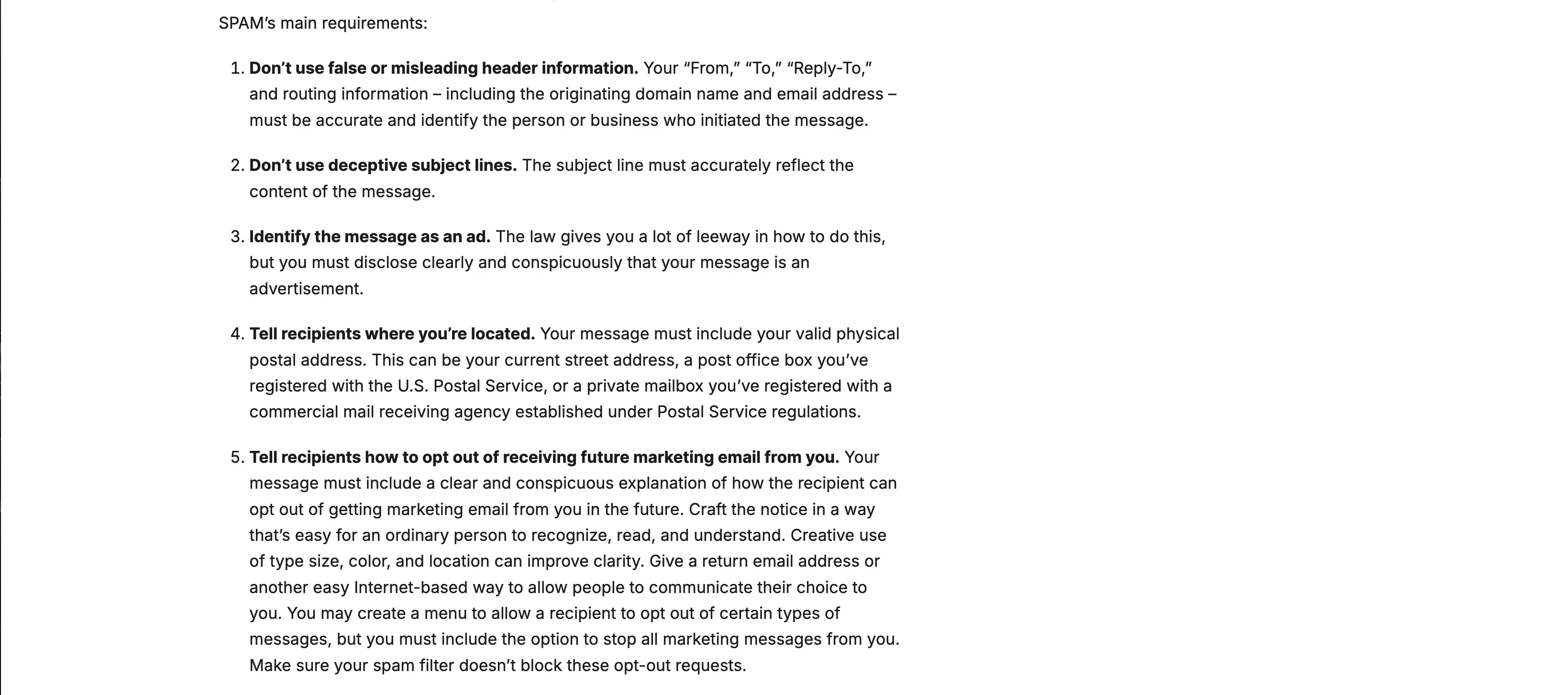
This is the actual rulebook, not a vendor's summary of it. Read it once and you will not need to take anyone's word for what CAN SPAM does and does not restrict.
Who this guide is for
A solo founder buying two hundred records for a single campaign has different priorities than a five person SDR team on a rolling subscription.
Team type | What to weight most | What to skip worrying about |
|---|---|---|
Solo founder or freelancer | Per credit pricing, no annual lock in | Enterprise integrations, SSO |
Small SDR team | CRM sync, seat based pricing | Custom data licensing terms |
Agency reselling data | Export rights, resale terms in the contract | Built in sequencing features |
Enterprise revenue team | Compliance certifications, uptime SLA | Free tier limits |
Two data points, five minutes of reading. That is the whole barrier to entry here.
What a b2b email database actually contains
A record is rarely just an email address. Most databases attach four layers to each name: identity data (title, seniority, department), firmographic data such as company size and industry, technographic data (which tools the company already runs), and sometimes intent signals showing recent buying activity.
That covers the record itself. What decides whether it's worth paying for, how each field actually gets checked, and what a passing accuracy sample looks like before you sign, is covered in what a B2B contact database actually is.
Not every provider sells all four. A cheap per credit tool might hand you a name and an email and nothing else. A full platform bundles identity, firmographic, and technographic layers into one record, which is also why the price gap between a nine dollar plan and a fifteen thousand dollar annual contract is so wide.
Some teams skip a full database and instead run data enrichment on records they already have, adding these same layers to a shorter list of contacts pulled from their own CRM.
How this differs from a sales intelligence platform
A database is a set of records you export or query. A sales intelligence platform adds buying signals, alerts, and workflow tools on top of that same underlying data.
The line blurs in marketing copy, but the practical test is simple: if the product tells you when to reach out, not just who to reach, you are looking at an intelligence platform wearing a database's pricing page.
How b2b email data is actually verified
This is the part almost nobody explains. Providers say "verified" and move on. Underneath, there are four separate checks, and each one catches a different category of bad address.
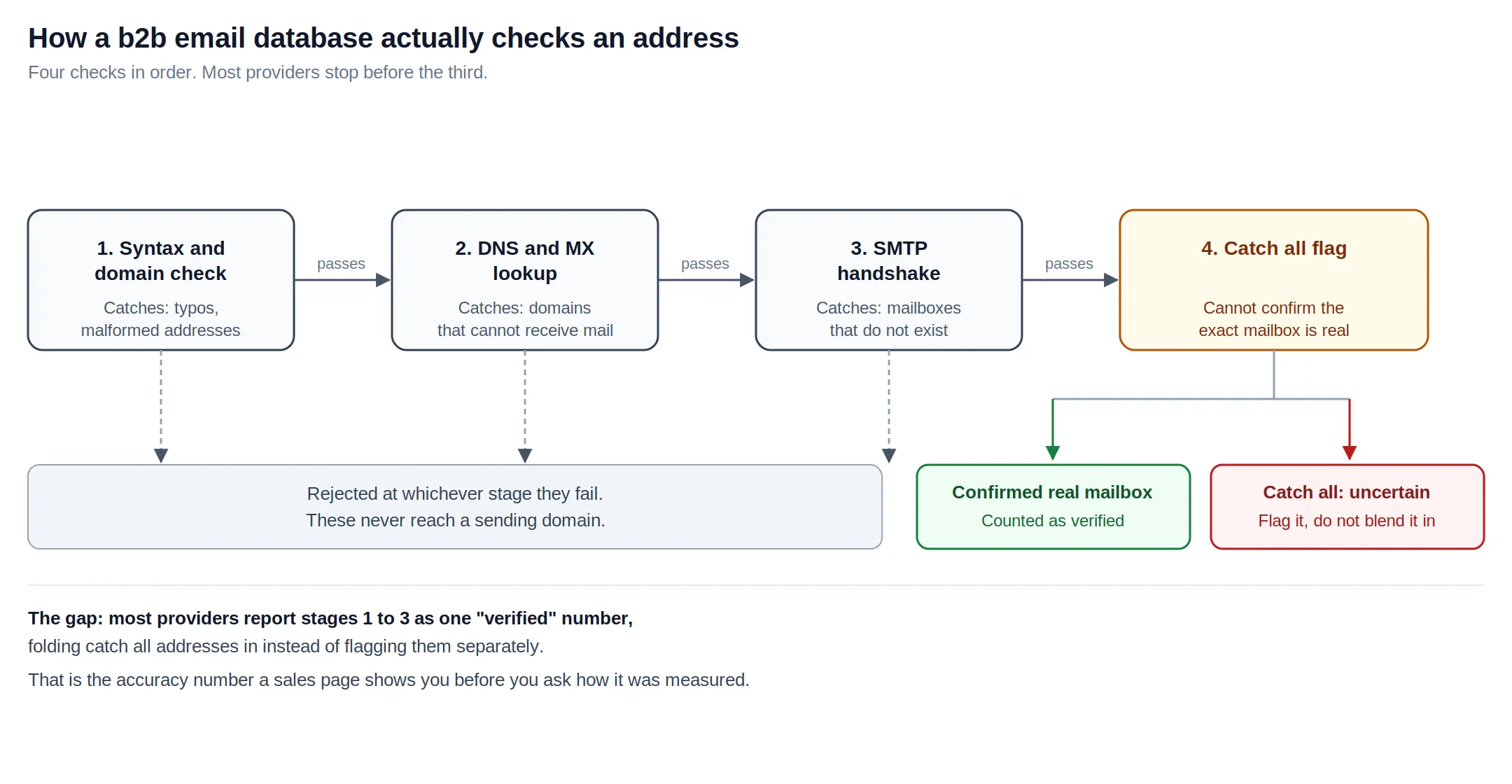
That funnel is the honest picture. A syntax check confirms the address is formatted correctly and nothing more. A DNS and MX lookup confirms the domain can receive mail at all. Next comes the real test.
An SMTP handshake connects to the mail server and asks whether that specific mailbox exists, without sending a message.
Some providers add a fourth pass on top: a human reviewer, or a cross check against a second source.
The checks that actually catch fake addresses
The SMTP handshake is the workhorse. It is also the step most providers skip or shortcut, because running it at scale against millions of records slows a database down and can flag the sender's own reputation if done carelessly.
Syntax and domain format check: instant, catches typos, catches nothing else
DNS and MX record lookup: confirms mail routing exists for the domain
SMTP handshake: connects to the real mail server and asks if the mailbox exists
Human or cross source review: rare, usually reserved for premium tiers or enterprise plans
The one signal verification cannot give you
A catch all domain accepts mail to any address at that domain, whether or not a real mailbox exists behind it.
An SMTP handshake against a catch all domain returns "yes" no matter what you send it, which means the address can pass every technical check and still bounce, or worse, silently vanish into a spam trap. No verification method fully solves this.
The best providers flag catch all addresses as a separate risk category instead of blending them into the "verified" count, and that flag is worth checking for before you trust an accuracy number on a sales page.
Is it legal to buy or use a b2b email database
Yes, with conditions. None of the three laws that matter here ban the purchase itself. All three regulate what happens after the data lands in your outbound tool.
Law | Applies when | What it actually requires |
|---|---|---|
CAN SPAM | You send commercial email from or into the US | Accurate headers, an honest subject line, a working opt out honored within ten business days, no reselling addresses that already opted out |
GDPR | Any contact sits in the EU or UK | A lawful basis for processing, usually "legitimate interests," weighed against the person's own rights and the original purpose the data was collected for |
CCPA | Any contact is a California resident | Disclosure of data use and an opt out mechanism, layered on top of whatever CAN SPAM already requires |
What this means before you send anything
CAN SPAM regulates how you send, not where you got the list. Sloppy, unlabeled mail to a purchased list is where businesses get fined, not the purchase itself.
GDPR is the harder line: Article 6 of the regulation allows processing under "legitimate interests," but a purchased list with no documented sourcing makes that basis difficult to argue, since regulators weigh the original purpose the data was collected for against your new use of it.
The contract you sign with a provider should tell you exactly where the records came from, which is the single detail that determines whether you can defend that basis later.
Build vs buy: growing your own list versus subscribing to a database
Building your own list from LinkedIn, company sites, and referrals costs time instead of money and gives you full control over sourcing, at the price of maybe twenty to thirty contacts a day per person doing the work. Subscribing to a database trades that time for a subscription fee and gets you thousands of records in an afternoon, with data quality now entirely dependent on someone else's verification pipeline.
Most teams end up doing both. A subscribed database fills the volume gap for cold outbound at scale.
A manually built list still wins for high value target accounts where one wrong title costs a meeting, not just a bounce.
The fine print vendors do not lead with
Two questions rarely show up on a pricing page, and both determine whether the subscription is actually worth what you paid.
What happens when the data turns out to be bad
Ask for the accuracy guarantee in writing, not the number on the homepage. A real guarantee names a specific bounce rate threshold, states how credits get refunded when you cross it, and gives you a window to report bad records, usually thirty to ninety days.
A guarantee with no threshold and no refund mechanism is a marketing claim wearing an SLA's clothing.
Contract terms that catch buyers off guard
Annual only contracts, minimum seat counts, and credits that expire at the end of a billing cycle are common and rarely disclosed until checkout.
Ask four questions before signing: does the contract auto renew, do unused credits roll over, what is the actual cancellation window, and is there a published data security certification such as SOC 2 Type II covering how records are stored.
Most providers can answer the first three on a call. Few volunteer the fourth unless you ask directly.
How to choose the right b2b email database for your team
Weight four criteria in this order: verification depth, coverage of your target segment, compliance documentation, and integration with the CRM or outreach tool you already run.
Pricing model comes after those four, not before, because a cheap database with a thirty percent bounce rate costs more in sender reputation than a pricier one that actually holds up.
What actually predicts data quality
Transparency is the tell. A provider that explains its SMTP and catch all handling in plain language, publishes a real accuracy percentage with a defined methodology, and offers a sample export before you commit is telling you more with that openness than with the number itself.
A provider that only says "verified" on the homepage is asking you to trust a word with no definition behind it.
Comparing your three sourcing options
Three common ways teams source contact data, compared on the same criteria:
Approach | Setup time | Ongoing cost | Data control | Best fit |
|---|---|---|---|---|
Buy a static list | Same day | One time fee | Low, sourcing is opaque | One off campaigns, small budgets |
Subscribe to a live database | A few days | Monthly or annual | Medium, refresh cadence set by vendor | Ongoing outbound at volume |
Enrich your own CRM records | Weeks | Per record or seat based | High, you control the source list | Existing contacts with missing fields |
If you already know which vendors to compare on price, a breakdown of ten providers and what they actually charge covers that ground in detail. This section is about the criteria, not the vendor names.
A short checklist before you sign
Copy this into your notes before your first call with a provider.
Ask for the exact verification method used, not just the word "verified"
Ask how catch all addresses are labeled and whether they count toward the accuracy guarantee
Ask for the bounce rate threshold that triggers a credit refund, in writing
Ask whether credits expire and whether the contract auto renews
Ask which data security certifications the provider holds and request the document
Ask where the underlying data was originally sourced, for GDPR purposes
Request a sample export before paying for the full plan
Confirm the CRM or outreach tool integration works with your current stack, not a future one
What happens after you load the data
The provider's accuracy number stops mattering the moment you hit send. What matters next is how your sending domain's mail server responds to real delivery attempts.
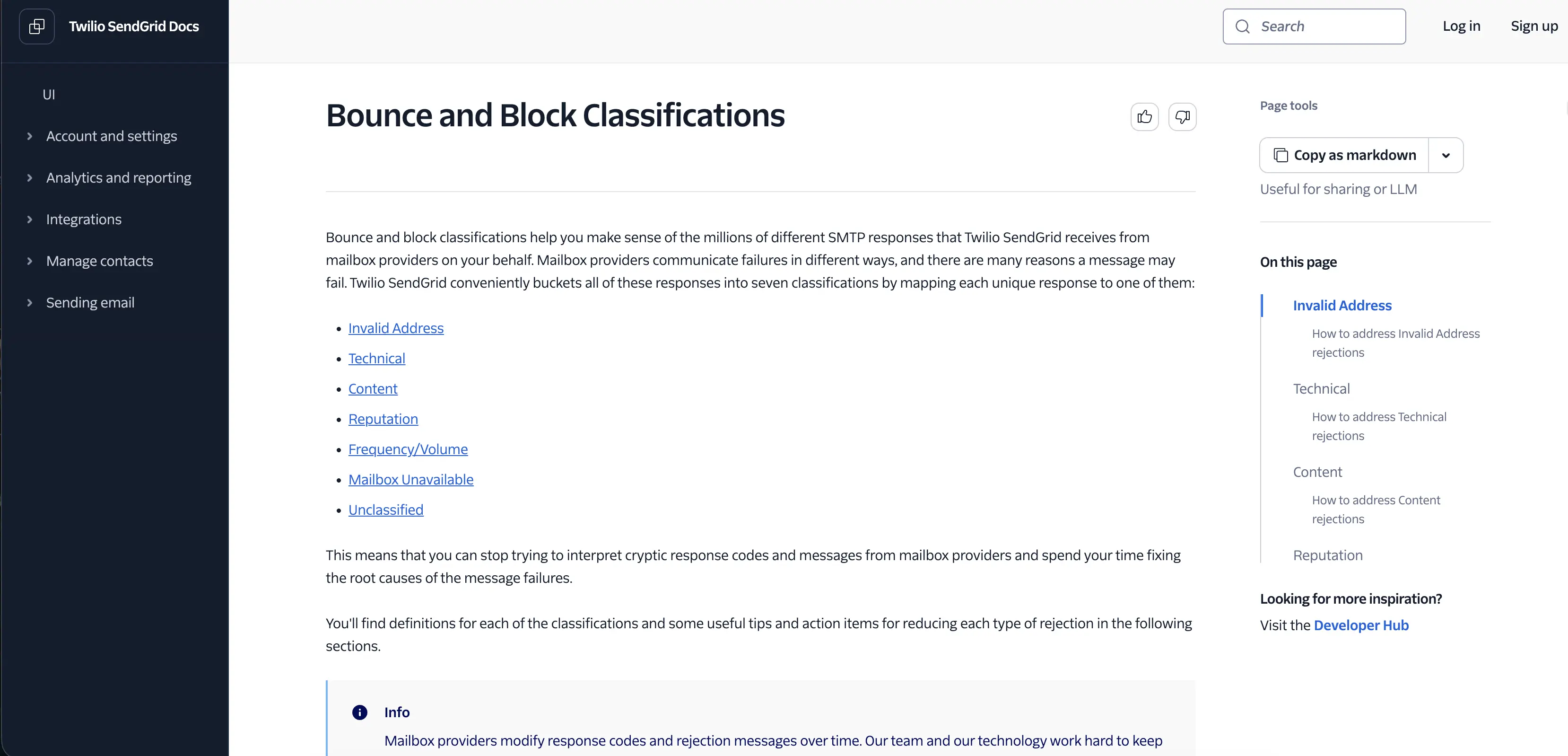
A hard bounce means the address does not exist and should be removed immediately. A soft bounce means the message reached the mail server but was temporarily rejected, a full mailbox or an oversized attachment, and can be retried.
A domain with a high hard bounce rate in its first few sends gets flagged by spam filters fast, sometimes within a single day, regardless of how "verified" the source list claimed to be.
Send a small batch first. Fifty to one hundred emails is enough to see your real bounce rate before you commit the rest of the list to a domain you plan to keep using.
Common mistakes when buying or using a b2b email database
Three mistakes account for most of the bad outcomes teams report after a purchase.
Mistake | Why it happens | Fix |
|---|---|---|
Sending the full list on day one | Excitement after paying, no test batch | Send fifty to one hundred first, check bounce rate, then scale |
Treating catch all as verified | Provider counts them in the accuracy number | Ask for catch all addresses to be labeled separately, exclude or flag them |
Buying once and never refreshing | Assuming the list stays accurate | Rebuy or re verify every three to six months, since roles and companies change constantly |
FAQ
Is there a free b2b email database?
A handful of providers offer a limited free tier, usually capped at ten to fifty credits a month. Free tiers work for testing a provider's accuracy before you commit, not for running a real campaign at volume.
How often should b2b contact data be refreshed before it goes stale?
Most providers recommend re verifying every three to six months. People change jobs constantly, and a list older than six months usually shows a noticeably higher bounce rate than a freshly pulled one.
What is the best b2b email database for a small team or startup?
For a small team, weight per credit or low seat count pricing over enterprise features you will not use yet. A solo founder or a two person team is usually better served by a database that charges per record than one built around annual seats.
I am worried about buying an email list. Is it as risky as it sounds?
Buying a list is not the risky part. Sending to it without verifying quality first is. A provider with a documented verification method and a real accuracy guarantee removes most of the risk that gives buying a list its bad reputation.
Does buying a b2b email database hurt my sender reputation?
Only if the bounce rate is high enough to trigger spam filtering, which usually means a poorly verified list, not the act of purchasing one. A small test batch before a full send is the simplest way to protect a domain you plan to keep using.
Where this leaves your next purchase
A B2B email database is only as good as the verification step you cannot see on the pricing page. Ask for the method, ask for the guarantee in writing, and test a small batch before you trust the rest of the list to your sending domain.
The providers worth paying for will answer every one of those questions without hesitating.
Guidance reviewed September 2, 2026.
About the author
Michael Doyle writes about B2B sales at Leaderr. He covers prospecting, cold outreach, sales data, and pipeline building, with a focus on what actually works for SDRs, founders selling on their own, and small sales teams. Connect with him on LinkedIn.