What a B2B contact database actually is, and how to test one before you buy
A B2B contact database explained: what a record actually contains, how to test accuracy before you pay, and what credit or seat pricing costs each month.
 Michael Doyle12 min read
A B2B contact database is a searchable set of business contact records, meaning names, job titles, work emails, and sometimes direct phone numbers. It sells ongoing access, not a one time file.
The typical US worker stays under four years in a job per current Bureau of Labor Statistics data, one reason no database stays accurate on its own.
Who this guide is for
Not every buyer needs the same thing here, and the segment table below is where most vendor pricing pages fall short. A page selling "unlimited credits" reads differently to a solo founder than to a procurement team.
Who you are | Volume you likely need each month | What matters most | Common mistake |
|---|---|---|---|
A solo founder or freelance seller | Under 200 contacts | A workable free tier, stacked across two or three tools | Paying for a seat before checking if free credits cover the volume |
An SDR on a small team | 500 to 2,000 contacts | Direct dial coverage and CRM sync | Buying the biggest plan instead of the most accurate one |
An agency running outreach for clients | Volume that changes with every client | Export rules and resale terms in the contract | Signing an annual contract before running a client specific sample |
An enterprise buyer | Thousands of contacts across several seats | Data governance and a security review | Skipping the accuracy sample because procurement moves faster than testing does |
What this guide does not cover: a ranked list of providers, or which single tool to buy. A full side by side of the leading providers sits elsewhere. It covers which ones publish real pricing and which force a sales call first, in the comparison of the leading B2B database providers.
What a record in a B2B contact database actually contains
A record almost always carries five layers: identity (name, title, seniority), contact fields (email, phone, sometimes a mobile direct dial), company fields (industry, headcount, revenue band), a source note, and a last verified date.
Not every vendor shows that last field. Ask for it anyway.
How this differs from a CRM or an enrichment tool
A contact database is where you go looking for people you do not have yet. A CRM is where you keep people you already found. It stores your own notes and history too. An enrichment tool sits between the two. It fills in missing fields on contacts you already have, rather than surfacing new people.
Confusing the three causes a common buying mistake: paying for a full database subscription when the real need was enrichment on a list already owned.
What actually predicts whether the data is good
Coverage numbers get marketed hard. Verification methodology almost never does. A provider that explains how it checks an email, syntax, domain, mailbox ping, human review, tells you more than one stating a coverage percentage with no method attached.
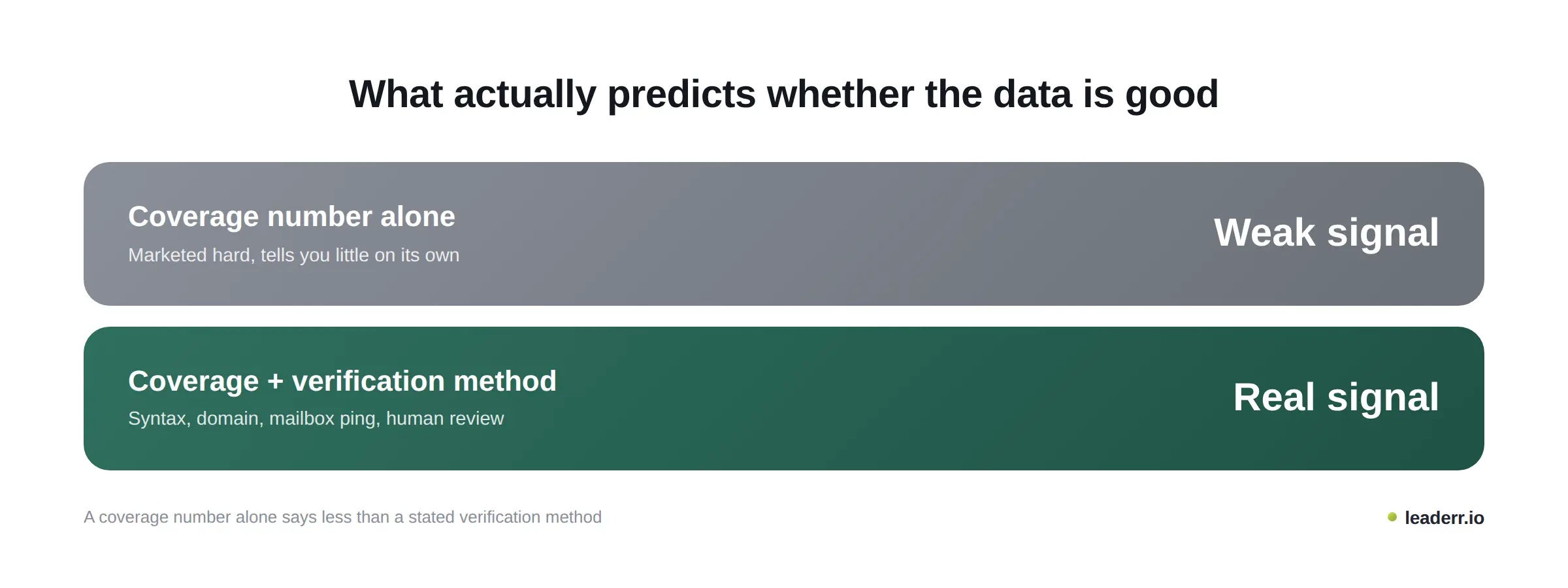
A coverage percentage with no method behind it is marketing. The same number paired with a stated check, syntax, domain, mailbox ping, human review, is the one worth paying for.
How to test a B2B contact database's accuracy before you pay
This is the step most buyers skip, and it is the biggest reason teams end up paying for a tool nobody trusts by month two.
How many records to sample
Pull a random sample of at least 30 records, never the newest additions or the ones the vendor's own dashboard scores highest. A biased sample tells you how good the best of the database is, not how good the average record is.
What counts as a passing hit rate
Run each sampled email through a real send, not just a syntax check, and log every hard bounce. A healthy result stays under 2 percent hard bounces, and anything above 5 percent signals a real deliverability problem rather than normal noise. The chart below shows the exact benchmark this threshold is drawn from.
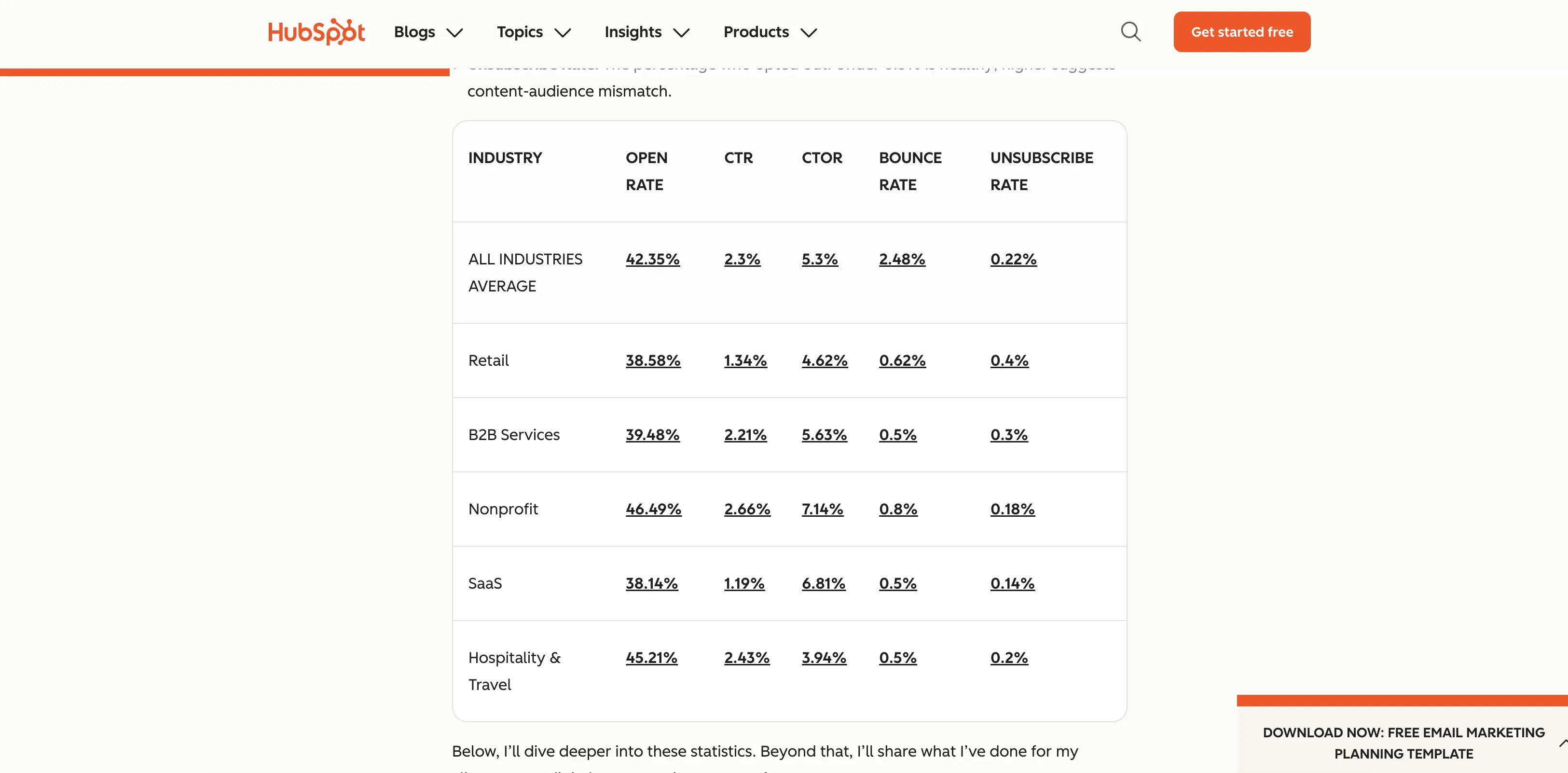
That is the same range HubSpot publishes for permission based sending, and it holds up as a fair pass or fail line for a purchased sample too. For phone numbers, call five of the sampled direct dials during business hours.
Count how many actually reach the named person, not a switchboard or a wrong number.
The checks that catch a fake or dead email in the first place, syntax, domain, mailbox, human review, are covered step by step in a closer look at how b2b email data gets verified.
What credit based and seat based pricing actually cost
Two pricing shapes dominate this category, and pricing pages rarely explain either in plain terms. Credit based pricing charges per contact revealed. A seat, by contrast, is a per user license that usually comes with its own credit allotment attached, so a five person team on a five seat plan pays for both people and pulls. The hidden cost sits in what a credit actually buys.
Checking several free plans this week, revealing an email costs a fraction of what revealing a mobile number costs from the same credit pool, sometimes a ten to one gap.
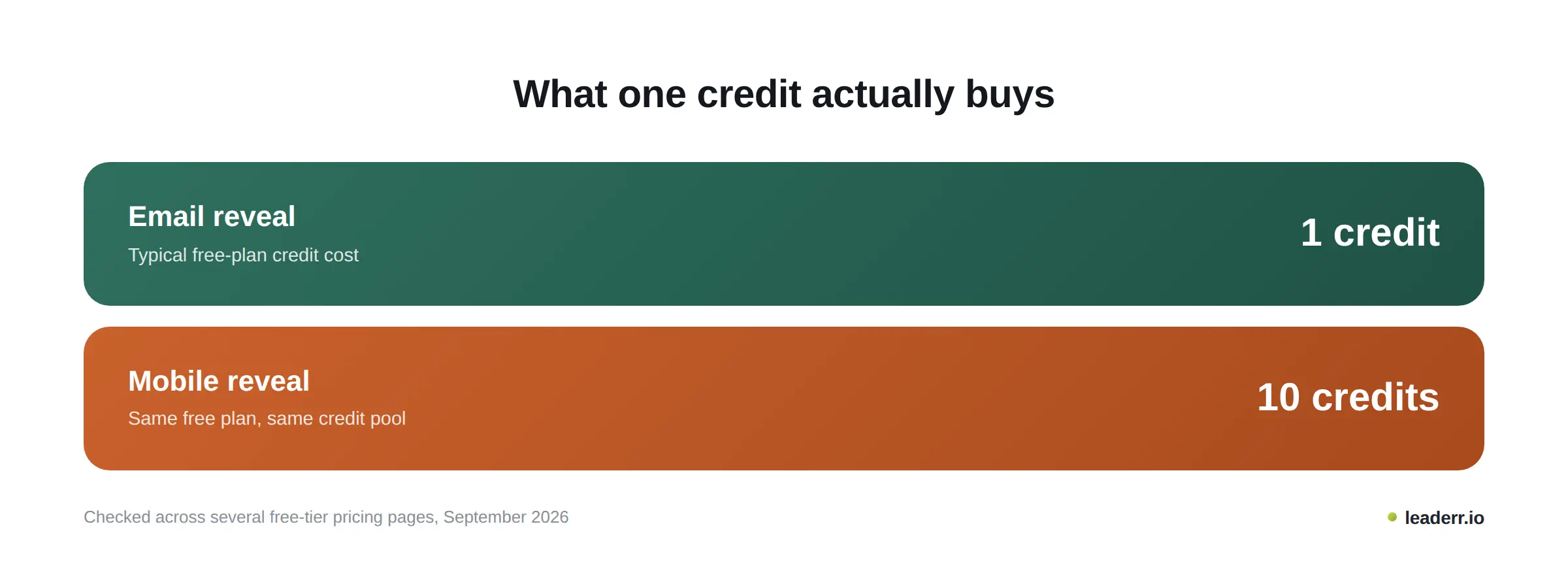
A generous looking plan can run out fast once a list leans on phone numbers instead of email addresses.
Comparing the four ways to source B2B contact data
A subscription database is not the only option, and it is not always the right one.
Method | Cost pattern | How fresh the data stays | Best fit |
|---|---|---|---|
Build your own list by hand | Time instead of money | As fresh as your last search | A narrow, well defined target list |
Subscribe to a live contact database | Monthly or annual credits or seats | Refreshed on the vendor's own schedule | Ongoing prospecting at real volume |
Add an enrichment layer to contacts you already have | Priced per record or per API call | Only as fresh as the source feeding it | A team with an existing but thin CRM |
Buy a one time exported list | A single upfront cost | Frozen the day it was exported | A single campaign with a hard deadline |
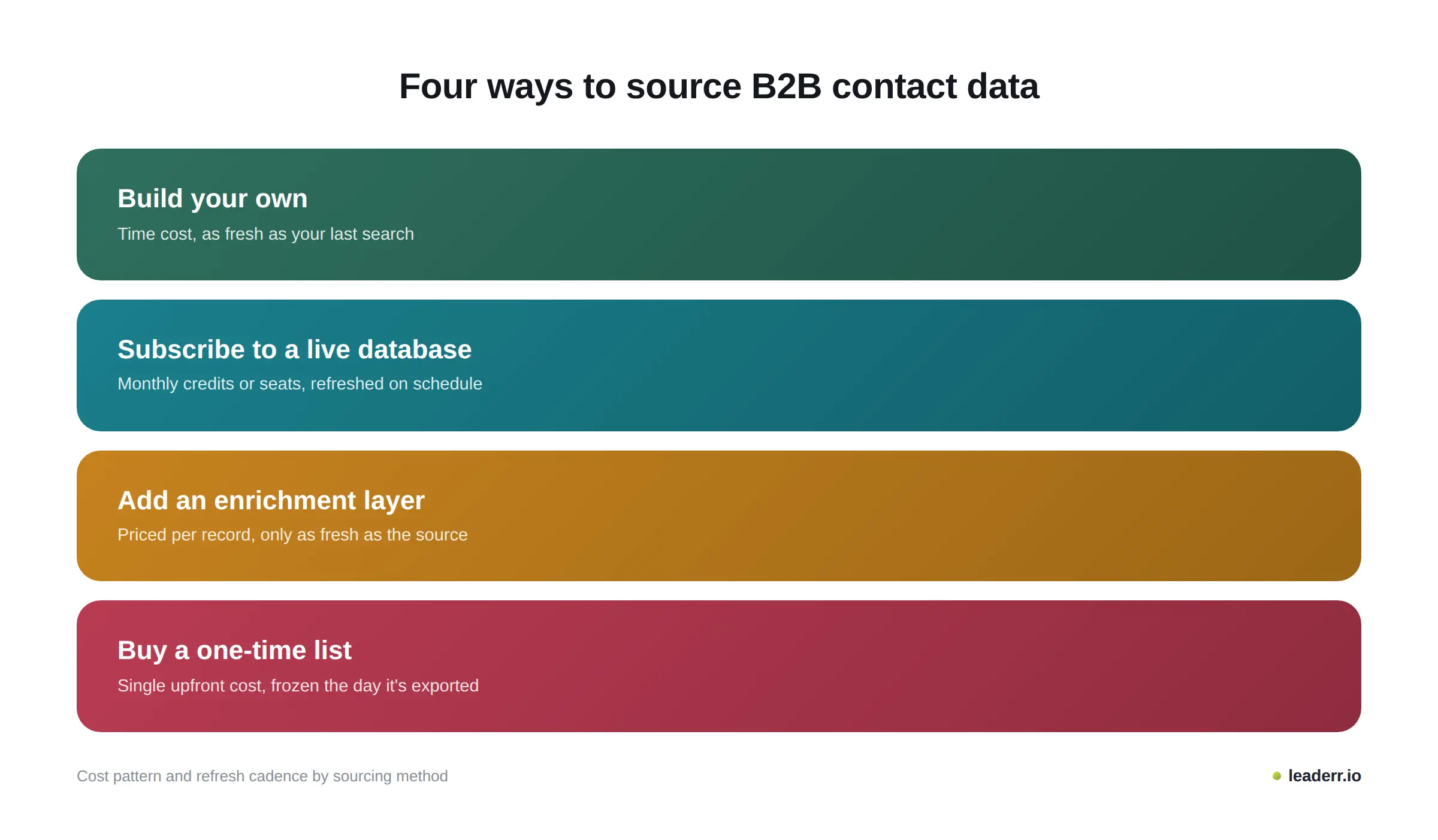
When the real need is filling gaps in contacts a team already owns rather than finding brand new people, that is a data enrichment problem, not a database subscription problem, and it is usually the cheaper fix.
A copyable accuracy test worksheet
Run this before you sign, not during the free trial window when the vendor is watching usage most closely.
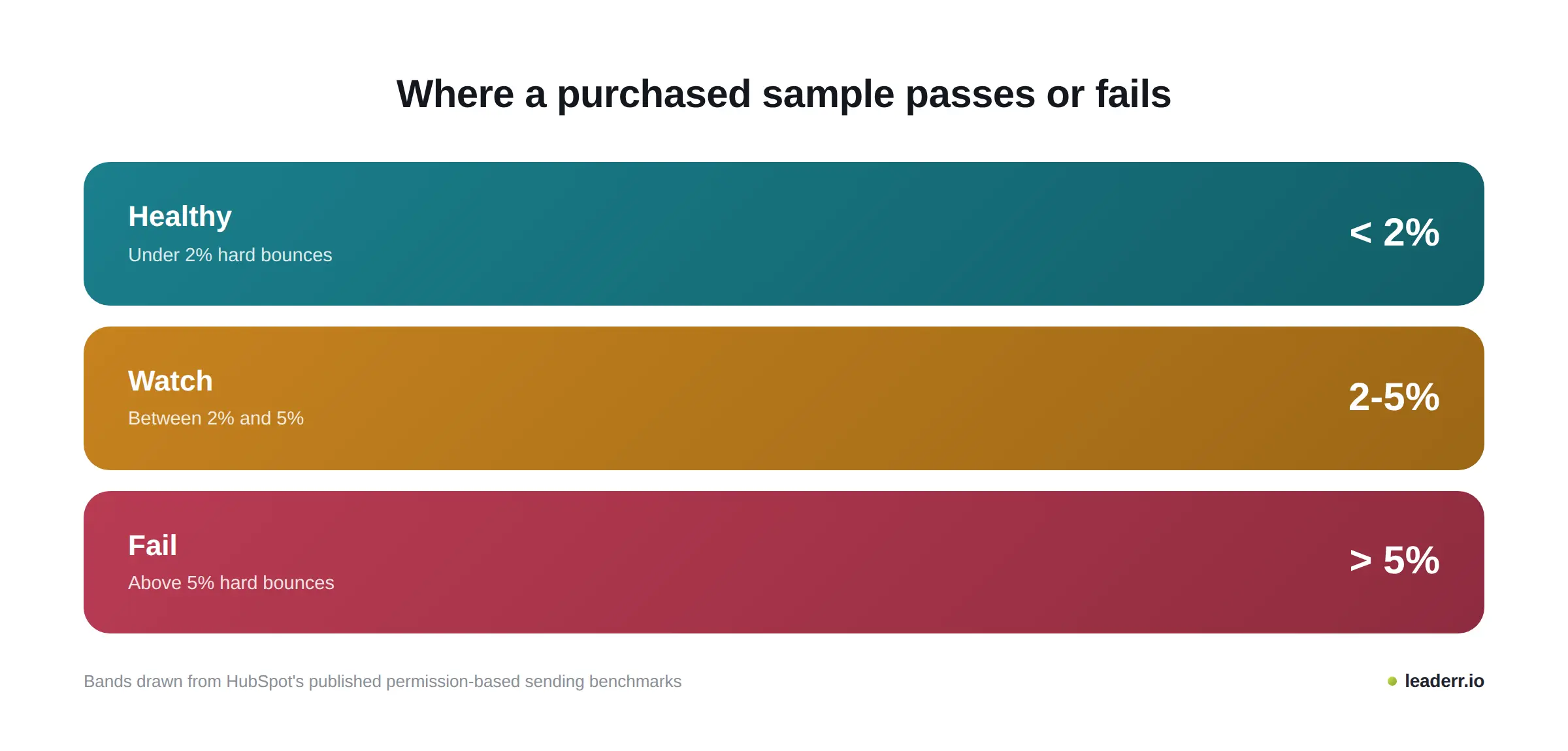
Score whatever comes back against those three bands before moving on to the next sample.
Export or request a random sample of at least 30 records, not the newest or highest scored ones.
Run each email through a syntax and domain check first, since a malformed address fails before it ever gets sent.
Send each surviving address a real message and log every hard bounce.
Pass the sample if hard bounces stay under 2 percent, fail it above 5 percent.
Call five of the sampled direct dial numbers during business hours and log how many connect to the named person.
Cross check the job title and company against a public source, such as the company website, for each record.
Note the file's last verified date if the vendor shows one at all.
Total the pass rate before you sign, never after the trial has already ended.
What a job change does to a contact record
A record does not go bad all at once. It goes bad one person at a time.
What actually happens on the recipient's end
The moment someone changes companies, their old work email starts bouncing. Their old direct line stops ringing at their desk. Their title on file goes wrong even if every other field is still correct.
Multiply that across a database of a few hundred thousand people and a meaningful share of any list is quietly wrong on the day you buy it, not because the vendor lied, but because people keep changing jobs.
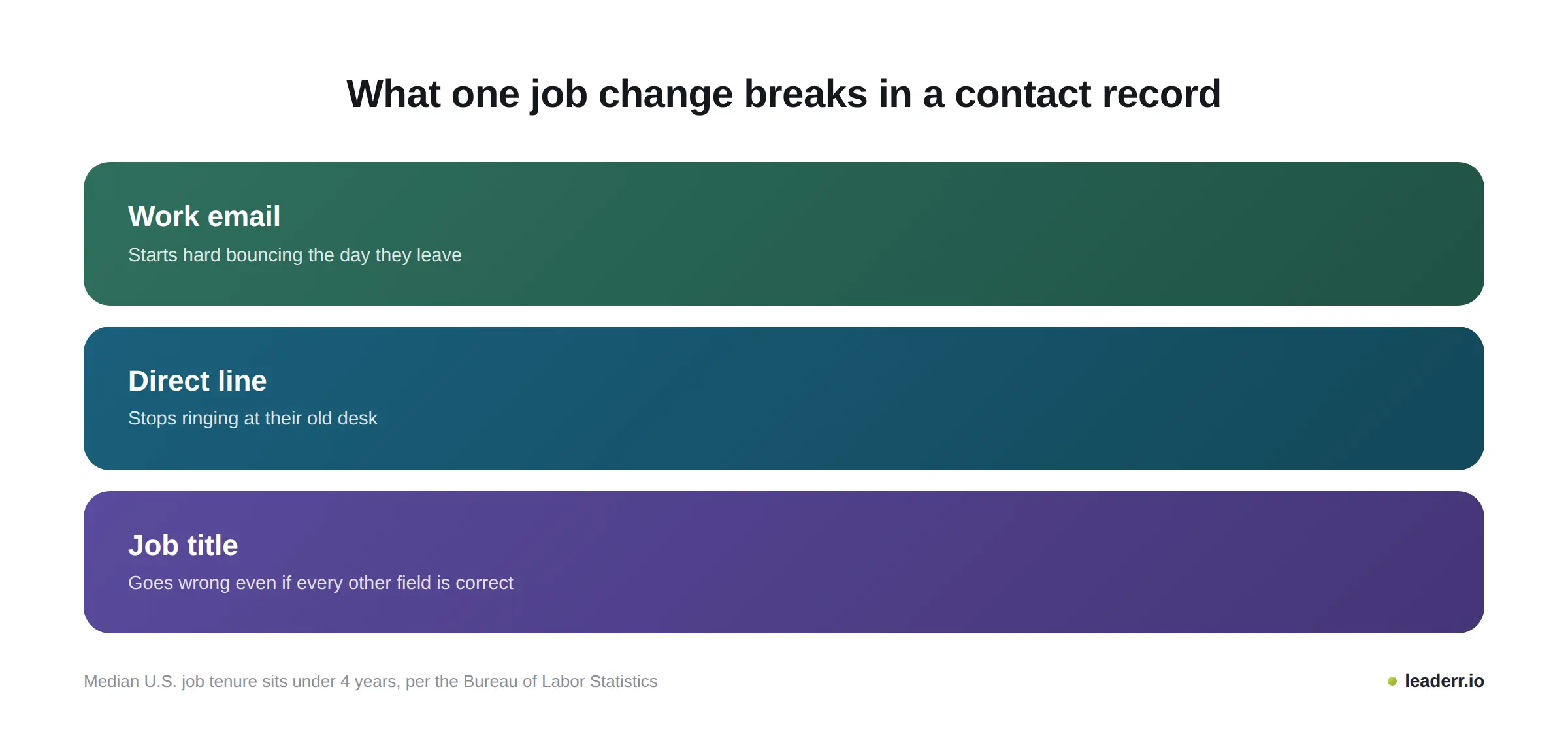
Median US job tenure sits under four years per the Bureau of Labor Statistics tenure report. A database with no refresh cadence at all is stale by design within a few years, before anyone even opens it.
Is a bigger database better than a more accurate one
Coverage claims in the hundreds of millions look impressive on a homepage. They answer a different question than the one most buyers are actually asking.
A database with ten million records and a 95 percent hit rate returns more usable contacts for a narrow target list than one with two hundred million records and a 60 percent hit rate, since most of that larger number sits outside the industries, sizes, or regions any one team sells into.
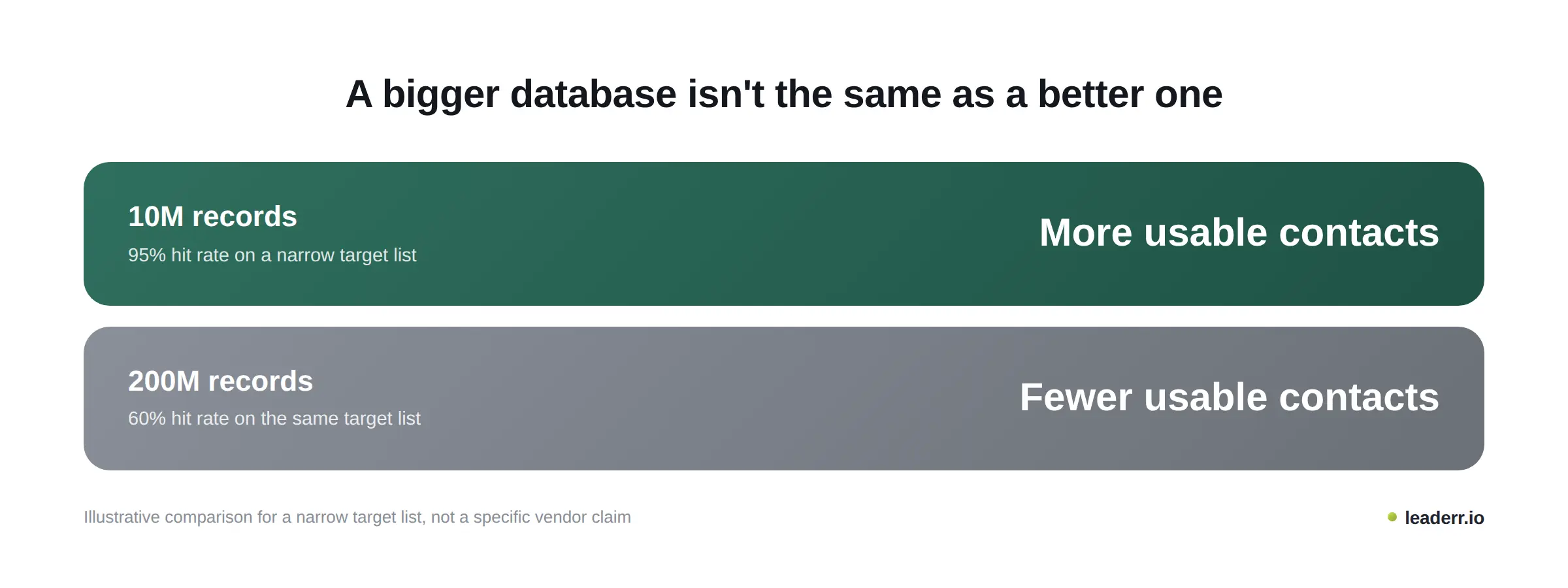
Size determines whether your market is in the database at all. Accuracy determines whether the records you pull out actually work. Test for the second one. The first is nearly always true already.
Mistakes that cost teams a month of credits
Symptom | Cause | Fix |
|---|---|---|
The same contact appears under two providers with different job titles | Each vendor refreshes on its own schedule and the two disagree | Treat the more recently verified record as correct and merge before sending |
Monthly credits run out in the middle of a list | Volume was estimated from company count, not contacts needed per account | Recalculate using contacts per target account, not accounts alone |
A purchased list draws spam complaints even though every email technically delivered | Opt out and sender reputation rules were skipped, even though buying the list itself was not illegal | Warm up the sending domain and include the opt out mechanism the law still requires |
Sales reps stop trusting the tool after two bad calls in a row | Nobody ran an accuracy sample before the team's first full list | Run the accuracy worksheet above before rollout, not after |
The FTC's CAN SPAM compliance guide confirms the model is opt out, not opt in. It still requires a working unsubscribe mechanism and honest sender information, and each violating email can carry a penalty up to $53,088.
GDPR and CCPA apply stricter, opt in style rules for contacts covered by those laws. The honest answer to "is this compliant" depends on where the person on the other end of the record actually lives.
Common questions about B2B contact databases
What is a B2B contact database?
A B2B contact database is a paid, searchable collection of business contact records, names, titles, work emails, and often direct phone numbers, that a vendor keeps updated and sells ongoing access to rather than handing over as a single static file.
Why does B2B contact data go stale so fast?
Mostly because people change jobs. Every job change breaks the old email and phone number on file, and with median tenure under four years, a meaningful share of any large database is already outdated the day it ships, regardless of how it was built.
Can I use more than one B2B contact database without creating duplicate records?
Yes, and most teams that stack providers end up with duplicates. Two vendors rarely agree on formatting or refresh timing for the same person.
Merge on email address first, keep the record with the more recent verified date, and treat mismatched job titles as a signal to re check.
Are B2B contact databases compliant with privacy law?
It depends on where the contact lives, not on the database itself. US commercial email generally falls under CAN SPAM's opt out model, while contacts in the EU or California carry stricter, opt in style rules under GDPR and CCPA.
Selling you the record is not the same as your outreach program being compliant.
Is there a real free B2B contact database?
Free tiers exist and they are real, not bait. They stay small by design, usually a few dozen credits a month per provider.
Stacked across two or three free plans, a small team can cover a low volume of contacts a month at zero cost, enough for early outreach but not a full time SDR's pipeline.
What you actually get from a free B2B contact database
Free tiers exist at most providers, and they are real, but they are metered in a way the pricing page rarely makes obvious. The cap is usually on credits rather than records, so exporting one contact with a verified email and a direct dial can spend three credits, not one.
A free plan advertising 50 credits a month is closer to 15 usable contacts.
The second limit is field depth. Free tiers commonly return the company and the role but withhold the direct dial and the verified personal email, which are the two fields that decide whether the list is sendable.
Before you judge a provider on its free tier, export 20 records and count how many arrive complete. That number, not the credit allowance, tells you what the paid plan will actually be worth.
Before you sign up for anything
Every pricing page in this category leads with coverage numbers, because coverage is the easiest thing to make look impressive. None of them lead with a sample test, the one thing that would actually tell you whether the homepage number means anything for your list.
Run the worksheet above before a contract, not during the trial week when the vendor already knows you are watching. It takes less time than the sales call most providers will try to book first.
Sources reviewed September 4, 2026.
About the author
Michael Doyle writes about B2B sales at Leaderr. He covers prospecting, cold outreach, sales data, and pipeline building, with a focus on what actually works for SDRs, founders selling on their own, and small sales teams.