

A subscription to B2B intent data starts around $15,000 a year and can run past $100,000. It signals that a company is actively researching a purchase before anyone there fills out a form.
The behavior comes from three places: your own site, sites you pay to appear on, and a shared pool covering thousands you don't control.
That single fact changes how you should read the rest of this page. The cost comes before any vendor name below, and the free version comes before either one.
Who actually needs this right now
Intent data is not equally useful at every stage. Before you read further, check where you actually sit.
A solo founder or a two person team selling into a handful of named accounts: run the free version below first. A paid platform will not tell you anything your own research cannot.
A small team of three to eight reps with a defined ideal customer profile: the free version still applies, but you're close to the size where a starter tier ($8,000 to $25,000 a year, reviewed further down) starts to pay for itself.
An agency running outreach for several clients at once: intent data works per client, not once across your whole book, so price it per account list, not per seat.
A marketing or revenue operations team already running account based marketing: you may already own this. Check your existing platform before adding a new line item.
An enterprise team with a defined total addressable market in the thousands of accounts: this is the segment every vendor on the market actually built their product for.
If you already have an ideal customer profile built out, intent data answers a narrower question than most people expect: not "who should we sell to," but "which accounts inside that list are moving right now."
The three types of intent data, and where each one actually comes from
Every vendor sorts intent data into the same three buckets. The difference between them is who owns the behavior being watched.
It sits next to technographic data as a separate category. One describes what a company is doing right now; the other describes what a company already runs.
Type | Plain meaning | Where it actually comes from |
|---|---|---|
First party | Behavior on channels you already own | Your own site visits, email opens, content downloads, chat transcripts |
Second party | Someone else's first party data, shared or sold to you directly | Review site profile views on G2, TrustRadius, or Capterra; a partner's customer activity |
Third party | Behavior aggregated across thousands of unrelated sites, then sold to many buyers at once | A shared cooperative network. Roughly seven in ten of the publisher sites inside the largest of these networks report to a single company: Bombora |
First party intent data
This is the only type you don't pay a vendor for, because you already own the pipes it travels through. A visit to your pricing page, a second download of the same white paper, a return trip to a case study: all first party.
It is also the least likely type to mislead you, since the person is looking directly at your own product.
Second party intent data
This sits between the two extremes. Review sites like G2 and TrustRadius know when someone views a listing in your category, and some of them will sell or share that signal.
It costs money, but the person doing the looking has at least chosen to visit a page about your category specifically.
Third party intent data
This is what most of the market means when it says "intent data" without qualifying it.
A shared network of publisher sites reports which topics a visiting IP address or cookie is reading about, and a co op company resells that pattern against a list of B2B firmographic profiles.
It's the least precise of the three types and the most expensive to buy on its own.
Is it worth paying for yet, or should you wait
Before any pricing table, one number deserves more attention than it usually gets. A widely repeated claim holds that only about five percent of B2B buyers are actively in market at any given time.
People use it to sell almost every product in this category, including intent data itself.
Marketing researcher Frank Strong traced that number back to actual peer reviewed work. The figure comes from a study by John Dawes, a professor at the Ehrenberg Bass Institute for Marketing Science, built around how long B2B purchase cycles usually run. Dawes himself calls it "a heuristic to get the idea across," not a precise measurement.
That distinction matters here specifically. If only one in twenty of your target accounts is shopping this quarter, a tool built to surface that one account has real value.
But a five figure subscription measured against a ninety-five percent miss rate needs a longer runway than most six month budget cycles allow.
A MarTech piece on the same question makes a related point worth sitting with: the same research activity that trips a signal can just as easily be the moment a prospect quietly rules you out, not in.
None of this means intent data doesn't work. It means the honest answer to "is it worth it" depends on how long you can wait for it to pay off, not on which vendor has the best demo.
What it actually costs in 2026, provider by provider
Public pricing pages published by the category's own vendors this year give a real range, even where none of them puts every provider on one page at once.
Provider category | Typical annual range | What you're actually buying |
|---|---|---|
Review site behavior (G2, TrustRadius) | $8,000 to $25,000 | Second party signal only, narrow to your listed category |
Third party co op, standalone (Bombora) | $25,000 to $50,000 | Raw third party topic data, no contact records included |
Bundled add on to an existing contract (ZoomInfo) | $15,000 to $60,000 | Third party signal layered onto a database you may already pay for |
Mid market platform with proprietary modeling (6sense) | $50,000 to $130,000 | First and third party data plus predictive scoring |
Full account based platform (Demandbase) | $24,000 to over $300,000 | Intent data bundled with advertising and account orchestration |
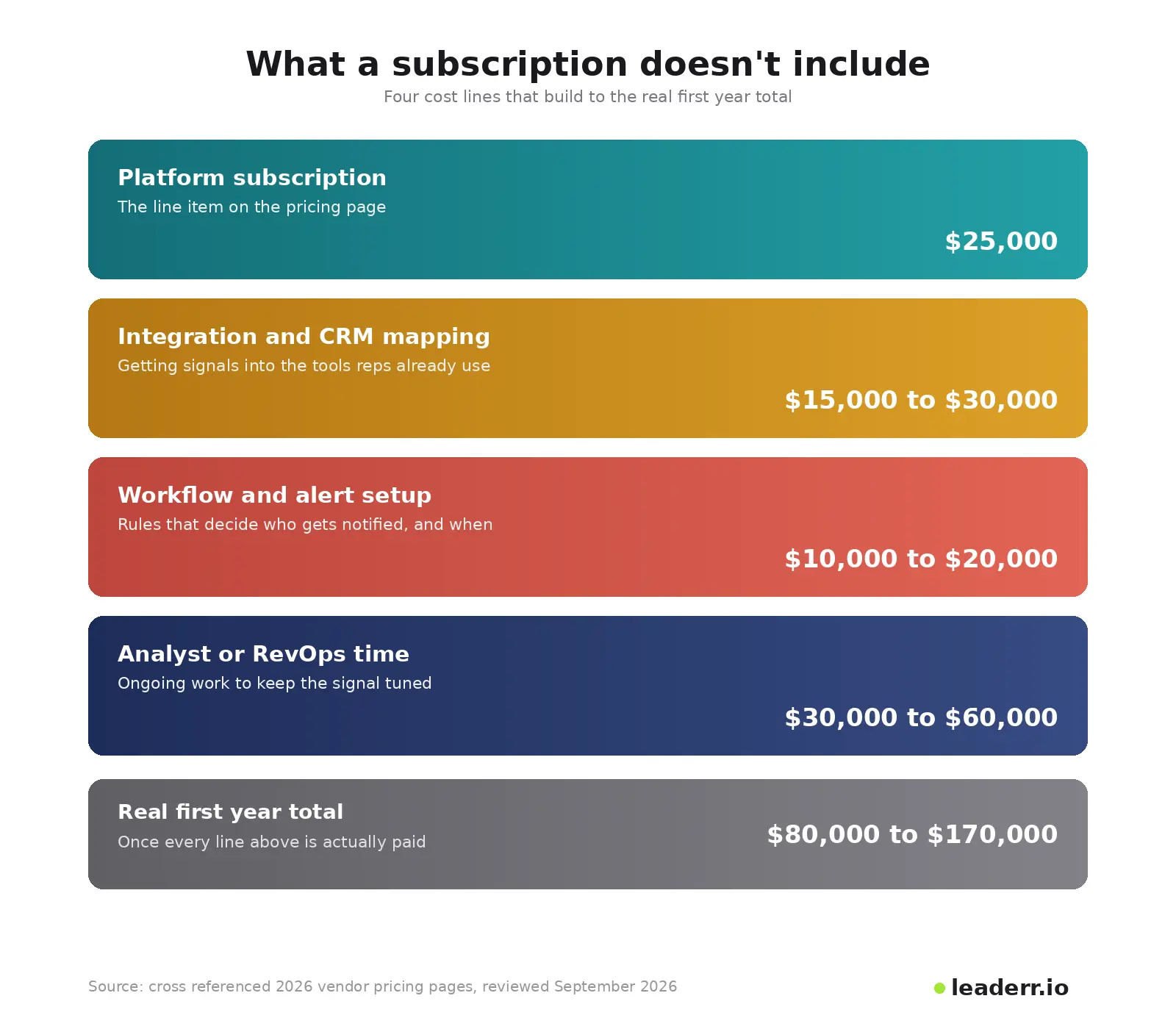
Two things worth noticing in that table. The cheapest row and the most expensive row differ by a factor of forty, and every single number above is a subscription price. None of it includes what it costs to actually get the data flowing into a rep's day.
The real first year cost, once setup and activation are added
A subscription is the number on the pricing page. It's rarely the number on the first invoice a company actually pays.
A way to test the idea for zero dollars before you buy anything
If you fall into the solo founder or small team group from the scope section above, none of the numbers so far apply to you yet. Run this for thirty days first.
Job post alerts. Set a free alert (Google Alerts or an RSS reader) for each target account's name plus a role tied to your product. A company hiring for a role your tool supports is a real signal, not a modeled one.
Review site alerts. Follow your top accounts on G2 or Capterra and check the review date column once a week.
A new review inside the last thirty days on a page in your category is a person at that company actively comparing options right now.
3. Funding and news alerts. Set a free alert for "[industry] funding" or "[industry] raises" tied to your target list. New funding inside a company's fiscal year is one of the more reliable triggers for new tool budget, and it costs nothing to watch for.
Log every hit in a plain spreadsheet: company, signal, date, and whether a rep actually followed up within 48 hours. After thirty days, count how many logged hits turned into a real conversation.
That number, not a vendor's demo, is what tells you whether paying for the third party version is worth the jump.
One thing worth stating plainly here: none of the three free methods above are a disguised trial.
A vendor's "free plan" is usually a capped sample of its own paid product; the three methods above use public information that was never behind anyone's paywall to begin with.
What happens after a signal fires
A signal is not a lead. It's closer to a reason to look again.
When to call
The signal lines up with something concrete: a renewal date you already know about, a role that was just posted, a funding round inside the last quarter.
When to wait
The signal is a single spike with nothing else backing it up. A person reading one blog post about your category is not the same as a buying committee forming.
Treating every signal as call ready is the single fastest way to burn a list of good accounts on bad timing.
Where this goes wrong, and how to catch it early
What you'll notice | What's actually causing it | What fixes it |
|---|---|---|
Reps stop trusting the tool and go back to manual research | A low topic threshold counts one person reading one article as a real signal | Raise the sustained topic count needed before a signal routes to a rep, instead of triggering on a single spike |
Two paid providers disagree on which accounts are in market | Each vendor measures accuracy against its own definition, and none publish the same standard | Track your own close rate against a flagged account list for 90 days rather than trusting either vendor's self reported number |
A rep gets a signal with no idea when to actually call | Research activity alone doesn't say if the account is comparing you or a competitor | Pair every signal with a real trigger, a renewal date, a published RFP, a budget cycle, before dialing |
The dashboard is live and results still haven't shown up after two months | The setup and activation lag was never built into the timeline, only the subscription price | Budget the full first year figure from the start, and set the first review at 90 days, not 30 |
A German marketing agency ran a real test of this across three companies in 2026, tracking three providers over a full quarter in one regional market.
The published results put measured accuracy at 81, 87, and 92 percent for the three providers, each one scored on a different basis.
Three companies in one region is a data point, not a verdict on the category, but it lines up with the same pattern in the table above: nobody in this market measures "accurate" the same way twice.
FAQs
What's an example of B2B intent data?
A visitor from a company's IP address reading three articles about your product category on an outside publisher site in one week, without ever visiting your own site, is a textbook third party signal.
How accurate is B2B intent data?
There's no shared, audited standard across vendors. Each one measures accuracy against its own funnel and its own definition of a converted signal, which is why two providers can disagree on the same account.
Is intent data the same as buyer intent?
They're usually used to mean the same thing. "Buyer intent" is the broader, older phrase; "intent data" refers specifically to the collected, packaged version a vendor sells.
Should sales contact every account showing intent?
No. A single spike with nothing else behind it is weak evidence on its own. Pair it with a concrete trigger first.
What actually counts as free versus a disguised trial?
A vendor's free plan is a limited sample of its own paid product, not free intent data. The three methods in the zero dollar test above use public information that was never a paid product in the first place.
Who are the leading B2B intent data providers?
Bombora runs the largest third party cooperative network. ZoomInfo and 6sense bundle intent signals into broader sales intelligence platforms. Demandbase bundles intent data into full account based programs. G2 and TrustRadius sell second party signal drawn from their own review traffic.
Run the free version before you sign anything
Every number in this piece points the same direction. The subscription price is the smallest number in the whole decision, and it's the only one any vendor puts on a page.
Run the thirty day test first. If it turns up real conversations, the case for paying writes itself, with your own numbers instead of a vendor's.
Guidance reviewed September 25, 2026.
About the author
Michael Doyle writes about B2B sales at Leaderr. He covers prospecting, cold outreach, sales data, and pipeline building, with a focus on what actually works for SDRs, founders selling on their own, and small sales teams. Connect with him on LinkedIn.