What technographic data actually shows, and when you do not need to buy it
Technographic data explained: what it is, how it gets collected, when a free check is enough, and why nobody publishes real pricing or accuracy figures.
 Michael Doyle13 min read
Technographic data is information about the specific software, tools, and technology a company runs, things like its CRM, cloud host, or marketing platform.
Most providers with real market recognition hide their price behind a sales call, and not one of them publishes an accuracy number that an outside party has tested.
Who needs technographic data, and who does not
This fits a narrow set of jobs, not every B2B seller.
It fits well for:
A founder selling their own product who wants to avoid pitching a tool the prospect already runs.
A small sales team, roughly two to ten people, that cannot justify a full time data analyst.
An agency or freelancer building a prospect list around one specific integration or platform gap.
A B2B marketing team scoring accounts as part of a wider account based campaign.
This fits less well for:
A consumer facing business with no company buyer to research.
A team selling to very small or informal businesses that run no real technology stack at all.
An enterprise team that already pays for a data or RevOps platform with support built in.
If none of the first group describes you, the sections below on free checks will matter more than the ones on providers.
It gets confused with two neighboring terms often enough that mixing them up wastes a filter pass.
Technographic data compared with firmographic, intent, and demographic data
Term | What it describes | Example |
|---|---|---|
Technographic data | The specific tools and technology a company runs | CRM platform, cloud host, marketing automation tool |
Firmographic data | Facts about the company itself | Industry, employee count, revenue band |
Intent data | Signals that a company is actively researching a purchase | Visits to review sites, spikes in topic research |
Demographic data | Facts about an individual person | Job title, seniority, location |
A plain guide to firmographic data covers the company level facts side of that table in full, with a worked scoring example.
Where the compliance line sits
One boundary matters for compliance, not just definitions. A record that says a company runs a certain CRM platform describes the company, not a person.
Under UK GDPR guidance, personal data has to relate to an identified or identifiable individual, and a company level tool detection does not meet that bar on its own.
The UK Information Commissioner's Office lays out the exact test. The line moves the moment a record ties a specific tool to one named employee instead of the company as a whole.
What a technographic data record looks like
Most explanations stop at the definition and skip the output itself. Here is what one real check produced.
What one page source check by hand found
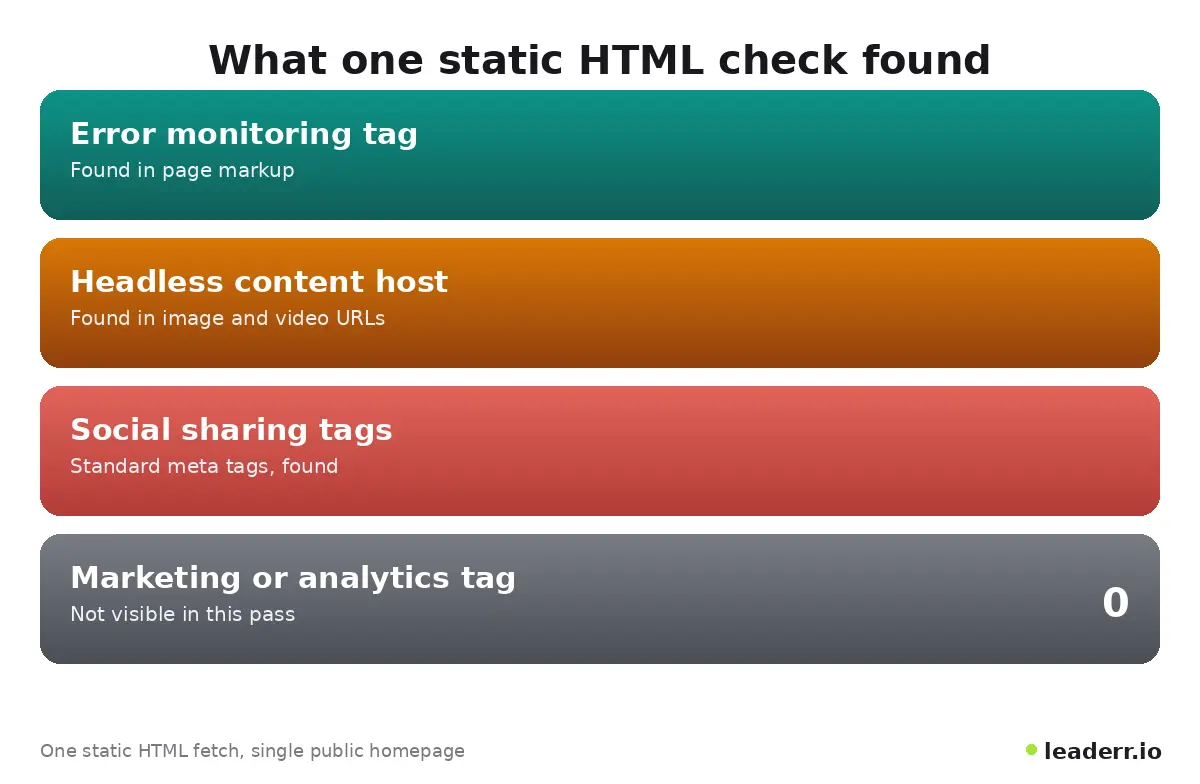
I opened the plain HTML source of a real public company homepage, Notion's, and read it by hand, the same first move a provider's crawler makes before any enrichment happens. Four identifiable third party technologies showed up in the raw markup: an error monitoring tag, a headless content hosting service, and standard social sharing meta tags.
That is the entire haul from a static fetch. No analytics tag and no marketing automation pixel appeared anywhere in that pass, not because the company runs none, but because tools that load through a tag manager after a cookie consent banner often do not render in a plain HTML fetch at all.
What the gap between the two counts means
Three of those four hits were structural, not the marketing stack a provider would flag as worth calling on. That gap between what a plain page load shows and what a company's stack contains is the entire reason a paid crawler renders pages, waits out consent banners, and checks more than the homepage.
How technographic data gets collected
Every method traces back to one of four sources.
Website detection: reading a site's public code for script tags, tracking pixels, and platform fingerprints, the method behind most free lookup tools.
Job postings: a listing that names a required tool as a job qualification is a strong signal the company already runs it.
Third party purchase: buying a feed from a vendor that has already crawled at scale, the same category of data that shows up inside a broader B2B data enrichment pass.
Direct disclosure: asking during a discovery call or a survey. Slowest to collect, but the most current answer for that one account on the day you ask.
None of these four is complete on its own. A crawler misses a tool loaded behind a login. A job posting only appears while the role is open. A purchased feed is only as fresh as its last recrawl.
Where technographic data helps
Three jobs cover most of the real use.
Account based marketing
A target list built around a specific integration gap performs differently than a list built around firmographic fit alone. If an account runs a CRM with no dedicated outbound tool connected to it, that gap becomes the campaign's whole premise instead of a guess.
Tools built to run a targeted campaign like that, reviewed here, depend on exactly this input to build the account list in the first place.
Sales prospecting and outreach
Filtering a cold list down to accounts running one named tool, before the first email goes out, changes the opening line from generic to specific.
A rep who knows the target's stack does not open with a question the prospect already answered somewhere else.
Segmentation and lead scoring
Tech stack fit becomes one input among several in a wider account score, sitting next to firmographic and behavioral signals rather than replacing them.
One scoring model built for building an ideal customer profile allocates real weight to exactly this signal, alongside company size and industry match.
How reps use tech stack information in a pitch
A record only earns its cost once someone acts on it. In practice, technographic data lands in a CRM field before a rep ever opens the account, usually through the same enrichment step that fills in firmographic fields at the same time.
That head start skips the discovery question entirely. The opening line names the gap directly: no dedicated tool connected to the CRM already in place, no guessing at what pain might exist.
That single sentence does more for a cold open than three paragraphs of generic value proposition, because it proves the rep looked at this specific account before dialing.
When a free check is enough, and when you need a paid provider
The choice comes down to how many accounts are on the list.
What you are checking | A free manual check | A paid provider |
|---|---|---|
Coverage | One company at a time | Thousands of companies in one pull |
Freshness | As current as your last look | Depends on the provider's recrawl schedule, sometimes weeks old |
Effort | A few minutes per company, done by hand | Minutes total, but only after setup and integration work |
Cost | No cash cost, real time cost instead | A recurring bill, priced per seat or per record |
A list under twenty accounts rarely justifies a subscription. Past that point, the hours spent checking by hand start to cost more than the bill would.
What technographic data cannot tell you
No single detected tool tells the whole story. Treat it as a fact on its own, and the pitch goes wrong.
It cannot tell you whether the tool is actually being used, only that it is installed somewhere in the stack.
It cannot tell you who inside the company owns the decision to renew or replace it.
It cannot tell you the contract length, the renewal date, or the budget set aside for a competing tool.
It cannot tell you why the company chose that tool over a competing one in the first place.
One more compliance point belongs here, since it comes up in the same breath as GDPR. The California Attorney General's CCPA page covers personal information belonging to California consumers specifically.
A company level technology record, the kind covered in this guide, sits outside that definition for the same reason it sits outside GDPR: it describes a business, not a consumer.
Before you sign a technographic data contract
Confirm these eight things before any money changes hands.
Ask what counts as one detected technology, and whether a removed tool drops off the record within a stated number of days.
Ask for the refresh cycle in writing, not a marketing claim of real time coverage.
Confirm whether the price is per seat, per credit, or per exported record.
Ask for a sample export of ten real company records before you commit to anything.
Check whether job posting signals come included or get sold as a separate add on.
Confirm whether a removed or migrated technology gets flagged as historical rather than shown as current.
Ask how false positives from a reseller or white label setup get corrected once found.
Confirm the contract length, and whether a monthly option exists before any annual discount applies.
How accurate technographic data is
No provider with broad market recognition publishes an accuracy figure that an outside party tested. What exists instead are confidence claims made by the provider about its own data, with no disclosed methodology behind the number.
Where the accuracy claims break down
Three patterns explain most of the wrong matches a real account list turns up.
Symptom | Cause | Fix |
|---|---|---|
A tool shows up that the company dropped months ago | The provider only recrawls a site every few weeks, so removed code takes time to disappear from the record | Cross check any account before you contact it against a fresh manual look at the page, not the provider's last snapshot |
The record lists a tool the company never bought | A reseller or white label partner embeds its own script under a different brand name, and the crawler tags the wrong vendor | Treat one detection as a lead, not a fact, and confirm it during discovery before it shapes the pitch |
Two sources show a completely different stack for the same company | One crawler reads only the homepage, the other reads product and pricing pages too, and they hit the site on different days | Ask any provider which pages it actually crawls and how often, then weigh a single detection accordingly |
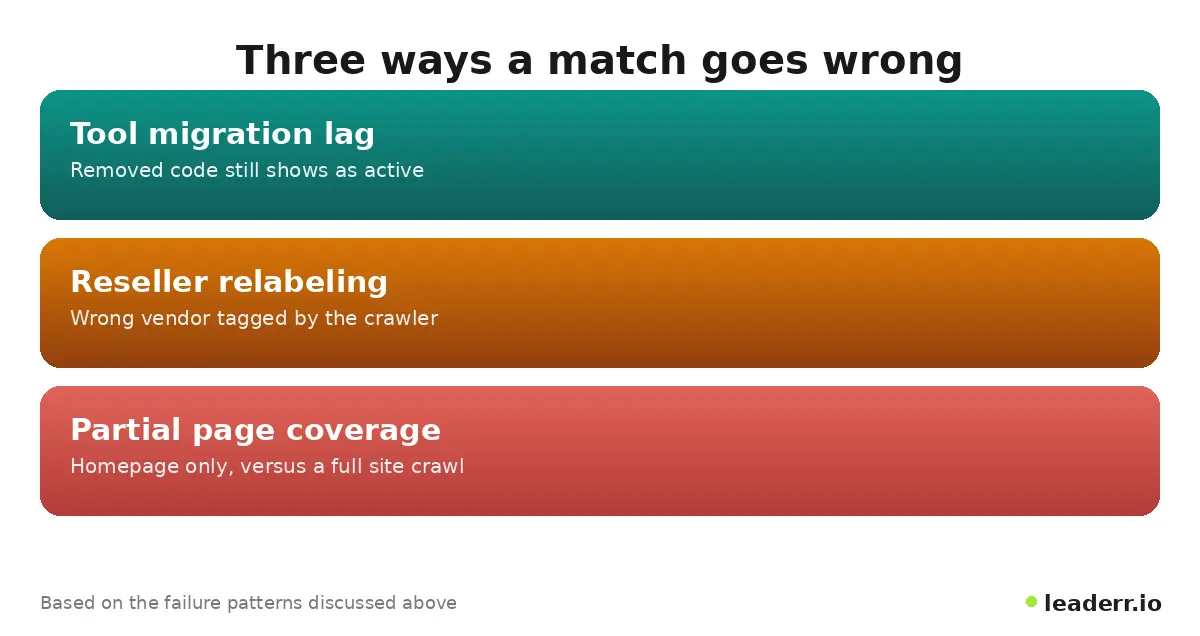
None of these three patterns shows up as a lower accuracy percentage anywhere. Each one shows up as one specific wrong fact sitting inside one specific account record, which is the type of error a summary confidence score cannot surface.
What little public discussion exists
Public discussion of this specific gap is thin. One open source project shared on Hacker News in February 2026 offered sample technographic records pulled from a self built crawler covering more than fifty million companies, a rare instance of someone showing raw detection output in public rather than a polished confidence score.
The post drew two points and one comment, which says as much about how little independent scrutiny this category gets as anything in the post itself.
What technographic data costs
Real pricing is close to nonexistent for the platforms most sales teams have already heard of. None of the providers with broad market recognition list a number on their site. You fill out a form, book a call, and get a quote shaped by team size and data volume, the same pattern across nearly every option a buyer is likely to shortlist first.
Smaller, narrower providers behave differently. Several publish a real number, usually structured one of three ways: a flat monthly seat fee, a credit system charged per lookup, or a per record price for a bulk export.
A credit system tends to cost more per company than a flat seat fee once volume climbs past a few hundred lookups a month, which matters more to a small team's budget than any headline accuracy claim.
FAQs
What is the difference between technographic and firmographic data?
Technographic data describes the tools a company runs, its CRM, cloud host, or marketing platform. Firmographic data describes the company itself, its industry, headcount, and revenue band.
Most teams filter by firmographic data first to find the right size and industry, then layer technographic data on top to find a specific tool fit or gap.
Can you get technographic data without paying for a provider?
Yes, for one company at a time. Reading a site's page source, checking public job listings, or asking directly during a discovery call all work without a subscription.
What you give up is coverage: a provider spans thousands of accounts already indexed, while a manual check only covers the one account in front of you.
How often should technographic data refresh?
There is no fixed industry number. A provider that recrawls a site every few weeks will keep showing a tool that left the stack months earlier as still active.
Ask any provider directly how often it revisits a domain, since that number affects your pitch more than any accuracy claim on its own.
Does using technographic data run into GDPR or CCPA rules?
Generally no, as long as the record stays at the company level rather than naming an individual. A note that a company runs a certain CRM platform describes the business, not a person, which keeps it outside the core definition both laws use.
The line moves the moment a record ties one specific tool to one named employee.
Who actually uses technographic data day to day?
Mostly sales development reps building a call list, marketing teams building an account based campaign, and product marketers checking which competing tools a target market already runs.
Founders selling their own product use it the same way at a smaller scale, usually by hand rather than through a subscription.
What matters before you buy
Everything above points to the same decision. A list under twenty accounts rarely earns a subscription back in saved time. A list in the thousands rarely survives a manual check without someone burning a week on it.
The number of accounts on your list, not the size of your budget, is what should decide which side of that line you land on.
Before signing anything, ask for the eight answers above in writing, not in a sales deck. A provider willing to put a refresh cycle and a sample export in an email is telling you something a glossy accuracy claim never will.
Guidance reviewed on September 8, 2026.
About the author
Michael Doyle writes about B2B sales at Leaderr. He covers prospecting, cold outreach, sales data, and pipeline building, with a focus on what actually works for SDRs, founders selling on their own, and small sales teams. Connect with him on LinkedIn.