

Gong's review of 300 million recorded cold calls sorted objections into three groups, and the smallest group, existing solution pushback, made up under 8 percent of the total.
Most objections are either a flat dismissal or a situational stall. The response that works is short: listen fully, name the concern out loud, ask one question, then answer only what the prospect actually raised.
What changes is not the framework. It is what the reply anchors to once you factor in who is talking and how far along the deal is.
That breakdown is worth seeing in full, since it explains why the same handful of objections keep resurfacing across cold calls, demos, and renewals alike.
The three category split holds up across roles, which is the starting point for the role by role breakdown further down this page.
What you need before you start
You do not need a script for every possible objection. You need a repeatable response and a clear read on where the conversation sits.
Before you use any of the steps below, have these on hand.
The deal stage: first call, demo, negotiation, or renewal
Your role: SDR doing outbound, AE running the deal, or CS holding the account
One sentence describing what the prospect has actually seen so far
A note on whether this is the first objection on this call or a repeat of one already raised
This is written for SDRs working cold outbound, AEs running demos and negotiation, founders selling without a team, and CS reps handling renewal pushback.
If your team is large enough to have a shared deal room, a few of the steps below point to where that record keeping already lives.
The five step response that works for almost any objection
Every objection, whatever the wording, gets the same five moves. Skipping a step is what turns a normal objection into an argument.
Listen without planning your reply
What happens: the prospect states a concern. Most reps start composing an answer at word three, which means they miss whatever comes after it.
Done when: you can repeat the objection back in one sentence without adding anything to it.
Acknowledge before you defend
What happens: you say the concern is fair before you respond to it. This is not agreement. It is confirmation that you heard a real thing, not a brush off.
Done when: the prospect's next sentence is information, not a repeat of the same objection in louder words.
Ask one clarifying question
What happens: you ask what is actually behind the stated objection. "No budget" and "not the priority this quarter" get answered differently, and the words alone rarely tell you which one you are hearing.
Done when: you can name the real concern in your own words, not just the phrase the prospect used.
One version of this step has a name worth knowing: feel, felt, found. You tell the prospect others have felt the same way, then say what they found once they moved past it. It is one move, not a separate framework.
Respond to the real concern
What happens: you answer only what the clarifying question surfaced. Scripts read as scripts. A generic answer to a specific concern gives one away, and prospects notice.
Done when: your reply references something the prospect said in this call, not a stock line you would give anyone.
Confirm the objection is actually gone
What happens: you ask directly whether that answers it, instead of moving on and hoping.
Done when: the prospect says yes in their own words, or names a new, different concern. A silent nod is not confirmation.
The four objection types worth knowing by name
Most objections fall into one of four categories. Name the type first. Doing that, even just to yourself, points to which of the five steps needs the most attention.
Type | What it actually means | Why it matters |
|---|---|---|
Budget | The stated or perceived cost feels too high right now | Usually a value question wearing a price complaint |
Authority | The person on the call cannot approve the purchase alone | Points to who else needs to hear the pitch |
Need | The prospect does not yet see the problem as worth solving | Signals you moved to pitching before qualifying the pain |
Timing | Now is the wrong moment, whether or not that is true | Often the softest brush off and the easiest one to accept at face value |
Objection handling changes by role and deal stage
The framework above holds. The words inside it should not stay fixed.
No two roles hear the same objection at the same point in a deal, and the correct reply is not one reply with a different name attached.
To test that, the same budget objection was drafted three times, once per role. Each draft was word counted afterward.
The prospect line stayed the same across all three: "we do not have budget for this." Only the reply changed.
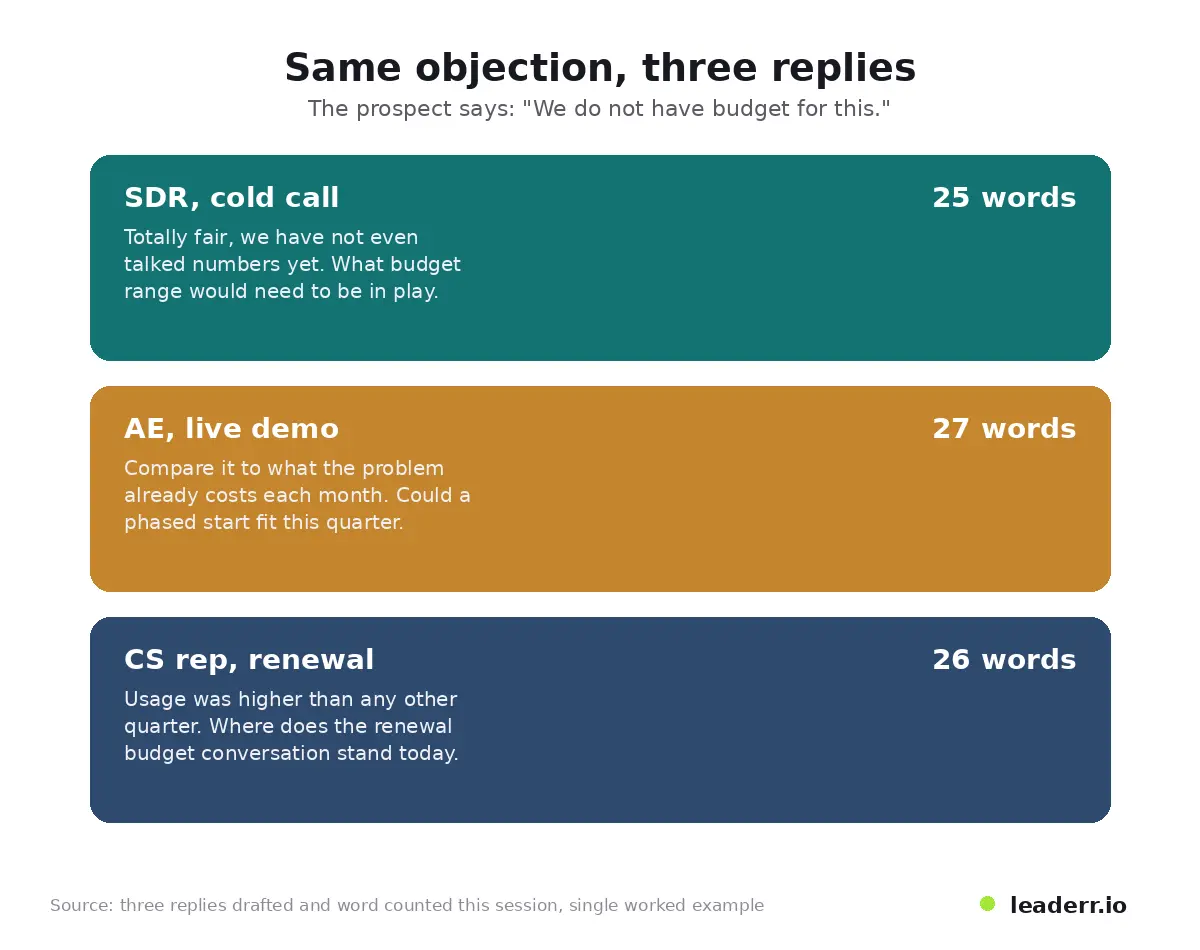
Length barely moved across the three drafts, 25 to 27 words each.
What changed was the anchor. An SDR on a cold call has not discussed a number yet, so the reply keeps the door open.
An AE in a live demo has already shown value, so the reply compares cost to the cost of the problem.
A CS rep at renewal has usage history on file, so the reply points there instead of pitching again.
SDR on a cold call
What happens: budget comes up before you have shown anything worth paying for. Treating it as a real budget objection this early usually means you answer a question the prospect has not actually formed yet.
A full cold call script with its own objection responses covers this stage in more depth than the anchor below.
Done when: you have a next step booked, even if the budget question stays open. An SDR's job at this stage is measured on booked conversations, not on closing a budget debate cold.
AE in a live demo
What happens: the objection lands after the prospect has seen the product work. That timing means you can compare the objection to a cost the prospect already agrees exists.
Done when: the prospect either names a number they could work with, or tells you specifically who else needs to approve it.
CS rep at renewal
What happens: the account already has a usage history, so the objection is answered with that record rather than a new pitch.
Renewal objections that sound like new deal objections are usually a sign the deal is stalling at the wrong stage, worth checking against where deals tend to stall in the funnel before you assume it is only about price.
Done when: the renewal conversation references specific usage numbers from the account, not general product value.
How to practice objection handling before it costs you a deal
Reading a list of responses is not the same skill as producing one out loud under time pressure. The three ways reps actually build that skill differ in what they train and what they miss.
Approach | What it actually trains | What it misses |
|---|---|---|
Self practice, reading scripts | Familiarity with wording and categories | Reaction speed and tone under real pressure |
AI roleplay practice | Repetition on demand, at any hour, with instant feedback on tone and pacing | Deal specific context and a real prospect's actual hesitation |
Live coaching on real calls | Feedback grounded in an actual deal and a real objection | Depends on a coach being free to listen at the right moment |
The Association for Talent Development reports that active practice such as roleplay produces around 75 percent retention against roughly 5 percent for lecture style learning.

Reading a list of responses sits closer to the lecture end of that gap, which is the same reason a memorized script falls apart the moment a prospect answers off pattern.
AI roleplay tools work by simulating a buyer persona so a rep can answer the same objection several times in a row and hear how the reply sounds out loud, not just how it reads on a page.
That repetition is the point. It does not replace a manager listening to a real call, but it removes the excuse of never practicing at all.
A prep worksheet to fill in before your next call
Copy this before a call where you expect pushback. Fill in the blanks with the specific deal in front of you.
Objection you expect this call: ______
Which of the four types it fits: ______
The real concern behind it, if different from the stated one: ______
What your reply will anchor to: something shown, something costed, or something on file
Your one clarifying question if the objection comes up as expected: ______
Mistakes that make objection handling worse
Giving every rep the same response regardless of role. A thread in Bravado's sales community, built entirely around this exact question, drew responses from account executives, sales VPs, and sales leads who largely agreed that the objections themselves barely change by role.
What changes is the point in the conversation where each one lands and the context available to answer it.
Copying an AE's script onto a cold call skips the context an SDR does not have yet.
Treating a stall as a real objection. "Send me some information" and "call me next quarter" are frequently a polite way to end the call, not a genuine budget or timing concern.
Answering the words literally means missing the actual signal.
Practicing a reply silently instead of saying it out loud. Rehearsing in your head trains recognition, not delivery.
The words feel ready until a real prospect interrupts halfway through and the reply has to adjust mid sentence instead of running to the end as planned.
Never confirming the objection actually resolved. Moving straight to the next talking point after a response, without asking whether it landed, leaves an objection technically unanswered even when it sounded handled in the moment.
FAQ
What are the 4 P's of objection handling?
Pause, probe, provide, and proceed. It is a shorter version of the same five step response: pause to listen, probe with a question, provide an answer to what you learned, then proceed once the prospect confirms it landed.
What is the feel, felt, found technique?
You tell the prospect that others have felt the same concern, then explain what they found once they moved past it. It works inside the respond step above rather than as a separate method.
How many times does a buyer object before saying yes?
There is no single fixed number, and figures vary by study and by deal type. What holds across most sales research is simpler: reps who stop after the first no close fewer deals than reps who treat one objection as the start of a conversation, not the end of it.
Do objection handling best practices differ by industry?
The core five step response holds across industries. What changes is the objection content itself.
Regulated industries such as financial services or healthcare raise compliance and approval objections far more often than a small business buyer would, so the categories above stay the same while the specific wording shifts.
The steps don't change. What you say inside them does.
A five step response and four objection categories cover almost every sales objection that comes up. The same objection means something different to an SDR on a first call than it does to a CS rep at renewal, and the reply should say so.
Guidance ]s reviewed 22 September 2026.
About the author
Michael Doyle writes about B2B sales at Leaderr. He covers prospecting, cold outreach, sales data, and pipeline building, with a focus on what actually works for SDRs, founders selling on their own, and small sales teams. Connect with him on LinkedIn.