MEDDIC sales: which version to use and what to ask for each letter
MEDDIC sales explained for the deal you work on today. Pick MEDDIC, MEDDICC, or MEDDPICC; get a question for each letter and a worked example to copy.
 Michael Doyle11 min read
MEDDIC sales is a six-letter checklist for one deal: Metrics, Economic buyer, Decision criteria, Decision process, Identify pain, and Champion. MEDDICC adds Competition. MEDDPICC adds Paper process.
Use MEDDIC when a few people decide, MEDDICC when named rivals compete, and MEDDPICC when legal or procurement reviews the contract.
Who this is for and what you need first
MEDDIC sales suits B2B deals where more than one person has to say yes. Account executives and sales development reps can use it as a call sheet.
Managers can use it as a shared deal check.
The table shows where each reader starts.
Reader | Start here | Done when |
|---|---|---|
Seller new to MEDDIC | Learn the six letters, then score one open deal | Every letter has an answer or a named gap |
Sales manager rolling it out | Pick the version, then add fields to the deal record | Every rep fills the same fields from real calls |
Founder selling alone | Use MEDDIC or BANT on your biggest open deal | You know who signs and what they need |
Have these ready before you start:
One open deal that has had a call.
Your call notes or the deal record.
Your ideal customer profile, so you know which buyers to score.
This guide does not cover MEDDIC courses, certificates or books.
What the six MEDDIC letters stand for
The six MEDDIC letters are Metrics, Economic buyer, Decision criteria, Decision process, Identify pain, and Champion.
The MEDDICC site defines each one. This table gives the plain meaning and when a letter counts as done.
Letter | Plain meaning | Done when |
|---|---|---|
Metrics | The measurable value the buyer gets, in dollars, hours or percent | You hold one number the buyer agrees with |
Economic buyer | The person with final say over the money | You have spoken to them |
Decision criteria | The rules the buyer uses to compare options | You can list the top rules in their words |
Decision process | The steps the buyer follows to choose | You know each step and its date |
Identify pain | The problem pushing the buyer to act, and what it costs | The buyer has said the cost out loud |
Champion | A person inside the buyer's company with influence who helps you win | They have agreed to a task, like arranging a meeting with the economic buyer |
MEDDPICC writes the I as Implicate the pain.
Who created MEDDIC and when
The MEDDICC site says Dick Dunkel created MEDDIC in 1996 at PTC (Parametric Technology Corporation).
The same page credits Jack Napoli and Dick Dunkel as creators. Sources differ on who and when, so "created at PTC in the 1990s" is the safe line.
Which version to use: MEDDIC, MEDDICC, or MEDDPICC
The MEDDICC site matches each version to a deal type. Its company sells MEDDPICC training, so read the match as one vendor's view.
The page lays the ladder out like this.
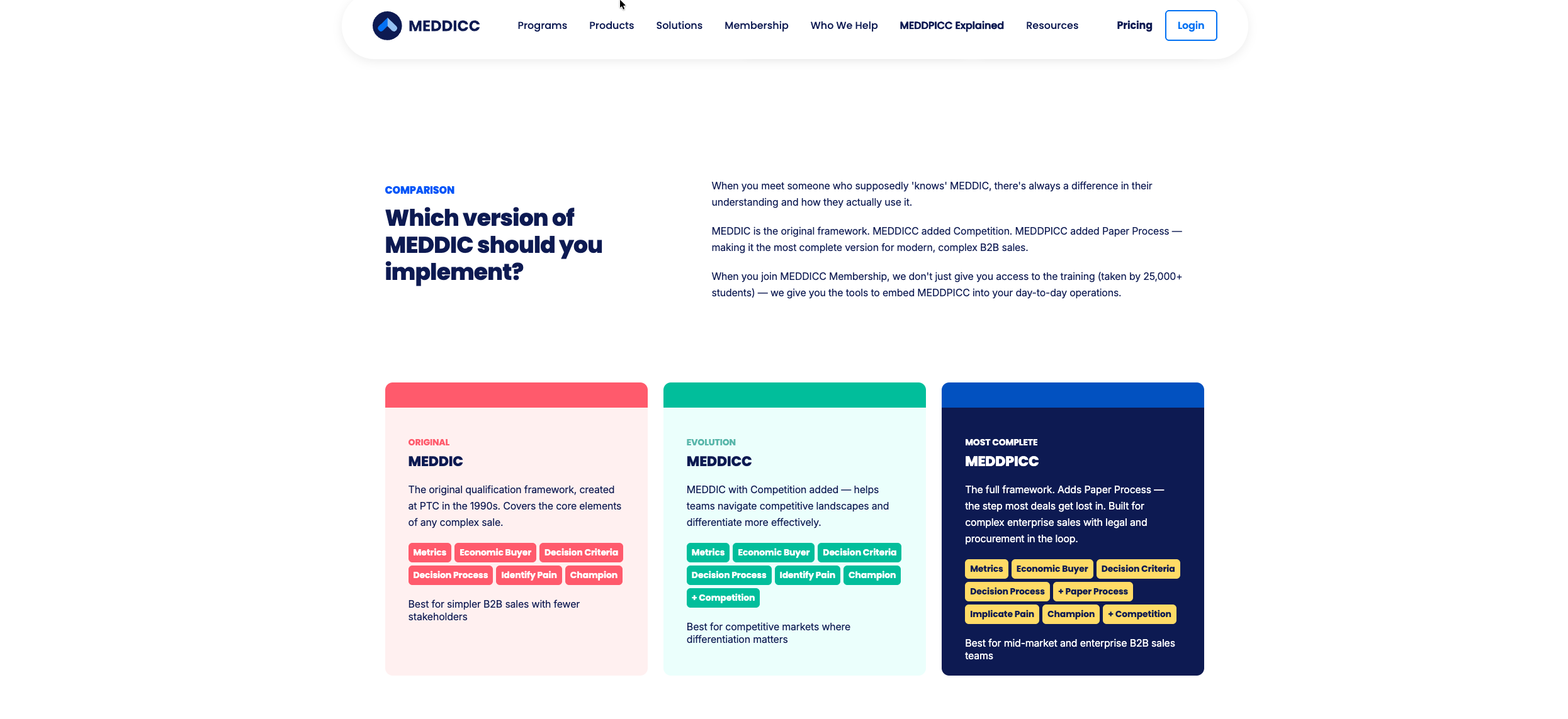
The table below compares four versions by what they add, the deal they suit, and when to pick each one.
Version | What it adds | Deal it suits, per the MEDDICC site | Pick it when (my rule) |
|---|---|---|---|
BANT | Budget, Authority, Need, Timeline | A quick early stage check for simple, transactional sales | One person decides and the sale closes in a call or two |
MEDDIC | The six letters | Simpler B2B sales with fewer buyers | Two to five people decide and no legal review is needed |
MEDDICC | Competition | Competitive markets where you must stand apart | The buyer is comparing you with named rivals |
MEDDPICC | Paper process | Mid-market and enterprise B2B sales teams | Legal, security or procurement must review the contract |
The ladder gives no dollar cutoff. It sorts deals by how many people and steps sit between you and a signature.
The same page also calls MEDDIC well suited to complex sales, so treat the ladder as a guide.
Count the buyers and reviews
I'd answer these three questions about your next deal, in order:
How many people must say yes? One person points to BANT, and two to five people point to MEDDIC.
Will the buyer compare you with named rivals, or with doing nothing? If yes, add Competition and use MEDDICC.
Will legal, security, or procurement review the contract? If yes, add Paper process and use MEDDPICC.
When BANT is enough
BANT checks Budget, Authority, Need, and Timeline in one early call. In a MEDDIC vs BANT choice, a deal that fits that check gains little from six letters.
The lead qualification process shows where BANT sits among other checks.
Check the proof before you build a business case
Two claims travel with MEDDIC: it took PTC from $300 million to $1 billion, and it lifts win rates by 15 percent. Both can be checked.
Did MEDDIC take PTC from $300 million to $1 billion?
PTC's revenue is public, so we can test the story against its reports.
PTC's annual report for fiscal 1995 shows revenue of $266,974 thousand in fiscal 1994 and $394,310 thousand in fiscal 1995, which is $394.3 million.
That is past $300 million before the 1996 date the MEDDICC site gives for MEDDIC.
A PTC history page lists $600 million for fiscal 1996 and $809 million for fiscal 1997.
The same page puts the $1 billion mark in 1998, after the Computervision merger closed on January 12, 1998.
PTC's fiscal 1998 filing calls that merger a pooling of interests, so earlier years were restated.
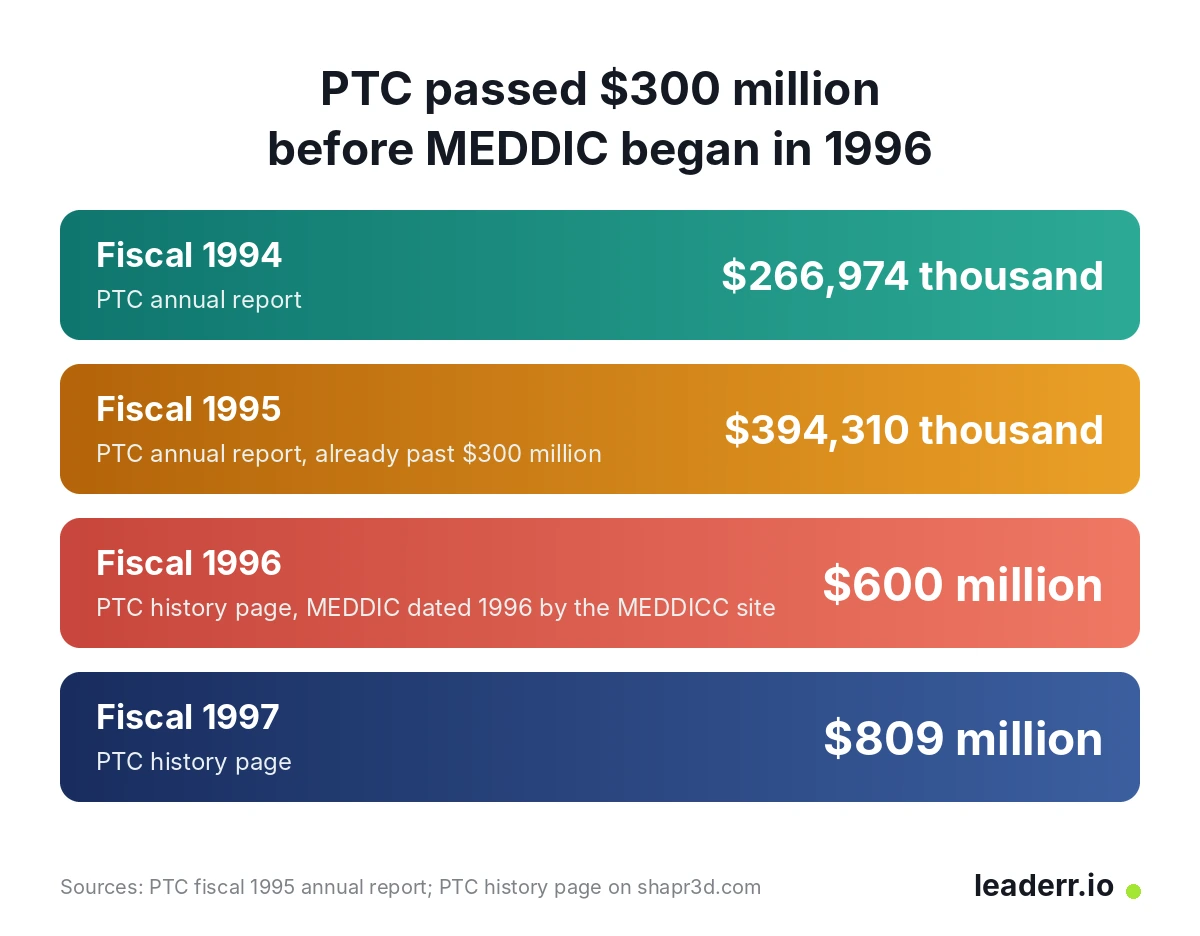
None of these pages credits MEDDIC for the growth, and the $1 billion mark came right after a merger.
Quote the revenue figures if you like. Do not quote them as MEDDIC results.
Where the 15 percent win rate comes from
One study gets cited for that number: the CSO Insights 5th annual sales enablement study.
Highspot's summary of it reports win rates 17.9 percent above the study average for companies with dynamic enablement alignment. The summary never mentions MEDDIC.
The study measured enablement alignment. A fair line for a business case is that MEDDIC is a way to check deals, and the sources above include no study of its effect alone.
How to run MEDDIC on one deal in four stages
The MEDDIC sales process works best when you run one deal from start to finish before you roll it out to a team.
Stage 1: Pick one open deal and write what you know
What happens: Choose a deal that has had a call. Write what you know under each letter.
Done when: Every letter has a note or a blank.
Stage 2: Ask the missing questions on your next call
What happens: Use the deal sheet below. Ask about two or three blank letters per discovery call, and ask for the economic buyer's name early.
Done when: Each blank letter has an answer or a date to get one.
Stage 3: Mark each letter and set a next step
What happens: Mark each letter as known, partly known, or missing. Give every gap a next step, an owner, and a date.
Done when: No missing letter is left without a next step.
Stage 4: Add the letters to the deal record
What happens: Add one text field per letter to the deal record in your CRM, for example, Salesforce.
Place the fields on each stage of your sales pipeline.
Done when: Every open deal shows six fields filled from real calls.
Deal sheet to copy, with a worked example
Copy the deal sheet
This template holds the MEDDIC sales questions.
Copy it into your notes or CRM, ask each question on a call, then write the answer next to it.
Deal: ______   Version: MEDDIC / MEDDICC / MEDDPICC

M  Metrics: What number will this buyer use to judge success? ______
E  Economic buyer: Who signs off on the money, and have I spoken to them? ______
D  Decision criteria: What rules do they use to compare options? ______
D  Decision process: What are the steps and dates from now to a decision? ______
I  Identify pain: What problem is costing them, and what does it cost? ______
C  Champion: Who inside will help me, and what have they agreed to do? ______

MEDDICC adds
C  Competition: What else could they pick, including doing nothing? ______

MEDDPICC adds
P  Paper process: Who reviews the contract, and how long does each review take? ______

For every gap: Next step ______  Owner ______  Date ______
Example deal: scheduling software for a dental group
Here is an example deal. Say a seller offers appointment scheduling software to a dental group with 12 clinics.
Every number below is an example input, not a result.
Start with Metrics:
Say each clinic loses 8 visits a week to no-shows.
Say each lost visit costs $150.
12 clinics times 8 visits is 96 lost visits a week.
96 visits times $150 is $14,400 a week.
$14,400 times 52 weeks is $748,800 a year.
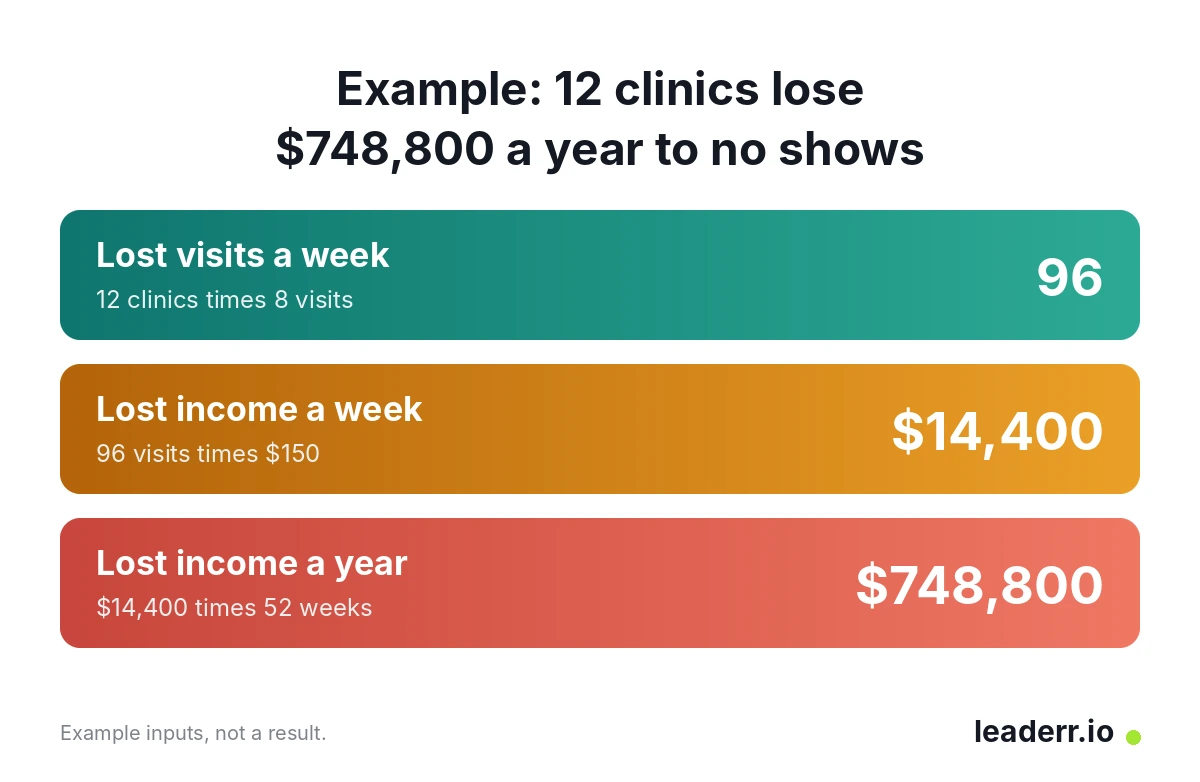
The seller now holds one number to bring to the buyer. The other five letters read like this:
Economic buyer: The CFO signs. The seller has met only the clinic manager, so this is a gap.
Decision criteria: The tool must connect to the dental group's patient records system and go live in 8 weeks.
Decision process: Clinic managers test it, the CFO reviews it, then the board votes on a set date.
Identify pain: Front desk staff calls patients by hand, and the CFO sees the $748,800 line each year.
Champion: The operations lead agreed to ask for a CFO meeting but has not booked it.
The seller has two gaps, so the next step is to ask the operations lead to book the CFO call this week.
What a first month of rollout looks like
No source gives a standard rollout length. This table is a suggested first month, not a measured timeline.
Week | Who | What happens |
|---|---|---|
1 | Manager | Pick the version and add the six fields to the deal record |
2 | Each rep | Score one open deal from call notes |
3 | Manager and rep | Review the gaps in a deal review and set next steps |
4 | Manager | Check that fields come from real calls, then adjust the questions |
Mistakes that break a MEDDIC rollout
The MEDDICC site's May 2026 podcast summary puts the main risk in one line: "MEDDPICC doesn't fail, culture does."
The table lists four failure states and a fix for each.
Symptom | Cause | Fix |
|---|---|---|
Every field is filled, but deals still stall | Reps treat the sheet as a checklist and fill it after the call | Ask each question on the call and write the answer from your notes |
Reps leave gaps blank or guess | Managers treat a missing letter as a fault | Treat a gap as a task with an owner and a date |
Calls turn into interviews | Every letter is asked on call one | Ask two or three letters per call and spread the rest |
No economic buyer or champion appears | The deal runs through a contact without authority | Ask who signs and who else is affected, then record the gap |
FAQ
What is the difference between MEDDIC and MEDDPICC?
MEDDPICC has eight letters: the six MEDDIC letters plus Competition and Paper process.
MEDDICC stops at seven, with Competition only. Use MEDDPICC when legal, security, or procurement reviews the contract.
Is MEDDIC a methodology or a qualification framework?
Both labels are used. The six letters work as a qualification framework. SPIN and Challenger Sale teach how to talk with a buyer, and MEDDIC does not replace them.
Is MEDDIC outdated?
The letters cover facts every large purchase still involves: who signs, how they decide, and what the problem costs.
No source here measured MEDDIC alone, so judge it by whether scored deals hold fewer surprises.
Can MEDDIC work for small businesses or startups?
Yes, in a lighter form. The MEDDICC site points MEDDIC at simpler B2B sales with fewer buyers and BANT at simple transactional sales.
A founder can score only the biggest open deals.
How long does it take to implement MEDDIC?
No source gives a standard length. Use the first month plan above, and judge progress by whether every open deal shows six fields filled from real calls.
Score one deal before you roll anything out
Pick the version with the three questions, fill the sheet for the deal closing soonest, and ask the question behind each blank letter on your next call.
Then track the win rate on scored deals for one quarter, since no source here proves a lift.
Guidance and sources reviewed 30 October 2026.