Revenue operations: what it is and whether your small team needs it yet
Is your small team ready for revenue operations? See the signs, how many people per seller, what the growth research measured, and a one-page owner brief.
 Michael Doyle11 min read
Revenue operations puts the operations work of sales, marketing, and customer success under one owner.
For a team of 25 or fewer, the Pedowitz Group lists one generalist.
That person covers admin, data cleanup, and basic reports.
Start with one named person and a one-page brief, not a revenue operations department.
What you need before you start
This guide fits founders, new SDRs, and startup team leaders. It assumes up to about 25 people. Gather these four things first:
A head count of everyone in marketing, sales, and customer success.
The name of whoever holds your CRM admin login today.
The stage names your deals move through.
The leaders who read sales numbers each week.
What revenue operations is
Gartner's definition of revenue operations is one model that joins customer work across sales, marketing, and customer success.
In a small team, RevOps is one owner of the CRM fields, stage names, and weekly numbers.
Most of that work sits in the CRM where deals move through a pipeline.
Revenue operations vs sales operations
Sales operations supports the sales team. Revenue operations covers marketing and customer success as well.
A Rework guide, updated on 9 June 2026, covers 3 to 10 sellers. It says to add sales ops or an ops generalist first. The title matters less than the scope you write down.
What the work covers by company size
The same Pedowitz Group guide lists what the work covers at each size.
Stage | Go-to-market staff | What revenue operations covers |
|---|---|---|
Startup | Up to about 25 | Admin, data hygiene, basic reporting |
Growth | About 25 to 80 | Automation, attribution, forecasting, enablement |
Mid-market and enterprise | More than 80 | Architecture, planning cadence, platform ownership, data products |
Do you need revenue operations at your size?
The sources below give signs, not one team size that triggers the need.
Starting too early or too late
A Gartner Peer Community thread asks for advice for companies that are considering revenue operations. It shows 4 comments and 2.3k views, and the answers split on timing.
One software co-founder says it may not be needed until selling moves past the founders. That person would set it up when a VP of Sales joins.
A director of operations says to start before the go-to-market team scales. Processes are easier to define then.
A founder who runs revenue operations says day one needs no full function with a VP. Start early, where the impact is highest.
The signs to look for
This table pairs each sign with a first move.
Sign | First move | Source |
|---|---|---|
Founders still run all sales | Keep one clean CRM and write down your stage names | Gartner thread |
A VP of Sales is joining | Give that leader the brief in this guide | Gartner thread |
You have 3 to 10 sellers | Name one revenue operations generalist, part-time if needed | Rework guide |
The CRM holds fewer than a few hundred meaningful records | Fix data entry first, then check again | Rework guide |
Three or more revenue leaders use the same data | Name one owner for that data | Rework guide |
Your revenue team is 25 or fewer | Start with admin, data cleanup, and basic reports | Pedowitz Group guide |
How many revenue operations people per seller
Published ratios side by side
Published ratios count different things, so they do not line up.
a16z published ratios by the number of account executives in February 2025.
On its ratio page, the Pedowitz Group counts every revenue role. Its staffing guide counts go-to-market staff.
This table sets the three side by side.
Source | Ratio | What it counts |
|---|---|---|
a16z, February 2025 | 5 account executives for each revenue operations person up to 25 account executives, then 7.5 for 26 to 50 and 10 for 51 to 150 | Account executives only |
Pedowitz Group staffing guide | One generalist up to about 25 staff, then 1 for each 30 to 40 staff up to 80 | Go-to-market staff |
Pedowitz Group ratio page | 1 for each 12 to 15 people, or 1 for each 20 to 30 for an early stage team with one sales motion | Marketing, sales development, account executives, account managers, customer success, renewals and partners |
Revenue operations example for a team of 24
Example: say 24 people work in marketing, sales and customer success. 8 of them are account executives.
a16z: 8 account executives divided by 5 is 1.6 people.
Pedowitz Group ratio page at 1 for each 15: 24 divided by 15 is 1.6 people.
Pedowitz Group ratio page at 1 for each 12: 24 divided by 12 is 2 people.
Pedowitz Group early stage ratio at 1 for each 20: 24 divided by 20 is 1.2 people.
Pedowitz Group early-stage ratio at 1 for each 30: 24 divided by 30 is 0.8 people.
Pedowitz Group staffing guide: 24 is under 25, so one generalist.
Here are the results side by side for the same team.
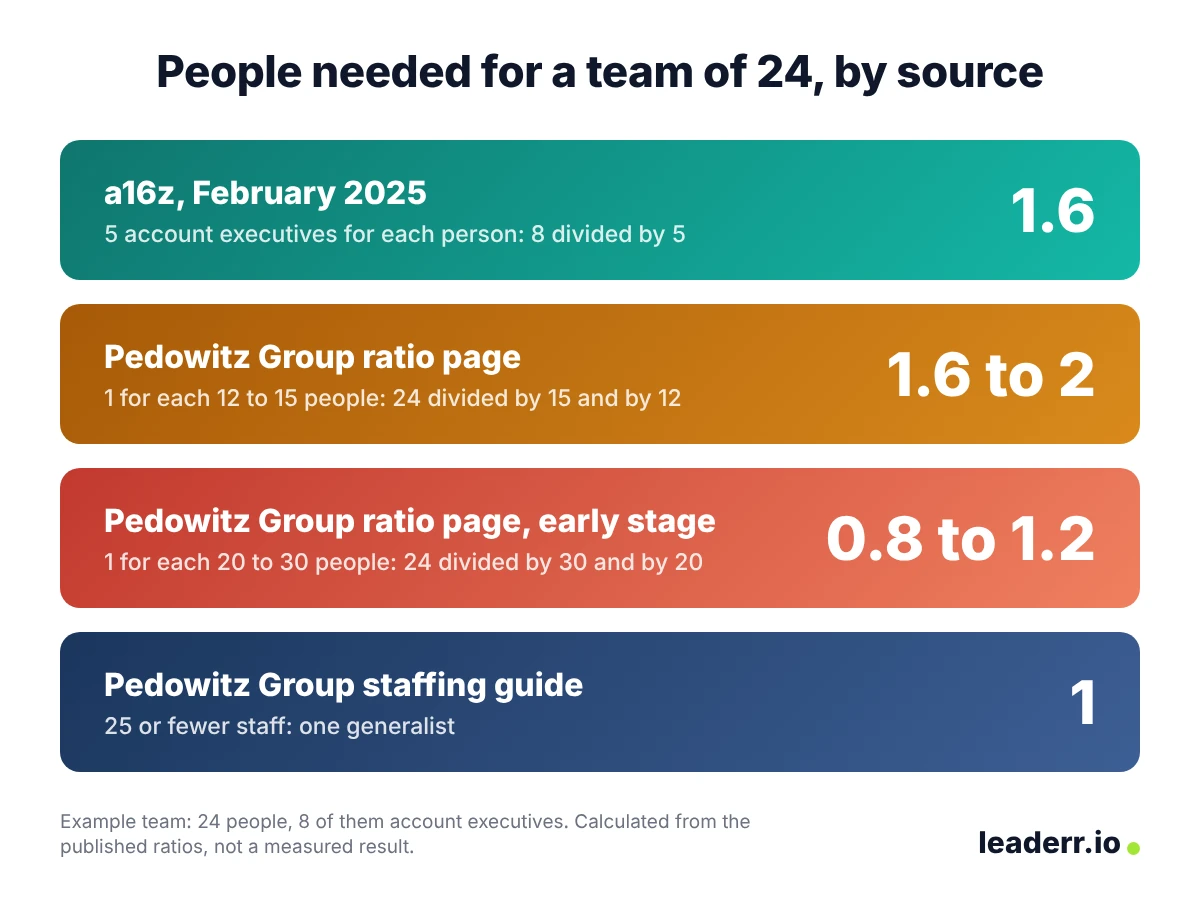
The same team needs 0.8 to 2 people depending on the source. A result under 1 points to one generalist or part-time help.
Your revenue operations team can be one person.
What the growth research does and does not say
Growth numbers for revenue operations trace to four pieces of research. Each measured something different.
The 19 percent figure
Forrester reported up to 19 percent faster revenue growth and 15 percent higher profit. The post covers the SiriusDecisions Summit 2015.
The data covers 400 B2B companies from 2006 to 2014. It measures how well sales, marketing, and product management were aligned.
The post never mentions revenue operations.
The post states the company base and the years in one place.
The nearly three times figure
In June 2019, Forrester said one group grew revenue nearly three times faster.
That group had revenue operations in some form. The comparison group had none.
The post cites a 2019 survey run with three software vendors. It does not show how many companies answered.
The 3-point figure from 2021
A Forrester Consulting study commissioned by Salesforce surveyed 927 decision makers in March 2021. Every company had 500 or more employees.
At the 169 firms planning a function, decision makers expected growth to rise from 5 to 7 percent.
At the 742 firms with a function, decision makers reported a rise from 5 to 8 percent. The gains are 2 points expected and 3 points reported.
What none of it says about small teams
None of the figures above is reported for a team of 25. The 2021 study starts at 500 employees.
BCG wrote in May 2020 that "implementing RevOps is a significant undertaking for any sizable organization."
It adds that the benefits outweigh the investment for many B2B businesses. Its benefit figures come from top B2B tech companies and BCG clients. No dataset is described.
How many companies use it
The Gartner topic page also says 75 percent of the highest growth companies will adopt a revenue operations model by 2026. It gives less than 30 percent as the starting point.
The page shows no date.
In May 2021, Gartner gave the same 75 percent for 2025.
The 2021 Forrester Consulting survey shows 78 percent with a formal capability and 19 percent planning one. All had 500 or more employees.
The report does not state the base for those two charts. The groups differ, so the figures do not compare.
What a revenue operations salary includes
Levels.fyi shows how much revenue operations makes in the US: a median of $200,000 in total pay, updated 26 November 2026.
The middle half of pay runs from $136,000 to $300,000. The 90th percentile is $360,000. Total pay counts base salary, the yearly value of stock grants, and bonus.
The page shows no sample size and no split by level.
The page charts the full spread in one view.
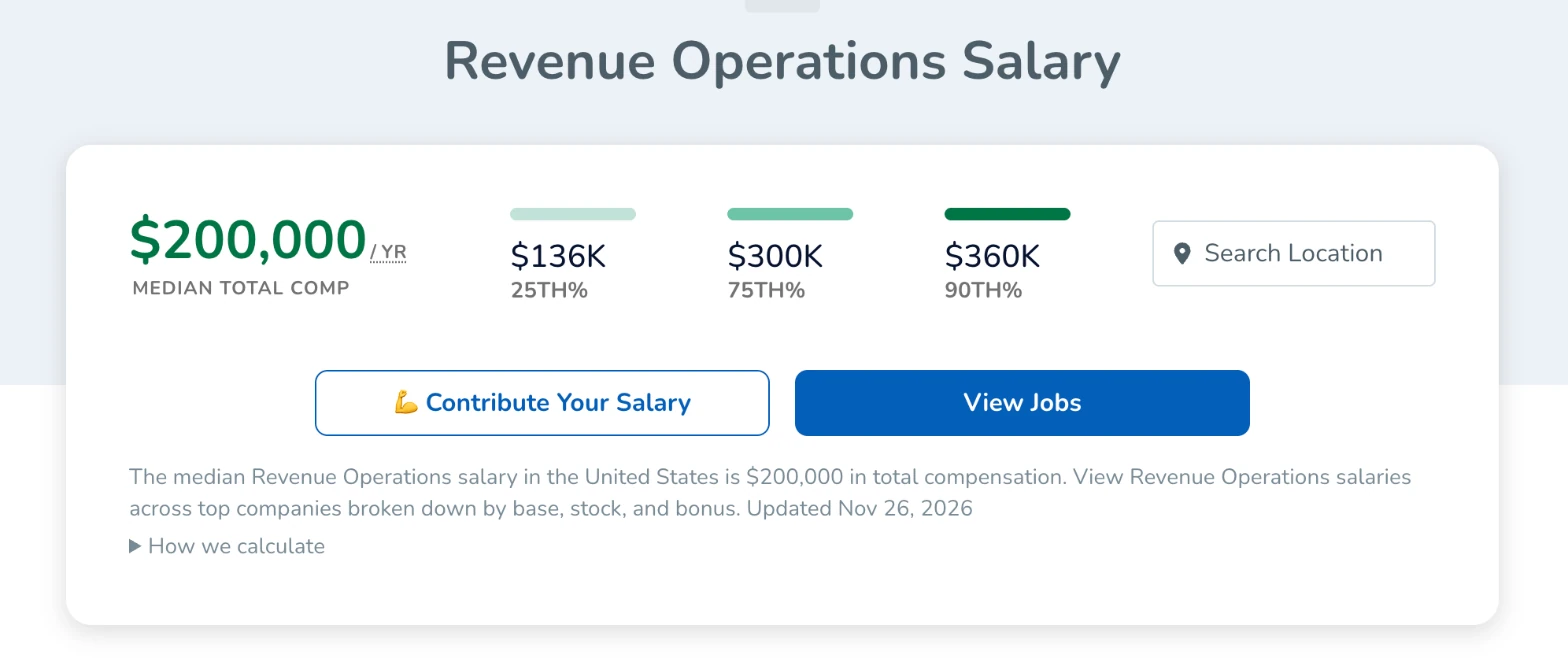
Read the median as total pay for the whole role, not as a base salary.
What a share of one hire costs
Example: the team of 24 needs 0.8 of a person.
At the median, 80 percent of $200,000 is $160,000.
At the 25th percentile, 80 percent of $136,000 is $108,800.
These are pay figures for an employee. They are not quotes from a provider.
What revenue operations consulting or an agency costs
Price lists for revenue operations consulting, agencies, and part-time help come from the sellers themselves. Get written quotes from at least two providers, including one agency.
Compare the hours each week, the systems covered, and the notice period.
Name a first revenue owner in four stages
Stage 1: pick the owner
What happens: Name one person who owns the CRM fields, stage names, and weekly report.
Done when: The owner's name is written on the brief below.
Stage 2: Write the definitions
What happens: Write down your deal stage names. Then write what counts as a qualified lead, a won deal, and a lost deal.
Done when: Every revenue leader has read the page and agreed to it.
Stage 3: clean the data
What happens: Remove duplicate records. Fill in the missing owner, amount, and close date on open deals. Keep it up with the habits of data hygiene.
Done when: Every open deal has an owner, an amount, and a close date.
Stage 4: send one weekly report
What happens: Pick a few revenue operations metrics from which sales KPIs to track.
Send them on the same day each week to the same leaders.
Done when: Three or more revenue leaders read the same numbers.
Copy this owner brief
Fill in one copy for your team.
Revenue owner brief

Owner:
Sponsor (the leader who owns the revenue number):
Systems the owner looks after:

Stage names, in order:
A qualified lead is:
A won deal is:
A lost deal is:

Weekly report
Numbers:
Sent on:
Sent to:

Review date:
Problems that stall a first revenue owner
This table lists three documented problems with a fix for each.
Problem | Why it happens | Fix |
|---|---|---|
A leader shares the 19 percent figure as proof | The research measured alignment of sales, marketing and product, not revenue operations | Quote the 2021 gain with its 500 employee limit, or say no small team figure exists |
Nobody wants to own it | BCG lists no clear reporting home as a concern, and one executive doubted it could work without a chief revenue officer | Name one sponsor who owns the revenue number and write that name on the brief |
The change feels too big | BCG lists the cost of change as a concern, while Gartner says it does not need to start with a large reorganization | Start with one owner, one page of definitions and one weekly report |
FAQ
Is revenue operations only for large companies?
No. Gartner says revenue operations does not need to start with a large organizational transformation. A team of 25 or fewer can start with one generalist and a one-page brief.
Is revenue operations the same as sales operations?
No. Sales operations supports the sales team, and revenue operations also covers marketing and customer success. The Pedowitz Group lists one generalist for a team of 25 or fewer.
Who should revenue operations report to?
Pick one sponsor who owns the revenue number. BCG found no clear reporting home for it in many organizations. One executive doubted it could work without a chief revenue officer.
What does a revenue operations person do day to day?
The Pedowitz Group lists admin, data cleanup, and basic reporting for 25 or fewer. One generalist covers all three.
Fill in the brief before you post a job
Write one name on the brief this week. If that person can hold the CRM, definitions, and weekly report, you have started.
Look at part-time help only when the work outgrows one person's time. Come back to the ratios when your headcount passes 25.
Guidance and sources reviewed 26 November 2026.
About the author
Michael Doyle writes about B2B sales at Leaderr. He covers prospecting, cold outreach, sales data, and pipeline building, with a focus on what actually works for SDRs, founders selling on their own, and small sales teams. Connect with him on LinkedIn.