12 best Lusha Alternatives in 2026 (now that phone credits cost double)
I checked 12 Lusha alternatives after Lusha quietly doubled its phone credit cost in 2026. Leaderr for AI proposals, Apollo for volume, Cognism for Europe.
 Michael Doyle13 min read
Fast answer: Leaderr is the pick if you want AI-drafted proposals and dossiers built around your prospecting, not just a contact list. Apollo is the safer default if you want a database plus outreach sequencing in one login. Cognism (or its sibling tool Kaspr) is the move if most of your pipeline sits in the UK or EU.
Lusha's phone number credits jumped from 5 to 10 sometime in the first half of 2026, and most of the "Lusha alternatives" articles ranking right now were written before that change went live. So I pulled up twelve tools and priced out one identical thing on each: what it actually costs to reveal 100 people's email and mobile number, using this week's numbers instead of last year's.
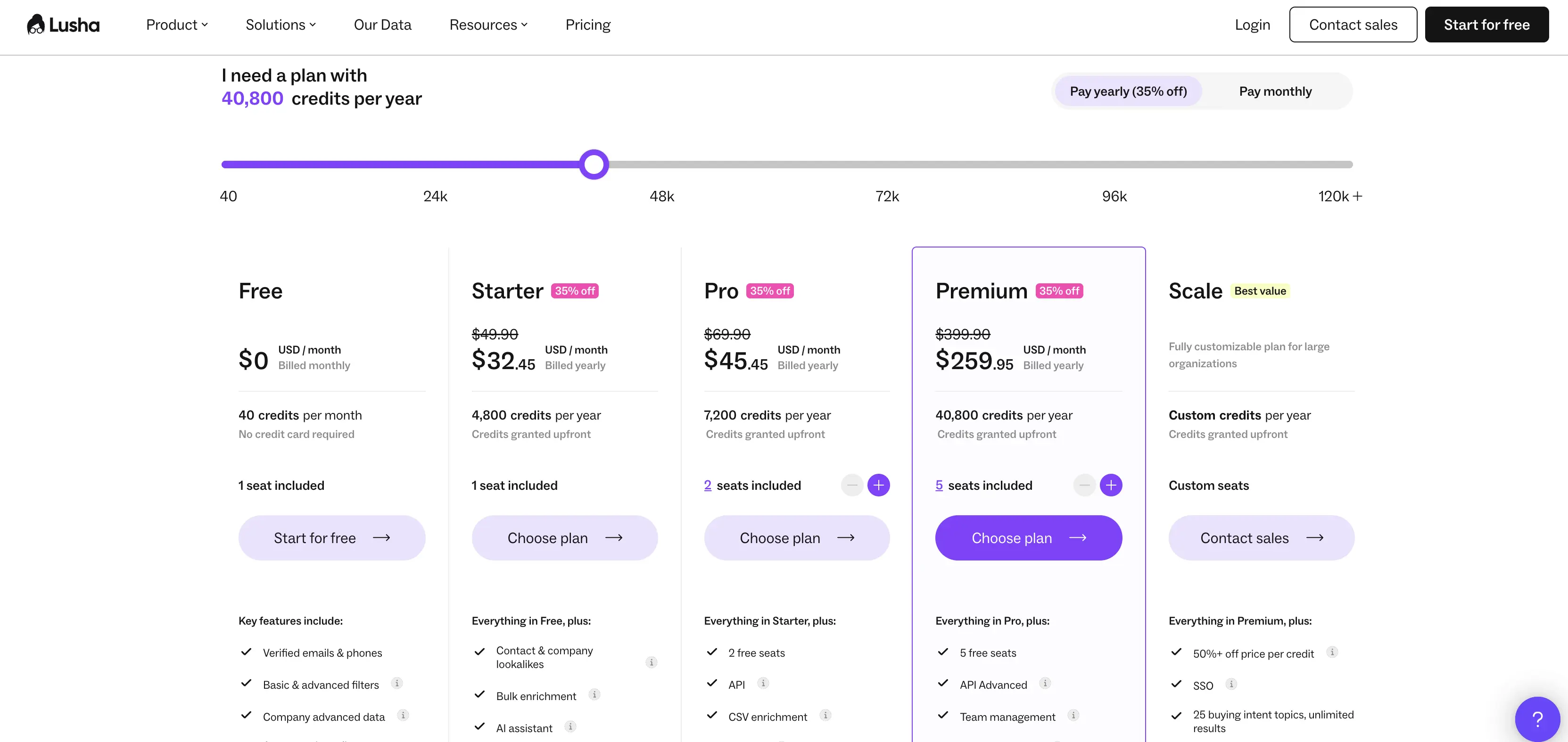 The number that changed the math: a full contact (email plus phone) now costs 11 credits on Lusha's own pricing page, not 6. On the base Pro plan's 600 monthly credits, that caps you at roughly 54 complete contacts a month. A year ago, the same 600 credits covered around 109.
What actually pushes teams off Lusha
Capterra rates Lusha 4.0 out of 5 based on 396 verified reviews as of this week, which is solid, not shaky. One verified Capterra reviewer, a senior SDR at a computer software company, put it plainly: "My experience with Lusha has been brilliant." The Chrome extension really does make LinkedIn prospecting close to instant, which is why Lusha built a following of 280,000-plus teams in the first place.
Scroll past the five-star reviews and a pattern repeats: the credit system feels restrictive at scale, phone number accuracy trails email accuracy, and coverage outside North America is thinner than the homepage suggests. None of that makes Lusha a bad tool. It makes it a tool with a ceiling, and the new phone credit pricing lowers that ceiling for anyone calling at volume.
The credit math nobody's updated yet: UpLead needs one credit to reveal both the email and the mobile number for a contact. Lusha now needs 11 credits for the same pair. That's not a knock on Lusha's data (UpLead's per-contact accuracy claim is separately verified, not inherited from Lusha); it's just a structural difference in how the two companies bill for the same action, and it's the kind of gap a sticker-price comparison misses entirely.
The 12 Lusha Alternatives Explained
1. Leaderr
Starting at $39/month (Starter, 1,500 credits) | Best for AI-drafted proposals and outreach, not just a contact list
Leaderr is a smaller, AI-first platform built around a different job than Lusha does. You describe your ideal prospect in plain language; its DataCore and IntelliSphere engines pull matching companies and verified emails, and then the tool writes a personalized proposal or a meeting dossier for each one automatically, pulling from both your company's site and the prospect's.
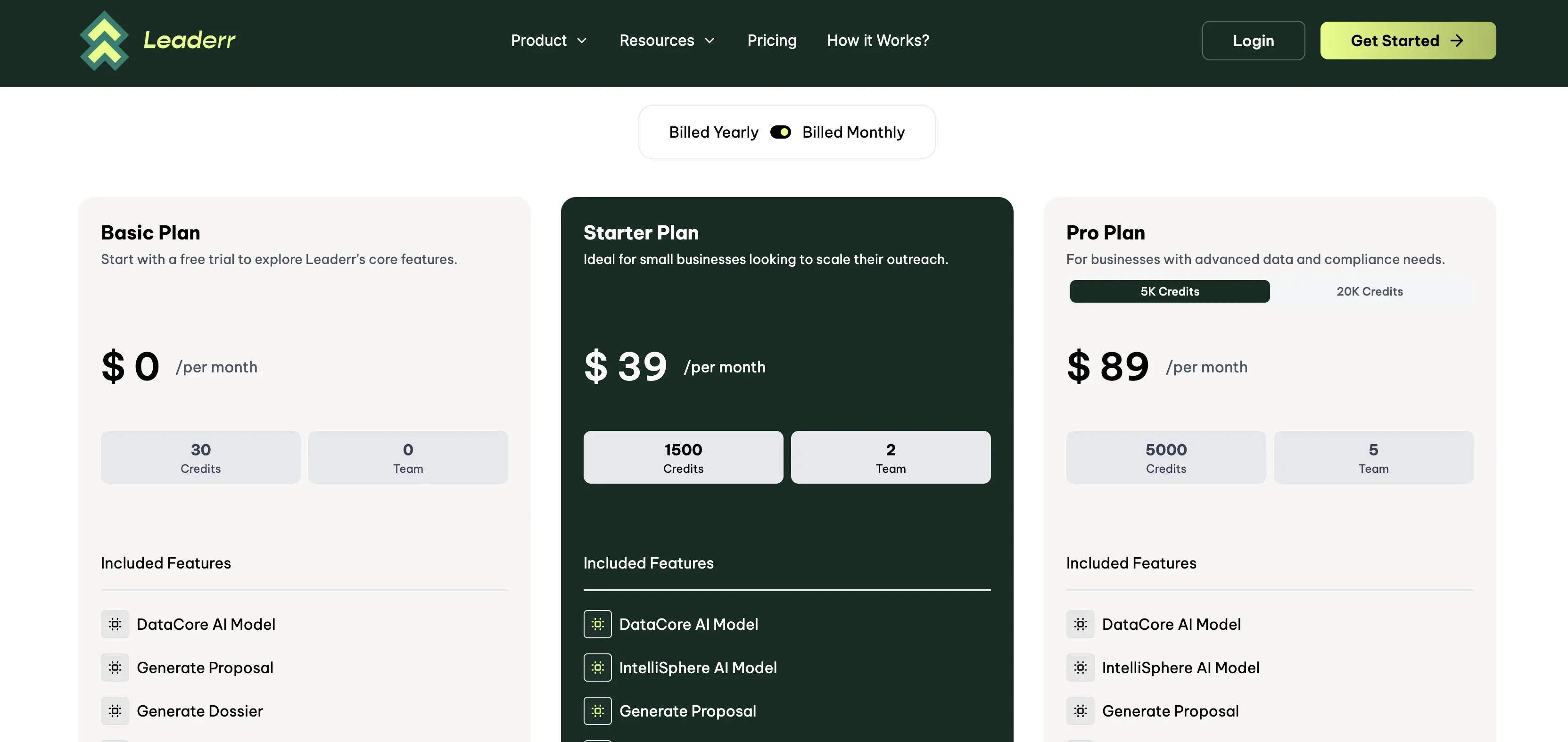 The free Basic plan gives 30 credits with no team seats. Starter runs $39 a month for 1,500 credits and two seats. Pro starts at $89 a month for 5,000 credits and scales to 20,000 credits with more seats. Leaderr reports 21,000-plus users and a 20 to 26x average return per dollar spent, both self-reported figures worth treating as directional. It's honest to say this isn't a database-size play. Leaderr didn't show up anywhere in the current search results for "Lusha alternatives," and its contact pool is nowhere near ZoomInfo's or Apollo's. If your bottleneck is writing personalized outreach after you've found someone, not finding people in the first place, it earns a look ahead of the bigger names.
2. Apollo.io
Free, then $49 to $119/user/month annual | Best for a database plus built-in sequencing
Apollo carries a 4.7 out of 5 rating from more than 9,000 reviews and reports 600,000-plus customer companies, both figures Apollo publishes directly on its pricing page. The Free plan includes unlimited email credits under a fair-use cap of roughly 250 a day. Basic runs $49 a month on annual billing, Professional is $79 and adds a US dialer plus unlimited sequences, and Organization starts at $119 with a 3-seat minimum for SSO and custom reporting.
The catch is that mobile number reveals and export credits are metered on top of the base plan, even at the higher tiers, so a team leaning hard on phone data can burn through the "unlimited" framing faster than the marketing suggests.
3. ZoomInfo
Roughly $15,000/year to start, quote-only | Best for enterprise teams that need the deepest US database
ZoomInfo doesn't publish self-serve pricing. Procurement trackers that follow real contracts put the entry-level Professional tier around $15,000 a year, climbing past $40,000 for Advanced packages. In exchange you get one of the largest US-focused contact databases in the category, plus built-in intent data and conversation intelligence Lusha doesn't offer at any price point.
A five-person team evaluating Lusha because of budget usually shouldn't land here. ZoomInfo solves a different problem: teams that have outgrown a contact database and need a full intelligence platform.
Read Also: How to Encrypt Email in Outlook (Windows, Mac, and web)
4. Cognism
Quote-only, usually $15,000 to $25,000+/year | Best for teams selling mostly into the UK and EU
Cognism doesn't run a free trial or list prices anywhere on its site. What it offers is Diamond Data, phone-verified mobile numbers checked by a human research team, plus a compliance stack built around GDPR from the start rather than added on later. Third-party procurement data (Vendr, Salesmotion) puts real contracts in the $15,000 to $25,000 range for a small team, with per-seat costs stacking on top of a platform fee.
North American mobile coverage lags behind Cognism's European data, so US-only teams usually get better value from Apollo or ZoomInfo instead.
5. UpLead
$74 to $149/month annual (Essentials and Plus) | Best for one credit covering the full contact
UpLead's core pitch is a 95% accuracy guarantee with automatic credit refunds when an email bounces, backed by real-time verification at the point of reveal. Essentials runs $74 a month on annual billing for 170 credits, Plus is $149 for 400 credits and adds technographics and data enrichment, and Professional is a custom, team-only plan with buyer intent data and full API access.
Essentials and Plus are single-user accounts. The moment a second person needs a login, you're into Professional's custom pricing, which erases some of the cost advantage over Lusha for a growing team.
6. Kaspr
$49 to $79/month annual | Best for LinkedIn-first prospecting in Europe
Kaspr is owned by Cognism, which explains its European data strength and GDPR posture. Starter runs $49 a month on annual billing, Business is $79, and both plans include the Sales Navigator Chrome extension for pulling contacts straight off LinkedIn profiles and searches.
Credits split three ways here (phone, direct personal email, and export), and Starter's direct email allowance is just 5 a month. Teams doing real outbound volume land on Business fairly quickly, which narrows the price gap with Lusha's own Starter tier.
7. Hunter.io
$34 to $209/month annual | Best for email-only prospecting with no phone number needs
Hunter is the cleanest option on this list if phone numbers were never really the point. Starter costs $34 a month on annual billing for 2,000 credits, Growth is $104 for 10,000, and Scale is $209 for 25,000, and every tier includes unlimited team seats sharing one credit pool, a real differentiator against per-seat tools like Apollo.
The trade-off is baked into the product: Hunter finds and verifies emails and nothing else. Teams that need direct dials alongside emails will still need a second tool, no matter which Hunter tier they're on.
8. Clay
Free, then $185 to $495/month | Best for waterfall enrichment across many data sources at once
Clay overhauled its pricing in March 2026, collapsing four legacy tiers into two: Launch at $185 a month for 2,500 Data Credits, and Growth at $495 for 6,000 Data Credits plus CRM auto-sync. Older articles still citing the retired $149 Starter plan are pricing this tool from before the change.
Clay isn't a direct Lusha replacement so much as a workflow engine that can call Lusha, Apollo, Hunter, and 150-plus other providers inside one enrichment step, picking whichever returns data for a given contact. That flexibility comes with a real learning curve; most reviewers describe weeks, not days, before a team builds workflows confidently.
9. LeadIQ
Free, then Pro from $200/month (200 Universal Credits) | Best for LinkedIn capture tied into CRM sync
LeadIQ's Chrome extension captures contacts straight from LinkedIn and Sales Navigator and pushes them into Salesforce or HubSpot with one click, plus job-change alerts when a tracked contact moves companies. Pro starts at $200 a month for 200 Universal Credits, and Enterprise is custom, with a median tracked contract around $26,400 a year according to procurement data.
The credit ratio is worth knowing before you buy: a phone reveal costs 10 Universal Credits against 1 for an email, and phone data quality is the single most repeated complaint in LeadIQ's own G2 reviews.
10. RocketReach
Free, then $69 to $209/month | Best for self-serve pricing with no sales call required
RocketReach draws from a database of 700 million profiles and is one of the few tools on this list where every tier, including the top one, is buyable online without talking to sales. Essentials runs $69 a month (about $33 on annual billing) for email lookups only, Pro at $119 adds mobile numbers, and Ultimate at $209 adds API access and Salesforce sync.
There's no built-in email sequencing or dialer here. RocketReach finds and verifies contacts; it doesn't help you reach out to them, so budget for a separate outreach tool alongside it.
11. Seamless.AI
Free (50 lifetime credits), Pro and Enterprise are quote-only | Best for real-time AI search when a static database comes up empty
Seamless.AI removed its old $147 Basic plan in a 2026 restructure, and now only the Free tier has a published number. Pro requires a 5-seat minimum and an annual contract, with third-party reports putting real deals anywhere from $150 to $300 per seat per month depending on negotiation.
This is the one entry on the list that comes with a genuine caution beyond pricing: Seamless.AI shows up repeatedly in reviews for aggressive auto-renewal terms and a 60-day cancellation window that's easy to miss. If you sign up, calendar the cancellation deadline the same day.
12. SalesIntel
Quote-only, median contract around $17,600/year | Best for human-verified data on a fixed refresh cycle
SalesIntel runs its contact database through a human research team rather than pure algorithmic matching, with records re-verified roughly every 90 days and a claimed 95% accuracy rate. Individual entry-level contracts start near $10,000 a year, and Vendr's benchmark data puts the median deal at $17,599, well under a comparable ZoomInfo contract.
Coverage is strongest in North America, so teams prospecting heavily into EMEA or APAC should test match rates on their actual target list before signing an annual contract.
How the 12 Lusha Alternatives Stack Up
Tool | Access model | Starting price | Standout difference |
|---|---|---|---|
Leaderr | Self-serve | $39/mo | AI-written proposals and dossiers, not just contacts |
Apollo.io | Self-serve | $49/mo (annual) | Database plus sequencing in one login |
ZoomInfo | Quote-only | ~$15,000/yr | Deepest US database and built-in intent data |
Cognism | Quote-only | ~$15,000/yr | Phone-verified EU mobile data |
UpLead | Self-serve | $74/mo (annual) | 1 credit covers email and phone together |
Kaspr | Self-serve | $49/mo (annual) | LinkedIn-first, EU-strong, Cognism-owned |
Self-serve | $34/mo (annual) | Unlimited seats on one shared credit pool | |
Clay | Self-serve | $185/mo | Waterfall enrichment across 150+ providers |
LeadIQ | Self-serve | $200/mo | LinkedIn capture with CRM sync |
RocketReach | Self-serve | $69/mo | Every tier buyable with no sales call |
Seamless.AI | Quote-only | Free tier only | Real-time AI search, watch the contract terms |
SalesIntel | Quote-only | ~$10,000/yr | Human-verified data, 90-day refresh cycle |
Picking One Lusha Alternatives: A Quick If-Then
If you want AI-drafted proposals built around your prospecting, not just a list, start with Leaderr.
If you want one tool that finds contacts and sends the outreach, Apollo covers both without a second subscription.
If most of your pipeline sits in the UK, DACH, or Nordics, Cognism or Kaspr will out-perform any US-first database.
If phone numbers were never the point and you only need clean emails, Hunter is the cheapest way in and the simplest to budget.
If you're already building enrichment workflows in Clay, treat Lusha, UpLead, or Hunter as one waterfall step instead of picking just one.
If budget isn't the constraint and you need the largest US dataset with intent signals attached, ZoomInfo or SalesIntel's human-verified layer are the safer enterprise bets.
Read Also: 10 Best ZoomInfo Alternatives in 2026 (no annual contracts, real per-seat pricing)
FAQs for Lusha Alternatives
Is there a free Lusha alternative?
Yes. Leaderr, Apollo, Hunter, Kaspr, and Clay all ship real free tiers, not time-limited trials, though the credit limits are tight enough that they work better as a test drive than a full replacement for active prospecting.
What's the cheapest Lusha alternative?
Hunter is the lowest sticker price at $34 a month on annual billing, but it's email-only. If you need phone numbers too, Kaspr's $49 Starter or UpLead's $74 Essentials land closest to what Lusha itself charges.
What's the best Lusha alternative for GDPR-heavy or European teams?
Cognism and Kaspr both lead with phone-verified European mobile data and GDPR-first compliance. That's not a coincidence: Kaspr is owned by Cognism, so the two share a data backbone.
Which Lusha alternative has better phone number data?
UpLead bundles a verified mobile number into the same single credit as the email. Cognism's Diamond Data and SalesIntel's human-verified contacts both aim at the same accuracy problem from the enterprise side, at enterprise prices.
What do actual users say about switching away from Lusha?
Capterra's 396 verified reviews average 4.0 out of 5, with the credit system as the most repeated complaint, right behind phone number accuracy once teams scale past a handful of seats.
What's the best Lusha alternative for solo founders or very small teams?
Leaderr's Starter plan and UpLead's Essentials plan are both built for one or two people rather than a full sales floor, and neither one runs on Lusha's new 11-credit phone math.
Conclusion
Lusha still works fine for a solo rep doing light LinkedIn prospecting. The credit hike on phone reveals is what changes the calculation for anyone calling contacts at real volume, and it's recent enough that most comparison articles haven't caught up to it yet. Leaderr is worth a look first if proposal writing eats more of your week than list building does. Past that, match the alternative to the actual gap: Apollo for an all-in-one budget play; Cognism or Kaspr for European phone data; Hunter if phone numbers were never required; and ZoomInfo or SalesIntel once the team and budget justify an enterprise contract.