

The fastest way to cold email for an internship is to find one specific person at the company, keep the message to six or eight sentences, ask directly for a short call or an internship opening, and follow up twice if you do not hear back. Most replies come from the follow up, not the first email.
My first cold email for an internship got no reply. Not a "no," not an away message, nothing. I sent 14 of those emails to general info@ inboxes over two weeks and got zero replies.
I had copied a template off a forum and asked for "any advice or opportunities." After I switched to emailing one named person, asking directly for a short call, and following up twice, the next batch of 11 emails got 4 replies and one internship offer. The difference was not the writing. It was who I sent it to and whether I followed up.
What you need before you start
Works for: college students and recent graduates without a referral, high school students who want an early look at a field, career changers targeting one company, and students in engineering, law, business, or any major who cannot find an open posting and need to ask directly.
Does not work for: a role you already applied to through a formal listing at the same company (a cold email on top of that application can read as going around the process), or anyone expecting a same day reply. Cold emailing for an internship is a numbers and follow up process, not a single message.
Before you start, you need: a short list of ten to fifteen companies you actually want to work for, a resume ready to attach as a PDF, roughly twenty to thirty minutes per company for research, and one to three weeks of patience for follow up. You do not need a referral, a job posting, or a connection at the company.
Build a short list of people to email
What happens: you pick companies you want, then find one specific person there, not a general inbox.
List ten to fifteen companies, ranked by how much you want to work there.
For each one, find a person doing the job you want or the person who would supervise an intern, using the company website or LinkedIn.
If you are cold emailing a company for an internship and cannot find one clear contact, a team lead or hiring manager is a better target than a general HR inbox, since a named person is more likely to read and answer.
Done when: you have one named contact and their role for each company on your list.
Find and confirm their email address
What happens: most company emails follow a predictable pattern, and you can check it before you send anything.
Look at the company website, press releases, or any public email already available (a staff directory, a byline, a conference speaker list) for the format: first.last@, firstinitiallast@, and similar patterns.
Build the address using that pattern for your contact.
Run the address through an email verification tool, such as leaderr.io, before you send. A bounced message wastes the one shot you have with that person and can flag your own email as unreliable.
Done when: the address comes back verified, or you have confirmed the pattern against at least one other known email at the same company.
Write the email that gets read
What happens: this is the stage where most people get stuck on how to write a cold email for an internship without sounding like everyone else who copied the same forum post. The subject line and the first line decide whether the rest gets read at all.
Subject line: name the role or your interest directly and keep it under eight words, for example "Marketing internship, University of X."
Opening line: say who you are and why you are writing this specific person, in one sentence.
Middle: one or two sentences on what you can offer, backed by one concrete detail, a class project, a tool you know, or relevant coursework.
Ask: one direct sentence requesting a short call or an internship, not "any advice you can give."
Close: thank them, sign with your full name, and include one link to your LinkedIn or portfolio.
Done when: the email runs six to eight sentences, and someone who has never met you could read it and understand your ask in under twenty seconds.
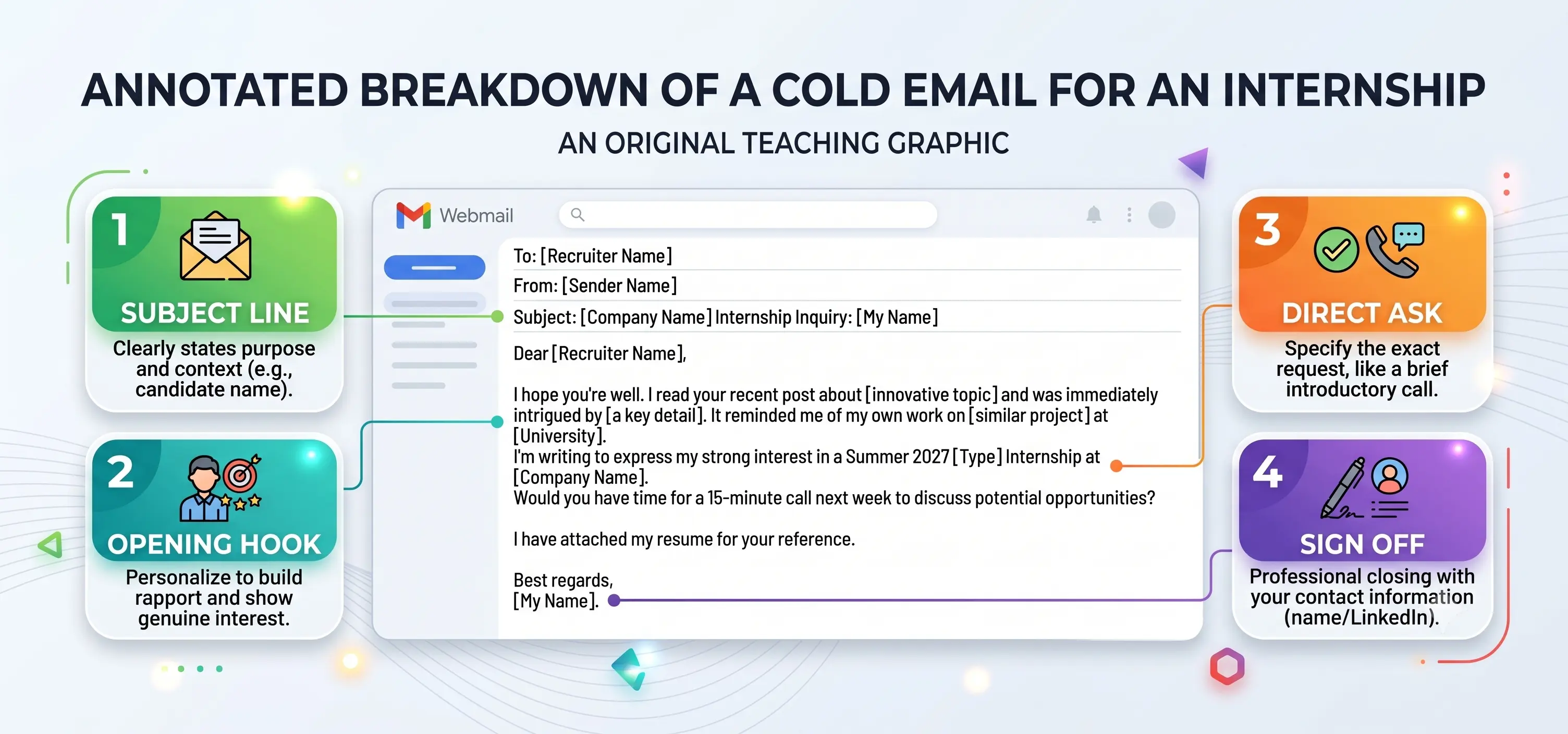
A cold email template you can copy and send
Swap in your own details before sending. This is a sample, not a script, so change the wording to match how you actually talk.
Subject: [Role] internship, [university]

Hi [Name],

I am a [year] at [university] studying [major], and I am reaching out because [one specific reason tied to their work or the company]. [One sentence on a relevant skill, project, or class that shows you can help].

Would you be open to a brief call about internship opportunities on your team, even an informal one? I know you may not be actively hiring interns, but I wanted to ask directly.

Thanks for considering it,
[Full name]
[LinkedIn or portfolio link]
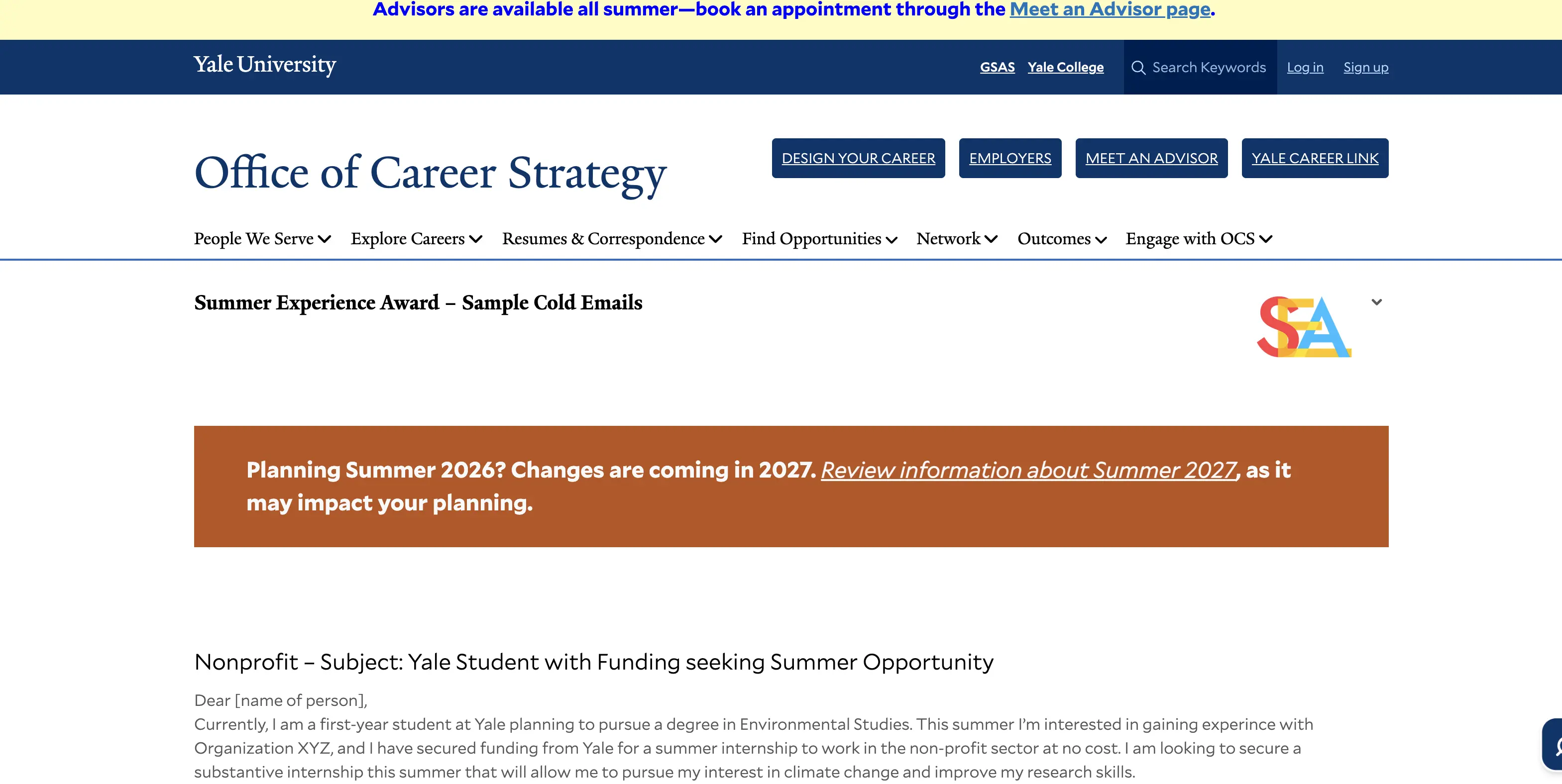
The Office of Career Strategy at Yale University publishes several full sample cold emails, including versions for nonprofit, government, and research roles, if you want to see how the same structure changes by field.
Send it at the right time
What happens: once you know how to send a cold email for an internship at the right time, you stop losing replies to bad timing alone. Timing affects whether your email gets opened before it gets buried.
Send Tuesday through Thursday, mid morning in the recipient's time zone. Avoid Monday morning and Friday afternoon, when inboxes are either flooded or already checked out.
Send to one contact per company at a time rather than three or four people at once. Emailing several people at the same firm in parallel can read as spam once they compare notes.
Log who you emailed and when in a simple spreadsheet, even three columns is enough.
Done when: you have sent your first five to ten emails and logged the date for each.
Follow up without being annoying
What happens: most replies come from the follow up, not the first message.
According to Brian DeChesare, founder of Mergers & Inquisitions, "a 5 to 10% response rate is normal" for cold outreach like this, and a rate under 1% usually means the message or the targets need to change, not that cold email itself does not work.
Wait five to seven business days, then send a two sentence follow up on the same email thread: "Just following up on this, would love a few minutes of your time if you have them."
If you still hear nothing after another week, send one more short follow up, then move on to the next company on your list.
If someone offers a quick call instead of replying by email, take it. A phone conversation sometimes finishes what the first email started, even if you set out to write a cold email and end up on a cold call instead.
Done when: you have sent up to three total messages to that contact and either heard back or moved on.
What the person on the other end actually sees
Most people read a cold email on their phone, standing up, in under ten seconds. They are deciding in the first line whether you researched them specifically or copied a template to fifty people.
A subject line with their company name, an opening sentence that names something true about their team, and an ask that takes thirty seconds to answer (yes, no, or "let's talk") are what get a reply. A long email asking them to "pick your brain" gets skimmed and forgotten.
The same ten second read happens in business outreach, and the five stage cold email outreach process covers what decides whether the message reaches that moment at all.
Email versus LinkedIn versus a cold call
Method | Best for | Typical reply speed | Main downside |
|---|---|---|---|
A specific person whose address you can find or verify | Days | Easy to ignore if the subject line is generic | |
LinkedIn message | Someone active on the platform, or when you share a mutual connection | Hours to days | Message requests can sit unread for weeks if you are not connected |
Cold call | Small firms with a public phone line and a specific ask | Immediate | Easy to catch someone at a bad time, and harder to follow up in writing |
If you are deciding whether to cold email for an internship or send a LinkedIn message instead, email tends to win when you already have a verified address, since it does not depend on the other person checking a message request folder.
Common mistakes and how to fix them
Problem: no one replies after three emails.
Fix: check your targeting before you rewrite the email again. If you search how to cold email for an internship on Reddit, you will find the same advice from the other direction. A thread on r/developersIndia about writing cold emails and finding contacts for an internship reports better results once students stopped emailing generic addresses and started naming a specific person and project.
Problem: you get "we do not have any interns right now."
Fix: ask if there is unpaid shadow work, a short project, or a call anyway. That response means a person read your email, which is further than most cold emails get.
Problem: your email bounces back.
Fix: your address pattern guess was wrong. Check the format again against a second known email at the company, or run it through a verification tool once more before retrying.
Problem: you sent the same email to twenty people and got nothing.
Fix: mass identical emails read as mass identical emails. Rewrite the middle section for each company with one detail that is actually true about them.
FAQs: How to cold email for an internship
Does cold emailing work for internships?
Yes, when you target one named person, keep the message short, and follow up. It works best for roles that are not posted publicly, since you are not competing against a stack of applications.
How long should a cold email be for an internship?
Six to eight sentences, short enough to read on a phone in under twenty seconds. Longer emails get skimmed, not read.
What is the 30/30/50 rule for cold emails?
It is a rough way to split your effort: roughly a third on personalizing the message, a third on your value to that specific team, and the rest on the direct ask and follow up. Different sources define the split slightly differently, so treat it as a rule of thumb rather than a fixed formula.
How many cold emails should I send before I stop?
Up to three messages to the same contact (the original email plus two follow ups) is standard before moving on to the next company on your list.
Is it okay to cold email the same company twice?
Yes, if you are contacting a different person for a different reason, such as a new team or a role that opened later. Emailing the same person again with the same ask usually is not worth it.
Before you send
A cold email for an internship is not one message; it is a short process: one named contact, a verified address, a short email, and two follow ups. The response rate is never going to be high in absolute terms, but it does not need to be. You only need one yes.