How to create a mutual action plan your buyer will follow (with an example)
Create a mutual action plan with a named owner for each step, the dates the buyer picks, and a worked example you can copy. Includes a small deal version.
 Michael Doyle11 min read
A mutual action plan in sales is a dated list of steps, each with one named owner, that you and the buyer agree on before a deal closes.
Gartner puts a buying group at five to 16 people, so give every step one named owner and keep the plan to one page.
What you need before you send a mutual action plan
A mutual action plan, also called a close plan, a mutual success plan, or a joint execution plan, gives the buyer dated steps to follow and gives you dates to forecast against.
Send it to a deal that has passed lead qualification, with these three things in place.
What to have in hand
A buyer who agreed to a next step after discovery, usually your champion.
An end date the buyer chose for solving the problem.
The names of the people who must approve, from legal, security, procurement, and finance.
Who will read the plan?
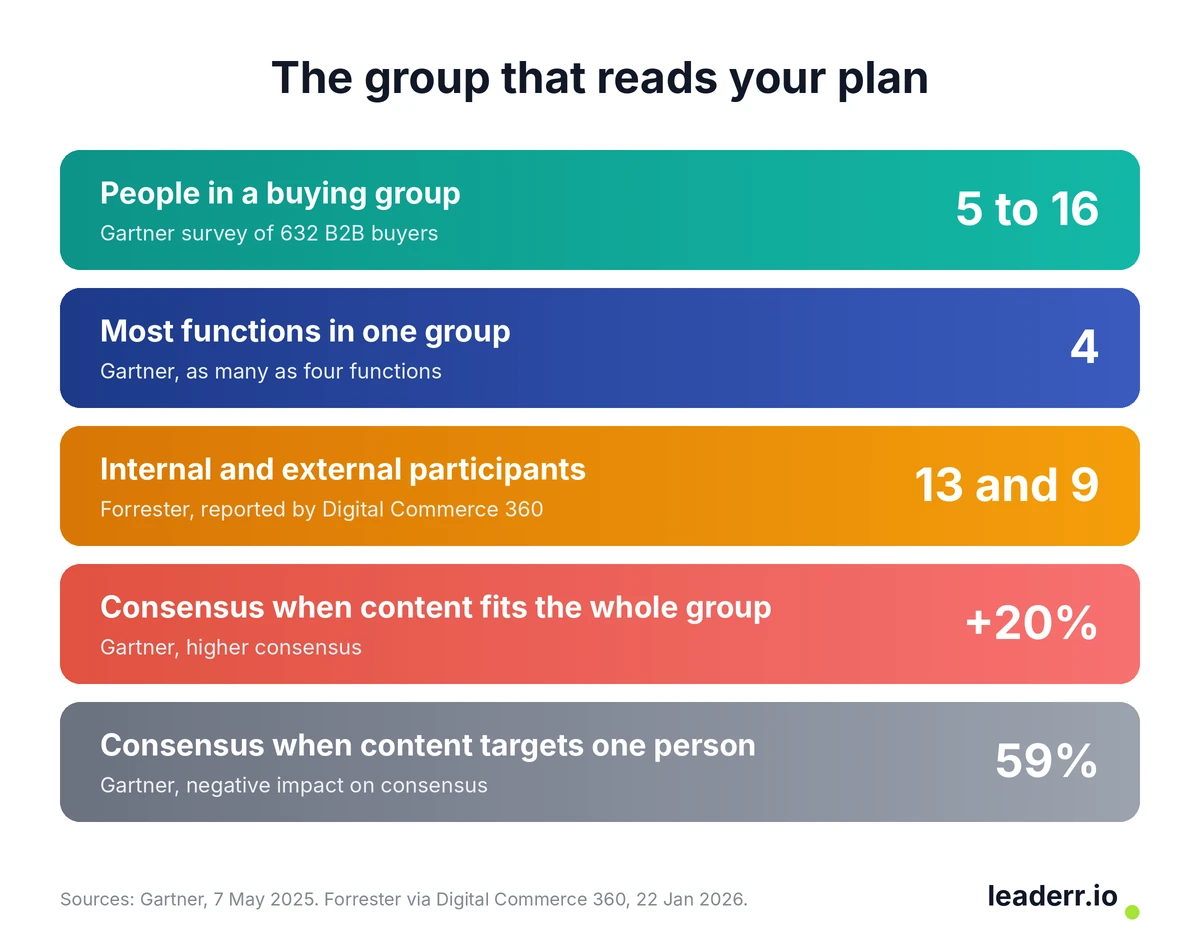
Your champion is likely to forward the plan to people you have not met. In its 7 May 2025 release on a survey of 632 B2B buyers, Gartner says buying groups range from five to 16 people across as many as four functions.
Forrester counts 13 internal stakeholders and 9 external participants on an average purchase decision, as Digital Commerce 360 reports.
Gartner also found that tailoring content for the whole buying group raised consensus by 20 percent, while content aimed at individual members had a 59 percent negative impact on it.
A plan is sales content too, so write it for the whole group. Here are the figures together.
Write every step so your champion can forward the plan unchanged to any function in that group.
How big the plan should be for your deal
This table sets the plan format for each deal size.
Deal | Plan format | Source |
|---|---|---|
One buyer, a couple thousand dollars, a quick timeline | Five-step mini plan and a control email | Sales Skills for Founders, 24 Aug 2025 |
About $10K | A shared checklist | GTMnow, published 2019, updated 2023 |
$50K to $75K ACV and above | Full plan with one owner and one date for each approval | GTMnow, published 2019, updated 2023 |
No source in this table covers deals between $10K and $50K. In that range, start with the checklist and add an owner and a date to each approval once a second person must agree.
The small deal version: five steps and a control email
Sales Skills for Founders calls a full plan overkill for one buyer, a couple thousand dollars and a quick timeline. Its five-step mini plan runs in this order:
Spell out the path from the problem to the result.
Confirm how the buyer buys.
Agree on the next step.
Present your solution.
Send a control email.
Build the proposal in step four as a sales proposal that gets read. The control email in step five lists four things:
A summary of the call.
What you are offering: a proposal or a demo.
What the buyer needs to do: review, reply, or check with colleagues.
The date of the next call or decision point.
The full plan for a larger deal
GTMnow says sales leaders most often make the plan formal once a deal reaches $50K to $75K ACV.
At that size, give every approval one owner and one date, using the five stages below.
Who owns each step on the buyer side?
The buyer owns the steps that happen inside the buyer's company: security review, legal review, budget approval, procurement, and signature.
You own the steps that send something: the proposal, the contract and the kickoff.
Put one buyer name next to every buyer step
A step owned by "the finance team" has no owner. A step owned by "the controller" has one. Ask your champion who does each step and write the answer down.
If the champion does not know, ask who signs off on that area, then send the plan to that person.
What to do when your champion cannot speak for the group
A champion cannot approve legal, security and finance alone. Ask the champion to forward the plan with one line asking each owner to confirm their date.
Each owner then sees their own step in a plan built for the whole group.
How to create a mutual action plan in five stages
Stage 1: Get the end date from the buyer
What happens: Ask the buyer when the problem must be solved and why. Write down the date and reason in the buyer's words.
Done when: The buyer has stated an end date and a reason out loud.
Stage 2: List every approval before that date
What happens: Work backward from the end date and list each approval and milestone: budget, security review, legal review, procurement and signature.
Teams that run MEDDPICC track these as the paper process.
Done when: Every approval between today and the end date is on the list.
Stage 3: Name one owner for each step
What happens: Put a name and a role next to every step. Add a backup owner for each approval in case the first owner leaves.
Done when: No step shows a team name in the owner column.
Stage 4: Set the dates by working backward
What happens: Place the signature on the end date, then set each earlier approval a few days before the one after it. Ask each owner to confirm their own date.
Done when: Every owner has agreed to a date, and the plan fits on one page.
Stage 5: Send it and keep one shared copy
What happens: Send the plan on the day of the call. Keep one shared copy in a spreadsheet or document, save its link on the deal record in your CRM, and update it before each call.
Done when: The buyer has replied to confirm the dates and the link is saved on the deal record.
Mutual action plan example you can copy
Say you sell SaaS expense software to an engineering firm with 150 employees.
The contract is $60,000 for the year, above the $50K to $75K range where GTMnow says plans turn formal, so this deal gets the full plan.
All inputs here are examples, not a record of a real deal.
Count who owns each step in the example plan.
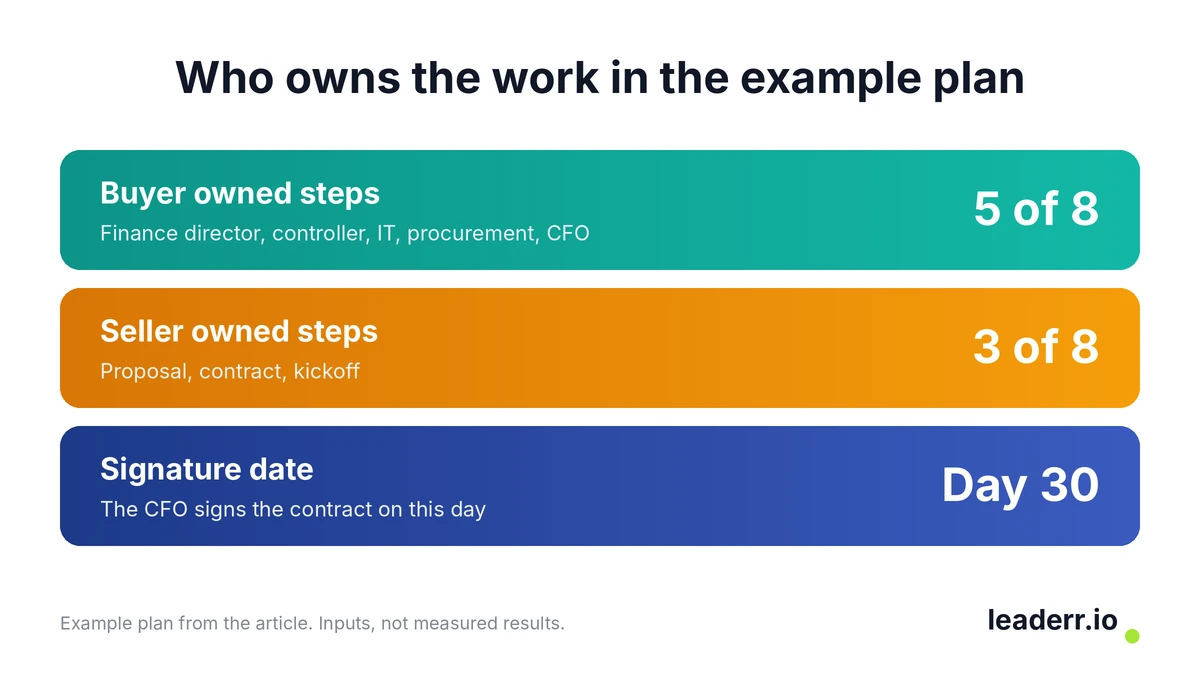
The buyer owns 5 of the 8 steps. You own the proposal, the contract, and the kickoff.
Use this table as your mutual action plan template. Copy it into a shared spreadsheet, a document, or a slide and replace each row with your own approvals.
# | Step | Owner | Due |
|---|---|---|---|
1 | Reply to confirm the goal and the end date | Finance director (buyer) | Day 2 |
2 | Send the expense policy and the list of approvers | Controller (buyer) | Day 4 |
3 | Send the proposal and the security documents | You (seller) | Day 6 |
4 | Review the security documents and give a yes or no | IT administrator (buyer) | Day 12 |
5 | Send the contract to procurement | You (seller) | Day 14 |
6 | Return changes to the contract | Procurement manager (buyer) | Day 20 |
7 | Approve the budget and sign the contract | CFO (buyer) | Day 30 |
8 | Hold the kickoff call with the finance team | You (seller) | Day 35 |
Swap the day numbers for calendar dates before you send it.
Is a mutual action plan legally binding?
A mutual action plan is a schedule, and it works without a signature. The nearest neutral comparison is the memorandum of understanding (MOU).
DocuSign says an MOU is generally not intended to be legally binding, yet it can become enforceable through a demonstrated intention to be bound or an exchange of payment or other consideration.
Its advice is to "explicitly state within the document whether you intend the MOU to be legally binding."
Add one line at the top of your plan: "This plan is a shared schedule and is not intended to be legally binding." This is general information, not legal advice.
Should the buyer sign it?
The buyer does not need to sign. GTMnow advises against signature blocks on the plan, because binding signatures belong to the contract stage.
Ask your champion to reply "agreed" to the plan email instead.
When not to send a mutual action plan
Rework's guide, updated 18 April 2026, lists five situations where a plan hurts the deal:
The buyer has not committed to anything yet, so a plan can feel presumptuous.
The buyer runs a structured RFP across several vendors.
The buyer's procurement team runs the process and expects its own document.
The buyer holds more bargaining power than the seller.
The champion is resistant, and Rework advises asking about the hesitation before pushing a plan.
In each case, answer the open question first and send the plan once the buyer commits to a next step.
What the buyer sees after you send the plan
This table shows what the buyer sees and what you do at four points in the life of the plan.
When | What the buyer sees | What you do |
|---|---|---|
The day of the call | An email with the end date, approvals, and their own steps | Send it within a few hours |
The day before a buyer step | A one-line reminder with the due date | Send it to the owner and copy the champion |
A missed date | The same plan with the date marked as moved | Ask the owner one specific question, then set a new date |
After signature | The open steps carried into onboarding | Hand the shared copy to onboarding |
What to do when the buyer ignores the plan
A Reddit thread in r/sales titled Mutual Action Plans suck shows 10+ comments and is about three years old. The thread preview says buyers mostly ignore the plans.
Trumpet's guide of 8 October 2026 names four reasons buyers ignore a plan, and the table below follows them.
Symptom | Likely cause | Fix |
|---|---|---|
The buyer never replies to the plan email | The steps follow your sales process, not the buyer's approvals | Rewrite the steps around the buyer's approvals and walk the champion through them |
Buyer dates pass without a word | A buyer step has no named owner | Ask the champion who owns the late step, then ask that person one question |
The buyer says the plan looks long | The plan runs past one page | Keep the approvals that need dates and move the rest to notes |
The dates differ between copies | The plan lives in emailed spreadsheets | Keep one shared copy and send its link, not a new attachment |
If dates keep slipping after the fix, GTMnow's order is to adjust the timeline, go to the champion's boss, and walk away if nobody will revise the dates.
I'd tell the champion before going above them. Once the dates have moved twice, treat the deal as stalled and use closing techniques for deals that stall.
FAQ
Is a mutual action plan the same as a close plan?
Close plan, mutual close plan, and joint execution plan are other names for a mutual action plan. Some teams use mutual success plan for the steps after signature, so ask the buyer which one they mean.
When should you send a mutual action plan?
Send it after your champion agrees to a next step and before you put heavy work into the deal.
How many steps should a mutual action plan have?
Use one step for each approval or handoff between today and the end date. An example plan for a $60,000 deal has eight steps, and the small deal version has five.
What if the champion leaves or someone new joins?
Ask the new person to confirm the end date and the steps they now own, then update the shared copy the same day.
A backup owner named for each approval keeps any step from going without a name.
Send one page before the next call
Put the end date, every approval, and one owner for each step on a single page, and send it before your next call. If no buyer will own a step by then, treat the deal as not yet committed and leave it out of your forecast.
Guidance and sources reviewed 16 November 2026.